

Crypto Fundamental Analysis Is uncertainty affecting demand again
As the end of July approaches, the cryptocurrency market continues to show a dynamic of broad weakness and neutrality. For now, mixed behavior remains dominant, in a context marked by important events during the week, including the return of possible tariffs and renewed tensions in the Middle East.
Written by
Julian Pineda
Market Analyst
As the end of July approaches, the cryptocurrency market continues to show a dynamic of broad weakness and neutrality. For now, mixed behavior remains dominant, in a context marked by important events during the week, including the return of possible tariffs and renewed tensions in the Middle East.
These factors have increased market uncertainty and could be affecting appetite for higher-risk assets such as cryptocurrencies. If this dynamic continues, the market could keep showing a phase of indecision or weakness over the next few trading sessions.

Risk events begin to change the Dynamic
During the week, important events emerged for overall market confidence. One of the most relevant was the renewed escalation of the conflict in the Middle East, which appears to be expanding beyond the Strait of Hormuz and could now also affect the commercial area around the Red Sea.
So far, military interventions by Iran, the United States and Iran-backed groups in Yemen continue, while no relevant progress has been seen toward the restart of concrete negotiations. This has increased uncertainty and pushed WTI crude oil above the 90-dollar area in the short term, which could also raise inflation concerns for the rest of 2026.
In addition, the week was marked by new developments in international trade. Toward the final trading session of the week, the United States confirmed a new round of tariffs against 60 economies worldwide, with duties of up to 12.5% on goods entering the country. These tariffs apply to partners that represent around 99% of U.S. imports and arrive just as previous 10% tariffs were expiring.
This decision has generated immediate reactions from trading partners, while countries such as China have expressed strong rejection amid the deterioration of relevant trade relationships.
Both events have started to create uncertainty around risk appetite. Fears of renewed inflationary pressure, possible trade disruptions and higher geopolitical risks may be driving a preference for safe-haven assets in the short term.
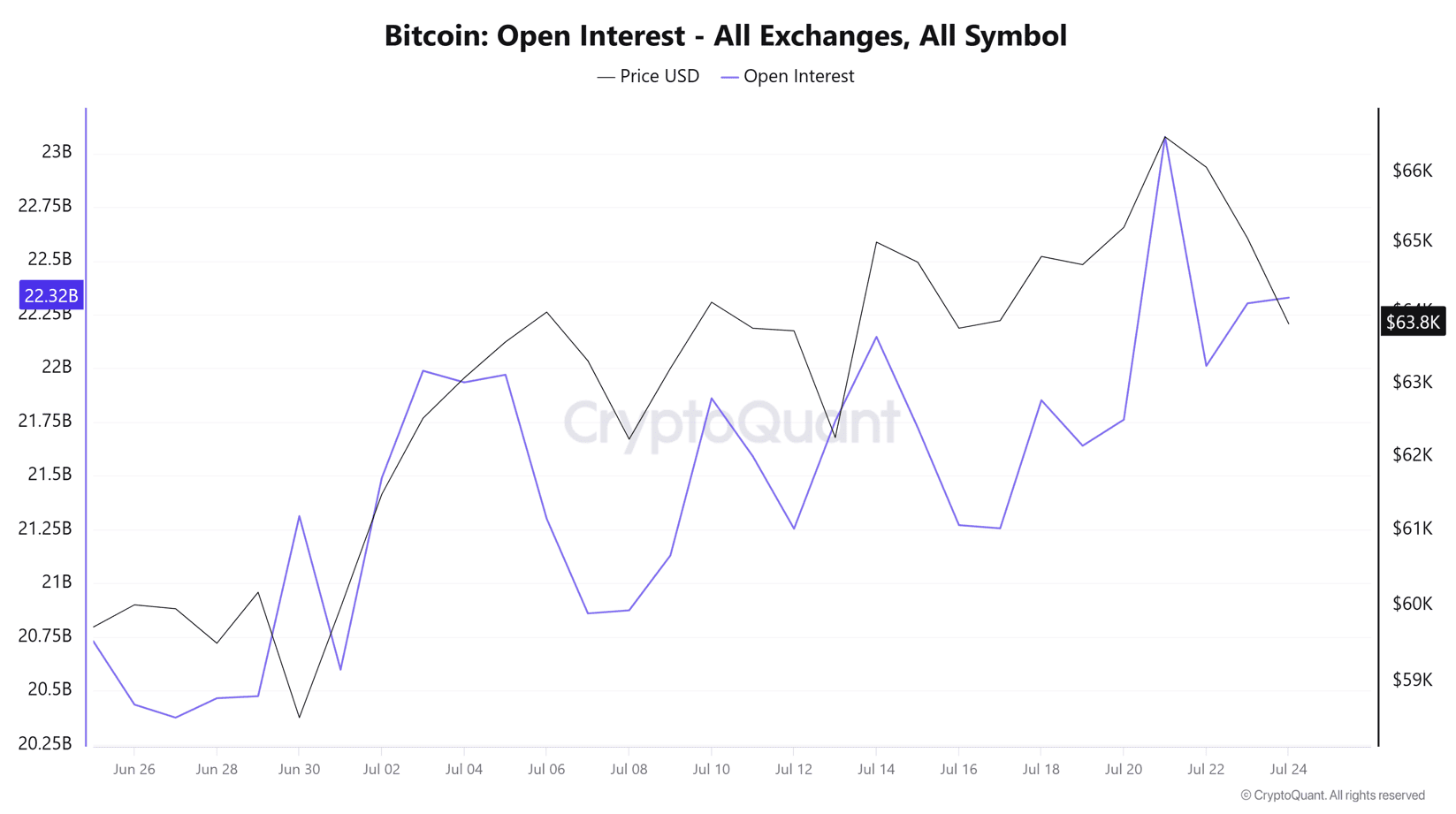
This lack of appetite for risk markets is also starting to be reflected in cryptocurrencies. In the case of Bitcoin, the market’s reference asset, open interest has once again shown weakness over the last few sessions, falling below the 22.5 billion area.
Open interest measures the total number of open positions across different exchanges. A decline in this indicator can reflect an exit of positions from the market and, if it happens alongside a drop in BTC prices, it could suggest a reduction in long positions or weaker demand. This again highlights a lack of consistent appetite for the crypto market, in a context where global risks have regained relevance.
Source: Cryptoquant
With all of the above in mind, this week’s risk events could be favoring a rotation toward safer or more stable markets. The cryptocurrency market has not managed to act as a relevant safe haven in recent months, nor as a liquidity shelter.
For this reason, as long as trade and geopolitical tensions remain present, uncertainty could continue to limit a consistent recovery in cryptocurrencies. This would keep the possibility of a phase of indecision or weakness open over the next few trading sessions.
Bitcoin versus other markets
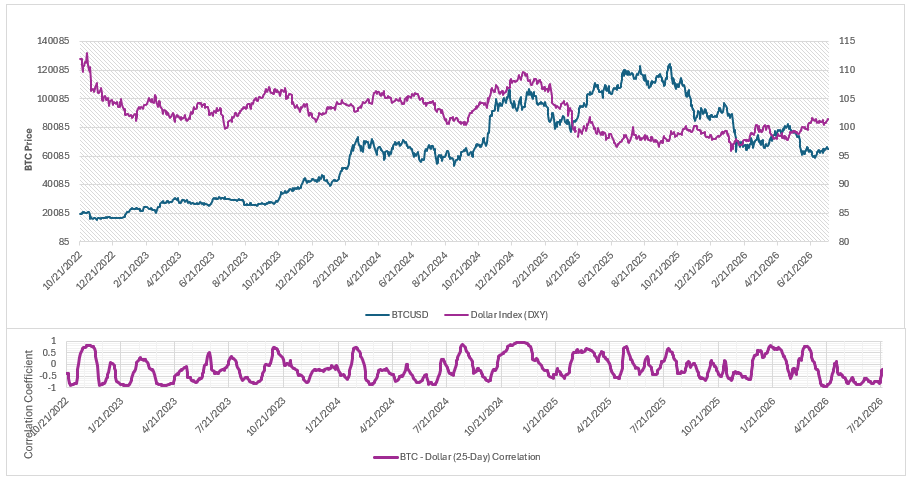
So far, the inverse relationship between Bitcoin, as the reference asset of the crypto market, and more defensive assets such as the U.S. dollar remains relevant. This dynamic can be seen in the correlation coefficient of the last 25 sessions, which remains in negative territory against the DXY, the index that measures the strength of the U.S. dollar against its main peers. It is important to remember that the correlation coefficient can change over time.
Source: Data – TVC, StoneX, Tradingview
This relationship is important because the recent weakness and neutrality in Bitcoin coincide with stronger demand for the U.S. dollar toward the end of the week. This suggests that caution continues to dominate risk sentiment and that capital may be rotating toward more stable markets, reducing interest in higher-risk assets such as cryptocurrencies.
In this context, geopolitical and trade concerns help explain why the market may be favoring safe-haven assets over risk markets.
If this inverse relationship continues, dollar strength could keep complicating a clearer recovery in Bitcoin and the broader crypto market. For that reason, the advance of safer substitute markets could continue to reinforce a phase of indecision or weakness in cryptocurrencies over the next few trading sessions.
Confidence shows no relevant recovery
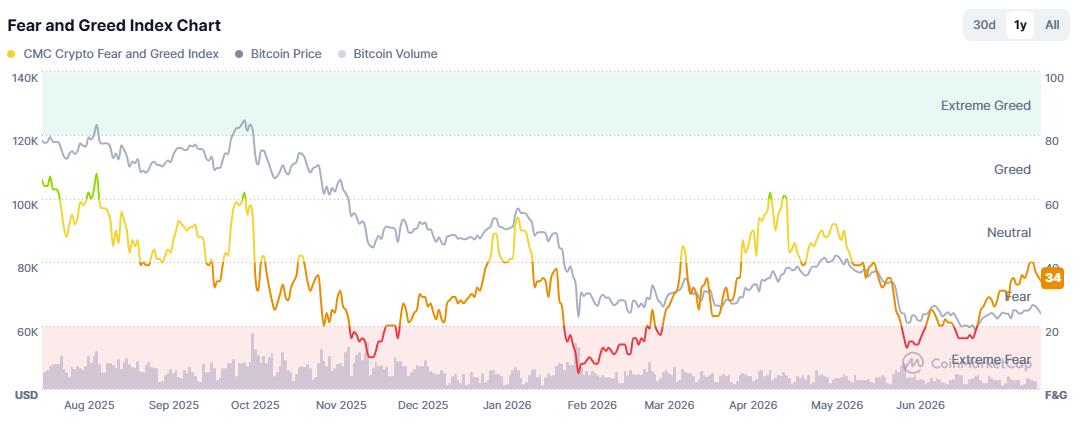
Looking at the Crypto Fear and Greed Index, it is worth noting that, despite the slight recovery seen in recent weeks, the indicator remains near 34 points, still within the “fear” zone and without reaching “neutral” territory.
This shows that confidence in the crypto market remains fragile and that there is still no stable environment of short-term optimism.
Source: Coinmarketcap
This dynamic suggests that, for now, there is not enough stability to confirm dominant demand in the cryptocurrency market. If the index fails to move toward neutral or positive territory, confidence could remain fragile and continue to reflect a phase of indecision or weakness over the next few sessions.
Written by Julian Pineda, CFA, CMT – Market Analyst
Follow him on: @julianpineda25







Web Trader platform
Our sophisticated web-based platform is packed with features.
Open an account today
Experience award-winning platforms with fast and secure execution.
Economic calendar
Related articles

Bitcoin Forecast: BTC/USD Back to $80K Ahead of Warsh’s Jackson Hole Speech
After surging over $15,000 in the past 10 days alone, there is risk of a near-term pullback if Warsh says anything remotely hawkish at Jackson Hole - what are the levels to watch from here?


Bitcoin’s failed breakouts are becoming hard to ignore
Three failed breakout attempts and fading momentum have put Bitcoin bulls on notice. Another rejection could open the door lower just as attention swings back towards NVIDIA and the AI trade.


US Dollar, Gold & Bitcoin Weekly Technical Outlook 8 24 2026
Key levels on active technical setups in DXY, Gold, and Bitcoin heading into the start of the week.