


FTSE 100 Today: Oil, Rates and Stocks to Watch
The FTSE 100 enters the final trading session of August after falling 0.8% on Thursday. Oil, gilt yields and sterling remain critical for the index, but the bigger question is whether investors are underestimating the impact of global rate expectations as September approaches.
Written by
Philip Papageorgiou
Market Analyst
FTSE 100: The Market Going Into Friday
The FTSE 100 closed Thursday at 10,792.54, down 0.79%, its largest daily decline in roughly six weeks. Banks and energy stocks accounted for much of the weakness, while technology and financial-data companies moved in the opposite direction.
Friday’s setup is more complicated. US technology stocks surged after Nvidia’s latest results, but that strength has not translated cleanly into London. The FTSE is simply less exposed to the AI leaders that are driving the US market.
My view is that this matters more than the headline index performance. As the market appears to be beginning to distinguish between companies with structural earnings growth and those whose performance remains heavily dependent on commodities or interest rates.
That rotation is likely to become more important in September.
Technical Analysis: 10,900 Is the Line in the Sand
The FTSE remains close to its recent record territory, but momentum has clearly softened.
The index reached 10,920.48 on August 26 before retreating to 10,792.54. The first important support is 10,750–10,770. If that area holds, the recent pullback can still be treated as consolidation within the broader uptrend.
A break below 10,750 would be more significant. It would suggest that buyers are no longer willing to defend the recent advance and would put 10,650–10,700 into focus.
On the upside, 10,900–10,920 remains the level to beat. A clean break would be technically bullish and could quickly attract momentum buyers.
For now, I would describe the setup as neutral-to-bearish below 10,900, but not structurally bearish above 10,750.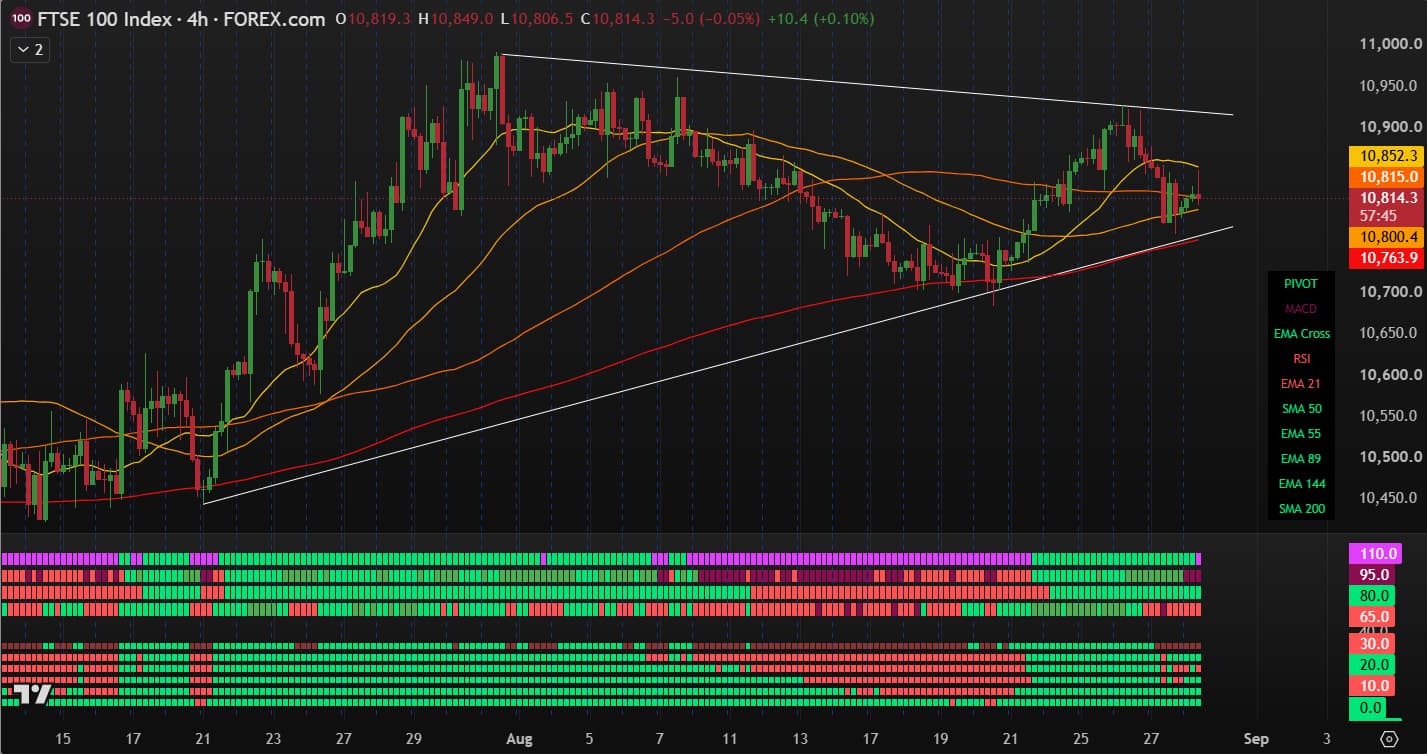
Oil Is Becoming the Bigger Macro Risk
Brent is trading around $89 a barrel, after falling more than 5% over the week. The decline initially looked positive for inflation-sensitive markets, but the geopolitical picture remains unstable. Iran and Oman have agreed on arrangements affecting traffic through the Strait of Hormuz, while Washington has shown little appetite for immediately reviving negotiations with Tehran.
Lower oil is positive for UK consumers and should help the inflation outlook, but it removes earnings support from Shell and BP. Higher oil does the opposite: it boosts the energy majors while making the Bank of England’s job harder.
I think investors may currently be underestimating the second-order effect. If crude remains around $90 rather than returning rapidly towards pre-conflict levels, the inflation relief is much smaller than the headline weekly decline suggests.
Rates and Sterling Matter More Than the Index Suggests
Bank shares were among Thursday’s biggest losers as gilt yields fell and markets pushed expectations for the next 25-basis-point Bank of England rate increase into 2027.
That is an important repricing for the FTSE as Lower rates are helpful for property, housebuilders and highly leveraged businesses, but less attractive for banks whose margins benefited from the higher-rate environment. Sterling also matters because roughly three-quarters of FTSE 100 company revenues are generated outside the UK.
A weaker pound can therefore support reported earnings even if the domestic economy is underwhelming.
The market is increasingly trading the FTSE as a global earnings index rather than a pure UK economic proxy.
Leaders, Laggards and Stocks to Watch
Thursday’s strongest FTSE 100 performer was Computacenter, which gained around 4.8% after Peel Hunt upgraded the shares to Buy and raised its price target to 6,000p. The broker expects continued investment in computing infrastructure, giving the company increasing exposure to the AI capital-spending cycle.
LSEG and RELX were also strong. That leadership is significant: investors are rewarding recurring revenue, data and financial infrastructure rather than simply buying the index.
The weakest names included Entain, LondonMetric Property and Games Workshop, while Shell and BP fell around 1.5% as crude weakened.
Recent results also provide useful stock-specific signals. Prudential reported first-half new business profit of $1.384 billion, up 8%, increased its interim dividend by 15% and added another $300 million to its 2026 buyback.
AstraZeneca reported positive Phase III results for Tezspire, another useful pipeline development for the pharmaceutical heavyweight.
Next Week: The Data That Matters
The UK market is closed on Monday, August 31, for the Summer Bank Holiday, so Tuesday effectively becomes the start of the trading week.
September 1: UK Manufacturing PMI, mortgage approvals and consumer credit. Manufacturing PMI is expected at 51.5.
September 3: UK Services PMI and Composite PMI. With services representing the bulk of UK economic activity, this is the more useful measure of domestic momentum. The current forecast is 52.8 for services and 52.5 for the composite.
Corporate results also increase, with Ashtead Technology and Bunzl reporting Tuesday, followed by Cairn Homes, Ecora Royalties and TT Electronics on Wednesday. Thursday brings a much heavier schedule, including M&G, Jet2, Grafton Group and Hilton Food Group.
The biggest global catalyst is Friday’s US August employment report. Reuters’ latest poll points to only 45,000 new jobs, following an unexpected 23,000 decline in July. That makes the report unusually important for rate expectations.
Investment View
The FTSE’s longer-term trend remains positive.
I am watching the 10,750–10,920 range and let the market establish direction. Above 10,920, the bullish trend strengthens as we break above the trendline. Below 10,750, the probability of a deeper September correction rises however.
Fundamentally, risk is not weak UK growth, but more a combination of oil remaining elevated and global bond yields rising again.
For Friday, the markets I would watch most closely are Brent crude, GBP/USD, 10-year gilts and US Treasury yields. They should tell us considerably more about the FTSE’s next move than the index itself.
Philip J Papageorgiou - Head of Investment Research
Philip on X (x twitter) - PhilipForexCom





Web Trader platform
Our sophisticated web-based platform is packed with features.
Open an account today
Experience award-winning platforms with fast and secure execution.
Economic calendar
Related articles

Nasdaq 100 Forecast: NDX slips ahead of Fed Chair Warsh’s speech
U.S. stocks are edging lower on Friday, giving back some of yesterday's gains after Nvidia's strong outlook revived the tech trade. The focus has now shifted firmly to Fed Chair Kevin Warsh's Jackson Hole speech, with investors looking for more clarity on the outlook for interest rates.


S&P 500 Forecast: SPX after Nvidia revives confidence in the AI trade
U.S. stocks are heading higher on Thursday, with technology leading the move after Nvidia's stronger-than-expected outlook revived confidence in the AI trade.

Oil, EUR/USD Forecast: Two trades to watch 2608
Oil falls further on diplomatic hopes for a Middle East resolution. EUR/USD consolidates ahead of U.S. inflation and Jackson Hole.