

Jackson Hole Returns: Nikkei 225 and Nasdaq 100 Volatility in Focus
Historical Jackson Hole returns point to elevated Nikkei 225 volatility around Fed speech day, with Nasdaq 100 direction hinging on Kevin Warsh.
Written by
Matt Simpson
Market Analyst
With US PCE inflation now behind us, attention turns squarely to Fed Chair Kevin Warsh’s Jackson Hole speech. Historical forward returns suggest volatility could remain elevated across the Nikkei 225 and Nasdaq 100 around the event, although direction will ultimately depend on how markets interpret Warsh’s policy message.
View related analysis:
With US PCE inflation now behind us, attention turns squarely to Fed Chair Kevin Warsh’s keynote address at the Jackson Hole Economic Policy Symposium. Warsh is scheduled to speak at 00:00 Sydney time on Saturday, potentially encouraging more subdued trade beforehand — but with a clear risk of volatility expanding sharply should he deliver a meaningful shift in policy guidance.
This will be Warsh’s first Jackson Hole appearance as Fed Chair, and markets are still getting to grips with his communication style and policy reaction function. Traders will therefore be looking for clues on how he intends to steer monetary policy under different economic scenarios, where he sees the balance of risks, and what might prompt the Fed to change course. With Warsh so far reluctant to provide traditional forward guidance, the potential for markets to read heavily into his choice of words is arguably higher than usual.
Nikkei Volatility Peaks Around Fed Speech Day and T+1
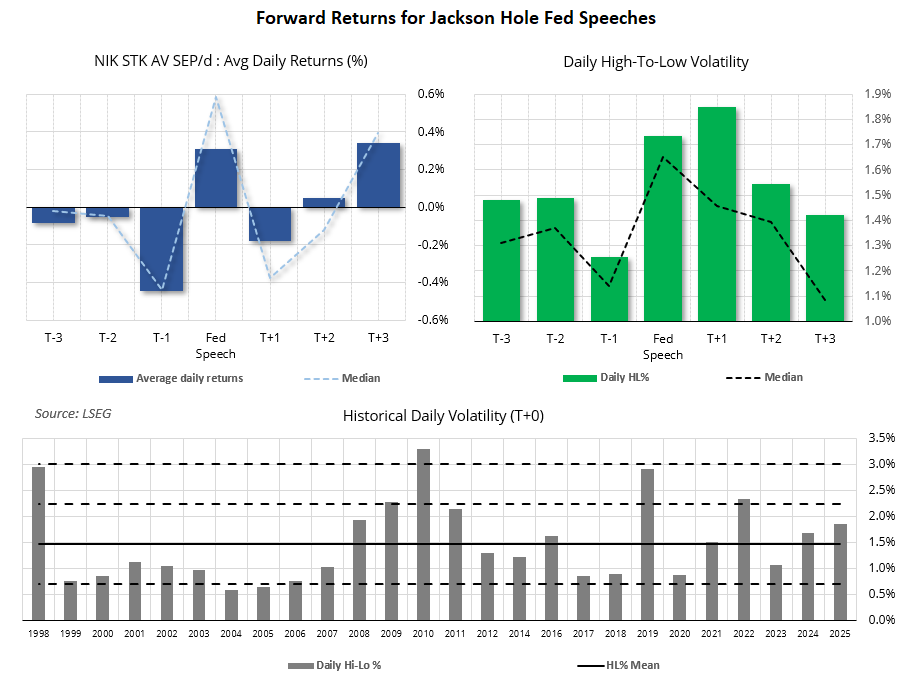
The forward returns charts show how Nikkei 225 futures have performed over the three trading days either side of Jackson Hole speeches. Given that the vast majority of Fed speeches since 1998 occurred on a Friday in European trading hours, we will assume T+1 represents the following Monday, T+2 the Tuesday, and so on.
Source: LSEG
- The clearest pattern is that volatility peaks on T+1, with an average high-to-low daily range of 1.85%. However, the median is considerably lower at 1.46%, suggesting a handful of outliers have pushed the average higher.
- Fed speech day is the second-most volatile session, with an average range of 1.74% and median of 1.65%. This suggests volatility has typically been elevated on the day itself, although several larger moves on the following Monday have pushed the T+1 average above it.
- Ultimately, today and Monday appear to have the greatest potential for Nikkei volatility based on this dataset.
Nikkei Returns Have Leaned Positive, but Policy Tone Remains Crucial
Fed speech day has also generated positive average returns of 0.31%, alongside a stronger median return of 0.6%.
While that is an interesting historical tendency, traders should not assume it provides a directional signal for this year. The reaction of the US dollar and broader risk appetite will ultimately depend on how hawkish or dovish the Fed Chair is perceived to be.
A hawkish speech would generally be expected to support the US dollar and weigh on risk appetite, potentially pressuring Wall Street indices and the Nikkei 225. Conversely, a relatively dovish — or simply less hawkish than expected — speech could support risk assets and the Nikkei while weighing on the US dollar.
Nasdaq 100 Eyes 30,000 After Nvidia Earnings
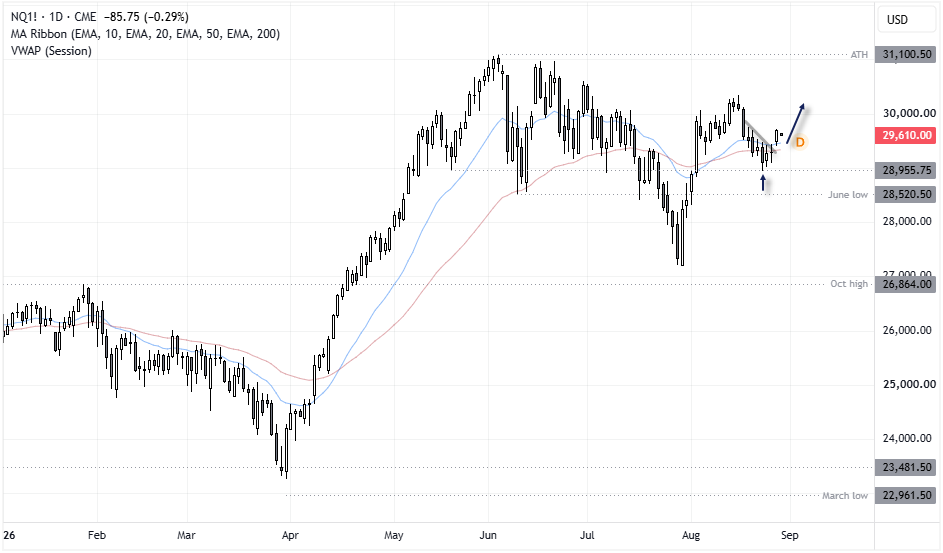
A strong performance from Nvidia following its earnings beat helped the Nasdaq 100 gap higher above its 20- and 50-day EMAs, putting 30,000 within striking distance.
Purely from a technical perspective, the Nasdaq looks capable of extending its rally after carving out a prominent low on Monday. But whether it can push materially higher from here is likely to come down to Kevin Warsh.
However, the Nasdaq does not currently share such a strong correlation with the Nikkei, with the 10-day reading sitting at just 0.21. Perhaps that positive correlation will strengthen again into next week, bringing it closer to the 0.84 and 0.79 readings seen over the 20- and 60-day lookbacks.
Source: CME, TradingView
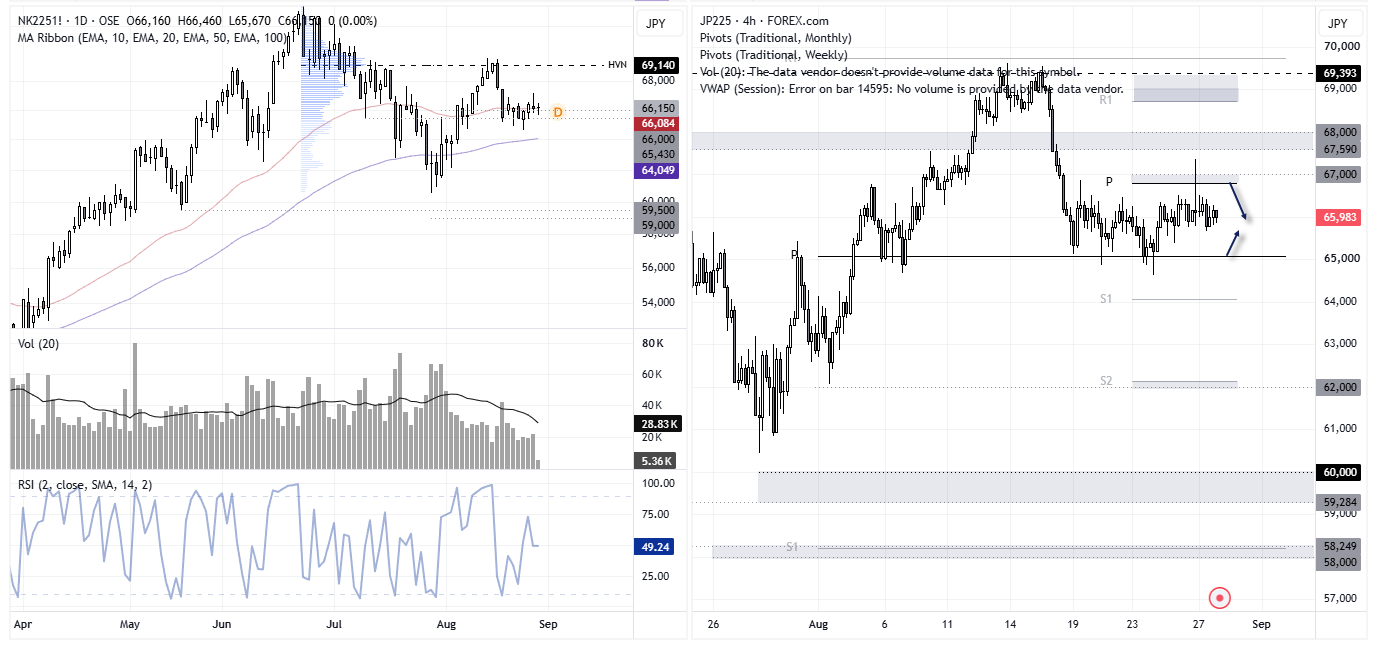
The daily futures chart (left) shows the Nikkei trying to grind higher, though it lacks the bullish enthusiasm seen on the Nasdaq overnight. Perhaps that will change after the open. However, daily trading volumes remain below average, which gives me less confidence in a meaningful move unless a fresh catalyst arrives.
The 4-hour chart shows choppy trade, with prices trapped between the monthly pivot point and weekly R1. Until we see a breakout, range-trading strategies may be preferred while prices remain between 65k and 67k. Otherwise, stepping aside until momentum tips its hand is always an option.
Source: SGX, Forex.com, TradingView
View the full economic calendar
-- Written by Matt Simpson
Follow Matt on Twitter @cLeverEdge
How to trade with City Index
You can trade with City Index by following these four easy steps:
- Open an account, or log in if you’re already a customer
• Open an account in the UK
• Open an account in Australia
• Open an account in Singapore
- Search for the market you want to trade in our award-winning platform
- Choose your position and size, and your stop and limit levels
- Place the trade
Related tags:




Web Trader platform
Our sophisticated web-based platform is packed with features.
Open an account today
Experience award-winning platforms with fast and secure execution.
Economic calendar
Related articles

Euro Short-term Outlook: EUR/USD Pullback Nears Pivotal Uptrend Support 8 28 2026
Warsh's comments accelerated the EUR/USD selloff, raising the stakes as buyers look to stabilize the broader recovery.
Gold and S&P 500 analysis: What now after Warsh’s hawkish speech?
The dollar surged across the board after the Fed Chair Kevin Warsh surprised with a hawkish-leaning speech at the Jackson Hole summit. All the bearish dollar bets that had been accumulated since last Friday on the back of data weakness and bond market troubles had to be squared and that triggered a short squeeze rally for the dollar. Gold and silver dropped, as a result, as too did bitcoin, while US indices were giving back earlier gains.

Nasdaq 100 Forecast: NDX slips ahead of Fed Chair Warsh’s speech
U.S. stocks are edging lower on Friday, giving back some of yesterday's gains after Nvidia's strong outlook revived the tech trade. The focus has now shifted firmly to Fed Chair Kevin Warsh's Jackson Hole speech, with investors looking for more clarity on the outlook for interest rates.
