


EUR/USD outlook: Conflicting US-Iran headlines keeps markets guessing
The EUR/USD gave back its entire gains from yesterday, even if European equity markets maintained much of those moves. Renewed optimism around a potential US-Iran agreement, which was met with far more scepticism than earlier this month, faded.
Written by
Fawad Razaqzada
Market Analyst
The EUR/USD gave back its entire gains from yesterday, even if European equity markets maintained much of those moves. Renewed optimism around a potential US-Iran agreement, which was met with far more scepticism than earlier this month, faded. Reuters earlier reported that Iran’s supreme leader ordered highly-enriched uranium to remain in Iran. This was later denied, but sentiment remained cautious nonetheless as markets were left guessing. This came after Trump yesterday claimed negotiations were in their “final stages.” Investors appear reluctant to fully price in a lasting de-escalation after several previous false starts. At the same time, the weakening signs of eurozone economy are helping to reduce the likelihood of ECB tightening, while the Federal Reserve’s increasingly hawkish tone is preventing the dollar to ease meaningfully lower. In truth, it is all about oil prices which will determine the near term direction for all risk assets and the EUR/USD outlook. All eyes therefore will be on headlines coming out of Tehran regarding the details of the potential agreement.
Before discussing the macro influences further, let’s have a quick look at the EUR/USD chart.
Technical EUR/USD outlook: key levels to watch
From a technical point of view, the 1.1575-1.1600 area was a key support zone that I had highlighted in my previous reports, and we got there following the break of the trendline and support around 1.1670 to 1.1700 yesterday. Price has now bounced a couple of times from this zone, but price action remains heavy amid mixed signals from US-Iran negotiations.
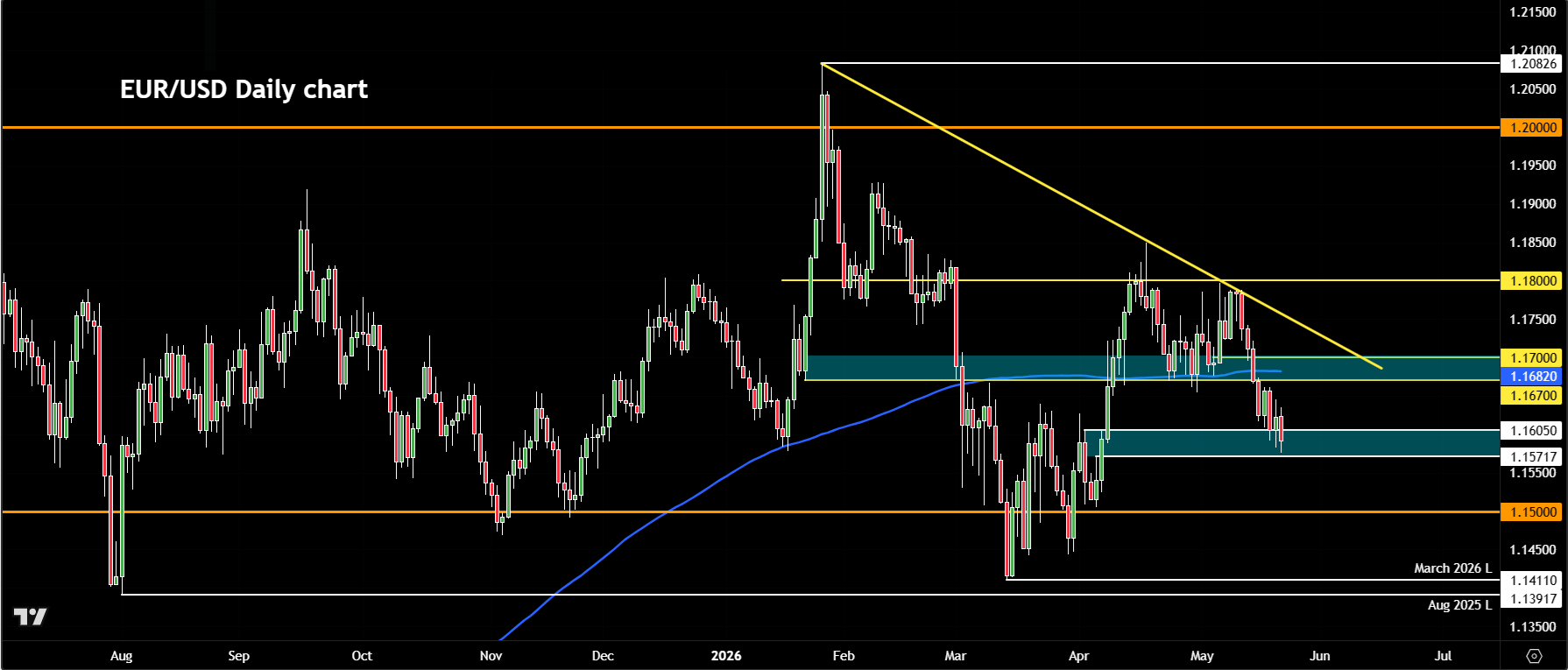
Until there’s genuine optimism that the US and Iran could strike a deal that would see the Strait of Hormuz reopen, the EUR/USD is likely to remain rangebound at best.
For now, watch your short-term levels and trade from level to level.
If we get a decisive break below this 1.1575-1.1600 area in the days ahead, then 1.1500 will be the next downside target, followed by the March low around the 1.1410 area.
We also have the August 2025 low slightly below that, around the 1.1390 area.
So those are the key downside targets from a broader technical point of view.
Prior support and resistance around 1.1670 to 1.1700 is now going to be the first area of resistance to watch on the upside. Break above that, and we could see EUR/USD climb back towards the 1.1800 handle.
However, for EUR/USD to climb decisively above 1.1800, it will require a proper de-escalation in the Middle East situation.
Soft Eurozone PMI limits euro’s recovery
The softer eurozone PMI figures released this morning also reinforced the divergence between the US and European growth outlooks. In truth, EUR/USD probably needs the Strait of Hormuz to reopen before the pair can establish a more sustainable move higher.
For now, rallies still look vulnerable. Unless markets receive a steady flow of genuinely constructive geopolitical developments, I can’t rule out the risks of EUR/USD slipping back below the 1.1500 in the near term, while 1.1800+ is likely if a deal is reached.
Today’s eurozone PMI data highlighted that the economic consequences of the Middle East conflict are extending well beyond inflation concerns alone. The latest surveys pointed to a notable deterioration in business activity, adding to fears that the region could be edging closer towards stagnation once again if geopolitical tensions remain elevated.
The composite PMI fell to 47.5 in May from 48.8 previously, marking its weakest reading since 2023 and remaining firmly below the 50 threshold that separates expansion from contraction. The survey painted a broadly fragile picture, with softer output, weaker new orders and slowing employment trends all contributing to the decline.
Rising energy costs linked to Middle East tensions are clearly weighing on business sentiment. At the same time, uncertainty across both corporate and consumer sectors continues to dampen demand, leaving both manufacturing and services under pressure.
The combination of weaker growth momentum and persistent input cost pressures creates an especially uncomfortable backdrop for the European Central Bank. Inflation risks tied to higher energy prices are resurfacing just as broader economic activity begins to soften more visibly.
On a country level, France delivered particularly disappointing figures within the broader eurozone release. The French composite PMI dropped sharply to 43.5 in May from 47.6 previously, marking the weakest reading in more than five years.
The services sector saw the most severe deterioration, falling deeper into contraction territory as businesses reported weakening demand conditions and rising operating costs. Manufacturing also lost momentum after showing some temporary resilience in previous months, with firms increasingly citing higher energy prices and deteriorating confidence levels as major headwinds.
Inflationary pressures meanwhile remain uncomfortable. French companies continued to report higher input costs, while some firms also indicated that selling prices were beginning to rise again in response.
Overall, the latest figures substantially increase the risk that French economic activity contracts during the second quarter after already stagnating at the start of the year. More broadly, the data reinforces the increasingly difficult backdrop facing the eurozone economy as geopolitical uncertainty and slowing domestic demand continue to collide.

-- Written by Fawad Razaqzada, Market Analyst
Follow Fawad on Twitter @Trader_F_R
How to trade with City Index
You can trade with City Index by following these four easy steps:
- Open an account, or log in if you’re already a customer
• Open an account in the UK
• Open an account in Australia
• Open an account in Singapore
- Search for the company you want to trade in our award-winning platform
- Choose your position and size, and your stop and limit levels
- Place the trade
Related tags:









Web Trader platform
Our sophisticated web-based platform is packed with features.
Open an account today
Experience award-winning platforms with fast and secure execution.
Economic calendar
Related articles

Australian Dollar Outlook: AUD/USD Faces RBA-Fed Rate Tug-of-War
AUD/USD faces competing RBA and Fed hike bets this week, with Australian GDP and US payrolls set to test the eight-week rally.

Canadian Dollar Forecast: USD/CAD Weekly Reversal Puts Yearly Uptrend Back in Focus 8 29 2026
USD/CAD has staged its strongest weekly advance since June, shifting the focus to whether a more durable low is finally taking shape.


USD/JPY weekly outlook: Payrolls may challenge the Fed’s hawkish reset
USD/JPY has finally woken from its slumber. Payrolls now loom as the key test of whether the latest hawkish repricing sticks or sinks.
