



EUR/USD Outlook: Dollar gives up oil driven gains as Powell testimony looms
EUR/USD outlook takes a boost by Israel-Iran-US ceasefire as focus turns to Powell’s testimony. The US dollar is weaker across the board after the oil plunge and dovish Fed signals.
Written by
Fawad Razaqzada
Market Analyst
- EUR/USD outlook takes a boost by Israel-Iran-US ceasefire as focus turns to Powell’s testimony
- Dollar weaker across the board after oil plunge, dovish Fed signals
- EUR/USD gains driven more by USD weakness than EUR strength
Much of the EUR/USD’s gains over the past day and a half stem from dollar weakness linked to the collapse in oil prices and shifting expectations around Fed policy. The markets are now fully pricing in a September rate cut, but calls are also growing for a cut in as early as July which was not even on the radar at the start of the week. News of the ceasefire agreement and the corresponding collapse in oil prices has certainly helped to undermine the dollar and thereby boost the EUR/USD outlook.
Ceasefire weighs on crude oil and dollar
After holding its own surprisingly well during the height of the conflict, the EUR/USD has turned notably more bullish this week as markets shed the geopolitical risk premium tied to the Middle East. With Iran, Israel and the US all agreeing to a ceasefire, and oil prices plunging sharply over the last day or so, traders are quickly rotating back into dollar shorts. Though Israel has accused Iran of already breaking that ceasefire, Tehran has denied it has attacked Israel after the ceasefire came into effect. And now, Donald Trump has issued a major warning to Israel:
"ISRAEL. DO NOT DROP THOSE BOMBS. IF YOU DO IT IS A MAJOR VIOLATION. BRING YOUR PILOTS HOME, NOW!"
The market has not reacted much to Israel’s threat of striking Iran forcefully, suggesting investors don’t expect the ceasefire agreement to fail.
Dollar Pressure Builds Ahead of Powell
But while the euro is gaining ground, this isn’t so much a story of eurozone resilience—it’s more about USD fragility. Indeed, the greenback was down across the board, even against haven currencies like the Swiss franc.
Markets are now shifting their attention to Fed Chair Jerome Powell’s testimony later today, and expectations are building for dovish hints after a string of policymakers, including Waller, Bowman, and Goolsbee, all expressed openness to rate cuts, with a couple of these members suggesting those cuts could come as early as July. With Powell on the stand, any perceived softening of the Fed’s stance could trigger another wave of USD selling. However, if Powell walks back on those dovish Fed commentary, then we could see the dollar turn more mixed. It could, for example, rise against low yielding currencies while underperforming risk-sensitive currencies like commodity dollars.
EUR/USD Outlook: More Dollar Retreat Than Euro Strength
The broader EUR/USD outlook remains balanced. While the dollar is clearly on the back foot, the euro’s own fundamentals are far from compelling. Yesterday’s eurozone PMIs landed roughly in line with expectations, showing that while business sentiment has stabilised, the economic outlook still points to stagnation. Today’s German IFO survey however was a touch stronger at 88.4 vs. 87.5 last, though nothing ground-breaking.
In other words, the euro isn’t rallying on strength. The drop in oil prices removes pressure on Europe’s energy-sensitive economy, which may support the single currency at the margins.
Still, some caution is warranted. The move higher in EUR/USD could stall if Powell resists delivering any dovish surprises.
Technical EUR/USD outlook: Key levels to watch
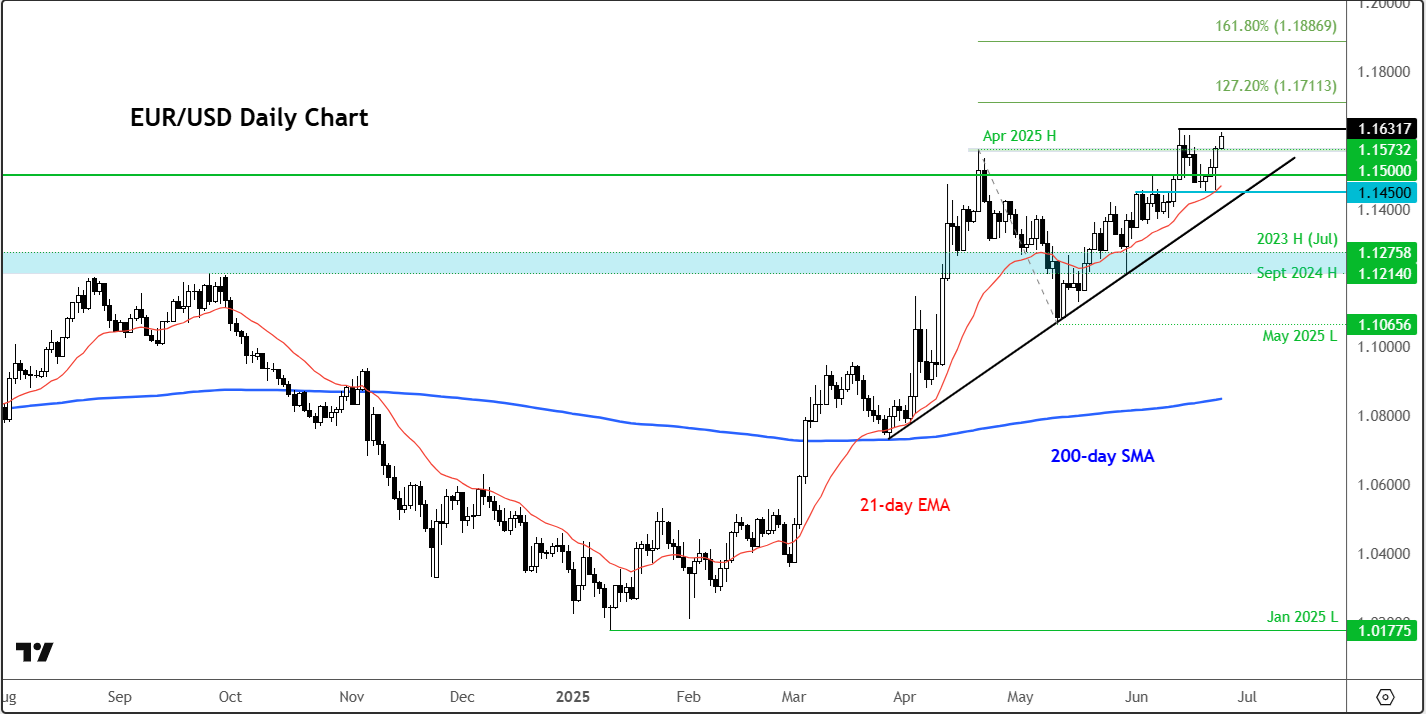
The technical outlook on the EUR/USD remains bullish as one could tell by just looking at the daily chart of the pair:
Source: TradingView.com
The higher highs and higher lows on the chart certainly paint a bullish EUR/USD outlook, or at least, it is largely keeping the bears at bay.
In terms of short term levels to watch, Monday’s oil-driven high at 1.1581 comes in just above the April high of 1.1573. This means the area between these two levels is now the first zone of potential support to watch. Below that, Friday’s high comes in at 1.1544 and then the psychologically important 1.15 handle comes into focus below that. As before 1.1450 remains the most important support area which was successfully defended on Monday. Bearish if we go below it.
On the upside, 1.1631 marks the current year to date high hit earlier this month, making liquidity testing above this level as the first bullish objective. Thereafter you have round handles like 1.17 and 1.18 as the next potential upside targets.
In conclusion, the EUR/USD outlook has shifted into bullish territory for now—but it’s driven by weakness in the dollar more than strength in the euro. Traders will be watching Powell’s every word today, with any signs of Fed capitulation likely to fuel another leg higher. But if the Fed Chair holds the line, we could see a quick fade from current levels. Either way, traders are focusing on fundamentals again as geopolitics take a back seat.
-- Written by Fawad Razaqzada, Market Analyst
Follow Fawad on Twitter @Trader_F_R
How to trade with City Index
You can trade with City Index by following these four easy steps:
- Open an account, or log in if you’re already a customer
• Open an account in the UK
• Open an account in Australia
• Open an account in Singapore
- Search for the company you want to trade in our award-winning platform
- Choose your position and size, and your stop and limit levels
- Place the trade
Related tags:









Web Trader platform
Our sophisticated web-based platform is packed with features.
Open an account today
Experience award-winning platforms with fast and secure execution.
Economic calendar
Related articles

Australian Dollar Outlook: AUD/USD Faces RBA-Fed Rate Tug-of-War
AUD/USD faces competing RBA and Fed hike bets this week, with Australian GDP and US payrolls set to test the eight-week rally.

Canadian Dollar Forecast: USD/CAD Weekly Reversal Puts Yearly Uptrend Back in Focus 8 29 2026
USD/CAD has staged its strongest weekly advance since June, shifting the focus to whether a more durable low is finally taking shape.


USD/JPY weekly outlook: Payrolls may challenge the Fed’s hawkish reset
USD/JPY has finally woken from its slumber. Payrolls now loom as the key test of whether the latest hawkish repricing sticks or sinks.
