


Nasdaq 100 Forecast: NDX slips ahead of Fed Chair Warsh’s speech
U.S. stock indices are falling on Tuesday, starting September on the back foot as higher Treasury yields and rising oil prices weigh on risk appetite.
Written by
Fiona Cincotta
Senior Market Analyst
US futures
Dow futures -0.53%, S&P futures -0.68% & Nasdaq futures -1.38%
European futures
FTSE 0.03%, DAX -1.17%
- US stocks fall as treasury yields hit an almost two-year high
- Fed Chair Warsh struck a hawkish tone on Friday
- Oil rises as two Saudi tankers are hit in the Strait
U.S. stocks fall as yields and oil rise
U.S. stock indices are falling on Tuesday, starting September on the back foot as higher Treasury yields and rising oil prices weigh on risk appetite.
The pressure comes after Fed Chair Kevin Warsh's hawkish tone at Jackson Hole pushed rate-hike expectations higher, while renewed tensions in the Middle East have sent oil prices back above $92 a barrel. The market is pricing in a 65% chance of a hike in September up from 35%.
The bond market is now becoming an important source of pressure for equities. Treasury yields have risen to their highest level since January 2025, increasing the opportunity cost of holding stocks and putting particular pressure on higher-valued, long-duration sectors such as technology.
There is also a seasonal headwind. September has historically been the weakest month for U.S. equities, with the S&P 500 averaging a 0.7% decline since 1926.
The question now is whether this is simply a typical September pullback or the start of something more significant.
The economic calendar could provide the answer. JOLTS job openings are due today, followed by Non-Farm Payrolls on Friday. Strong labour-market data would give the Fed more room to keep rates higher, potentially pushing yields and the dollar higher again. Weaker data would ease some of that pressure.
Corporate Movers
Semiconductor stocks are under pressure as higher yields weigh on the broader technology sector. The VanEck Semiconductor ETF is down more than 1%, with Nvidia, AMD and Micron also lower.
Energy stocks are moving in the opposite direction, benefiting from the rise in crude prices.
Robinhood is up more than 2% after Morgan Stanley upgraded the stock to overweight from equal weight.
Duolingo is up around 6% after Evercore ISI upgraded the shares to outperform, citing strong survey data.
Nasdaq 100 forecast – technical analysis
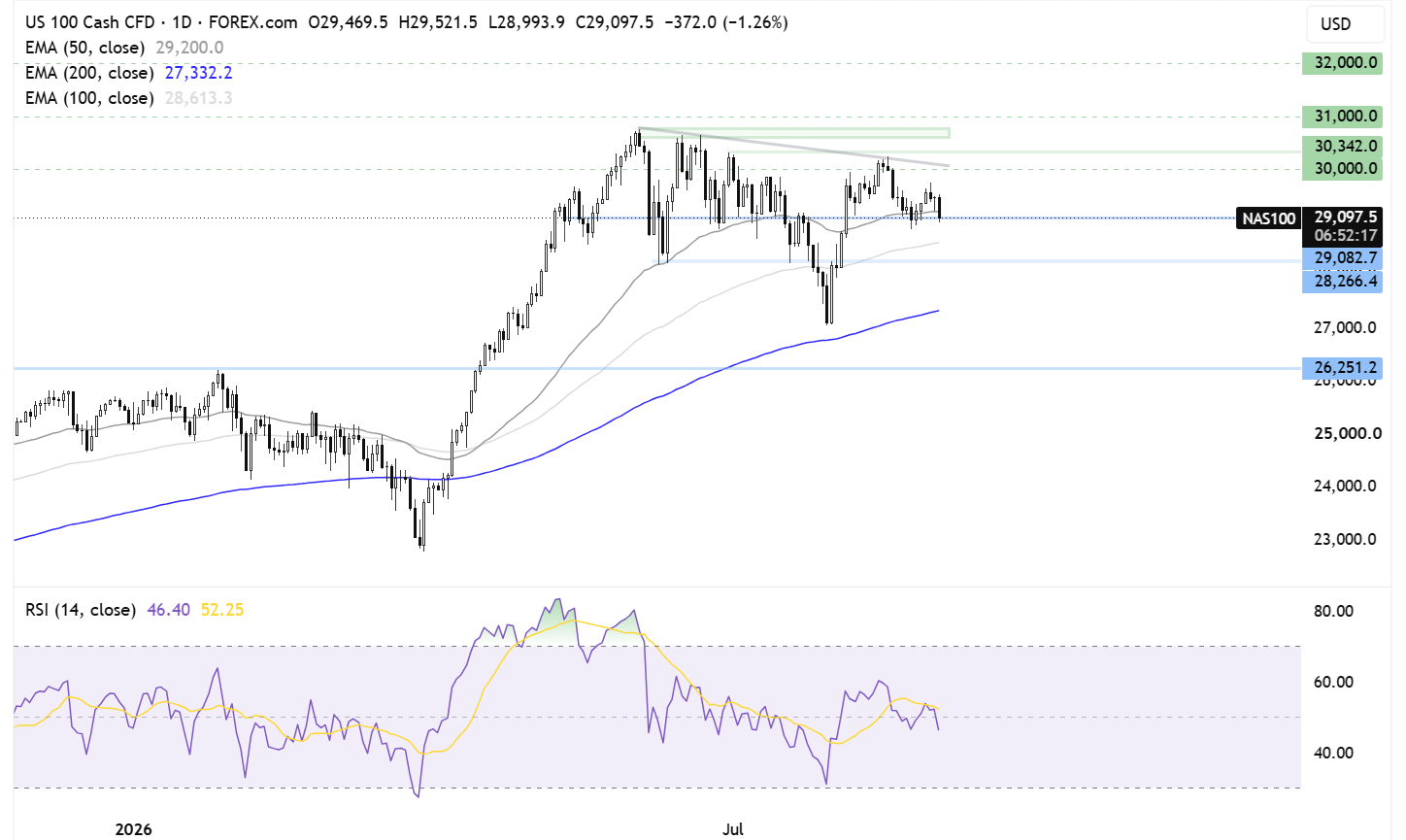
The Nasdaq 100 has fallen back below the 50 EMA and is testing 29,000 support. The RSI is below 50, giving sellers the near-term advantage.
A break below 29,000 would weaken the setup and expose 28,260, around the July 17 and June 10 lows. Below there, attention turns to 27,300, the 200 EMA, followed by 27,000.
For buyers, holding 29,000 is important. A recovery above 30,000 and the falling trend line, followed by a break above the August high, would create a higher high and reopen the upside towards 30,750 and fresh record levels.
FX Markets – Dollar firms post Warsh
The U.S. dollar is benefiting from higher Treasury yields, rising oil prices and safe-haven demand.
The combination of a more hawkish Fed and higher energy prices has increased expectations that the Fed could hike rates in September. The dollar is also benefiting from the U.S.'s position as an oil producer and exporter as Brent moves above $92.
EUR/USD is falling despite hotter Eurozone inflation. Inflation accelerated to 3.3% in August from 2.9%, while core inflation eased to 2.4%. Energy inflation, however, jumped to 14.3%, its highest rate since early 2023.
That creates a difficult backdrop for the ECB. Higher inflation supports tighter policy, but rising energy costs also threaten growth.
GBP/USD is also falling, with the stronger dollar and broader risk-off mood weighing on sterling. Rising gilt yields and higher oil prices are adding to the inflation problem, although the Bank of England is still expected to leave rates unchanged this month.
Oil rises as Strait of Hormuz tensions escalate
Oil prices are moving higher after another escalation around the Strait of Hormuz, with two supertankers carrying Saudi oil reportedly struck by projectiles while transiting the key shipping route.
The incident increases the risk premium around crude at a time when energy exports through the region are already heavily disrupted.
Attempts by mediators to reopen the Strait have so far failed, while President Trump has continued to threaten further strikes against Iran.
For oil, the direction remains heavily dependent on the Strait. Any improvement in shipping flows could quickly remove some of the geopolitical premium, but another escalation could push prices significantly higher.
Related tags:
Latest market news








Web Trader platform
Our sophisticated web-based platform is packed with features.
Open an account today
Experience award-winning platforms with fast and secure execution.
Economic calendar
Related articles

Nasdaq 100 Forecast: NDX slips ahead of Fed Chair Warsh’s speech
U.S. stocks are edging lower on Friday, giving back some of yesterday's gains after Nvidia's strong outlook revived the tech trade. The focus has now shifted firmly to Fed Chair Kevin Warsh's Jackson Hole speech, with investors looking for more clarity on the outlook for interest rates.

S&P 500 Forecast: SPX after Nvidia revives confidence in the AI trade
U.S. stocks are heading higher on Thursday, with technology leading the move after Nvidia's stronger-than-expected outlook revived confidence in the AI trade.

Dow Jones Forecast: DJIA rises, tech rebounds
U.S. stocks are heading higher on Tuesday as Treasury yields fall and semiconductor stocks recover. Investors are positioning ahead of Nvidia's earnings tomorrow and the Federal Reserve's Jackson Hole symposium later this week.