


USD/JPY Pressured as BOJ Hike Bets Ramp Up
Markets are now pricing a faster BOJ rate hiking cycle, but the JGB curve isn’t behaving the way you’d normally expect.
Written by
David Scutt
Market Analyst
- Markets now favour two BOJ rate hikes this year
- Front-end JGB yields hit fresh multi-decade highs
- Bessent keeps doling out free advice to Japan
- USD/JPY slips back below 160
Yen Strength Returns
USD/JPY started the week on the back foot, with the yen strengthening as Japanese front-end yields pushed to fresh multi-decade highs, coinciding with remarks from US Treasury Secretary Scott Bessent implying the BOJ may speed up the pace of rate hikes.
However, coming at month-end, it’s difficult to know whether the move truly reflects the repricing in Japanese rates, which have been a secondary factor relative to the US interest rate outlook this cycle, or simply month-end flows and portfolio rebalancing.
Whatever the driver, it’s been enough to knock USD/JPY back beneath 160, having closed above the level for the first time since late July on Friday. Today, demand for longer-dated Japanese debt and second-tier US labour market data look set to provide the fundamental catalysts for directional risks.
More Free Advice from Bessent
Speaking on the sidelines of the G20 finance ministers meeting in North Carolina, US Treasury Secretary Scott Bessent continued to weigh in on Japan’s interest rate outlook. Not for the first time, he said he had information that the market doesn’t have, implying he knows Japanese authorities may be preparing further measures to counter persistent weakness in the yen.
Separately, Bessent was asked whether the BOJ should consider consecutive rate hikes to combat yen weakness. He said he expected Governor Kazuo Ueda to “do the right thing”.
The comments come as media reports suggest the BOJ may raise rates faster than the roughly twice-a-year pace seen so far this cycle, with a September hike potentially opening the door to another by year-end.
Stepping back from speculation about what the BOJ may or may not do, it’s highly unusual to have the head of the US Treasury Department publicly doling out advice to Japanese fiscal and monetary policymakers on how to proceed on policy settings. It follows the rare joint intervention between US and Japanese authorities to support the yen in late July, which many interpreted as a way for the US to help combat persistent yen weakness while allowing Japanese officials to refrain from selling the nation’s vast pool of US Treasury debt to fund it.
Markets Pull Forward BOJ Hikes
Source: Bloomberg, FOREX.com
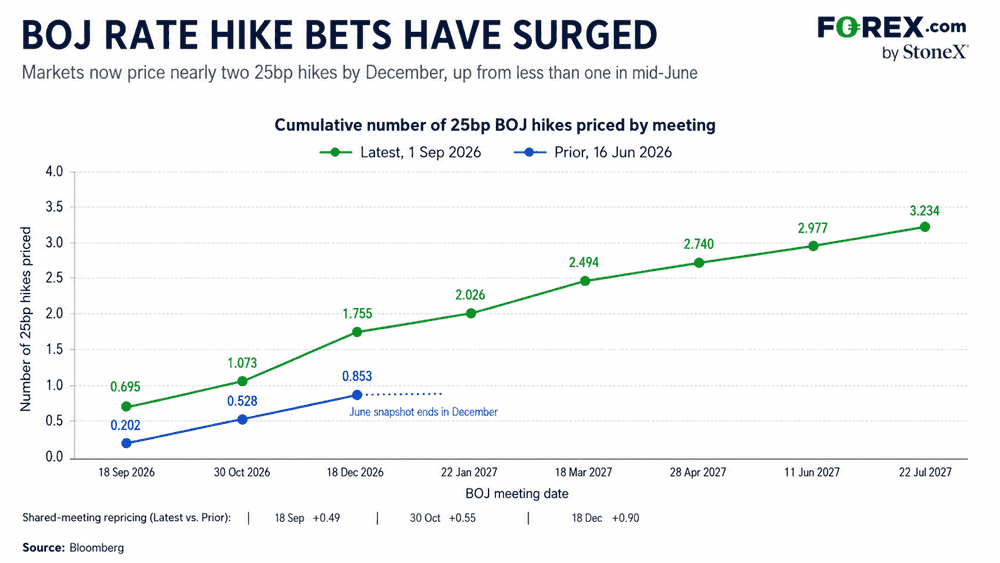
In line with Bessent's comments and the media reports, Japan's OIS curve has undergone a significant hawkish shift over the past couple of months. Markets now price around a 70% chance of a 25bp hike in September, with a second move by the December meeting now priced at roughly 75%.
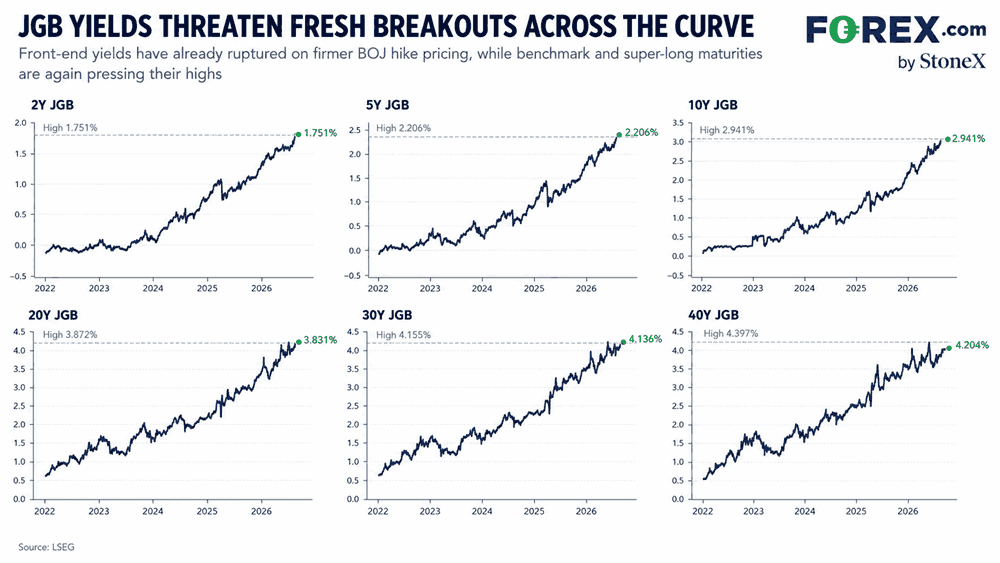
Back on June 16, just 20% of a hike was priced by September and less than one full move by December. As seen in the next graphic, that faster pace of expected tightening has put the front end of the JGB yield curve under pressure, with yields pushing to fresh multi-decade and outright record highs.
Pressure Spreads Across JGB Curve
Source: LSEG, FOREX.com
Despite the prospect of faster rate hikes, there hasn’t been a meaningful flattening further out the JGB curve. Since June 16, the 2s10s spread has only narrowed modestly, while 2s30s and 10s30s have actually widened.
A more aggressive BOJ tightening cycle would normally be expected to restrain inflation and nominal growth expectations in the future, helping to flatten it. Instead, 10-year yields and beyond remain close to their highs, leaving the back end vulnerable to another upwards rupture.
The lack of curve flattening raises serious questions about whether attempts to tame the back end of the JGB yield curve will be successful, with potentially global implications given Japan’s standing as the second-largest sovereign bond market behind the US. If yields rip higher in Japan, it may well pressure longer-dated US Treasuries, potentially explaining why Bessent doesn't require a second invitation right now to issue free advice.
US Data May Matter More for USD/JPY
Whether the back end of the JGB yield curve ruptures higher may come down to demand at today’s 10-year JGB auction, along with a separate 30-year offering on Thursday. Any signs of tepid demand or significant tailing relative to where the market is trading beforehand, even with yields sitting at historically elevated levels, risk adding to the pressure already evident across longer-duration tenors.
Source: TradingView, FOREX.com
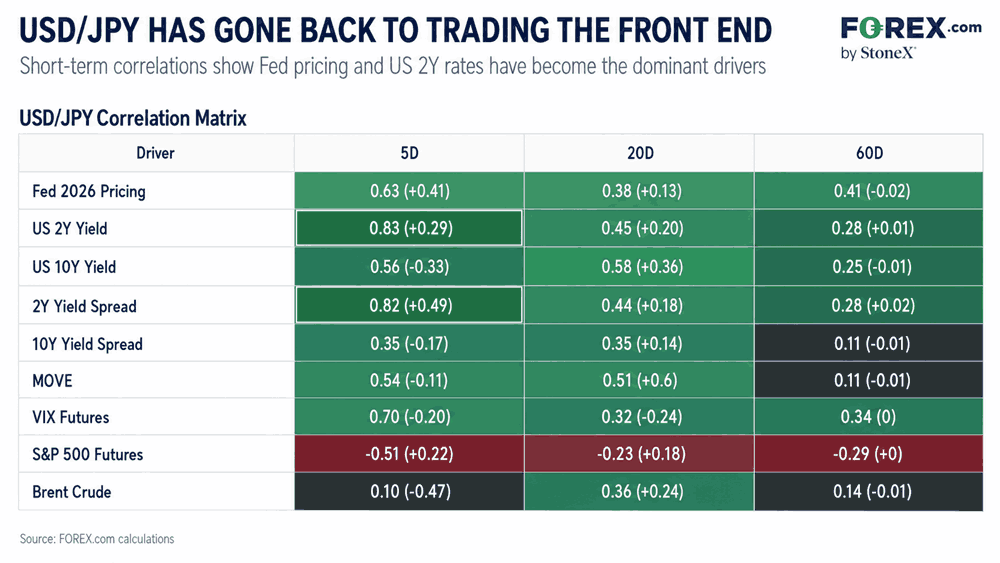
But for USD/JPY, the US side of today’s event calendar may be more influential. As seen in the correlation matrix above, the pair’s relationship with US front-end yields, Fed pricing and the US-Japan two-year yield spread has strengthened sharply over the past week, reinforcing the importance of shifts in the US rate outlook.
That puts ISM manufacturing PMI and the July JOLTS survey in focus as markets move towards the data crescendo of the week with August non-farm payrolls on Friday. Any detail that materially shifts Fed rate expectations could therefore generate a meaningful reaction in USD/JPY.
Buying Dips Still Favoured
Source: TradingView
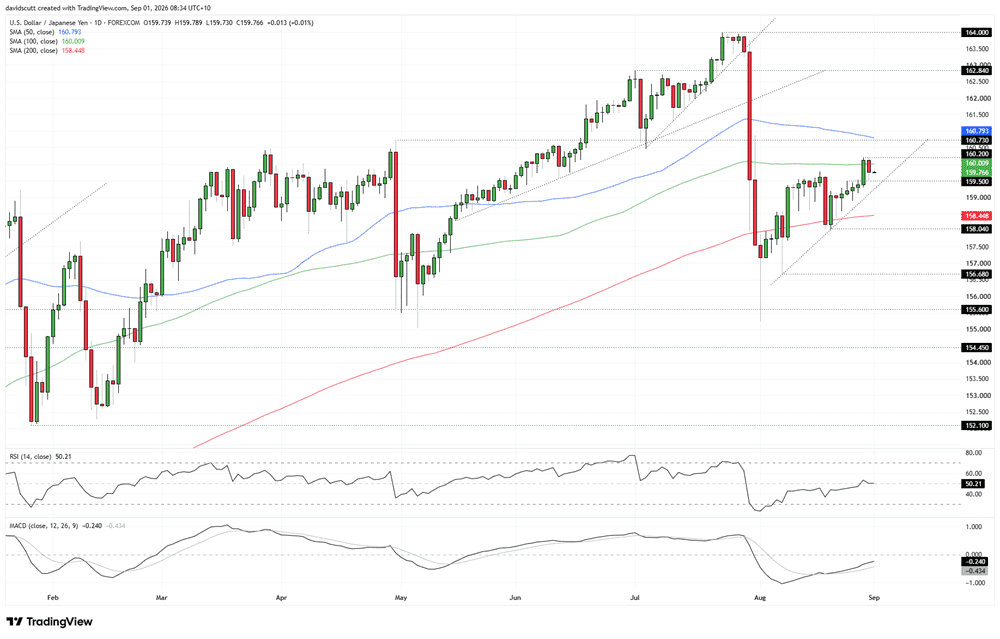
As seen on the daily chart, USD/JPY’s probe above the 100-day moving average didn’t last long, with the pair reversing back into the 159s before bouncing from minor support at 159.50, a level that acted as resistance for a period last week.
That’s the immediate focal point underneath where the pair now trades, with the minor uptrend from the early-August low and 200-day moving average the next levels after that.
Overhead, 160.20 is the first level to watch, coinciding with Friday’s high. A break above would put the confluence of the 50-day simple moving average and 160.73 in focus, the latter the former year-to-date high that has since offered both support and resistance. A break above that zone would increase the probability of USD/JPY resuming its push back towards the high set earlier this year.
The oscillators offer little directional guidance. RSI 14 sits exactly on the neutral 50 level, having gradually ground higher from oversold conditions in early August. MACD delivers a similar message, having crossed its signal line and gradually moved back towards positive territory.
The overall message favours putting greater emphasis on price action rather than adopting a strong directional bias, although the preference remains to buy dips given the current structure.
Latest market news







Web Trader platform
Our sophisticated web-based platform is packed with features.
Open an account today
Experience award-winning platforms with fast and secure execution.
Economic calendar
Related articles

EUR/USD, AUD/USD, Gold Weekly Technical Outlook 8 31 2026
Sr. Technical Strategist Michael Boutros highlights the levels that matter on the Euro, Aussie and Gold this week.


FX Futures Positioning: Dollar Rebound Meets Diverging Forex Bets | COT Report
US dollar longs held firm into Jackson Hole, while euro, yen and commodity FX positioning diverged ahead of ISM and NFP.


Australian Dollar Outlook: AUD/USD Faces RBA-Fed Rate Tug-of-War
AUD/USD faces competing RBA and Fed hike bets this week, with Australian GDP and US payrolls set to test the eight-week rally.