

USD/JPY Weekly Forecast: Energy shock hammers yen as intervention risk looms
Energy prices are driving USD/JPY higher, but rising intervention risk and carry trade vulnerability threaten to complicate the outlook.
Written by
David Scutt
Market Analyst
- Energy shock from Hormuz disruption drives USD/JPY higher
- Oil and LNG correlations highlight energy’s growing influence
- CPI data key for Fed pricing and USD/JPY direction
- Intervention risk rising as pair approaches prior trigger levels
- Carry trade unwind remains a potential tail risk for the yen
Hormuz disruption reshapes FX dynamics
Markets over the past week have been almost entirely beholden to the conflict between the United States and Israel against Iran, with the effective closure of the Strait of Hormuz at the centre. The disruption has created a clear divide between the energy haves and have-nots in currency markets, with those with vast reserves and production capacity benefiting from a positive terms-of-trade shock, while currencies linked to economies heavily reliant on imported energy have come under pressure.
That largely explains why USD/JPY has continued to grind higher. The United States is an energy superpower and largely self-sufficient, while Japan remains heavily dependent on energy imports.
Markets test Trump’s tolerance
Source: TradingView
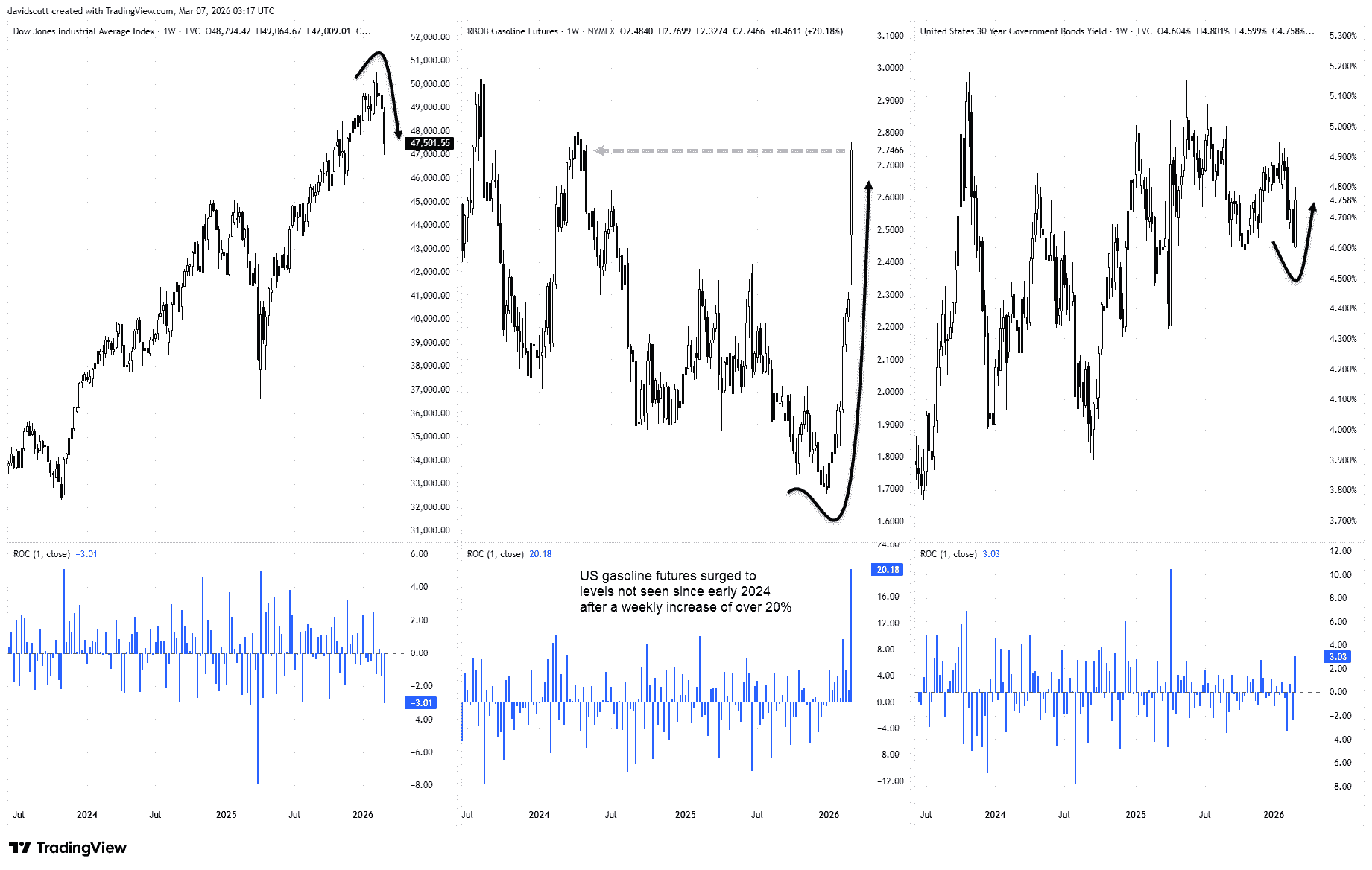
What’s less clear is how much tolerance Donald Trump has to keep the conflict going before the political costs begin to outweigh the strategic benefits. That’s where the Trump TACO Monitor comes in. Trump has long shown a clear fixation on the Dow Jones Industrial Average in his public commentary, making it a useful proxy for the type of market signal that may capture his attention.
The index fell around 3% last week, chipping away at the post-election rally but still well short of the type of stress that previously prompted a policy rethink. For context, it took a weekly decline of nearly 8% during the Liberation Day risk rout in April 2025 to spark a reversal in policy direction.
However, the Dow’s decline is more likely to be felt on Wall Street than on Main Street. The surge in energy prices may prove far more politically sensitive. RBOB gasoline futures jumped 20.18% last week, pushing the front-month contract to levels not seen since early 2024. If sustained, that move will soon begin to filter through to prices at the pump, adding pressure on the administration to bring the conflict to an end before campaigning for the midterm elections ramps up.
There are also early signs the shock is beginning to ripple through financial conditions. The increase in the 30-year Treasury yield last week was the largest since Liberation Day, although only around a third of the magnitude seen during that curve selloff. Given the close relationship between long-end Treasury yields and mortgage rates, the move threatens to push borrowing costs for homebuyers higher again, worsening housing affordability for many Americans.
Taken together, the signals suggest pressure may be building, but not yet to a level where markets have forced Trump to “TACO”. Of course, even if he does, it offers no guarantee the conflict cools quickly given the uncertainty surrounding how Iran may respond.
Correlations highlight energy influence
Source: TradingView
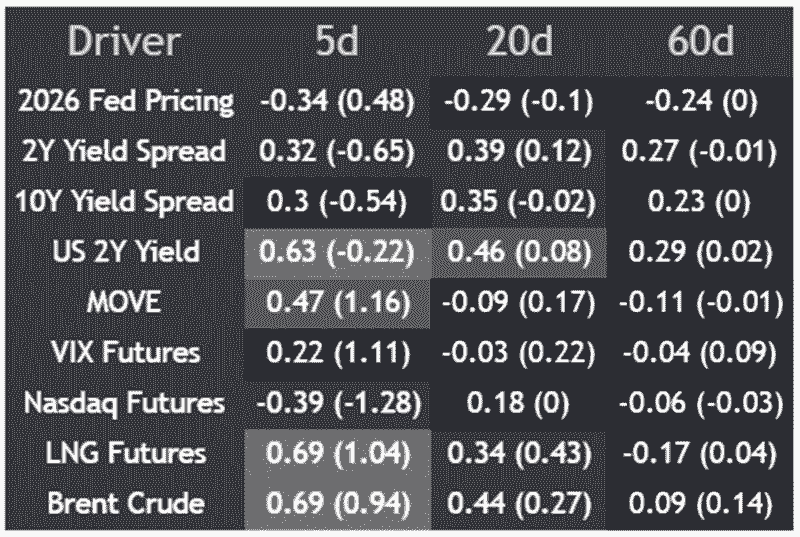
While the geopolitical backdrop has helped drive USD/JPY higher, a look at the pair’s key correlations suggests the energy shock has been playing an unusually large role in shaping price action.
Over the past week, USD/JPY has shown a strong positive correlation with energy markets, with both LNG and Brent crude futures posting correlations of around 0.69 over the five-day window. The bracketed figures show how those relationships have shifted over the past week, highlighting just how quickly energy has moved up the list of key drivers.
However, the relationship was even stronger earlier in the week before easing slightly on Friday following the softer-than-expected US payrolls report. That shift suggests macro data still matters for the pair, particularly when it influences expectations for how the Federal Reserve may adjust interest rates this year.
Payrolls shift Fed expectations slightly
Source: TradingView
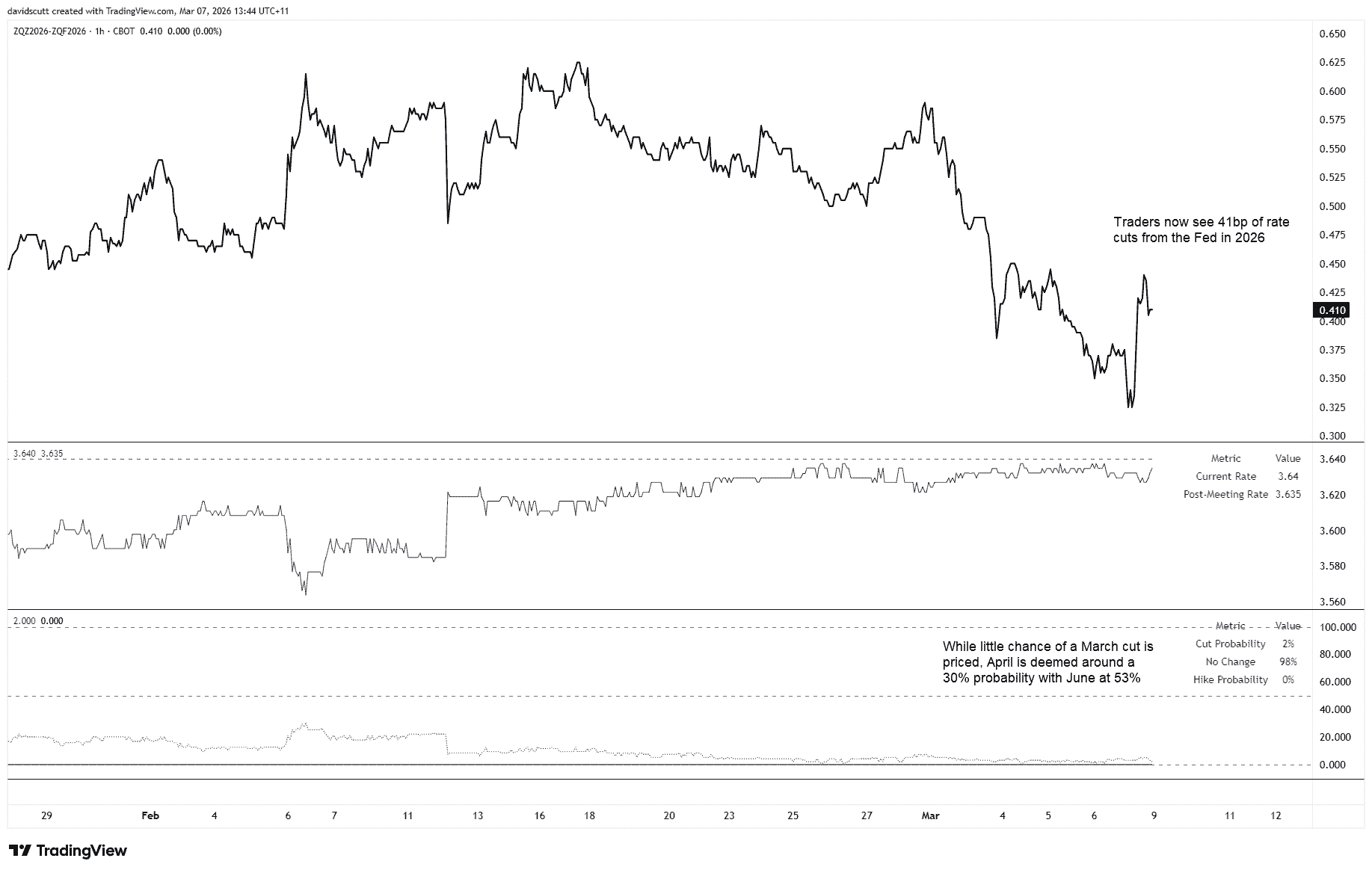
On Fed pricing, markets continue to treat the March meeting as a placeholder with effectively no chance of a move priced.
However, expectations for easing later in the year remain very much alive. An April cut is currently priced at roughly one-in-three, while the probability of a move by June has crept slightly above a coin flip at around 53%.
Markets clearly want to see whether the February payrolls report proves to be little more than statistical noise or something more sinister for the labour market. Developments in the conflict with Iran will also matter given the potential inflationary impulse from higher energy prices.
Still, the roughly 9bp increase in 2026 rate cut pricing following the payrolls report shows that incoming data continues to matter for the US rates outlook, and by extension USD/JPY.
Inflation data takes centre stage
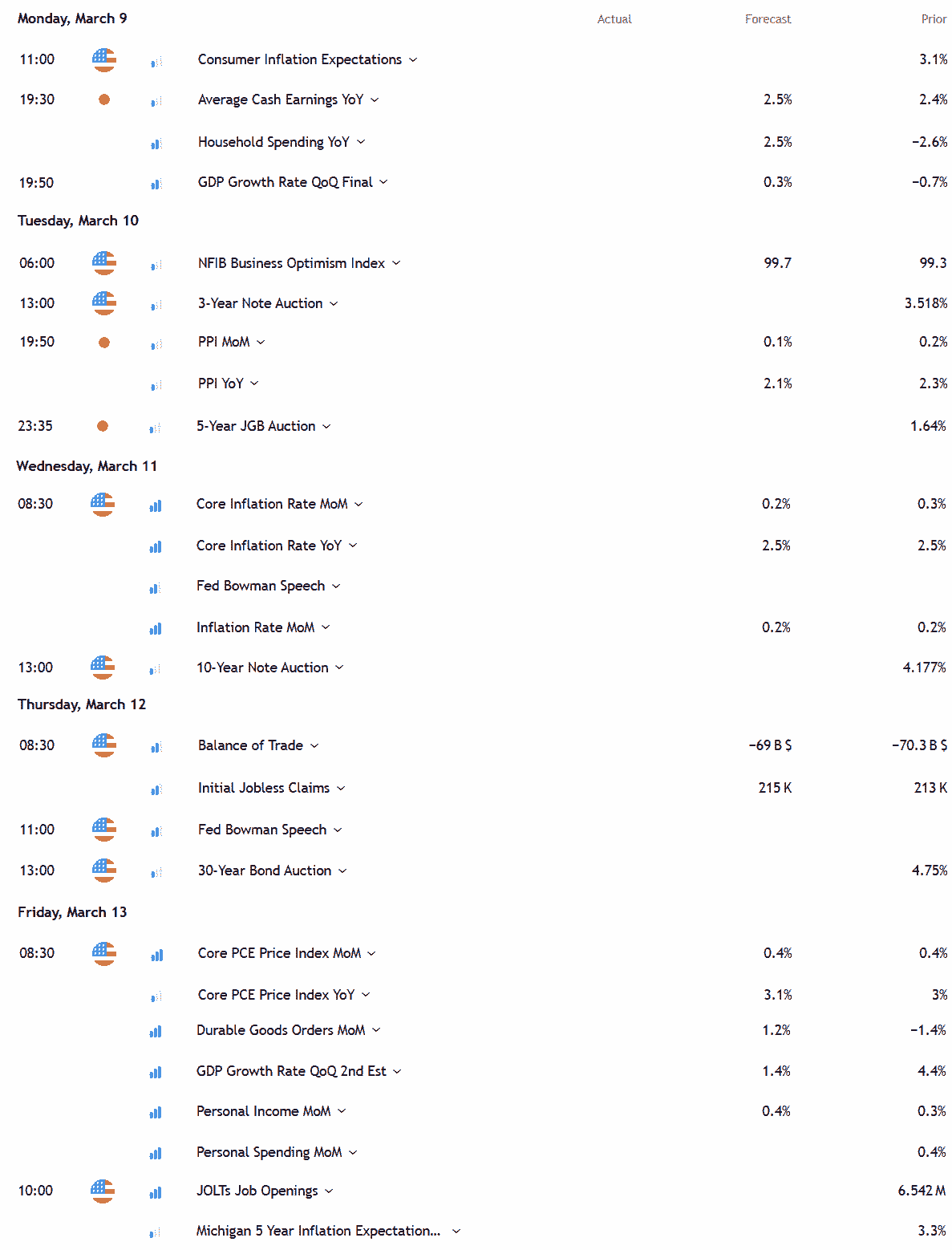
For the calendar below, all times are listed in US ET.
Source: TradingView
With the Fed now in its pre-meeting blackout period, policymakers will not be providing fresh guidance ahead of the March FOMC. If markets are to receive any messaging from the Fed in the near term, it will most likely come indirectly via media “whisperers” rather than from officials themselves.
Given historic volatility trends, arguably the most important release this week will be February’s CPI report on Wednesday. The key core measure is expected to decelerate to 0.2% over the month, leaving the annual rate unchanged at 2.5%. Any meaningful deviation from the forecast could shake up USD/JPY, particularly an undershoot given it may provide cover for the Fed to resume cutting rates even with the looming impact of higher energy prices.
While the Fed’s preferred inflation gauge, the PCE deflator, is released on Friday, it covers January and rarely delivers meaningful surprises relative to consensus nowadays. That’s why CPI looms as the more important report, offering a timelier signal on underlying inflation pressures and what the next PCE reading may look like.
Within the PCE report itself, the consumption and incomes components may prove more interesting. Recent data has pointed to a noticeable deceleration in consumer spending, and further weakness would only reinforce the narrative that the Fed may need to ease policy further.
Beyond those releases, the second estimate of Q4 GDP should remain on the watchlist, along with consumer inflation expectations at either end of the week and Friday’s JOLTS report for January. While JOLTS is often viewed as a lead indicator for labour market conditions, its notoriously wide margin of error means it should not be taken too literally.
Fiscal concerns have taken a backseat recently, including in Japan, meaning a series of bond auctions are events to be aware of but not ones likely to dominate market attention. The Japanese data calendar also screens as secondary relative to the United States, although wages data on Tuesday and PPI on Wednesday could still tweak expectations for the BOJ rate outlook later this year.
Key risks outside the calendar
Two risks worth flagging sit outside the scheduled calendar. The first is the potential for intervention from the Bank of Japan acting on behalf of the Ministry of Finance should the current trajectory in USD/JPY persist.
The pair is not far from the levels seen earlier this year when authorities conducted a series of rate checks, signalling an increased risk of actual intervention. As a result, traders should keep a close eye on any heightened commentary from Japanese government officials, particularly Prime Minister Takaishi and Finance Minister Katayama.
The second is the risk that an escalation in the Middle East conflict sparks a sharp deterioration in global risk appetite, triggering forced unwinds of carry trades. Given the yen’s role as a funding currency, that would likely see it strengthen rapidly.
Aside from a clear de-escalation in the conflict with Iran, these remain among the few obvious factors capable of disrupting the pair’s current trajectory.
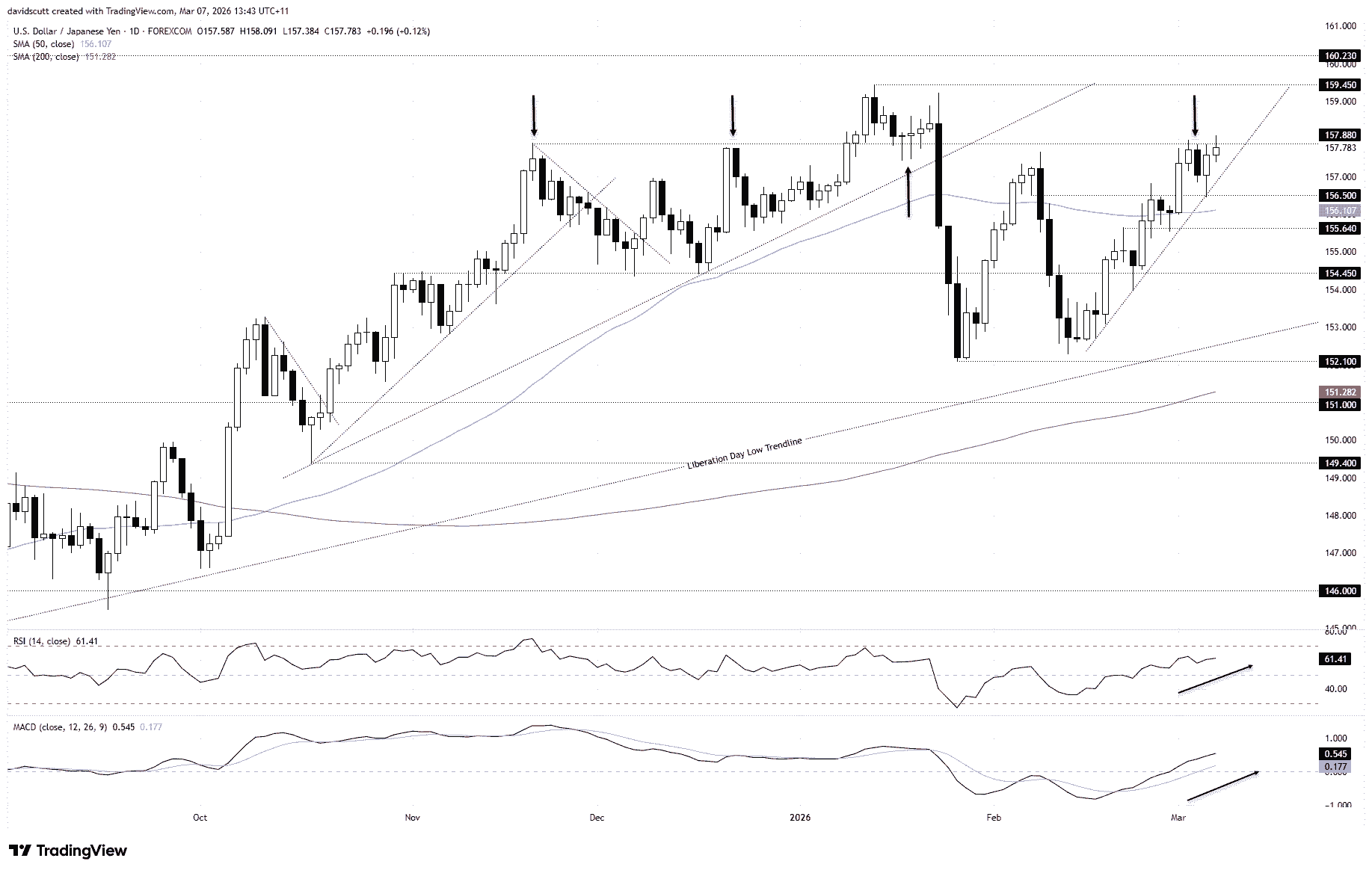
Coiling price action favours upside
Source: TradingView
Technically, signals may prove less reliable than usual in the current environment, with geopolitics and energy markets likely to exert greater influence over near-term price action.
If energy prices continue to lift and there’s no major dislocation in riskier asset classes, the path of least resistance points higher. Even if we were to see a positive resolution to Middle East tensions, while that would likely see energy prices fall sharply, the boost to risk appetite may limit how far USD/JPY declines.
The first level traders should be watching overhead is 157.88, the high set in November last year. The pair has already made several attempts to break through the level, but none have managed to stick. To get excited about a resumption of the bullish trend, it would likely require a break and close above it, a move that would put the 2026 highs into view should it hold.
Resolution may come quickly in the new week with the pair squeezing up against the February uptrend. The coiling pattern suggests the break is more likely to be higher, especially with the yen now functioning more as a funding currency than a traditional safe haven.
On the downside, the February uptrend and 156.50 are the first levels to watch, followed by the 50DMA, 155.64 and 154.45 below.
Signals from the oscillators complement the bullish trend and coiling price action, with RSI (14) trending higher above 50 while MACD has flipped positive after crossing above the signal line from below. Momentum is building behind the move, favouring a similar directional bias.







Web Trader platform
Our sophisticated web-based platform is packed with features.
Open an account today
Experience award-winning platforms with fast and secure execution.
Economic calendar
Related articles

USD/JPY weekly outlook: Payrolls may challenge the Fed’s hawkish reset
USD/JPY has finally woken from its slumber. Payrolls now loom as the key test of whether the latest hawkish repricing sticks or sinks.

Euro Short-term Outlook: EUR/USD Pullback Nears Pivotal Uptrend Support 8 28 2026
Warsh's comments accelerated the EUR/USD selloff, raising the stakes as buyers look to stabilize the broader recovery.


EUR/USD forecast: All eyes on Warsh at Jackson Hole - Forex Friday
For much of this week, the EUR/USD has been edging lower with the US dollar regaining some ground after last week’s sell-off that was triggered, in part, by the bond market worries. Investors have been unwilling to bet further against the US dollar so far this week ahead of Kevin Warsh’s keynote speech at the Jackson Hole summit, due later today.
