


USD/JPY Weekly Outlook: CPI Takes Centre Stage After Payrolls Revive Fed Hike Bets
Intervention innuendo, confused Fed messaging and a hawkish BOJ repricing drove a violent move lower in USD/JPY last week. Strong payrolls stopped the slide, leaving this week’s inflation data to determine whether the rebound sticks.
Written by
David Scutt
Market Analyst
- Suspected intervention helped drive USD/JPY sharply lower
- September BOJ hike now fully priced
- Payrolls revived September Fed hike expectations
- CPI and PPI dominate this week’s US calendar.
- USD/JPY moves remains tightly linked to US Treasury yields
USD/JPY suffered its largest weekly loss since late July as we entered September, hit by relatively dovish remarks from senior Fed officials and possible intervention from the Bank of Japan on behalf of the Japanese government.
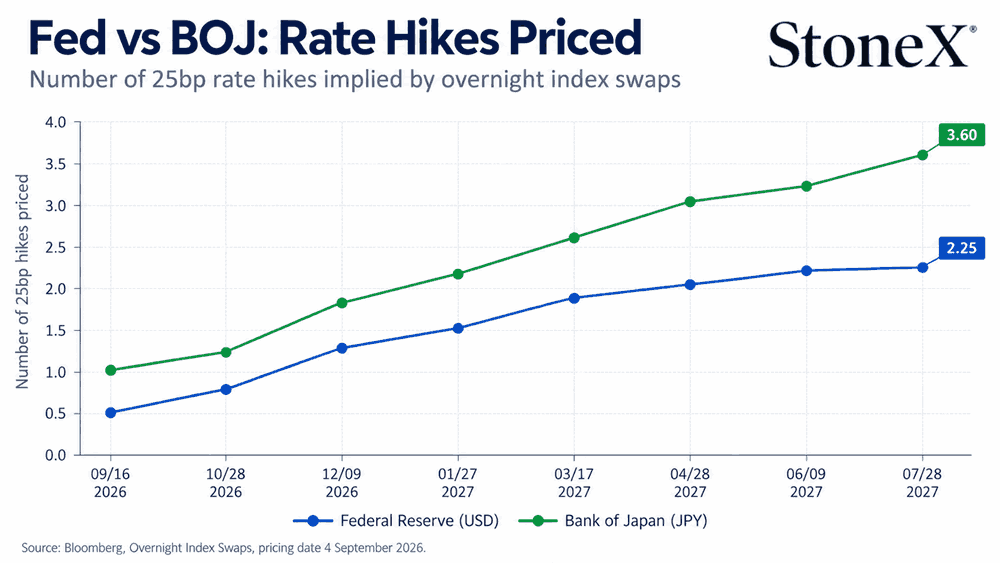
However, an unusually strong August payrolls report in the United States on Friday managed to resuscitate not only rate hike pricing for the Fed’s meeting the week after next, but also stall what had been an abrupt move lower in the pair.
With a strong and strengthening relationship with gyrations in US bond yields, how the Fed rate outlook evolves this week will likely determine where USD/JPY finishes up on Friday.
Inflation Data Set to Drive Fed Pricing
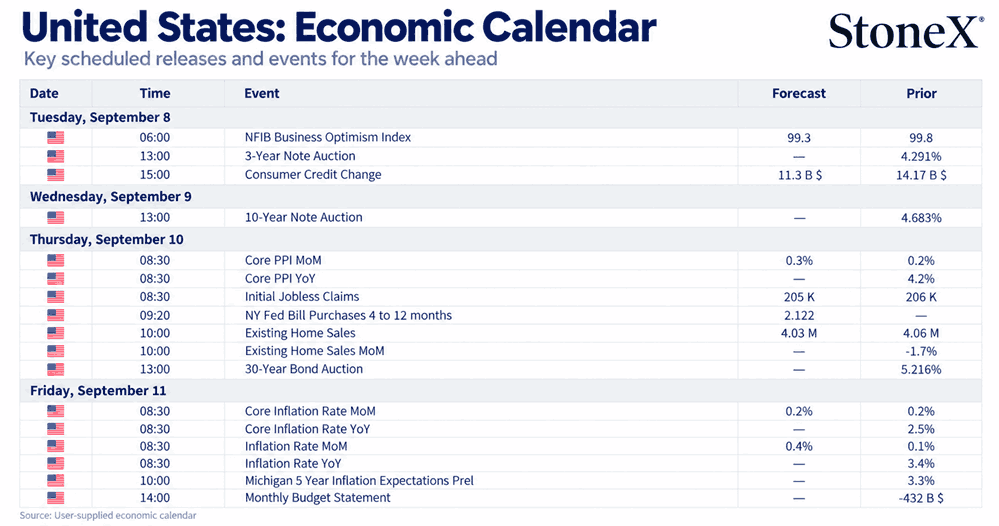
Thursday’s PPI and Friday’s CPI reports stand out as the known knowns most likely to impact USD/JPY this week.
Both will not only help shape expectations for what core PCE may print at later this month, but could go a long way to determining whether the Fed begins a new tightening cycle in September.
Source: TradingView
The timing is especially important given conflicting messages from senior Fed officials over the past week. Chair Kevin Warsh struck a hawkish tone at Jackson Hole, making it clear he remained uncomfortable with inflation and that the Fed still had work to do if price pressures failed to ease sufficiently. Governor Michael Barr also sounded relatively hawkish, reinforcing the sense that another hike remained firmly on the table.
But that messaging was subsequently tempered by New York Fed President John Williams, who said the case for a September hike “isn’t yet firm”, and Governor Christopher Waller, who said he would support keeping rates unchanged if August inflation continued to cool.
With the Fed now in blackout ahead of the September meeting, it will therefore leave the data to do the talking.
At the very least, the core figures probably need to print in line with expectations, if not a touch above, to really cement the case for a September hike. If that happens, you’d expect market pricing to follow, with the probability of a move currently sitting just shy of two in three.
The underlying detail will also matter, particularly in areas of the economy that are more heavily influenced by domestic factors, such as services inflation excluding housing and energy services.
If the core readings undershoot, market pricing for a September hike would likely ratchet lower, leaving December as the more likely candidate as the Fed and markets have more time to assess incoming economic data.
While history suggests the more volatile market reaction normally comes following CPI, PPI arrives first on this occasion, meaning it could provide markets with a strong steer on whether upside or downside inflation risks are prevalent heading into Friday.
Treasury Auctions Enter the Spotlight
Another area of note on the US calendar will be Treasury supply, with three, 10 and 30-year auctions scheduled across the week. They arrive at a time when there’s already plenty of unease around Fed credibility and the size of the US deficit.
US President Donald Trump’s threat on Friday to impose tariffs on countries if the Fed doesn’t cut rates could, at the margin, dissuade international investors from participating in those auctions.
We also get the Treasury’s monthly budget statement on Friday. If that delivers another ugly deficit print, as we saw in the July figures, it could place renewed upward pressure on Treasury yields.
Contrary to what you might normally expect from renewed fiscal concerns, given the strong positive relationship between USD/JPY and moves in US Treasury yields over recent weeks, any renewed move higher in yields from weak auction demand or another poor budget print could also help generate upside in the pair.
Source: Bloomberg
Japan Data Must Back the Hawkish Shift
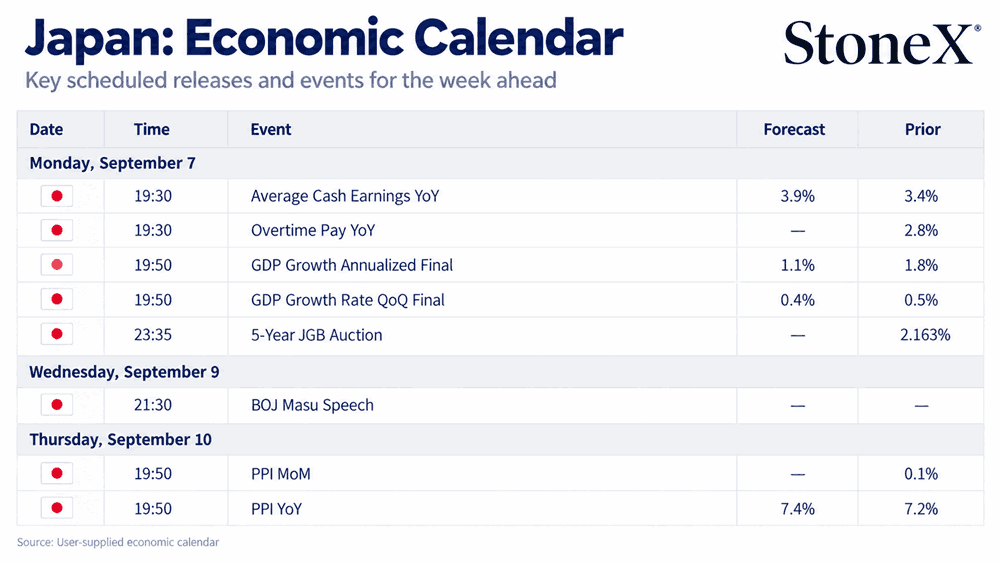
On the Japanese side of the ledger, the impetus to sustain the strengthening in the yen seen last week will come down to key wages and upstream PPI data released during the week.
There’s been a distinct hawkish repricing of the Japanese rates outlook over the past couple of weeks, with a September hike now fully priced and an over 80% probability attached to a follow-up move in December.
Source: TradingView
It will be left to those reports, along with the detail in the final read of Q2 GDP released on Tuesday, to justify those expectations. If we see weakness relative to market expectations, it runs the risk of pushing BOJ policymakers back towards a more cautious stance on the cadence of policy tightening.
The detail in the GDP report will also be important. The initial release was soft beneath the headline, with weakness in household consumption especially prominent.
Even though the report now comes across as a little like ancient history, stronger underlying detail would still help build confidence in the virtuous cycle the BOJ wants to see between strengthening wage pressures, firmer demand and self-sustaining inflationary pressures. At the margin, that will be another important consideration for the rates outlook.
US Rates Link Tightens
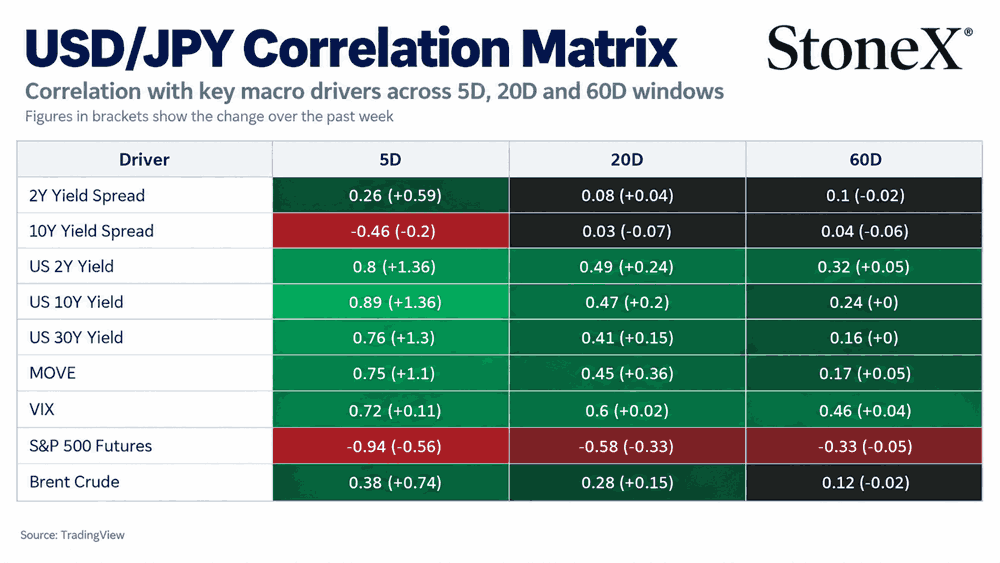
Despite the hawkish repricing of the Japanese rates outlook, the correlation matrix below continues to point to a very strong linkage between USD/JPY and outright movements in US Treasury yields.
Source: TradingView
Over the past five days, the correlation with the US 2-year yield sits at 0.80, rising to 0.89 with the US 10-year and 0.76 with the 30-year. That compares with just 0.26 for the US-Japan 2-year yield spread and -0.46 for the 10-year spread over the same period.
So even though Japan’s rates outlook has undergone quite a major hawkish transition recently, the message from the matrix remains one where the US rates outlook, along with the implications further out the curve, continues to have a vice-like grip on movements in USD/JPY.
It’s also worth pointing out that we’re seeing an unusual positive correlation between USD/JPY and both VIX and MOVE, which is contrary to what you’d normally expect given the yen’s status as a funding currency for carry trades. At the same time, the inverse relationship with risk assets has persisted and strengthened, with the five-day correlation with S&P 500 futures sitting at -0.94.
What’s also notable is that the damage higher energy prices had been doing to the yen appears to have weakened. That relationship had been driven by concerns around Japan’s energy security and the deterioration in its terms of trade, yet the yen managed to strengthen last week even as energy prices continued to rise.
USD/JPY Respects the Range
Source: TradingView
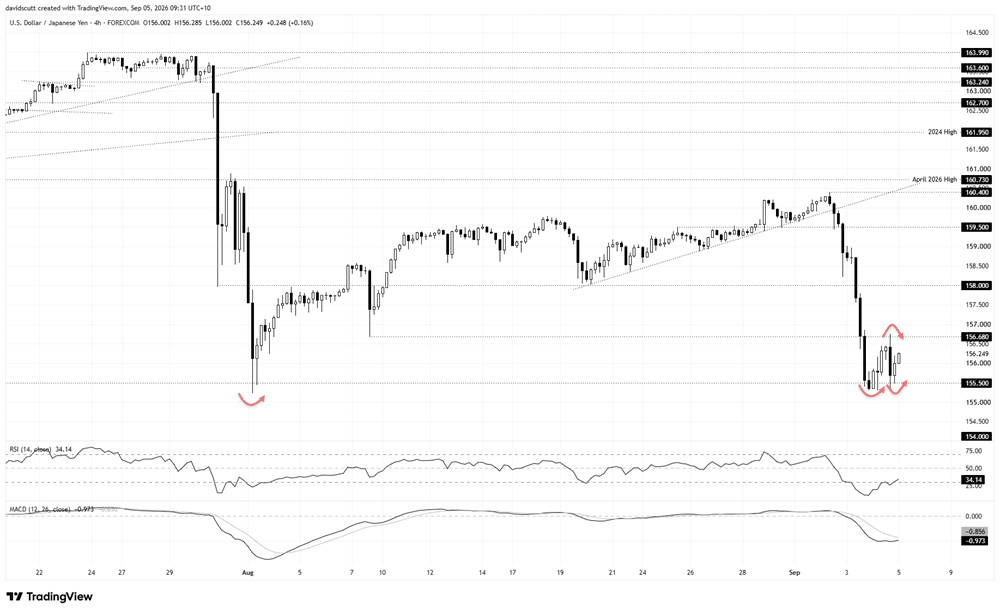
While the question as to whether the BOJ was instructed to intervene last week remains unanswered, despite the violence of the bearish unwind, USD/JPY continues to be respectful of known technical levels, providing something akin to a blueprint for traders to focus on.
The immediate range in focus is 156.68 on the topside and 155.50 on the downside, with the former coinciding with the low set on August 7, while the latter is the top of a zone that has sparked some savage bounces over the course of this year.
While the overall message from the oscillators continues to favour selling into strength and downside breaks, with RSI (14) still sitting at 34 and MACD remaining beneath the signal line in negative territory, the rapid increase in downside momentum looks to have reversed slightly thanks to the strong payrolls print last Friday.
My view is therefore to place greater emphasis on price action rather than holding a specific directional bias in the near term. While we entered this range at rapid velocity from above, you can’t dismiss the fact we’ve seen some big bounces from this zone in the past.
On the topside, above 156.68, the levels to keep an eye on are 158, which has acted as both support and resistance for periods this year, and 159.50, another similar level above that.
Underneath, 155.50 down to 155 has been the support zone where bids have been lurking this year. A clean break beneath the lower rung of that zone could bring 154 into play, which has acted as both resistance and support for periods this year, along with 152.09, 151.50 and a more prominent support level at 151.
Latest market news










Web Trader platform
Our sophisticated web-based platform is packed with features.
Open an account today
Experience award-winning platforms with fast and secure execution.
Economic calendar
Related articles

Euro Technical Forecast: EUR/USD Holds the Line as September Battle Takes Shape 9 4 2026
EUR/USD has defended pivotal support for a second week, with ECB and U.S. inflation risk poised to test the developing September range.


FX Futures Positioning: Dollar Rebound Meets Diverging Forex Bets | COT Report
US dollar longs held firm into Jackson Hole, while euro, yen and commodity FX positioning diverged ahead of ISM and NFP.


USD/JPY weekly outlook: Payrolls may challenge the Fed’s hawkish reset
USD/JPY has finally woken from its slumber. Payrolls now loom as the key test of whether the latest hawkish repricing sticks or sinks.