


Gold Analysis: XAU/USD Shines Again Ahead of NFP
The last two trading sessions have been particularly important for gold's price action in the short term. XAU/USD has gained more than 3.7% during this period, once again highlighting a meaningful bullish bias around the precious metal.
Written by
Julian Pineda
Market Analyst
The last two trading sessions have been particularly important for gold's price action in the short term. XAU/USD has gained more than 3.7% during this period, once again highlighting a meaningful bullish bias around the precious metal. For now, this recovery has been driven mainly by weakness in both the U.S. dollar and the bond market ahead of tomorrow's NFP release. Both markets remain important alternatives to gold, and their recent pullback appears to be allowing demand for the metal to recover. As long as this dynamic remains in place, buying pressure could continue to play an important role during the coming sessions.
How Is the Market Reacting Ahead of NFP?
Tomorrow, markets will focus on the release of the U.S. Non-Farm Payrolls (NFP) report, which measures changes in non-agricultural employment during August. Current expectations point to the creation of around 55,000 new jobs, a figure that would represent an improvement compared with July's reading, when approximately 23,000 jobs were lost.
However, beyond the headline number itself, what truly matters is the potential impact this report could have on the Federal Reserve's next monetary policy decision. At the moment, there is still no clear consensus regarding how the central bank will proceed at its mid-September meeting. While a more aggressive Fed was the dominant expectation just weeks ago, recent comments from policymakers have begun to support a more cautious approach.
Officials such as John Williams have indicated that they prefer to remain in a wait-and-see mode, highlighting that recent inflation data has been more encouraging. At the same time, Christopher Waller has suggested that he would support leaving rates unchanged if inflation continues to show signs of moderation.
This has increased uncertainty heading into the NFP report, as markets increasingly view the release as a potentially decisive factor for September's policy decision. In fact, CME Group probabilities currently show an almost evenly split scenario, with approximately 49% odds of rates remaining unchanged versus 51% odds of a rate increase. This reflects a decline in conviction around the idea of a clearly more hawkish Federal Reserve.
This uncertainty has already begun affecting markets that compete directly with gold. Both U.S. Treasuries and the dollar have reacted to recent Fed comments and to expectations surrounding the NFP release.
On one hand, 10-year Treasury yields have retreated from recent highs near the 4.8% area. On the other, the DXY Index, which measures the U.S. dollar against its major peers, has also moved back below the 99-point level. This highlights how sensitive both markets remain to monetary policy developments and suggests that investors are beginning to price in a less aggressive Fed scenario.
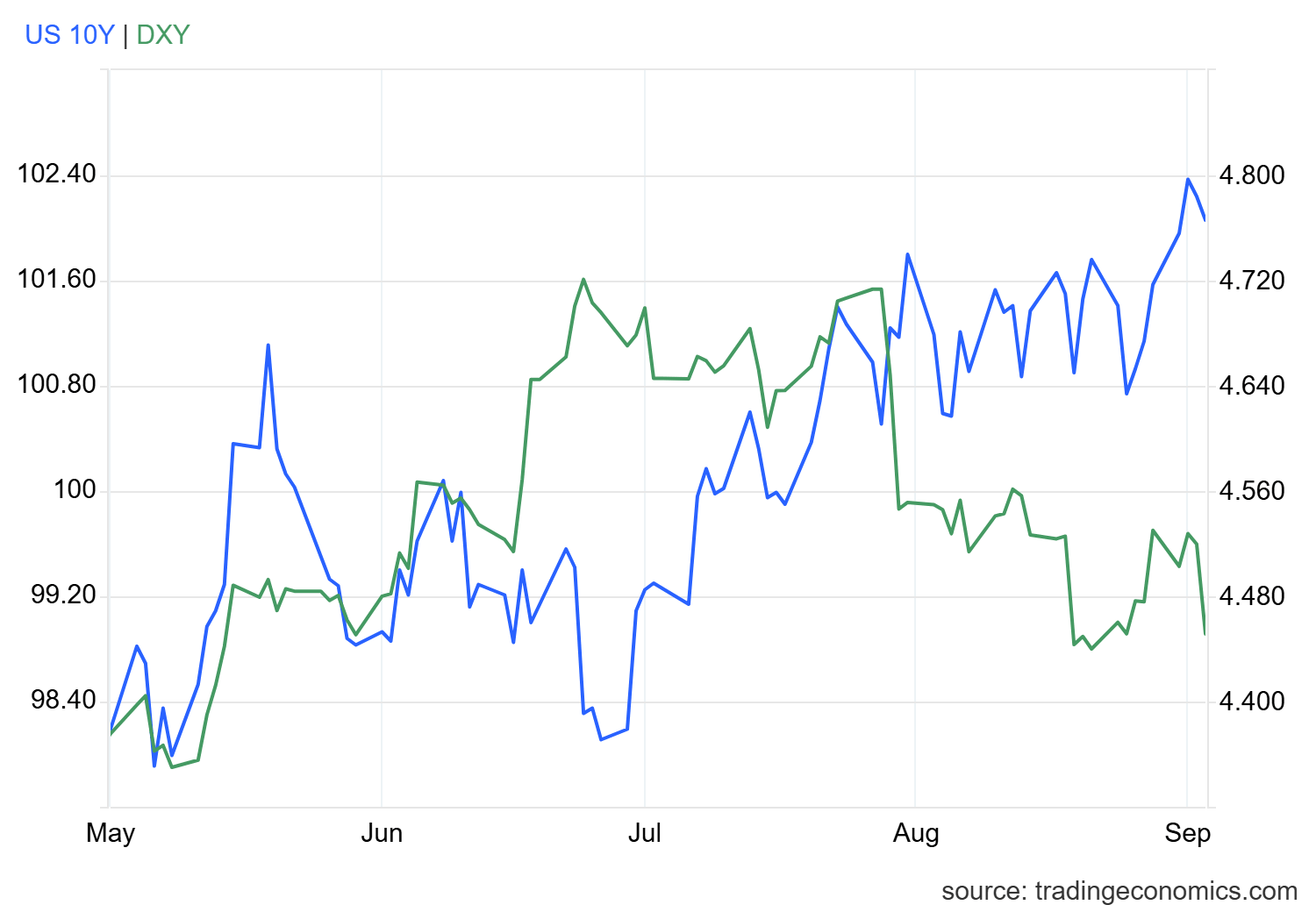
Source: Trading Economics
In this environment, the current dynamic remains particularly important for gold because weakness in alternative markets often supports a recovery in demand for the precious metal. This relationship becomes evident when comparing gold's performance with the DXY Index, where periods of dollar weakness continue to coincide with stronger price action in gold.
In addition, the correlation coefficient between both markets remains close to -0.93, reflecting a strong inverse relationship over the past 100 trading sessions. This suggests that continued dollar weakness may remain supportive of the recovery currently underway in gold. It is important to remember that correlation coefficients can change over time.
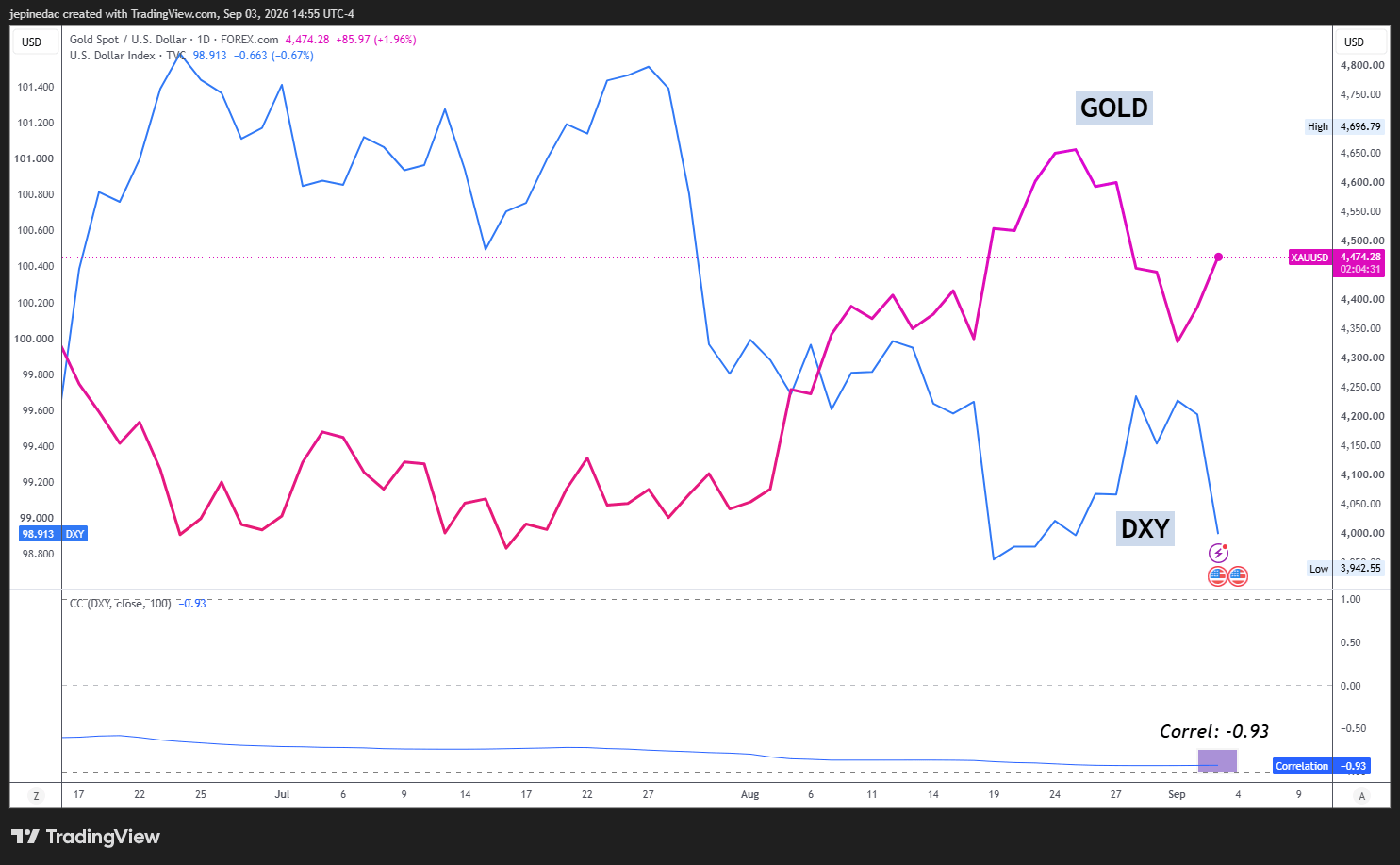
Source: TVC, StoneX, Tradingview
Against this backdrop, market attention will likely remain focused on how the Federal Reserve responds to tomorrow's labor market data. If job creation proves weaker than expected, the relative attractiveness of both bonds and the U.S. dollar could continue to decline, potentially extending buying pressure around XAU/USD. Conversely, if employment data shows significant strength, markets may begin reconsidering a more hawkish Fed outlook, which could push gold into a broader period of consolidation toward the end of the week.
Gold Technical Outlook
Source: StoneX, Tradingview
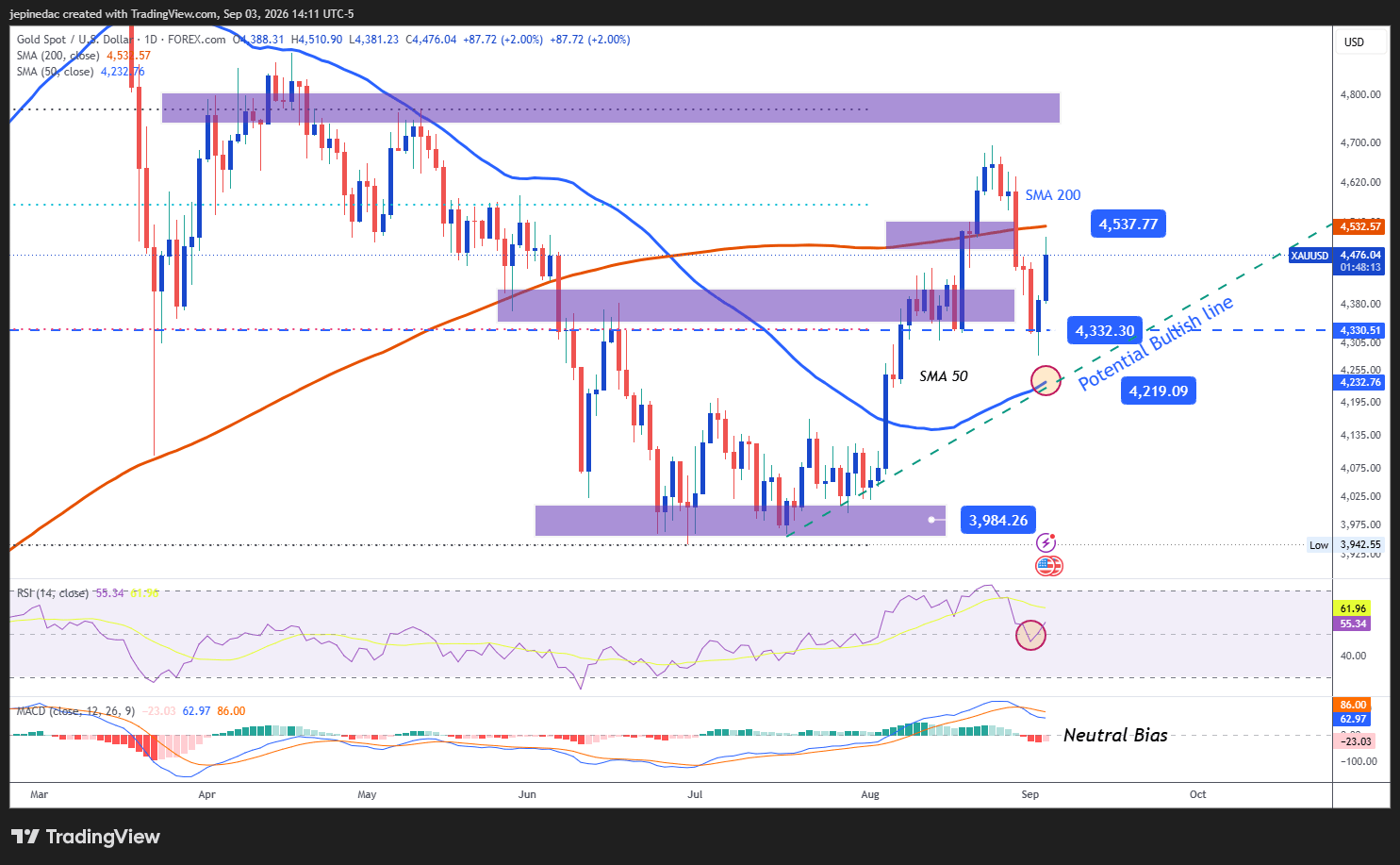
- Trendline Continues Attempting to Hold: Recent gold price action continues to defend a long-term bullish trendline that remains one of the most important technical structures on the chart. As long as buying pressure remains stable and prices continue breaking through important technical barriers, a more established uptrend could begin to develop over the coming weeks.
- RSI: The RSI has moved back above the neutral 50 level, signaling that average buying momentum is beginning to regain relevance within the market. If this dynamic continues to develop, the bullish bias could continue gaining importance in the short term.
- MACD: However, it is also important to note that the MACD histogram continues to fluctuate near the neutral 0 line. This suggests that a degree of balance still exists within the average strength of short-term moving averages and indicates that the broader neutral environment has not disappeared completely from the chart.
Key Levels to Watch:
- $4,530 – Critical Resistance: An important upside barrier that coincides with the 200-period Simple Moving Average. A sustained close above this level could begin to change the recent market structure and create room for stronger buying pressure during the coming sessions.
- $4,332 – Nearby Barrier: An equilibrium area that has contained a large portion of price action over the last two weeks. It remains an important reference level for potential pullbacks and, as long as prices continue developing around this zone, a sideways environment could remain a relevant feature of the market.
- $4,200 – Critical Support: This level coincides with the 50-period Simple Moving Average. Price action returning toward this area could begin to challenge the bullish structure that has developed recently and potentially open the door to a more dominant bearish bias in the weeks ahead.
Written by Julian Pineda, CFA, CMT – Market Analyst
Follow him on: @julianpineda25
Latest market news











Web Trader platform
Our sophisticated web-based platform is packed with features.
Open an account today
Experience award-winning platforms with fast and secure execution.
Economic calendar
Related articles

Gold and S&P 500 analysis: What now after Warsh’s hawkish speech?
The dollar surged across the board after the Fed Chair Kevin Warsh surprised with a hawkish-leaning speech at the Jackson Hole summit. All the bearish dollar bets that had been accumulated since last Friday on the back of data weakness and bond market troubles had to be squared and that triggered a short squeeze rally for the dollar. Gold and silver dropped, as a result, as too did bitcoin, while US indices were giving back earlier gains.


Gold Falters at Resistance, Grappling With PCE, Month-End Flows and Jackson Hole
Gold has pulled back from resistance after sticky PCE data, with month-end flows and Jackson Hole now shaping the near-term outlook.


Gold forecast: XAU/USD retreats along with dollar debasement trade
Gold was down nearly 1.5% on the session, with US indices and Bitcoin also struggling. Is this a mere pause before more gains are seen, or have we already seen the end of the recent bullish advance?