

USD/MXN Forecast: Peso Loses Momentum Ahead of Banxico Decision
Over recent trading sessions, the Mexican peso has started to show signs of losing strength against the U.S. dollar. This can be seen in the performance of USD/MXN, which has gained more than 1.7% over the last three sessions, highlighting the dollar's renewed strength against the peso.
Written by
Julian Pineda
Market Analyst
Over recent trading sessions, the Mexican peso has started to show signs of losing strength against the U.S. dollar. This can be seen in the performance of USD/MXN, which has gained more than 1.7% over the last three sessions, highlighting the dollar's renewed strength against the peso. Buying pressure has remained in place even as markets prepare for tomorrow's Banco de México policy decision, suggesting that expectations surrounding the event have not been sufficient to support a more consistent recovery in the Mexican currency. If this dynamic continues, buying pressure around USD/MXN could remain relevant in the sessions ahead.
What Is Expected from Banxico's Decision?
Tomorrow, Banco de México will announce its latest monetary policy decision. Despite maintaining one of the highest interest rates among major central banks, currently at 6.5%, markets are widely expecting policymakers to leave rates unchanged for a third consecutive meeting.
This expectation is largely driven by the recent evolution of inflation. Although price pressures remain present, inflation has slowed significantly over the past several months. After reaching a peak of 4.59% in March 2026, inflation has followed a consistent downward path, falling to 3.26% in August, a level that is now relatively close to Banxico's 3.00% target. This contrasts with the United States, where inflation continues to hold near 3.4%, still above the Federal Reserve's 2.00% objective. As a result, while markets expect Banxico to maintain a more stable stance, expectations for the Fed continue to point toward a more restrictive monetary policy.
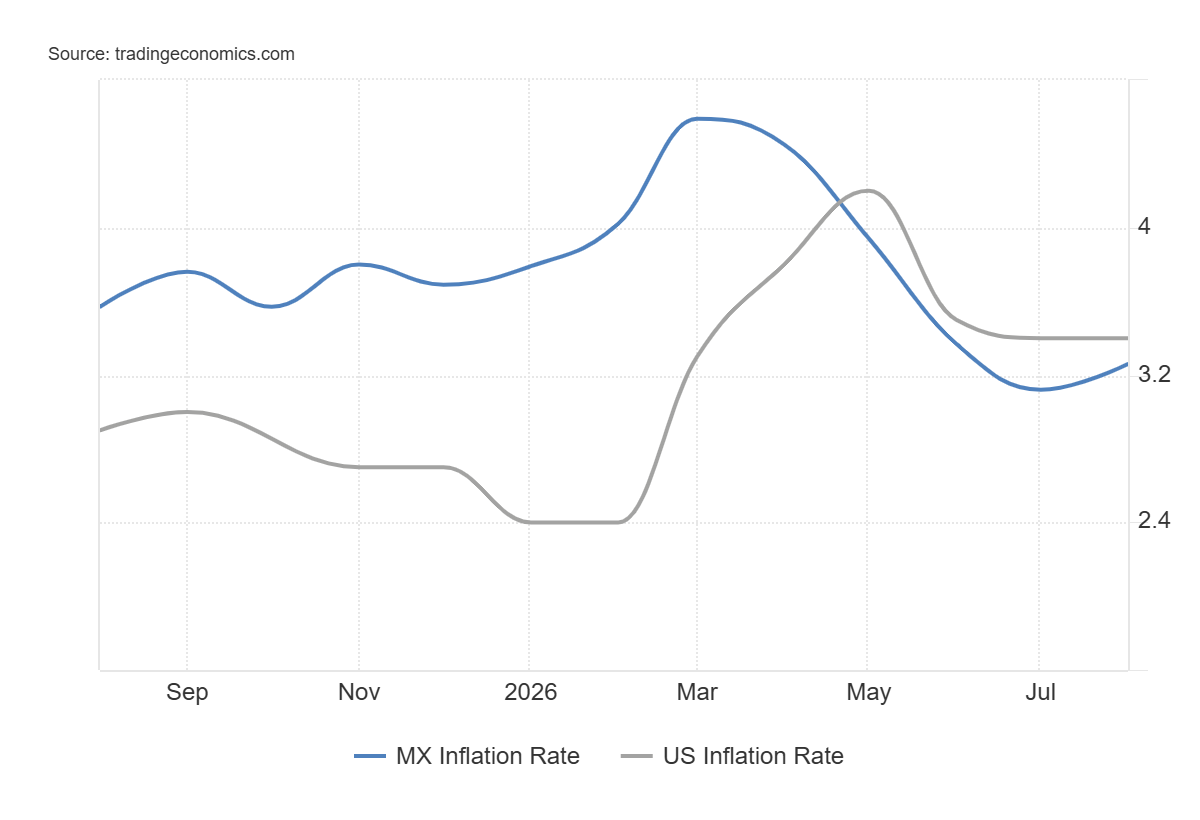
Source: TradingEconomics
This divergence is becoming increasingly important because markets are now assigning more than a 70% probability to another Federal Reserve rate hike at the October meeting, potentially taking rates to the 4.25% area. Although Mexico continues to maintain a significantly higher policy rate than the United States, the discussion is no longer focused solely on current levels but rather on the direction each central bank may take in the months ahead.
This divergence is already beginning to show up in the bond market. Mexican 10-year government bonds continue to offer attractive yields around 9.3%, but those yields have started to moderate as investors increasingly expect Banxico to keep rates unchanged. By contrast, U.S. 10-year yields continue to move higher and remain slightly above 5.00%, supported by expectations of a more aggressive Federal Reserve.
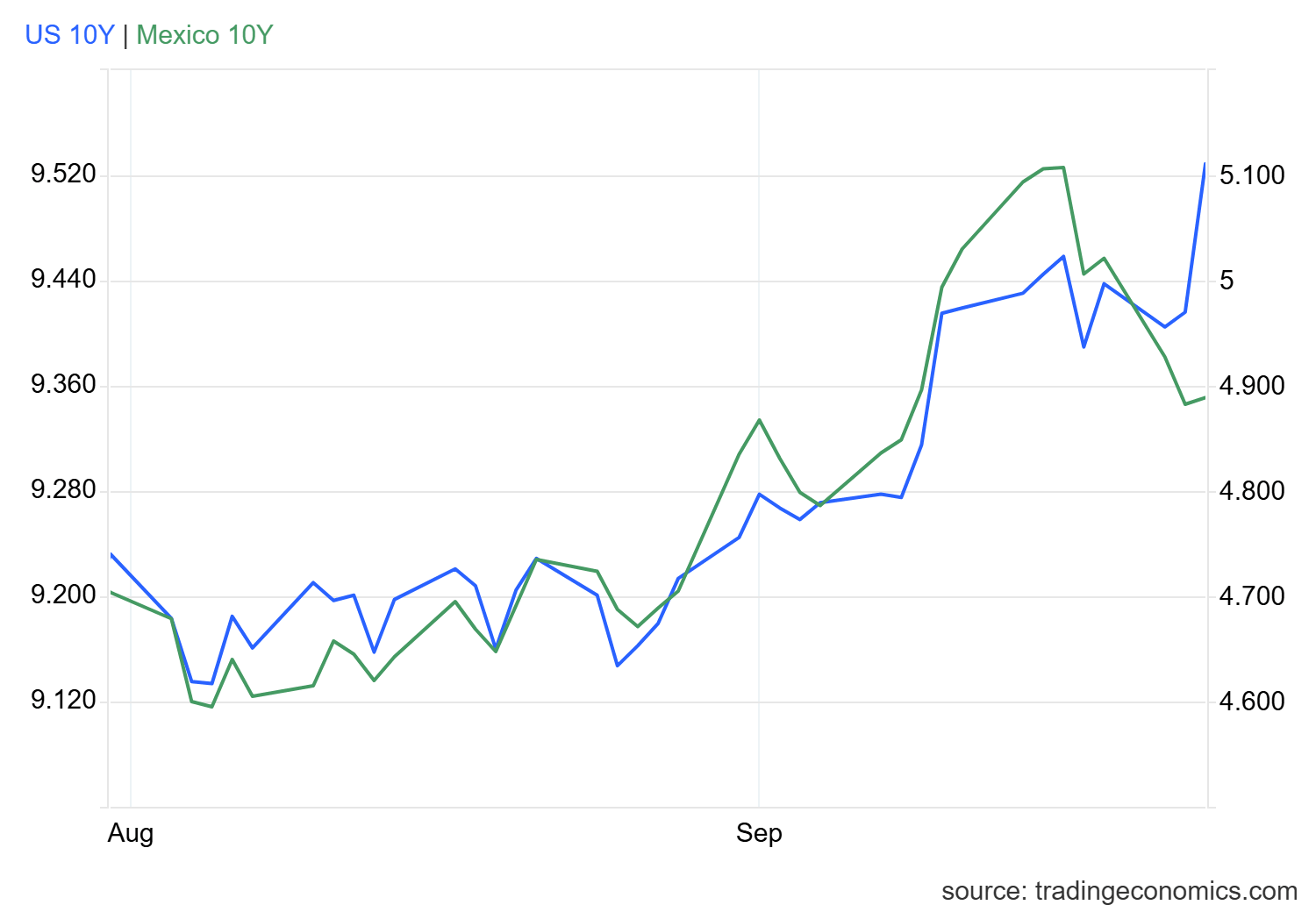
Source: TradingEconomics
This development matters because a significant part of the peso's strength throughout much of 2026 was supported by the wide interest-rate differential with the United States. However, as markets continue to price in a more aggressive Fed and a more neutral Banxico, part of that relative advantage may gradually begin to shrink. While Mexican assets continue to offer higher yields, U.S. assets combine rising returns with a lower perceived level of risk, a combination that could continue to favor demand for U.S. dollars over the Mexican peso.
Under this backdrop, if Banxico once again confirms a stable policy stance tomorrow, the peso could continue to struggle to regain ground against the dollar. As a result, buying pressure around USD/MXN could remain a relevant market theme in the weeks ahead.
USD/MXN Technical Forecast
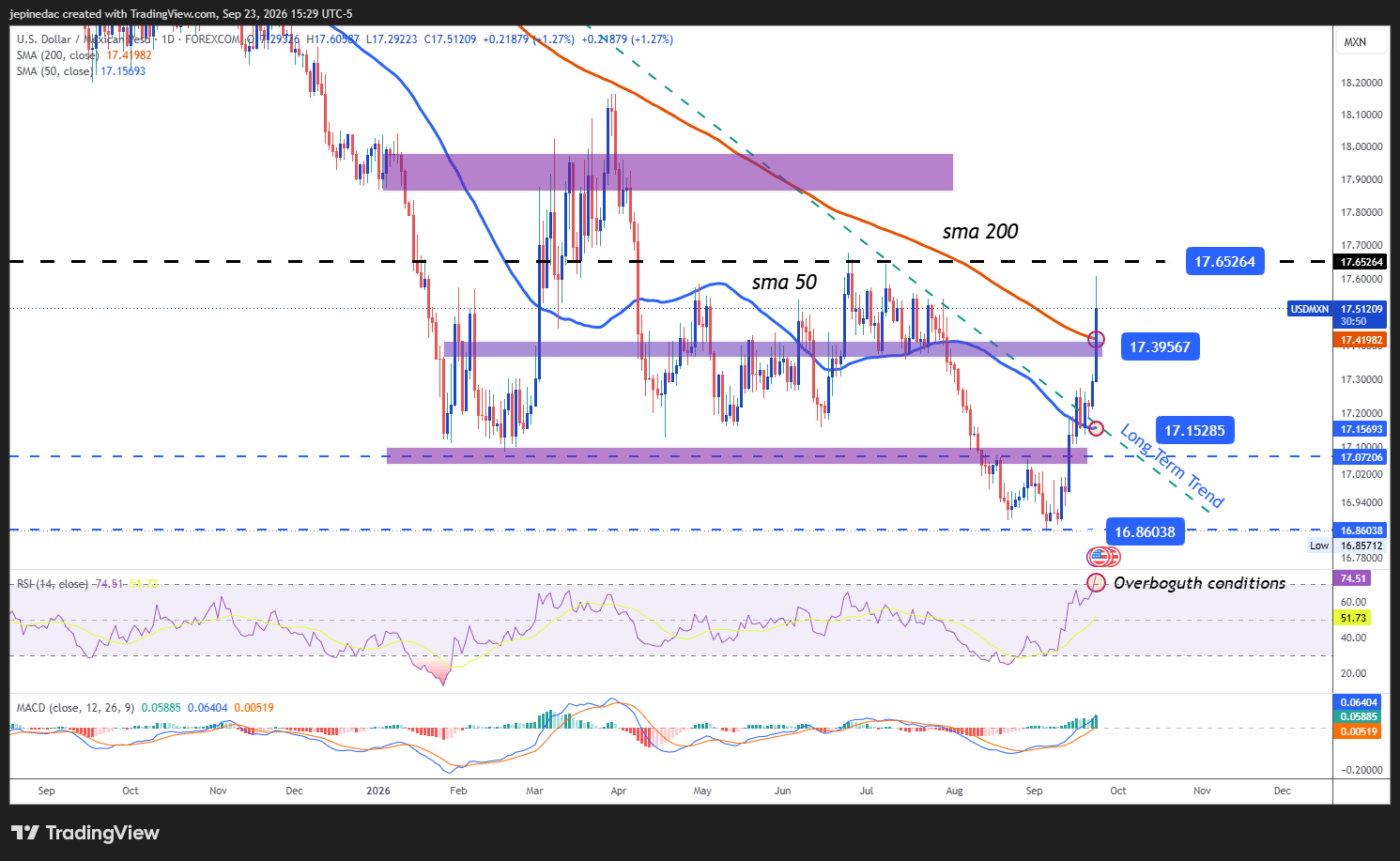
Source: StoneX, Tradingview
- A new bullish move begins to take center stage: For most of the year, USD/MXN traded within a well-defined downtrend that served as the dominant technical structure on the chart. However, the recovery seen in recent sessions has produced a meaningful break above that trendline, with prices now challenging important resistance levels. If buying pressure remains in place, the pair could begin developing a new short-term uptrend in the weeks ahead.
- MACD: The MACD histogram continues to develop above the 0 neutral line, a reading that suggests short-term moving-average momentum remains tilted to the upside. As long as this behavior persists, buying pressure could continue playing an important role in the market.
- RSI: A similar picture can be observed in the RSI, which remains above the 50 neutral level, supporting the importance of the recent bullish momentum. However, the indicator has also moved above the 70 overbought threshold, suggesting that the pace of the recent advance has been significant and could leave room for short-term corrective pullbacks.
Key Levels:
- 17.65 – Major Resistance: A significant high from previous months that currently stands as the most important upside barrier on the chart. Sustained price action above this level could reinforce the dominance of buying pressure, support the formation of higher highs, and encourage the development of a more established bullish structure in the weeks ahead.
- 17.39 – Current Barrier: A level that coincides with the 200-period simple moving average and remains the nearest technical reference to monitor in the event of short-term bearish corrections.
- 17.15 – Key Support: An area that aligns with the 50-period simple moving average and the base of the former bearish structure. A move back toward this level could highlight a renewed lack of direction and favor the development of a broader trading range over the coming weeks.
Written by Julian Pineda, CFA, CMT – Market Analyst
Follow him on: @julianpineda25
Latest market news










Web Trader platform
Our sophisticated web-based platform is packed with features.
Open an account today
Experience award-winning platforms with fast and secure execution.
Economic calendar
Related articles

Nasdaq 100 Forecast: NDX slips ahead of Fed Chair Warsh’s speech
U.S. stocks are edging lower on Friday, giving back some of yesterday's gains after Nvidia's strong outlook revived the tech trade. The focus has now shifted firmly to Fed Chair Kevin Warsh's Jackson Hole speech, with investors looking for more clarity on the outlook for interest rates.


EUR/USD forecast: All eyes on Warsh at Jackson Hole - Forex Friday
For much of this week, the EUR/USD has been edging lower with the US dollar regaining some ground after last week’s sell-off that was triggered, in part, by the bond market worries. Investors have been unwilling to bet further against the US dollar so far this week ahead of Kevin Warsh’s keynote speech at the Jackson Hole summit, due later today.


S&P 500 Forecast: SPX after Nvidia revives confidence in the AI trade
U.S. stocks are heading higher on Thursday, with technology leading the move after Nvidia's stronger-than-expected outlook revived confidence in the AI trade.