


AUD/USD outlook: Australian jobs report puts bullish trend to the test
Australian jobs data will set the tone for the Aussie dollar and RBA rate outlook today. With AUD/USD sitting on its bullish uptrend and markets still pricing a chance of another hike, there's plenty riding on the outcome.
Written by
David Scutt
Market Analyst
- Jobs report may decide August RBA hike prospects
- Three-year futures threaten bullish breakout
- US spending data trumps core PCE deflator
- Risk appetite still driving Aussie dollar direction
- AUD/USD clings to Liberation Day uptrend
All eyes on Australia's jobs report
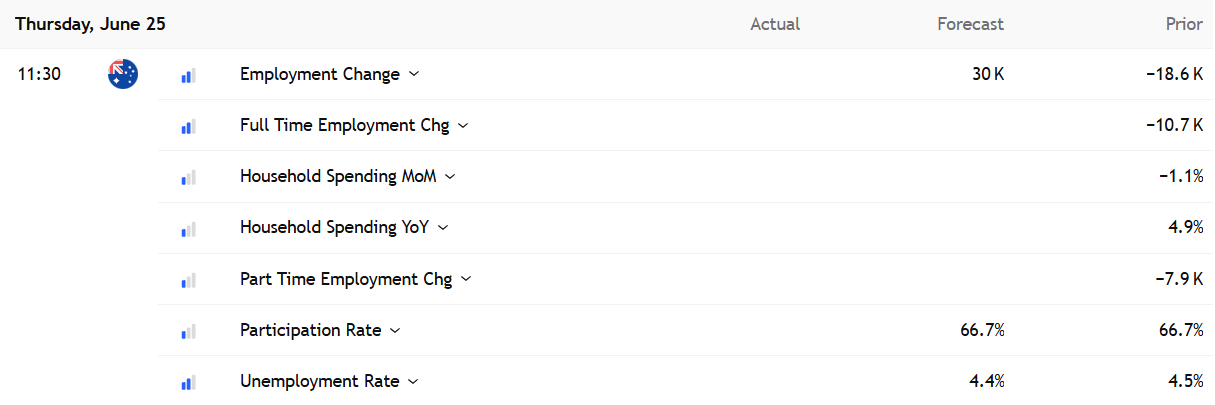
Today is a huge day for the Australian economy with the release of May labour force and household spending data, carrying the potential to significantly shift RBA cash rate expectations, bond yields and Aussie dollar.
Inflation update leaves a sting in the tail
Those, like myself, who believe the RBA will soon call time on its tightening cycle were given food for thought by the detail in Wednesday's monthly inflation report.
The RBA's preferred trimmed mean inflation measure came in a tenth above market expectations, rising 0.4% in May to leave the annual rate at 3.6%. While that still points to inflation running below the RBA's 3.8% forecast for Q2, there were several uncomfortable features beneath the surface.
New dwelling costs for owner-occupiers rose 0.88%, the largest monthly increase since December 2022, while rents, at 0.42%, recorded their largest monthly increase in more than a year. There was also evidence the inflationary impulse from higher energy prices is starting to be passed through to consumers, as evidenced by price changes across a number of categories, especially goods.
Source: TradingView (AEST)
That puts even greater emphasis on today's labour force report. If it reveals a scorching hot labour market, with a huge increase in employment and unemployment reversing much of April's jump to 4.5%, it's on like Donkey Kong for another RBA rate hike in August.
Beyond the headline figures, keep an eye on underutilisation and youth unemployment. The RBA is placing greater emphasis on leading labour market indicators right now, meaning both carry extra weight. Underutilisation has historically had a strong inverse relationship with wage pressures, while youth unemployment tends to be more responsive to immediate changes in economic conditions. As such, both could prove influential.
August hike remains in play
Source: TradingView
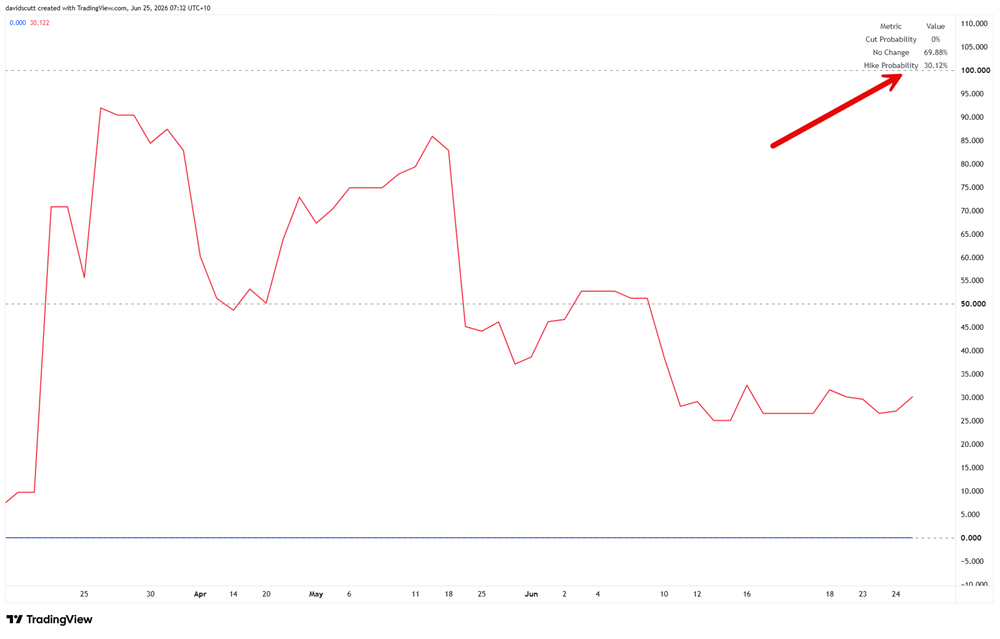
Earlier this month, markets were flirting with around a 50% probability of another rate hike in August, while at one point in May the odds were sitting north of 85%.
That dovish recalibration has been substantial, but it hasn't completely snuffed out the risk of another move. Markets still assign around a 30% probability of a 25 basis point hike next month, meaning today's labour force report could trigger a substantial repricing and significant volatility across Australian markets.
That dovish recalibration has also been reflected in Australian short-end rate futures.
Futures back RBA doves
Source: TradingView
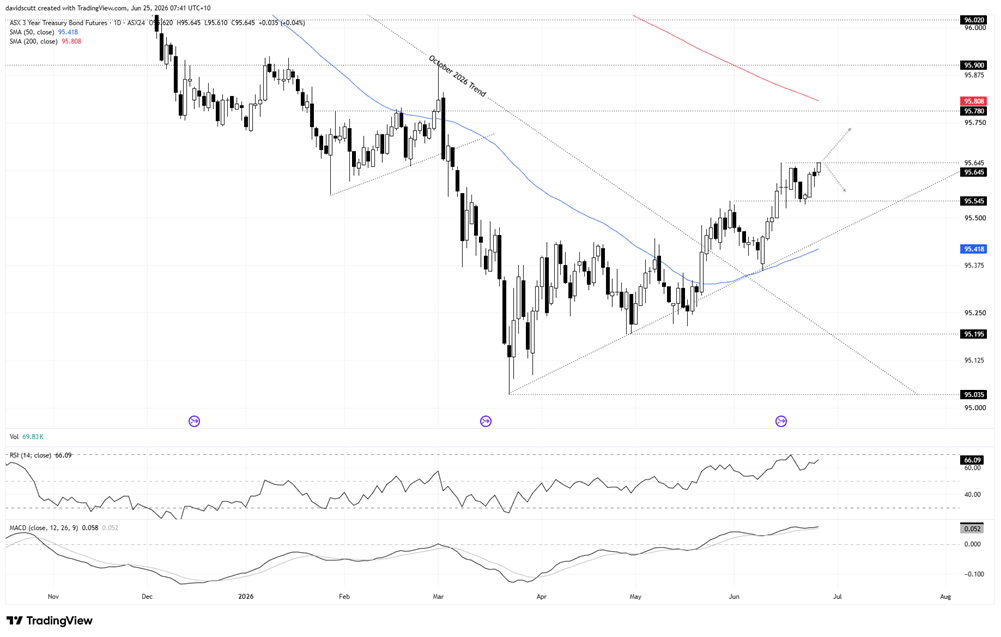
The technical picture in three-year futures remains constructive for those who think the RBA's tightening cycle is done. An uptrend has clearly formed from the lows hit in March with a series of higher lows seen, while the downtrend from the October 2025 highs, which was essentially when the RBA called time on its prior easing cycle, has been broken. After finding support at the 50-day moving average, the price is now knocking on the door of the high set earlier this month.
At current levels, the implied yield sits at around 4.35%, effectively in line with where the RBA cash rate today. With momentum indicators continuing to favour buying dips and bullish breakouts, the path of least resistance remains higher.
On the downside, 95.545 is the first support level of note before the uptrend from the March lows comes into play. Overhead, a break of 95.645 would put 95.78 on the radar for bulls.
Don't get distracted by PCE
The other data event that will receive plenty of attention today comes from the United States with the release of the May PCE report, including the core deflator which, for now, remains the Fed's preferred inflation measure. While it may sound like a big deal, it rarely generates market volatility unless we see an outcome that deviates materially from expectations, which recent history suggests is unlikely.
Instead, the income and spending components may prove more interesting. Consumer spending has continued to outpace income growth recently, pushing the savings rate lower. That's not a trend that can continue indefinitely, making those figures potentially more important than the inflation data itself when assessing the outlook for the US consumer.
Risk appetite still calls the shots
Source: TradingView
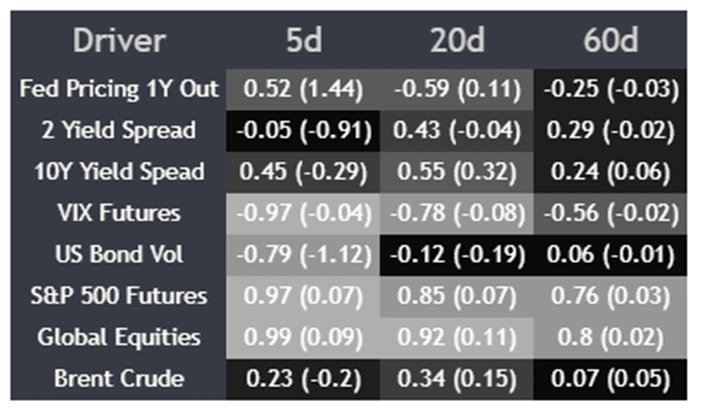
While the risk of a substantial move following today's Australian data is clearly there, beyond the near-term reaction, the correlation matrix above suggests global risk appetite is likely to remain the dominant driver for the Aussie dollar over longer timeframes.
Five-day correlations with equity futures are sitting around 0.97-0.99, indicating the Aussie has been trading almost tick-for-tick with moves in broader risk assets, while similarly strong negative correlations with bond and equity volatility suggest it continues to struggle whenever market uncertainty rises.
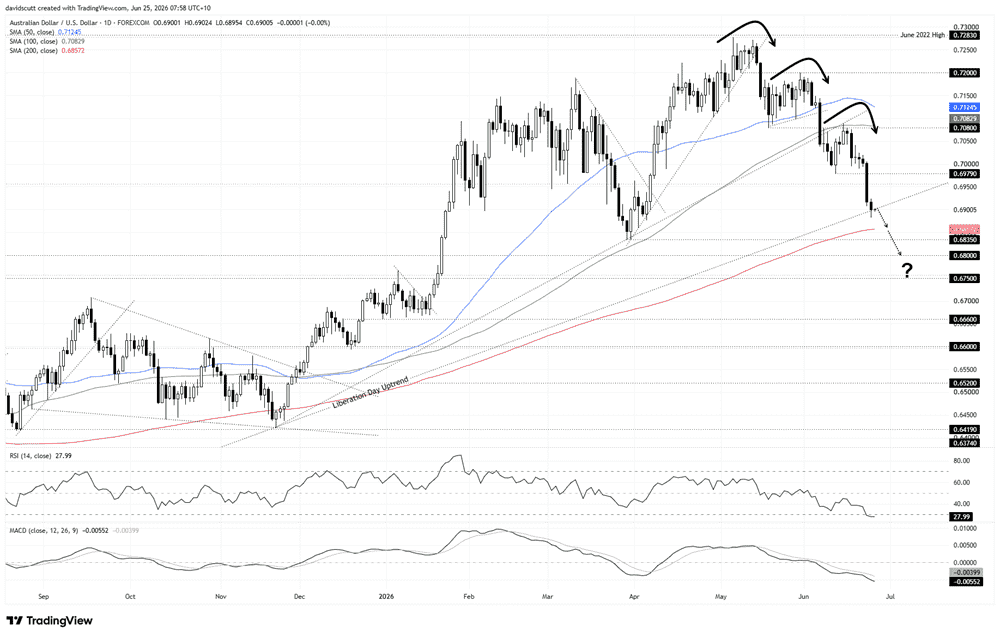
Aussie clings to Liberation Day uptrend
Source: TradingView
The price action in AUD/USD has been brutal over the past couple of days, but it's not the domestic rates story that's been driving the move. Instead, it reflects a deterioration in global risk appetite, as seen by large declines across equities, cryptocurrencies and gold. US real yields have also pushed into territory that has historically created wobbles in risk appetite, and the Aussie has been no exception to the rule on this occasion.
After support at 0.6979 gave way, selling accelerated on Wednesday, leaving AUD/USD clinging to the uptrend running from the lows hit during the Liberation Day risk-off episode in early April 2025. Whether the trend line holds may go a long way to determining the next directional move.
The message from the momentum indicators is clear. RSI (14) continues to post lower highs, indicating downside momentum continues to build, although it has now shifted marginally into oversold territory. MACD has already crossed below the signal line, turned negative and continues to diverge away from it. Taken together, the oscillators and price action continue to favour selling into strength and downside breaks.
Should the Liberation Day uptrend give way, the immediate focal point on the downside is the 200-day moving average at 0.6857. A decisive break beneath that level would raise serious questions about whether a broader bearish trend is now underway. Below there, the late-March swing low of .6835 and 68-cent level are the next levels to watch.
Should the uptrend hold, attention will swing back to former support at 0.6979 before the psychologically important 70-cent level comes into view.







Web Trader platform
Our sophisticated web-based platform is packed with features.
Open an account today
Experience award-winning platforms with fast and secure execution.
Economic calendar
Related articles

Euro Short-term Outlook: EUR/USD Pullback Nears Pivotal Uptrend Support 8 28 2026
Warsh's comments accelerated the EUR/USD selloff, raising the stakes as buyers look to stabilize the broader recovery.


EUR/USD forecast: All eyes on Warsh at Jackson Hole - Forex Friday
For much of this week, the EUR/USD has been edging lower with the US dollar regaining some ground after last week’s sell-off that was triggered, in part, by the bond market worries. Investors have been unwilling to bet further against the US dollar so far this week ahead of Kevin Warsh’s keynote speech at the Jackson Hole summit, due later today.


AUD/CAD breakout puts the Bradman barrier in sight
A bullish breakout has pushed AUD/CAD to its highest level since early 2021. Whether it can clear 0.9994 may determine if the move extends well above parity.