


Crude oil outlook: WTI remains delicately balanced
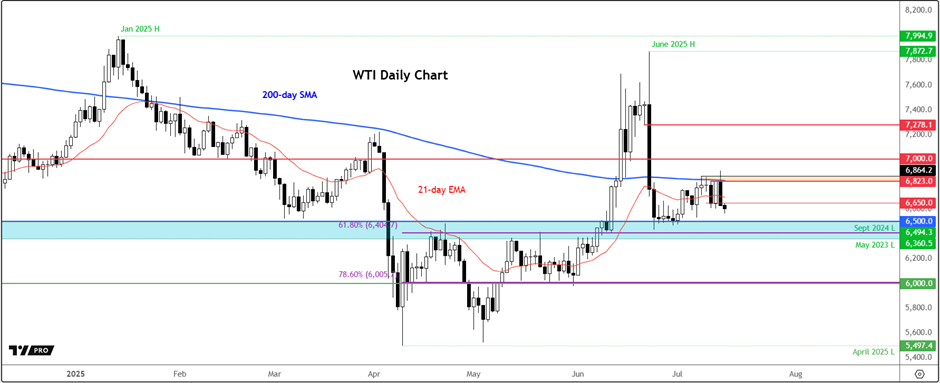
Oil prices remain on the backfoot. After initially spiking higher, crude oil turned and closed lower on Monday, as traders reacted to threats of 'very severe' tariffs against Russia. WTI was still holding above the $65 barrel, so it wasn’t all doom and gloom. Still, the crude oil outlook is far from bullish, but we continue to expect more side-ways chop in the coming weeks.
Written by
Fawad Razaqzada
Market Analyst
Oil prices remain on the backfoot. After initially spiking higher, crude oil turned and closed lower on Monday, as traders reacted to threats of 'very severe' tariffs against Russia. WTI was still holding above the $65 barrel, so it wasn’t all doom and gloom. Still, the crude oil outlook is far from bullish, but we continue to expect more side-ways chop in the coming weeks.
Trump’s tariff threats on Russia shrugged off - here’s why
Donald Trump said he was "very, very unhappy" with Russia and has announced plans to deliver "top-of-the-line" weapons to Ukraine, adding he will introduce "very severe" secondary tariffs of 100% if no ceasefire deal is reached within 50 days.
Traders worried that Trump would target countries buying Russian oil, including India and China. But while it would seem that secondary sanctions on countries buying Russian oil would tighten the market, the fact that oil prices fell suggests investors are relieved that Trump has allowed sufficiently enough time for Putin to agree to a ceasefire. They are also getting used to Trump threating tariffs, only to change his mind in the last minute and extend deadlines. In other words, the market hasn’t taken Trump’s threats seriously. Either that, or investors are hopeful that Trump will manage to bring Putin and Zelensky to the table and make a ceasefire agreement.
Investors are also still digesting the OPEC’s decision to increase supplies more than expected, so it is not all about Russia when it comes to the volatility in the crude oil price.
What factors have supported the crude oil outlook?
Following the sudden de-escalation in the conflict between Israel and Iran a few weeks ago, we saw oil prices collapse in initial response, as you would expect. Then, prices started to bounce back and while they have sold off a bit, WTI was still holding above $65 at the time of writing, while Brent was above $68 per barrel.
So, what’s behind the recent support in oil prices? Well, the answer lies in a cocktail of easing concerns and seasonal demand dynamics. Initially, markets were rattled by fears that trade tensions would derail global growth and, by extension, energy demand. But such fears have since subsided rather noticeably, as evidenced by a buoyant equities market—benchmark indices have surged from their April troughs to post fresh record highs.
Inflation, which was expected to surge due to higher tariffs, has remained subdued – as we found out with today’s core CPI reading out of the US. Most central banks, for their part, have been cutting interest rates cautiously, adding a layer of support. Meanwhile, Washington has pushed through a hefty budget and tax package, which—while likely to swell the national debt—should give near-term economic growth a nudge.
On the demand side, we’re entering the US peak driving season, where gasoline consumption tends to spike. So, the crude oil outlook is not entirely bearish, but the upside should be limited as well.
But what about the OPEC+ production story?
The group has announced a production hike of 548,000 barrels per day for August—an increase on the 411,000-bpd rises seen over the previous three months. This move effectively brings back nearly half of the 2.2 million-bpd voluntary cuts agreed earlier this year by eight OPEC members. More is expected in September, with Goldman Sachs projecting an additional 550,000 bpd to come online.
Now, the strategic question: was this prudent? OPEC+ is clearly aiming to maintain market share, especially as US output growth has stalled. The Energy Information Administration now expects US oil production to average 13.37 million barrels per day this year, a downward revision from the previous forecast of 13.42 million. The culprit? Softening oil prices have dented drilling activity.
All of which raises an intriguing possibility: OPEC+ may well be seizing the moment—capitalising on a window where US shale is not in full “drill-baby-drill” mode. One could argue this is as good a time as any for the group to flex its muscles and restore some barrels to the market. But by pumping more oil, this is going to weigh on the crude oil outlook as demand post peak driving season is likely to ease back.
-- Written by Fawad Razaqzada, Market Analyst
Follow Fawad on Twitter @Trader_F_R
How to trade with City Index
You can trade with City Index by following these four easy steps:
- Open an account, or log in if you’re already a customer
• Open an account in the UK
• Open an account in Australia
• Open an account in Singapore
- Search for the company you want to trade in our award-winning platform
- Choose your position and size, and your stop and limit levels
- Place the trade
Related tags:





Web Trader platform
Our sophisticated web-based platform is packed with features.
Open an account today
Experience award-winning platforms with fast and secure execution.
Economic calendar
Related articles

Nasdaq 100 Forecast: NDX slips ahead of Fed Chair Warsh’s speech
U.S. stocks are edging lower on Friday, giving back some of yesterday's gains after Nvidia's strong outlook revived the tech trade. The focus has now shifted firmly to Fed Chair Kevin Warsh's Jackson Hole speech, with investors looking for more clarity on the outlook for interest rates.


S&P 500 Forecast: SPX after Nvidia revives confidence in the AI trade
U.S. stocks are heading higher on Thursday, with technology leading the move after Nvidia's stronger-than-expected outlook revived confidence in the AI trade.

Oil, EUR/USD Forecast: Two trades to watch 2608
Oil falls further on diplomatic hopes for a Middle East resolution. EUR/USD consolidates ahead of U.S. inflation and Jackson Hole.