


EUR/USD, EUR/AUD Forecast: Have Markets Already Done the ECB's Job?
Markets expect the ECB to validate the recent significant hawkish repricing. Updated forecasts and Lagarde's tone may tell a different tale.
Written by
David Scutt
Market Analyst
- Markets focus on ECB forecasts
- Swaps price three hikes by March 2027
- Dovish surprise remains possible
- Risk appetite dominates EUR/AUD
Markets have aggressively repriced the ECB outlook in recent weeks, leaving little doubt over the outcome of today's policy decision. The bigger question is whether the updated forecasts and Christine Lagarde's messaging validate the hawkish shift or open the door to a dovish surprise, with potentially very different implications for EUR/USD and EUR/AUD.
Beyond the Fully Priced Hike
A hike is fully priced for today's ECB meeting, meaning the updated staff forecasts and how Christine Lagarde frames the outlook in her statement and press conference may matter far more for markets.
The projections will offer fresh insight into how the ECB views the balance between inflation and growth risks following the recent energy shock, and whether policymakers believe the path back to target has become any more difficult.
Why a Dovish Twist Is Possible
Back in March, the ECB's baseline forecasts suggested headline inflation would average 2.6% this year before slowing to 2.0% in 2027, effectively returning to target. Growth was expected to remain subdued at 0.9% in 2026 before improving to 1.3% the following year.
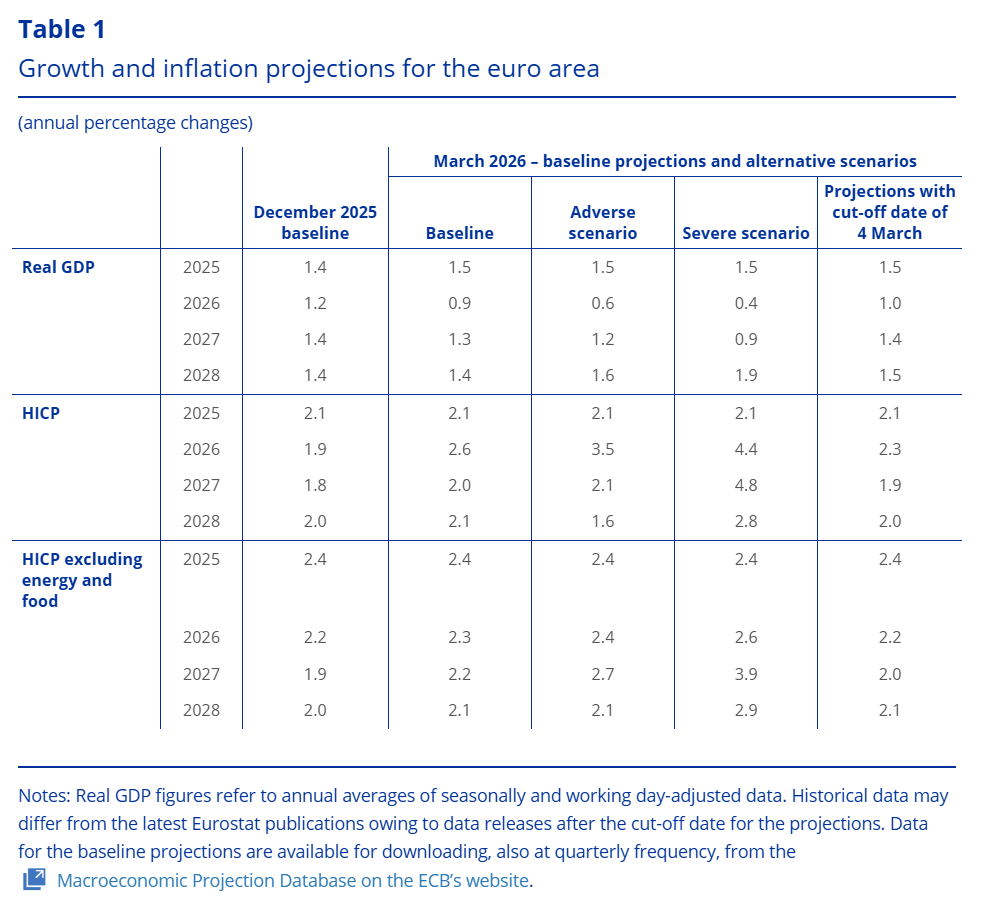
Source: ECB
Importantly, those forecasts were generated with only around one hike priced into the EUR curve by the end of 2027. Today, the backdrop looks very different.
Traders have done a lot of the ECB's job for them by premeditating higher rates, pricing over three hikes by early next year, as shown in implied probabilities derived from swaps markets.
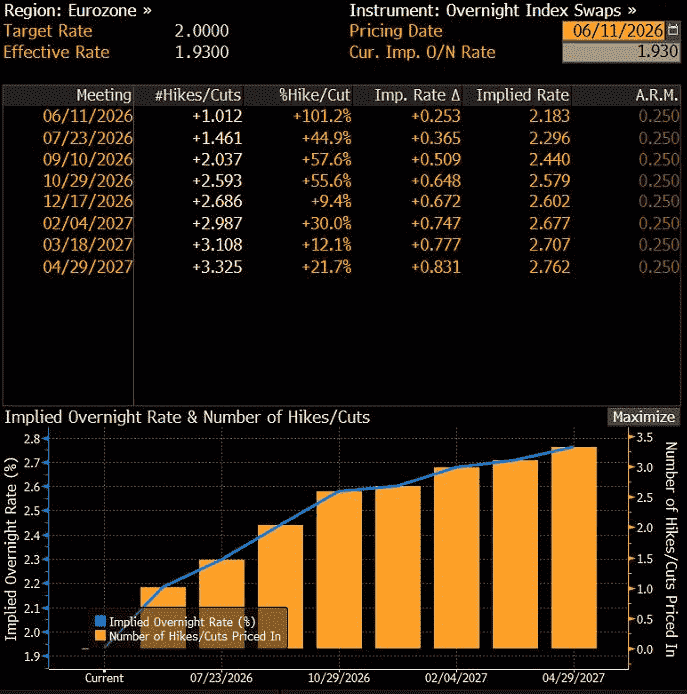
Source: Bloomberg
That may leave the ECB updated forecasts flagging upside risks to unemployment and downside risks to growth relative to March, while pointing to a steeper unwind in inflationary pressures over the medium to longer term. If that's the message, a meeting many expect to validate the hawkish repricing could instead deliver a dovish surprise.
Rates, Risk and Oil
If the ECB fails to deliver a hawkish message relative to pricing, EUR/USD downside risks may grow.
Front-end rate differentials have only recently re-emerged as an important driver. Over the past five sessions, EUR/USD has printed correlations of -0.94 with Fed pricing one year out and -0.95 against the two-year US-German yield spread, suggesting it's the US side of the equation doing most of the heavy lifting.
However, the pair’s more enduring relationship has been with risk appetite, with the pair maintaining 20-day correlations of 0.72 with S&P 500 futures and -0.54 with VIX futures. Brent crude has also been a factor at times, posting a 0.48 correlation over the past week, reflecting Europe's vulnerability to imported energy shocks.
That leaves EUR/USD tethered not only to the ECB's updated forecasts and Lagarde's tone, but also broader risk appetite, adding another layer of complexity at a time when headline risk from the Gulf remains elevated.
EUR/USD Technicals
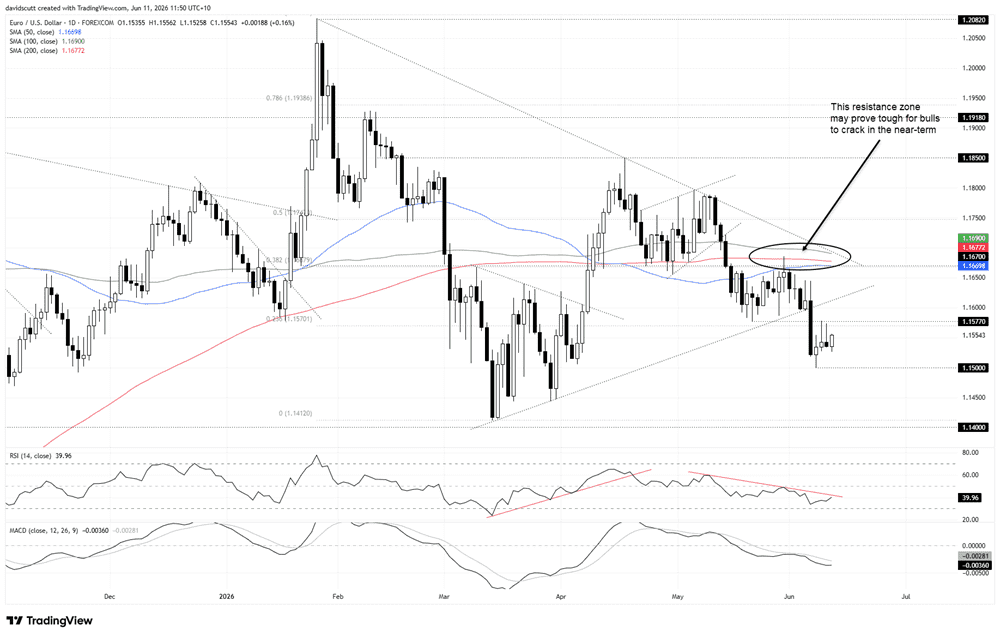
Source: TradingView
Already trading heavily beneath a major resistance zone comprising the 50, 100 and 200-day moving averages and the 38.2% Fibonacci retracement of the January-March decline, the technical picture for EUR/USD has deteriorated further over the past week.
Following the US payrolls report last Friday, the pair staged a bearish breakout from the symmetrical triangle pattern it had been coiling within for several months, slicing through the May low of 1.1577 before eventually tagging 1.1500.
Those are now the two levels to watch either side of where the pair currently trades. A break beneath 1.1500 would see bears eye a retest of the March swing low at 1.1412, with further support found at 1.1400. In between, 1.1450 warrants attention, coinciding with an area where the price bounced repeatedly in March.
Overhead, a break back above 1.1577 would bring former triangle support just above 1.1600 into focus, with the major resistance zone located not far above at 1.1668.
With RSI (14) and MACD delivering complementary messages suggesting downside momentum continues to build, playing the pair from the short side is preferred near term.
Why EUR/AUD Is Different
While the ECB decision may matter immediately for EUR/AUD, broader risk appetite remains the key factor to watch for anyone trading the pair, demonstrating a far stronger relationship than energy prices or rate differentials recently.
Bullish risk sentiment has tended to favour the Aussie over the euro, and vice versa when sentiment has soured. So while today's ECB meeting may generate an initial reaction, unless it triggers a broader change in market mood, which is unlikely, EUR/AUD could quickly find itself handing the baton back to risk appetite.
EUR/AUD Technicals
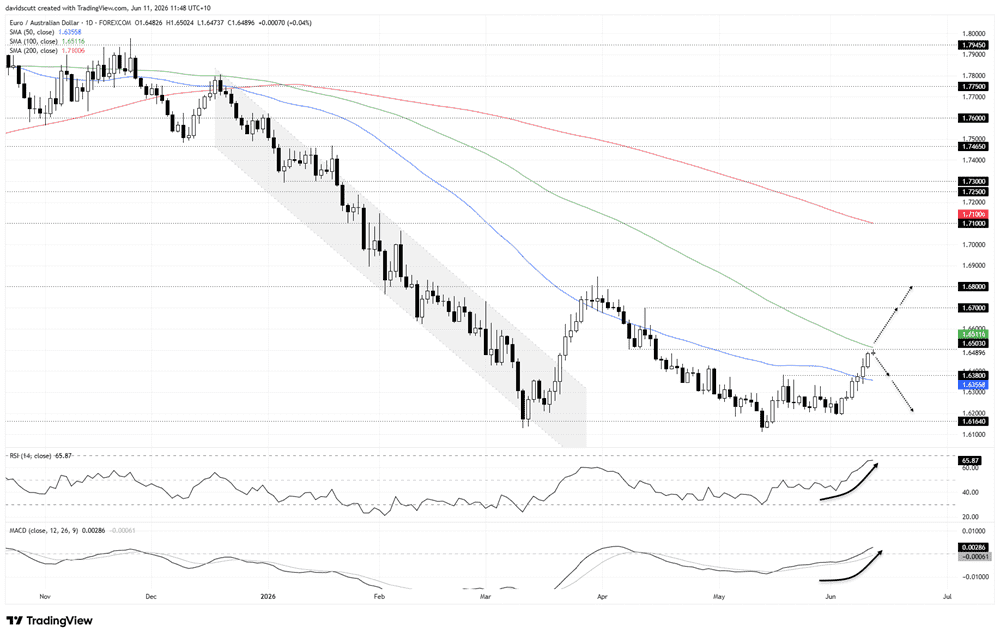
Source: TradingView
Unlike the skittish price movements on the EUR/USD chart, fitting with the headline volatility emanating from the Gulf that's influenced direct pairs, the thing that stands out on the EUR/AUD chart is just how well-behaved the price action has been.
After a period of Aussie outperformance initially sparked by the RBA's tightening cycle before energy took over, twin failures beneath 1.6164 support have seen the pair turn higher over the past fortnight. In the process, it has broken the sequence of lower highs after clearing 1.6380 resistance, eventually pushing back to 1.6503, a former support level from April. Immediately overhead sits the 100-day moving average, a level the pair has often respected over the past year.
As such, we now have a well-defined range to assess EUR/AUD setups.
Given the bullish message from RSI (14), which is trending higher above 50, complemented by MACD having flipped positive after crossing above its signal line, longs are favoured in the near term. Should the price break and hold above the 100-day moving average, 1.6700 and 1.6800 screen as initial upside targets. A stop beneath 1.6500 would provide protection.
However, should risk appetite rebound with 1.6503 and 100-day moving average resistance holding firm, shorts could be considered with a tight stop above, targeting 1.6380 initially. The 50-day moving average and 1.6164 are other levels to watch should the prior bearish trend reassert itself.







Web Trader platform
Our sophisticated web-based platform is packed with features.
Open an account today
Experience award-winning platforms with fast and secure execution.
Economic calendar
Related articles

Canadian Dollar Forecast: USD/CAD Weekly Reversal Puts Yearly Uptrend Back in Focus 8 29 2026
USD/CAD has staged its strongest weekly advance since June, shifting the focus to whether a more durable low is finally taking shape.


USD/JPY weekly outlook: Payrolls may challenge the Fed’s hawkish reset
USD/JPY has finally woken from its slumber. Payrolls now loom as the key test of whether the latest hawkish repricing sticks or sinks.

Euro Short-term Outlook: EUR/USD Pullback Nears Pivotal Uptrend Support 8 28 2026
Warsh's comments accelerated the EUR/USD selloff, raising the stakes as buyers look to stabilize the broader recovery.