


EUR/USD forecast: Limited FX impact from crude collapse so far
The dollar has largely ignored the sharp decline in oil prices, suggesting the FX markets had already largely discounted the deal. After opening lower, the greenback spent most of yesterday’s session recovering, eventually returning to levels seen before the weekend. The lack of a more meaningful move in FX suggests that investors remain focused on the underlying support coming from US economic data and Federal Reserve expectations rather than just developments in the energy market.
Written by
Fawad Razaqzada
Market Analyst
The dollar has largely ignored the sharp decline in oil prices, suggesting the FX markets had already largely discounted the deal. After opening lower, the greenback spent most of yesterday’s session recovering, eventually returning to levels seen before the weekend. The lack of a more meaningful move in FX suggests that investors remain focused on the underlying support coming from US economic data and Federal Reserve expectations rather than just developments in the energy market. Still, my near-term EUR/USD forecast is no longer bearish, so long as there are no further disruptions to oil supply from the Strait of Hormuz. In fact, my base case is that in the coming weeks, the pair could be heading back towards 1.18 area.
Crude oil extends drop, boosting EUR/USD forecast
With expectations of Iranian oil coming back online, with prior disruptions having been partially offset by historic releases of oil reserves and increased output elsewhere (e.g., Venezuela), markets are betting on a quick return to normalcy in the oil markets. Accordingly, oil prices were down another 2-3% at the time of writing, extending the drop for the fourth consecutive day.
Further falls in oil should be good news for the euro and other currencies where the economy relies on energy imports, all else being equal. Thus, if crude continues to retreat, currencies such as the euro and sterling could find support after recent weakness. The EUR/USD has already shown signs of stabilisation as traders position themselves ahead of this week’s key central bank meetings and wonder what lower oil prices mean for the Eurozone economy.
Central banks in focus
Meanwhile, among the major events on the calendar, Wednesday’s Federal Reserve decision is increasingly shaping up as the most important catalyst for foreign exchange markets. We have already heard from two central banks overnight. The Bank of Japan delivered a widely anticipated rate increase, although the move has so far failed to lift the yen, while the Reserve Bank’s attempt to maintain a hawkish tone failed to convince investors.
The FX market’s response since the announcement of the US-Iran agreement has been a little surprising, suggesting that the dollar enjoys firmer foundations than it did when the war first started. Despite a substantial fall in oil prices, most of the greenback’s initial losses were reversed, underlining a shift in market priorities away from crude and back towards monetary policy.
That said, some softness in the dollar has since emerged during the first half of today’s London session, hinting that lower energy prices may still be filtering through to currency markets with a delay. Nevertheless, the broader narrative remains centred on central bank policy and economic data rather than just geopolitical risk and commodity prices, which dominated trading during the early stages of the Middle East conflict.
This places the FOMC meeting firmly at the centre of attention. For the dollar to extend its recent resilience, policymakers may need to reinforce the view that additional tightening remains on the table. Markets appear to be demanding stronger signals before rewarding hawkish rhetoric. Unless the Fed is hawkish, I am now expecting the greenback to take a tumble and that could benefit currencies that were previously hurt by oil’s upsurge.
EUR/USD could be heading to +1.1700
For the euro, attention today will also remain on developments surrounding the US-Iran Memorandum of Understanding ahead of its expected signing later this week. President Trump has expressed confidence that shipping through the Strait of Hormuz could normalise quickly, although logistical challenges, including de-mining operations, may delay the process. But oil investors remain optimistic, as currently implied by lower oil prices.
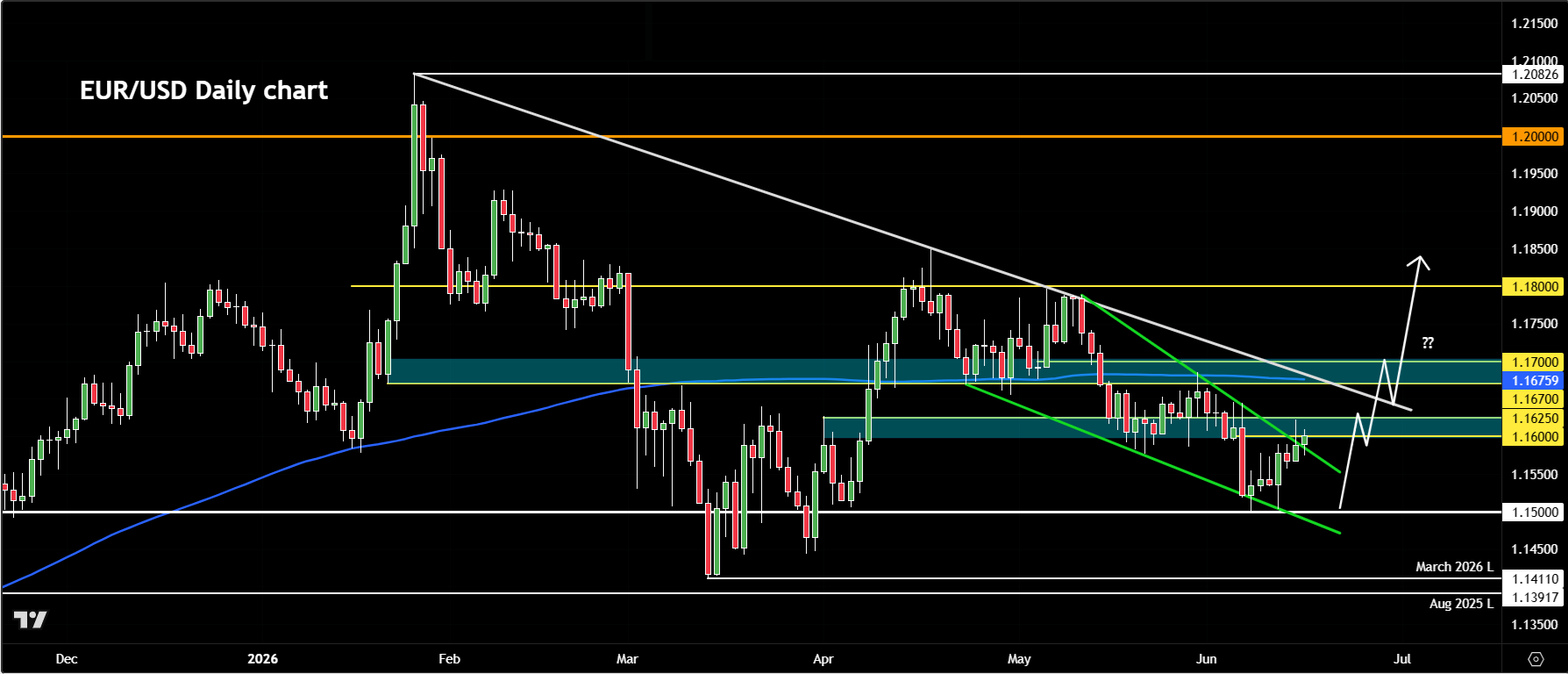
The EUR/USD fell back to levels seen before the weekend, before bouncing back again. The recent energy spike is likely to have dampened growth in the Eurozone, which may be revealed in upcoming data releases. This helps explain why investors remain reluctant to establish aggressive bullish euro positions just yet.
In my view, however, the downside risks for EUR/USD forecast have shrunk significantly, albeit not disappeared entirely. Any renewed concerns regarding the implementation of the US-Iran agreement or delays to the reopening of Hormuz shipping routes could hold back the single currency. But it will take a lot of effort to push the EUR/USD back below the 1.1500 level.
I think the path of least resistance is now to the upside again and accordingly, I expect rates to break above the 1.1600-1.1625 resistance area ahead of the Fed meeting. This would constitute a bullish technical development as rates will have climbed out of the falling wedge pattern. Still, there are more potential resistance levels ahead, including around the 1.1670-1.1700 zone where a bearish trend line and the 200-day average meet with prior support and resistance area. Bullish if we go above that zone.
-- Written by Fawad Razaqzada, Market Analyst
Follow Fawad on Twitter @Trader_F_R
Related tags:







Web Trader platform
Our sophisticated web-based platform is packed with features.
Open an account today
Experience award-winning platforms with fast and secure execution.
Economic calendar
Related articles

Canadian Dollar Forecast: USD/CAD Weekly Reversal Puts Yearly Uptrend Back in Focus 8 29 2026
USD/CAD has staged its strongest weekly advance since June, shifting the focus to whether a more durable low is finally taking shape.


USD/JPY weekly outlook: Payrolls may challenge the Fed’s hawkish reset
USD/JPY has finally woken from its slumber. Payrolls now loom as the key test of whether the latest hawkish repricing sticks or sinks.


Euro Short-term Outlook: EUR/USD Pullback Nears Pivotal Uptrend Support 8 28 2026
Warsh's comments accelerated the EUR/USD selloff, raising the stakes as buyers look to stabilize the broader recovery.