


EUR/USD Outlook: Hormuz tensions tilt risks back to the downside
Markets are back to playing headline hockey as the US resumes strikes on Iran. That may not trigger an immediate plunge in EUR/USD, but it does leave the balance of risks skewed to the downside.
Written by
David Scutt
Market Analyst
- Fresh US strikes reignite Hormuz disruption fears
- Europe's energy vulnerability back in focus
- Euro and European cyclicals resume underperforming
- Bearish wedge points to renewed downside risk
Back to pricing energy risk
The US has resumed strikes on Iran after attacks on commercial shipping transiting the Strait of Hormuz, raising the prospect that markets may once again have to price the risk of prolonged disruption to one of the world's most important energy chokepoints.
As Donald Trump declares the memorandum of understanding signed only weeks ago between the US and Iran "over", so too may be the brief respite for the euro, reviving simmering fears over energy security.
While it's too early to know whether the Strait will face prolonged disruption, the prospect alone is enough to remind investors that the region remains far more exposed to Middle Eastern energy shocks than the United States.
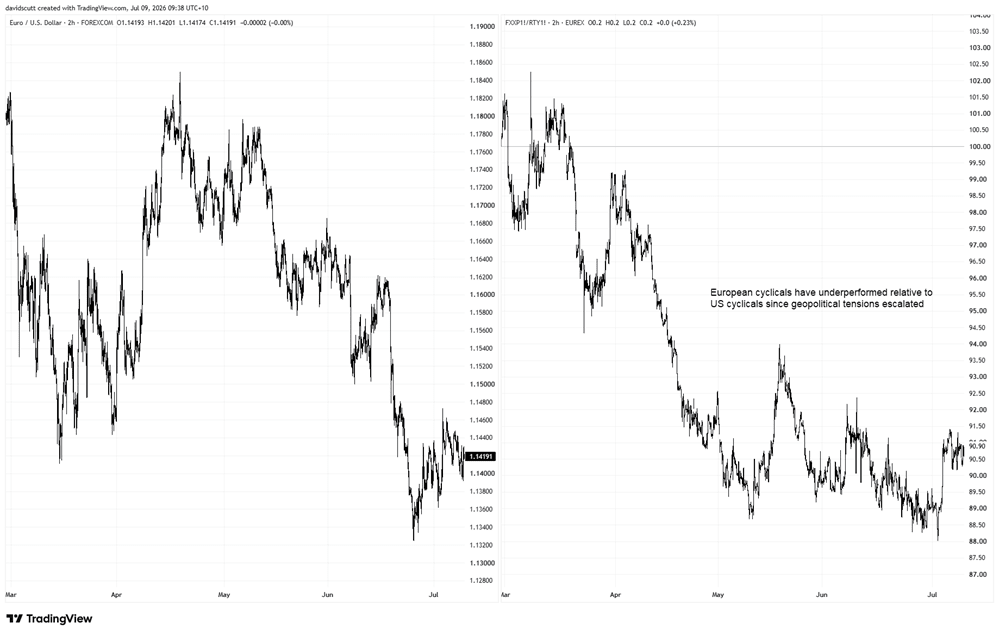
Even if higher energy prices increase the odds of another ECB rate hike later this month, the potential hit to growth may prove the more important driver, tilting the balance of risks for the euro and European assets to the downside, as shown in the chart below.
Europe left behind
Source: TradingView
The left-hand panel tracks EUR/USD since the Friday before the initial US strikes on Iran in late February. Alongside it is the performance of Euro Stoxx 600 futures relative to Russell 2000 futures over the same period. The latter were chosen because both are broader, more cyclical equity benchmarks, avoiding the outsized influence that mega-cap tch companies exert on US indices such as the S&P 500 and Nasdaq.
Since the conflict began, the euro has weakened while European equities have generally underperformed comparable US peers. To be sure, geopolitics is far from the only driver behind that divergence, but Europe's greater reliance on imported energy makes it far more vulnerable, impacting economic sentiment and capital flows.
However, while Trump's declaration that the MOU is "over" has revived geopolitical risk, traders are unlikely to price in the worst case scenario immediately. Throughout the conflict, markets have repeatedly lurched between reports of imminent de-escalation and renewed hostilities, whether from Trump himself or sources familiar with the negotiations.
The prolonged whipsawing may temper any immediate knee-jerk reaction, with trader instead likely to demand clearer evidence that the latest escalation will have a lasting impact on energy supplies and European economy. Rather than a single sharp move, EUR/USD may instead be vulnerable to a gradual grind lower, punctuated by bouts of volatility as markets once again find themselves playing headline hockey.
Technicals and fundamentals align
Source: TradingView
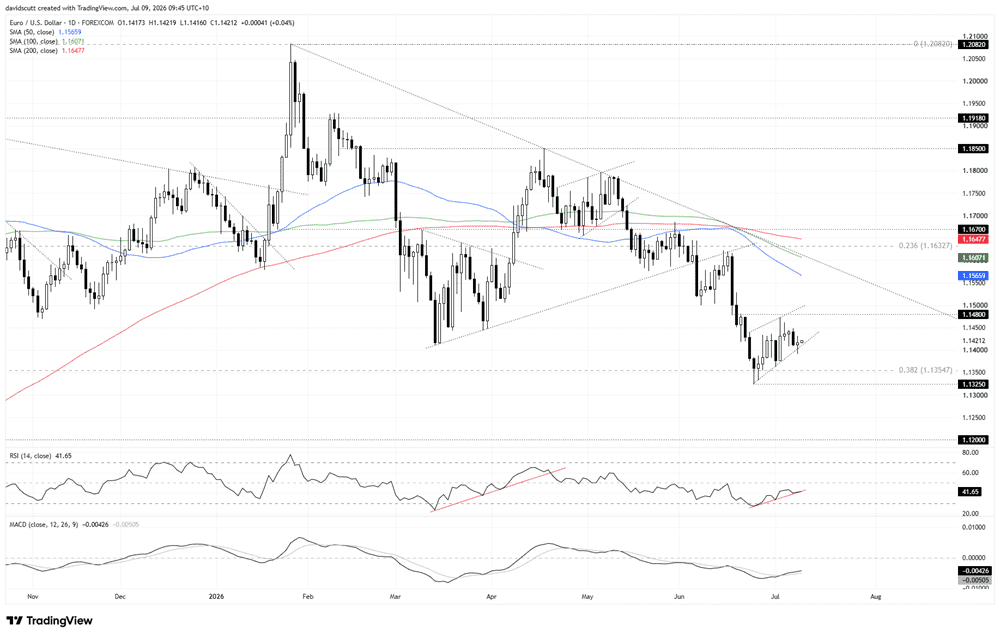
When you zoom out, the price action continues to favour the bears with EUR/USD carving out a series of lower highs and lower lows. It also remains beneath its key medium and longer-term moving averages, all of which are now starting to roll over and carry a negative slope.
And when you zoom in, the price appears to be sitting in what resembles a rising wedge, a pattern typically associated with bearish continuation. Admittedly, the structure isn't the cleanest, but a sustained break beneath wedge support would increase the risk of a retest of the lows set in June, and potentially an extension of the broader bearish trend.
If that scenario were to unfold, the first level to watch is the 38.2% Fibonacci retracement of the April 2025 advance at 1.1355, followed by the June 24 swing low at 1.1325. Should that latter level give way, there's not a lot of meaningful technical support to speak of until 1.1200, an area that repeatedly influenced price action following the Liberation Day tariff announcement in April 2025.
On the topside, the pair has repeatedly struggled above 1.1450, with another minor resistance zone sitting around 1.1480. Above there, 1.1500 and 1.1566 are the levels to watch.
The story from the oscillators is one of diminishing downside strength, not building upside momentum. RSI has lifted from oversold territory but, at around 42, remains below the midpoint and looks close to breaking the very shallow uptrend it's been sitting in over recent weeks. MACD has crossed above its signal line, but that merely suggests downside momentum has eased rather than been eradicated altogether. For now, that continues to favour selling into strength.







Web Trader platform
Our sophisticated web-based platform is packed with features.
Open an account today
Experience award-winning platforms with fast and secure execution.
Economic calendar
Related articles

USD/JPY weekly outlook: Payrolls may challenge the Fed’s hawkish reset
USD/JPY has finally woken from its slumber. Payrolls now loom as the key test of whether the latest hawkish repricing sticks or sinks.

Euro Short-term Outlook: EUR/USD Pullback Nears Pivotal Uptrend Support 8 28 2026
Warsh's comments accelerated the EUR/USD selloff, raising the stakes as buyers look to stabilize the broader recovery.


EUR/USD forecast: All eyes on Warsh at Jackson Hole - Forex Friday
For much of this week, the EUR/USD has been edging lower with the US dollar regaining some ground after last week’s sell-off that was triggered, in part, by the bond market worries. Investors have been unwilling to bet further against the US dollar so far this week ahead of Kevin Warsh’s keynote speech at the Jackson Hole summit, due later today.
