


EURUSD Forecast Dollar strength keeps euro recovery limited
The latest trading sessions have not been fully decisive for short-term euro movements. For now, EUR/USD continues to show a lack of clear direction, after gaining close to 0.4% during the previous session but posting an average decline of -0.23% in the current session.
Written by
Julian Pineda
Market Analyst
The latest trading sessions have not been fully decisive for short-term euro movements. For now, EUR/USD continues to show a lack of clear direction, after gaining close to 0.4% during the previous session but posting an average decline of -0.23% in the current session.
This behavior highlights a lack of consistent strength in the euro. So far, the European currency remains pressured by the relative strength of the U.S. dollar and by expectations surrounding the Federal Reserve. If this effect continues, a phase of indecision could remain relevant in EUR/USD movements over the next few trading sessions.

Is the dollar still applying pressure?
After the release of some inflation figures in the United States, such as CPI and PPI, the market began to price in the possibility of a less aggressive Federal Reserve. This initially affected U.S. dollar strength and allowed the euro to recover some ground at the beginning of the week.
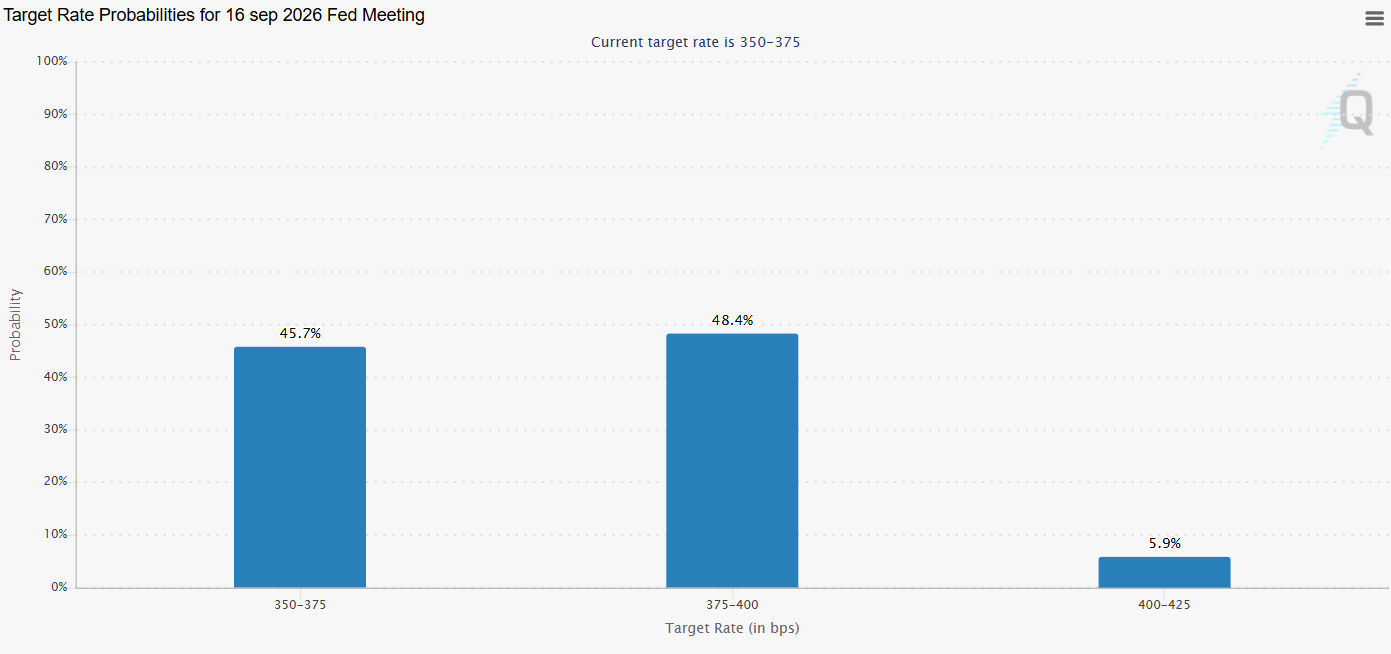
However, this dynamic has not fully held. During the current session, a new shift has been observed in the probability table for the Federal Reserve’s upcoming decisions. Now, the market assigns a probability above 48% to a possible interest rate increase at the September 16 decision, which would take the rate toward a new area near 4.00%.
At the same time, there is a slightly lower probability of 45.7% that rates will remain unchanged in September. This dynamic is relevant because it positions the Federal Reserve as one of the few central banks still maintaining an aggressive monetary policy outlook.
Source: CMEGROUP
This scenario remains important for U.S. dollar strength in the short term. The currency has not managed to consolidate clear weakness, partly because the market remains cautious about what the Federal Reserve may decide.
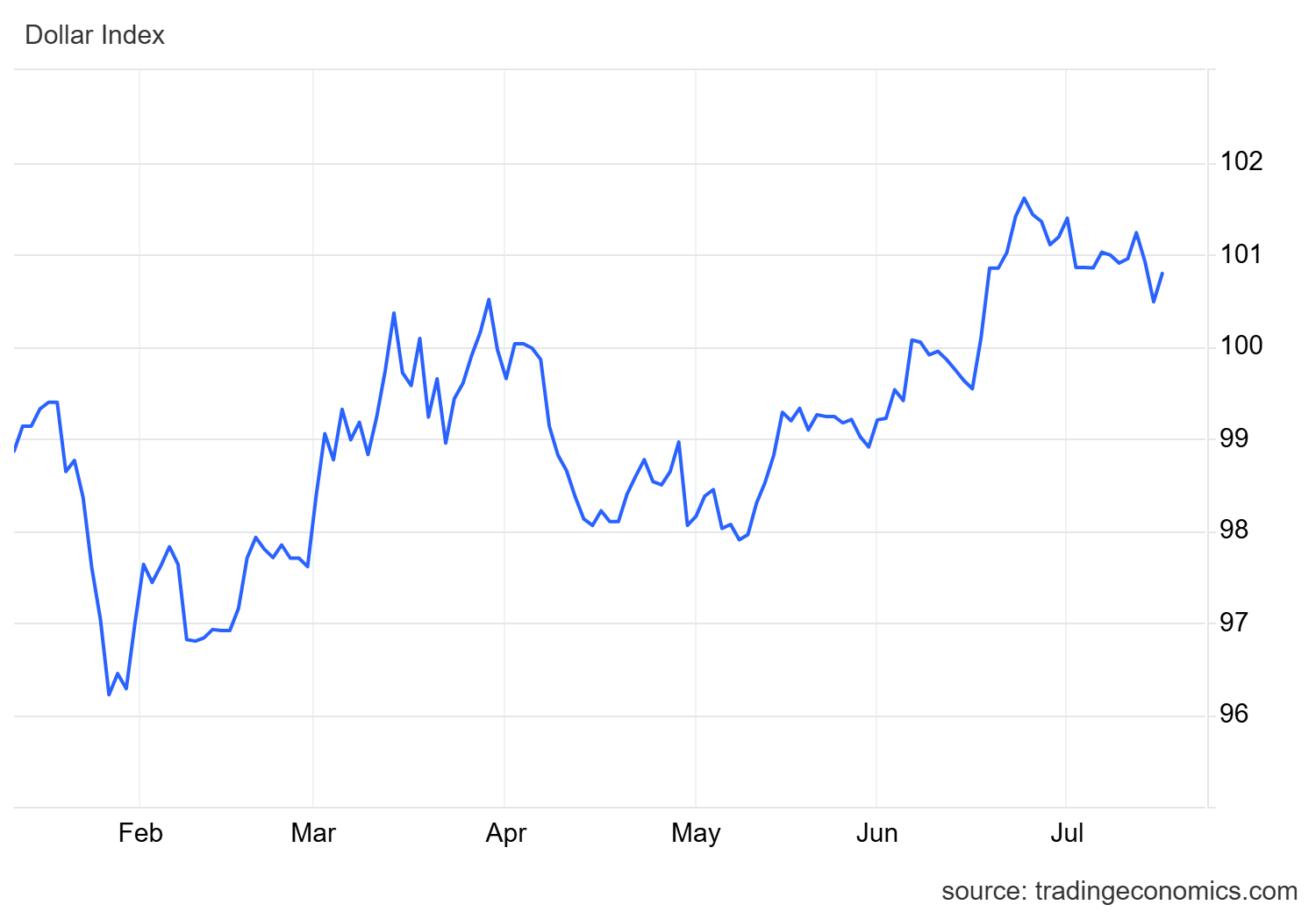
This is reflected in the behavior of the DXY index, which measures the dollar’s strength against its main peers. Despite the weakness observed at the beginning of the week, the index continues to trade above the 100-point level.
This suggests that demand for U.S. dollars remains relevant and could be limiting the euro’s ability to recover ground consistently in the short term.
Source: TradingEconomics
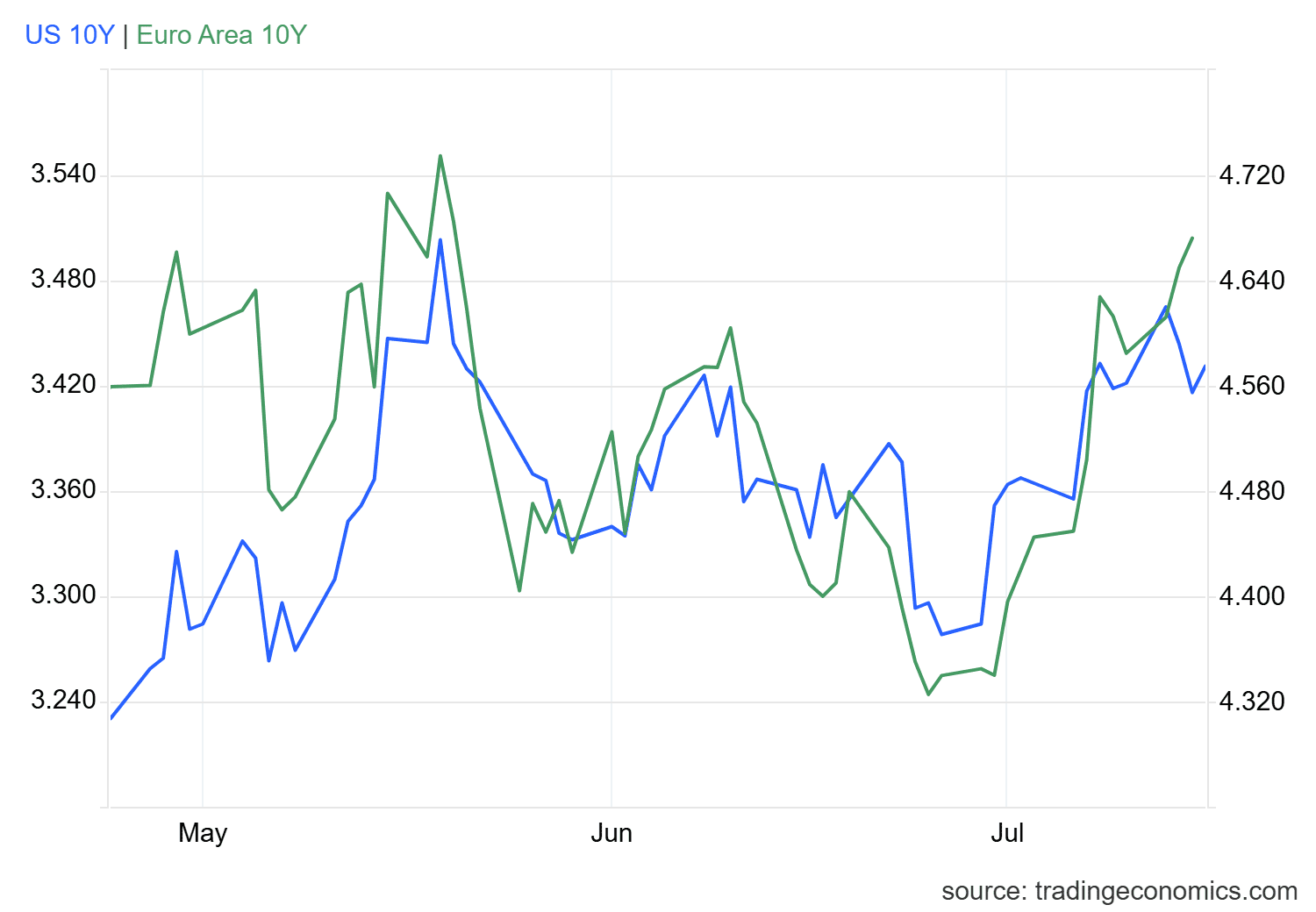
Expectations around U.S. monetary policy have also affected the bond market. For now, 10-year U.S. bonds remain more attractive than European bonds, with yields holding above the 4.5% area despite the weakness seen at the beginning of the week.
Although 10-year European bonds have managed to recover, they are still trading near 3.5%, below U.S. securities. This difference continues to favor dollar-denominated investments, as the market still does not fully price in a more accommodative stance from the Federal Reserve.
If the yield differential remains in place, the relative appeal of dollar-denominated assets could continue to be more consistent compared to euro-denominated investments.
Source: TradingEconomics
Therefore, the euro’s outlook remains complex. For now, there has been no relevant shift in Federal Reserve expectations that would suggest stronger weakness in U.S. bonds or the dollar.
This scenario could limit the euro’s recovery against the dollar in the short term and maintain a relevant phase of indecision in EUR/USD over the next few trading sessions.
Technical forecast for EUR/USD
Source: StoneX, Tradingview
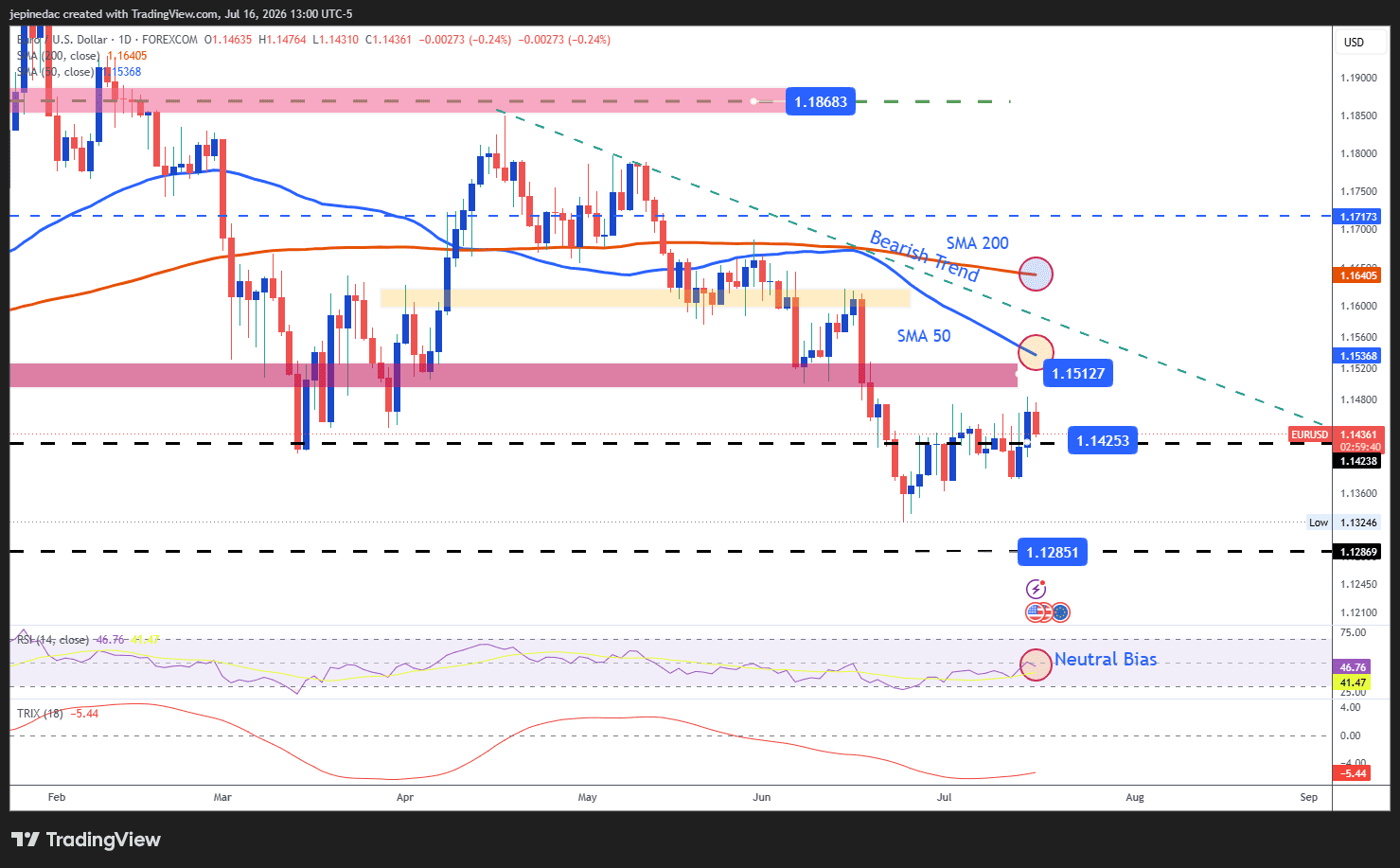
- Bearish trend still dominates: Despite EUR/USD’s recovery attempts in recent sessions, price has still not managed to clearly change the technical outlook on the daily chart. The multi-month bearish pressure remains relevant and, for now, bullish movements have not been enough to confirm a change in direction. If price fails to break above more important technical zones, the selling bias could continue to influence the pair’s movements over the next few sessions.
- RSI: Now, the RSI line remains near the neutral 50 level. This suggests that the average of buying and selling impulses over the last 14 sessions remains balanced. This reading reflects a phase of indecision that could remain relevant in the chart’s movements, where no clear market direction is currently visible.
- TRIX: In the TRIX, the indicator line remains below the 0 zone, indicating that the average strength of long-term exponential moving averages continues to show a selling bias in the broader chart outlook. However, the recent flattening of the curve suggests a slowdown in short-term selling momentum, which is also highlighting a potential phase of relevant indecision.
Key levels:
- 1.15127 – Relevant resistance: This important high level coincides with a retracement area from previous weeks and with the barrier formed by the 50-period moving average. Price movements attempting to break above this level could start to put the long bearish trend line at risk and open room for a more dominant buying bias over the coming trading weeks.
- 1.14253 – Near-term barrier: This level corresponds to the most relevant average retracement area at the moment and works as the most important short-term neutrality reference. Price movements too close to this level could continue to reinforce a phase of indecision and maintain relevant neutrality over the next few sessions.
- 1.12851 – Definitive support: This level is associated with a neutral area observed in May 2025 and now acts as the main support to watch. If price continues to move closer to this area, the selling bias would be reinforced and the possibility of an extension of the bearish trend line as the dominant chart structure over the coming weeks would increase.
Written by Julian Pineda, CFA, CMT – Market Analyst
Follow him on: @julianpineda25








Web Trader platform
Our sophisticated web-based platform is packed with features.
Open an account today
Experience award-winning platforms with fast and secure execution.
Economic calendar
Related articles

Euro Short-term Outlook: EUR/USD Pullback Nears Pivotal Uptrend Support 8 28 2026
Warsh's comments accelerated the EUR/USD selloff, raising the stakes as buyers look to stabilize the broader recovery.

EUR/USD forecast: All eyes on Warsh at Jackson Hole - Forex Friday
For much of this week, the EUR/USD has been edging lower with the US dollar regaining some ground after last week’s sell-off that was triggered, in part, by the bond market worries. Investors have been unwilling to bet further against the US dollar so far this week ahead of Kevin Warsh’s keynote speech at the Jackson Hole summit, due later today.


AUD/CAD breakout puts the Bradman barrier in sight
A bullish breakout has pushed AUD/CAD to its highest level since early 2021. Whether it can clear 0.9994 may determine if the move extends well above parity.
