


EURUSD Update Is the euro still struggling to recover strength
The euro continues to face difficult trading sessions in the short term. The European currency has been unable to stabilize a consistent recovery, and for now, a phase of indecision appears to be dominating its recent strength. This is reflected in the average movements of EUR/USD over the last 3 sessions, which have barely recorded an approximate price variation of 0.07%, showing a renewed neutral bias.
Written by
Julian Pineda
Market Analyst
The euro continues to face difficult trading sessions in the short term. The European currency has been unable to stabilize a consistent recovery, and for now, a phase of indecision appears to be dominating its recent strength.
This is reflected in the average movements of EUR/USD over the last 3 sessions, which have barely recorded an approximate price variation of 0.07%, showing a renewed neutral bias.
For now, this dynamic of indecision, or even euro weakness, could be related to the loss of appeal of the European Central Bank compared to a potentially more aggressive Federal Reserve in the short term. This scenario could remain relevant and keep neutrality as an important factor in the pair’s movements over the next few sessions.

What is the central bank dynamic?
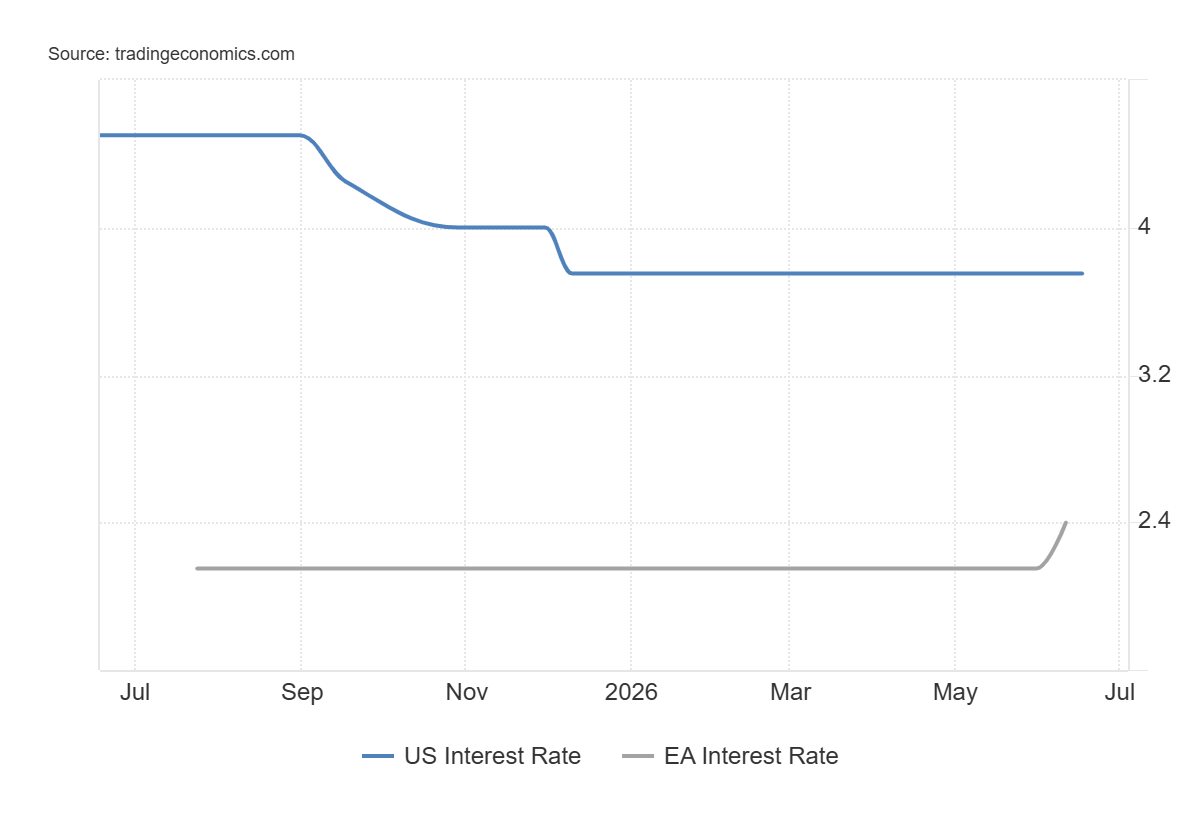
Now, the main catalyst for EUR/USD movements remains the interest rate dynamic between both central banks. In this regard, the relative advantage continues to favor the United States, as the current reference rate of 3.75% remains more attractive than the European rate, which is near 2.4%.
This has allowed the market, not only in the short term but also for several months, to perceive dollar-denominated investments as potentially more attractive than euro-denominated alternatives. To some extent, this dynamic could continue to support stronger demand for the U.S. dollar in the short term.
Source: TradingEconomics
For this relationship to remain relevant over the coming weeks, it is important to consider the potential path of both central banks over the next few months. So far, the scenario continues to point to a U.S. central bank that could remain more aggressive than its European counterpart.
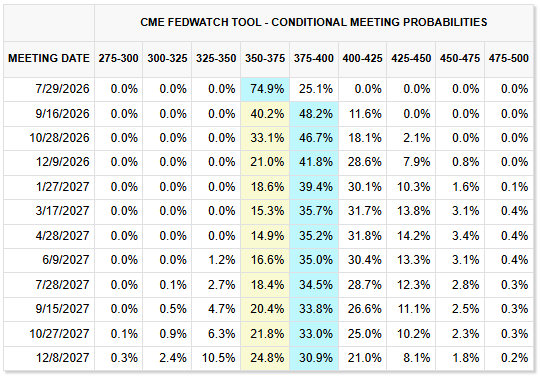
This dynamic is reflected in CME Group’s probability table for the upcoming monetary policy decisions. For the July 29 decision, there is a 74.9% probability that interest rates will remain unchanged. However, attention begins to shift toward the September 16 decision, where there is still a probability above 48% that the interest rate could be increased toward a new reference area of 4.00%.
For now, this keeps alive the view that the Federal Reserve could become more aggressive over the coming months.
Source: CMEGROUP
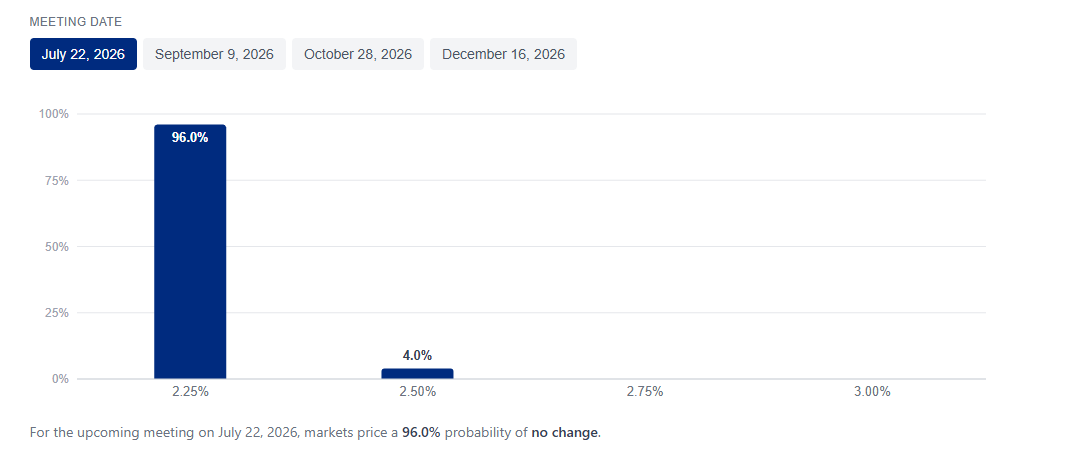
The European Central Bank appears to be somewhat removed from this dynamic in the short term. Unlike the Federal Reserve, the European central bank probability table currently shows a 96% probability that, at the July 22 decision, the current deposit rate will remain unchanged at 2.25%.
This follows the tone of the comments made during the latest central bank decision, where officials mentioned that the institution is not committing to a particular rate path and, for now, is not maintaining an aggressive stance, as it will continue to analyze inflation data consistently.
Source: ECBWATCH
With all of this in mind, the dynamic remains relevant because, on one hand, the market expects a potentially more aggressive Federal Reserve over the coming months and, on the other, a calmer European Central Bank. This suggests that the rate differential between both economies could widen even further.
This scenario could continue to favor the appeal of dollar-denominated investments and keep the euro in a difficult position when it comes to recovering ground consistently in the short term. If this outlook continues to shape the dynamic between both central banks, a phase of indecision, or even weakness, could remain present in EUR/USD movements over the coming trading weeks.
Technical outlook for EUR/USD
Source: StoneX, Tradingview
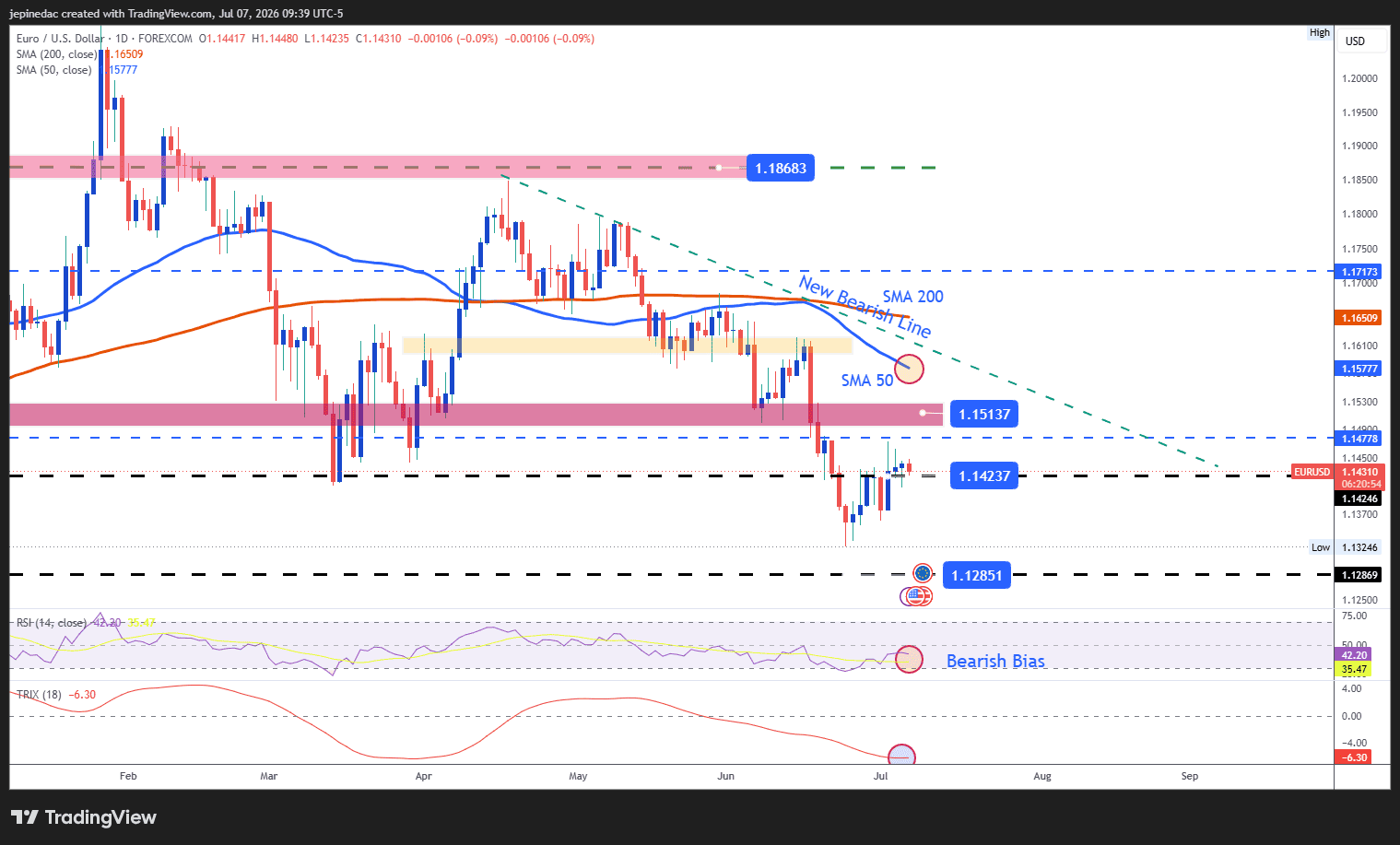
- Bullish trend line remains relevant: Over the last few months of trading, EUR/USD has maintained a relevant bearish trend line in its average movements. So far, this remains the dominant pattern on the chart, as there have been no sufficiently relevant bullish corrections that could change this dynamic in the short term. If selling pressure becomes relevant again in the market’s average movements, a possible extension of this bearish trend line could remain important over the coming trading weeks.
- RSI: Now, the average movements of the RSI indicator remain below the 50 level. This suggests that, based on the average of the last 14 trading sessions, a consistent selling impulse continues to dominate. If this behavior continues, selling pressure could remain relevant over the next few sessions.
- TRIX: A similar dynamic can be seen in the TRIX indicator, as its line maintains a bearish slope and remains below the neutral 0 level. This suggests that bearish strength remains relevant in the recent average of long-term exponential moving averages. In the broader picture, this reading continues to point to a relevant selling bias within the daily chart.
Key levels:
- 1.15137 – Relevant resistance: This level corresponds to important highs that coincide with a retracement area from previous weeks. Now, it remains the most important barrier to watch in the event of potential bullish corrections in the short term.
- 1.14237 – Near-term barrier: This level corresponds to the most relevant neutral area now. Price movements staying too close to this level could continue to highlight significant indecision and even open room for a possible short-term sideways range over the next few sessions.
- 1.12851 – Definitive support: This level is associated with a neutral area observed in May 2025 and now acts as the main support to watch. If price continues to move closer to this area, the selling bias would be reinforced and the possibility of an extension of the bearish trend line over the coming weeks would increase.
Written by Julian Pineda, CFA, CMT – Market Analyst
Follow him on: @julianpineda25







Web Trader platform
Our sophisticated web-based platform is packed with features.
Open an account today
Experience award-winning platforms with fast and secure execution.
Economic calendar
Related articles

Canadian Dollar Forecast: USD/CAD Weekly Reversal Puts Yearly Uptrend Back in Focus 8 29 2026
USD/CAD has staged its strongest weekly advance since June, shifting the focus to whether a more durable low is finally taking shape.


USD/JPY weekly outlook: Payrolls may challenge the Fed’s hawkish reset
USD/JPY has finally woken from its slumber. Payrolls now loom as the key test of whether the latest hawkish repricing sticks or sinks.


Euro Short-term Outlook: EUR/USD Pullback Nears Pivotal Uptrend Support 8 28 2026
Warsh's comments accelerated the EUR/USD selloff, raising the stakes as buyers look to stabilize the broader recovery.