

FOMC Meeting Preview: Will Warsh Kill the Rate Cut Trade For Good?
FOMC Chairman Kevin Warsh’s first Fed meeting may leave rates unchanged, but the SEP, dot plot and press conference could reshape expectations for interest rates
Written by
Matt Weller
Head of Market Research
Federal Reserve, FOMC Key Points
- Traders and economists expect the Fed to hold interest rates in the 3.50-3.75% range.
- Kevin Warsh’s answers about the central bank’s independence and communication strategy will have the longest-lasting impact on markets.
- The 99.50 level in the US Dollar Index (DXY) will be the key “line in the sand” that could determine the technical bias for the rest of the week and beyond.
When is the FOMC Meeting?
The June 2026 FOMC meeting will conclude on Wednesday, June 17 at 2:00 ET.
Fed Chairman Kevin Warsh’s press conference will begin at 2:30 ET.
What are the FOMC Interest Rate Expectations?
Traders and economists expect the Fed to hold interest rates in the 3.50-3.75% range with high confidence
As of writing, Fed Funds futures traders are pricing in 99% odds of no change to interest rates per CME FedWatch. Perhaps more importantly, traders are pricing in a ~60% probability of at least one interest rate hike by the end of the year:
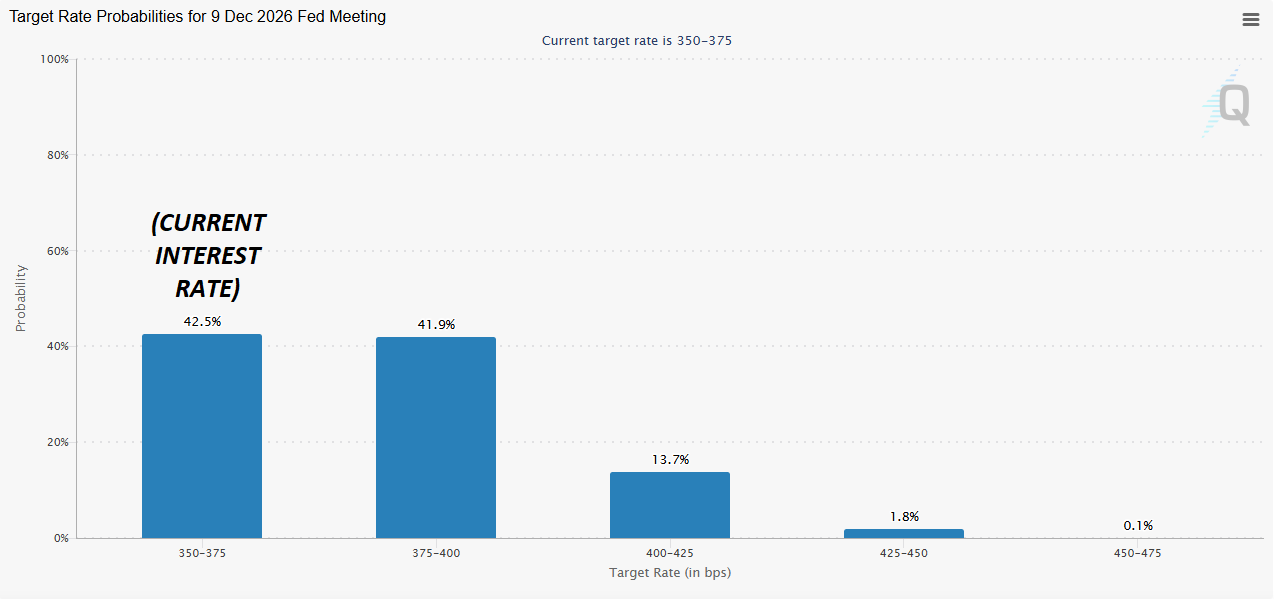
Source: CME FedWatch
FOMC Preview: The Monetary Policy Statement
Assuming the Fed leaves rates unchanged as expected, the market’s focus will immediately shift to the central bank’s Monetary Policy Statement. The last FOMC meeting brought three dissents (Kashkari, Hammack, and Logan) against maintaining the “easing bias” in the statement, and several centrist members of the board have expressed similar concerns, so a shift to a more balanced statement is a distinct possibility; watch for a removal of the “extent and timing of additional adjustments” phrasing to pave the way for a potential interest rate hike later this year.
FOMC Preview: The Summary of Economic Projections
While Warsh has hinted that he is skeptical of the value of FOMC projections, we will get the usual quarterly forecasts in this week’s meeting. As a reminder, the central bank’s most recent economic projections in March projected 2.4% GDP, a 4.4% unemployment rate, and 2.7% PCE inflation at the end of the year. Based on the data we’ve seen over the last three months, the cleanest SEP change is to revise up its inflation forecast (April PCE was running 3.8% y/y and May will likely be no lower); though the Committee may still “look through” the spike in energy prices to some degree, it would be nigh impossible to credibly leave inflation forecasts unchanged.
The growth and inflation forecasts are where this meeting gets awkward for doves: If growth/labor projections remain resilient while inflation projections rise, the SEP mechanically argues for tighter policy. On the back of strong AI capital expenditures and a solid run of jobs reports, I wouldn’t expect much, if any, deterioration to the FOMC’s GDP and unemployment projections.
Probably most importantly, the median end-2026 interest rate projection is likely to be revised higher. In March, the median 2026 funds-rate projection was 3.4%, with 2027 and 2028 at 3.1%. The March SEP also had 2026 PCE and core PCE inflation at 2.7%, already above target. Given the subsequent energy-led inflation shock and still-firm labor market, the risk is that the 2026 dot shifts from implying eventual easing toward no cuts (3.6%) or even a modest bias toward hiking interest rates.
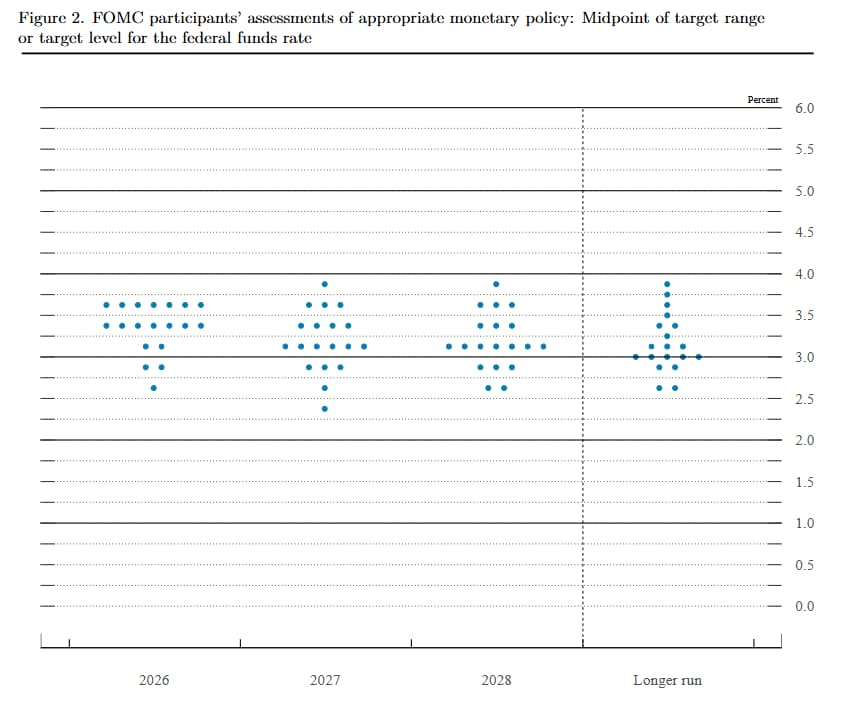
Source: Federal Reserve
FOMC Preview: Chairman Warsh’s Press Conference
Any time there is a new Chairman at the Federal Reserve, the press conference becomes the main event. This is where Kevin Warsh can change the Fed’s tone faster than he can change its framework.
The first storyline to watch is whether Warsh uses the presser to project institutional continuity or to signal a clear break from the Powell/Yellen/Bernanke communication era. In the past, Warsh has been associated with criticism of overcommunication, forward guidance, and the dot plot, with recent reporting emphasizing that he wants a Fed that “talks less and says more.” Investors should listen less for a specific promise about the July or September meeting and more for whether Warsh is trying to reprice the Fed’s entire communications regime.
In that vein, traders will be keen to see if Warsh downplays the aforementioned “dot plot” of interest rate projections. He has three possible approaches:
- Full embrace: “The SEP is a useful summary of individual participants’ views.”
That would be the most market-friendly and continuity-oriented answer. - Soft downgrade: “The dots are not a forecast, not a plan, and not a Committee commitment.”
That is likely the base case. Chairs always say this, but Warsh may say it with more force. - Hard downgrade: “We are reviewing whether this tool improves public understanding.”
That would be a genuine communication shock. It would imply the June SEP may be one of the last dot plots in its current form, or at least that the Fed may try to reduce its market importance.
From a macroeconomic perspective, the most important question is whether Warsh treats the current inflation shock as a temporary blip or a continuation of a dangerous trend. If Warsh says the recent inflation rise is mostly energy-driven and potentially temporary, markets may fade the hawkish SEP. If he says energy shocks can bleed into expectations and broader price-setting, that is a much more hawkish message that could argue for interest rate hikes sooner rather than later. In addition, the market will parse whether he emphasizes headline inflation or core/underlying inflation. A Warsh Fed that talks more about headline inflation and inflation expectations will sound more hawkish than a Powell-style Fed that leans harder on core services, shelter disinflation, and lags.
Given President Trump’s preference for lower rates, Warsh will almost certainly be asked about political pressure and Fed independence. For traders and investors, the key will be whether he answers narrowly (“Congress has given us a mandate, and we will pursue that mandate” or similar) or more expansively (“We will do what is necessary to restore price stability, regardless of political considerations.”). A more expansive answer would signal that Warsh is willing to disappoint the White House if inflation requires it, reinforcing the central bank’s independence and potentially weighing on risk assets while boosting the US dollar.
Ultimately, the questions about the central bank’s independence and communication strategy moving forward will have the longest-lasting impact on markets, with potentially big implications for currency, equity and fixed income markets in the months and years to come.
US Dollar Technical Analysis – DXY Daily Chart
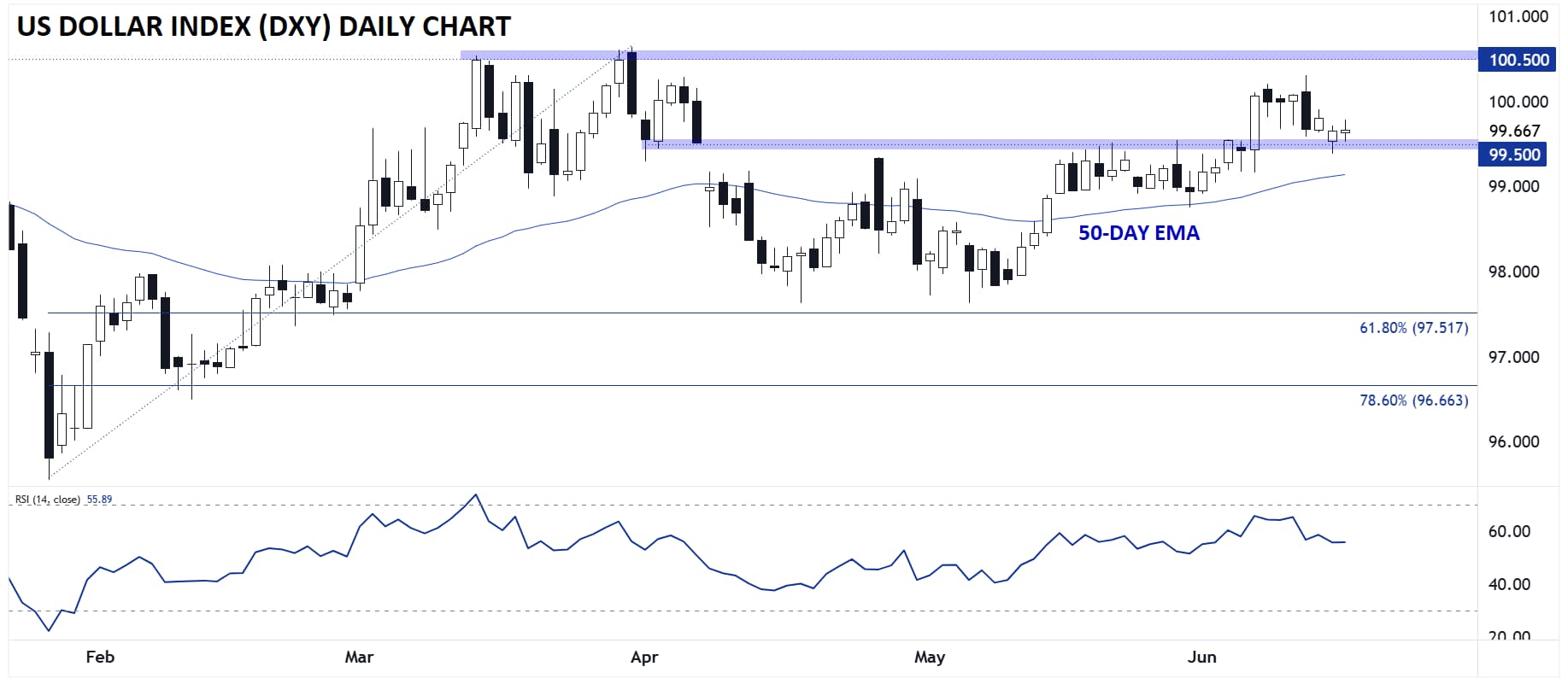
Source: StoneX, TradingView
Turning our attention to the charts, the US Dollar Index is holding up relatively well even with strong signs toward an extended ceasefire in Iran. Looking at the US Dollar Index (DXY), the world’s reserve currency is holding above previous-resistance-turned-support at 99.50, keeping a near-term bullish bias intact. If the central bank opens the door for an interest rate hike later this year and Warsh emphasizes the FOMC’s independence, the Dollar Index could rally back toward 1+ year highs near 100.50 in short order.
Meanwhile, a more timid set of FOMC forecasts and narrow answers on the independence of the central bank from the new Chairman would likely weigh on the greenback, with a break below 99.50 exposing the 50-day EMA closer to 99.00 in short order.
-- Written by Matt Weller, Global Head of Research
Check out Matt’s Daily Market Update videos on YouTube and be sure to follow Matt on Twitter: @MWellerFX



Web Trader platform
Our sophisticated web-based platform is packed with features.
Open an account today
Experience award-winning platforms with fast and secure execution.
Economic calendar
Related articles

Euro Short-term Outlook: EUR/USD Pullback Nears Pivotal Uptrend Support 8 28 2026
Warsh's comments accelerated the EUR/USD selloff, raising the stakes as buyers look to stabilize the broader recovery.
Nasdaq 100 Forecast: NDX slips ahead of Fed Chair Warsh’s speech
U.S. stocks are edging lower on Friday, giving back some of yesterday's gains after Nvidia's strong outlook revived the tech trade. The focus has now shifted firmly to Fed Chair Kevin Warsh's Jackson Hole speech, with investors looking for more clarity on the outlook for interest rates.

EUR/USD forecast: All eyes on Warsh at Jackson Hole - Forex Friday
For much of this week, the EUR/USD has been edging lower with the US dollar regaining some ground after last week’s sell-off that was triggered, in part, by the bond market worries. Investors have been unwilling to bet further against the US dollar so far this week ahead of Kevin Warsh’s keynote speech at the Jackson Hole summit, due later today.
