

US Dollar Price Action Setups: USD/JPY, EUR/USD, GBP/USD, USD/CAD
The FX market is centered around the Japanese Yen at this point, as the built-in carry trade faces pressure from the US Treasury department.
Written by
James Stanley
Sr. Strategist
US Dollar Talking Points:
- The carry trade in USD/JPY has been building for more than five years now and the Japanese Yen weakness that’s seen the pair rise by more than 50% over that time is a large point of imbalance across global foreign exchange markets.
- The Bank of Japan has no dire need for near-term rate hikes, as Japanese inflation is currently at 1.6-1.7%. They also have an inflation target of 2% but unlike the US, inflation is currently subdued below that waypoint.
- Nonetheless, US Treasury Secretary Scott Bessent hinted that Japanese officials should look to tighter policy following the posture around interventions last week after the FOMC and BoJ rate decisions.
It’s truly a conundrum for the Bank of Japan. On one hand, they’d probably prefer it if the Japanese Yen didn’t weaken dramatically against global currencies, like the US Dollar. But on the other, there’s no pressing demand for a rate hike as their inflation levels remain below the bank’s 2% target.
Allowing the currency to fall rapidly runs the risk of bringing on unsavory levels of inflation, which would require rate hikes and, in-turn, a threat to Japanese growth. And for a country with an aging and declining population who spent decades struggling with deflation and disinflation, risking that growth is a pretty unsavory concept particularly when there’s not a massive current demand for such.
On the part of the United States, however, there’s a couple of reasons that they would want to see some form of action. The USD/JPY spot rate sits near recently-established 40-year highs. As the second largest component of the DXY basket, the significant JPY weakness of the past five years has kept the value of DXY elevated, which makes trade a more difficult venture for the United States as exported products are more expensive and imports are relatively cheaper.
But perhaps the biggest risk – is that if Japanese policymakers wanted to continue to try to have their cake and eat it too, by using interventions to run stops on market participants while trying to draw some artificial line in the sand, without hiking rates to address the fundamental divergence between the two economies rate policies – that would probably entail Japan selling US Treasuries. And that would mean even higher US Treasury yields, and we’ve already seen the 30-year bond push up to a fresh 19-year high.
So this is really a story wrapped in intrigue and it can have repercussions far and wide depending on how aggressively it spins out of control.
That global carry trade is, in essence, a form of leverage. We saw what happens when just some of that leverage gets taken out back in July of 2024, when the BoJ intervened on the morning of a US CPI print and despite markets finally getting the confirmation they needed that rate cuts were on the way, the Nasdaq 100 put in a bearish engulf and then sold off with aggression over the next few weeks.
The reason was some of that leverage brought upon by the carry trade was taken out as USD/JPY unwound, and that hit levered markets like high flying AI tech stocks until calm started to return on the morning of August 5th.
We’re not at that point yet, but if Scott Bessent has his way the situation could produce unwelcome and unexpected repercussions fairly soon.
Where this matters for the US Dollar – it’s been obvious for some time that the current administration would like a weaker USD. Trump has said as much, extolling the benefit of a weak currency for exporting goods while making domestic goods more competitive on a cost basis. Those efforts have largely fallen flat over the past year-and-change as the USD is roughly flat since last April, and a big reason why is the run in USD/JPY which extended after last year’s election of Sanae Takaichi, thereby putting both central banks in a precarious spot.
For now, it’s difficult to get too excited about USD/JPY above 160.00 as that’s the type of level that may evoke another intervention or a threat of such. Meanwhile, the fundamental bias remains tilted to the long side of the pair and thusly, for the US Dollar as a whole, there’s a lean towards trend strategies for short-term strength and breakout strategies for broader weakness.
US Dollar Four-Hour Chart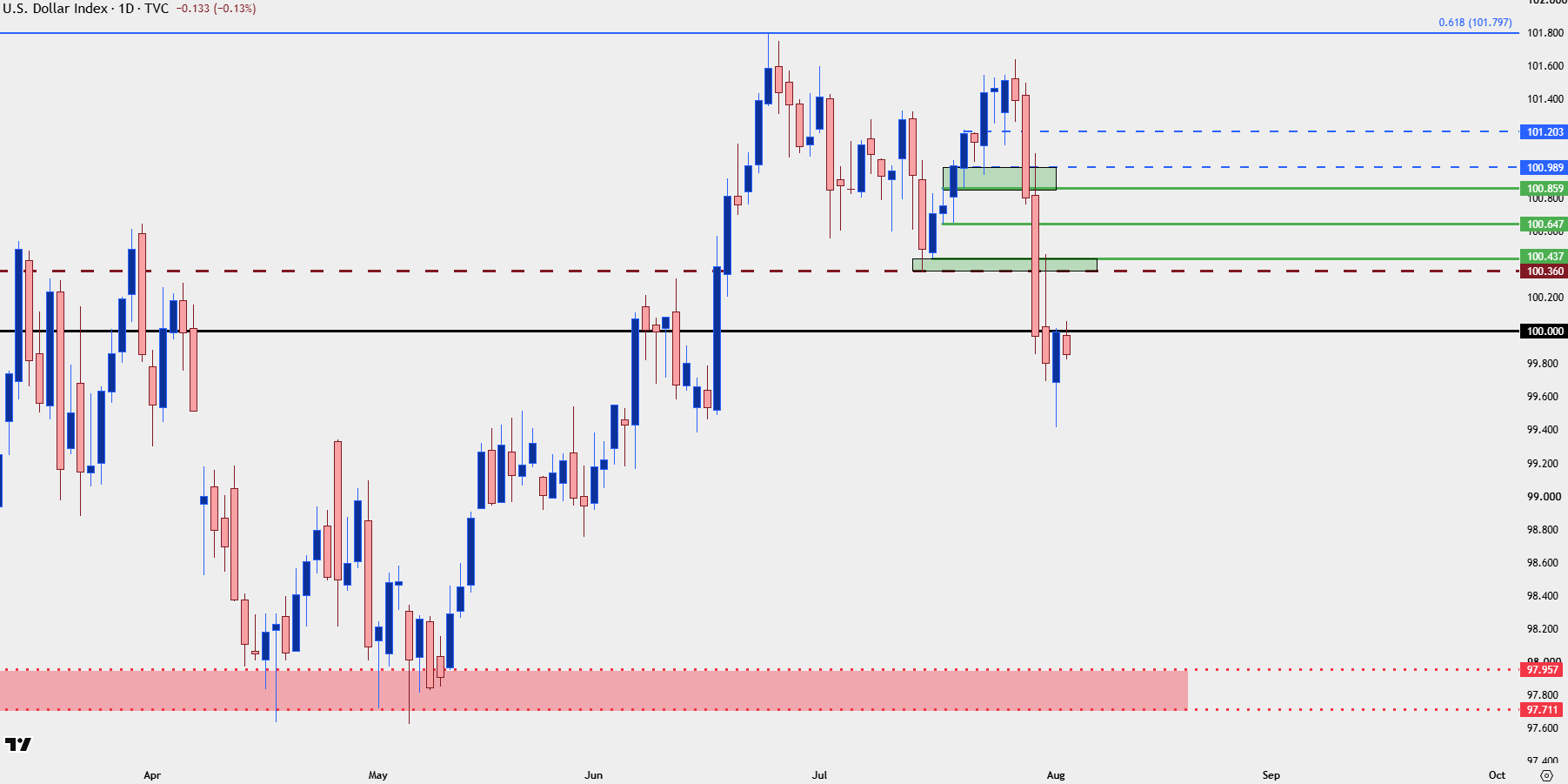
Chart prepared by James Stanley; data derived from Tradingview
USD/JPY
Last week was one of the largest red bars in USD/JPY since that July 2024 episode, and already for this week it looks like bulls are starting to make a return. It’s still too early to say that the dust has settled but it also highlights what I was talking about in the weekend video, where interventions at or around that 155.00 level seem to make little sense. Thus, we’ve seen buyers return to bid the dip but what remains to be seen is whether there is another swing of intervention above 158 or perhaps upon a test of the 160.00 handle.
USD/JPY Weekly Price Chart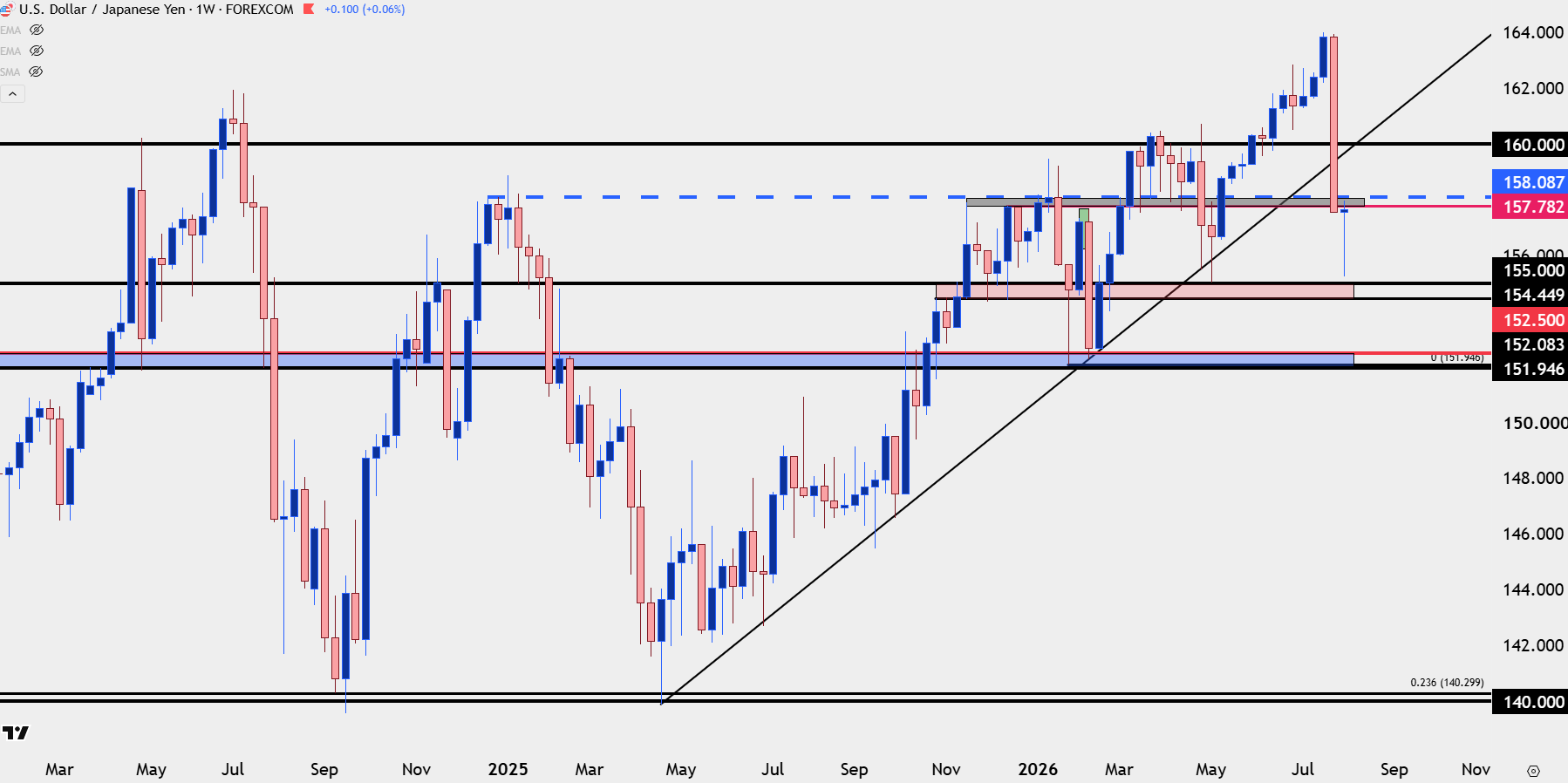
Chart prepared by James Stanley; data derived from Tradingview
EUR/USD
Despite the Euro being a 57.6% allocation of the DXY basket it really does feel like the larger currency pair is along for the ride.
This makes sense if we consider that USD/JPY is up more than 50% over the past five years – and given that the only thing that can actually push price in a real market is demand it highlights that there’s still an imbalance of longs v/s shorts. And when that comes into question, even just a little bit, that USD-selling could happen across currency pairs and not just against the Japanese Yen.
I talked about this in last week’s webinar and I reiterated it this week. At this point it’s the 1.1500 level in EUR/USD that’s held the lows now for two consecutive days and there’s bullish structure in place down to the Friday swing low of 1.1455.
EUR/USD Daily Chart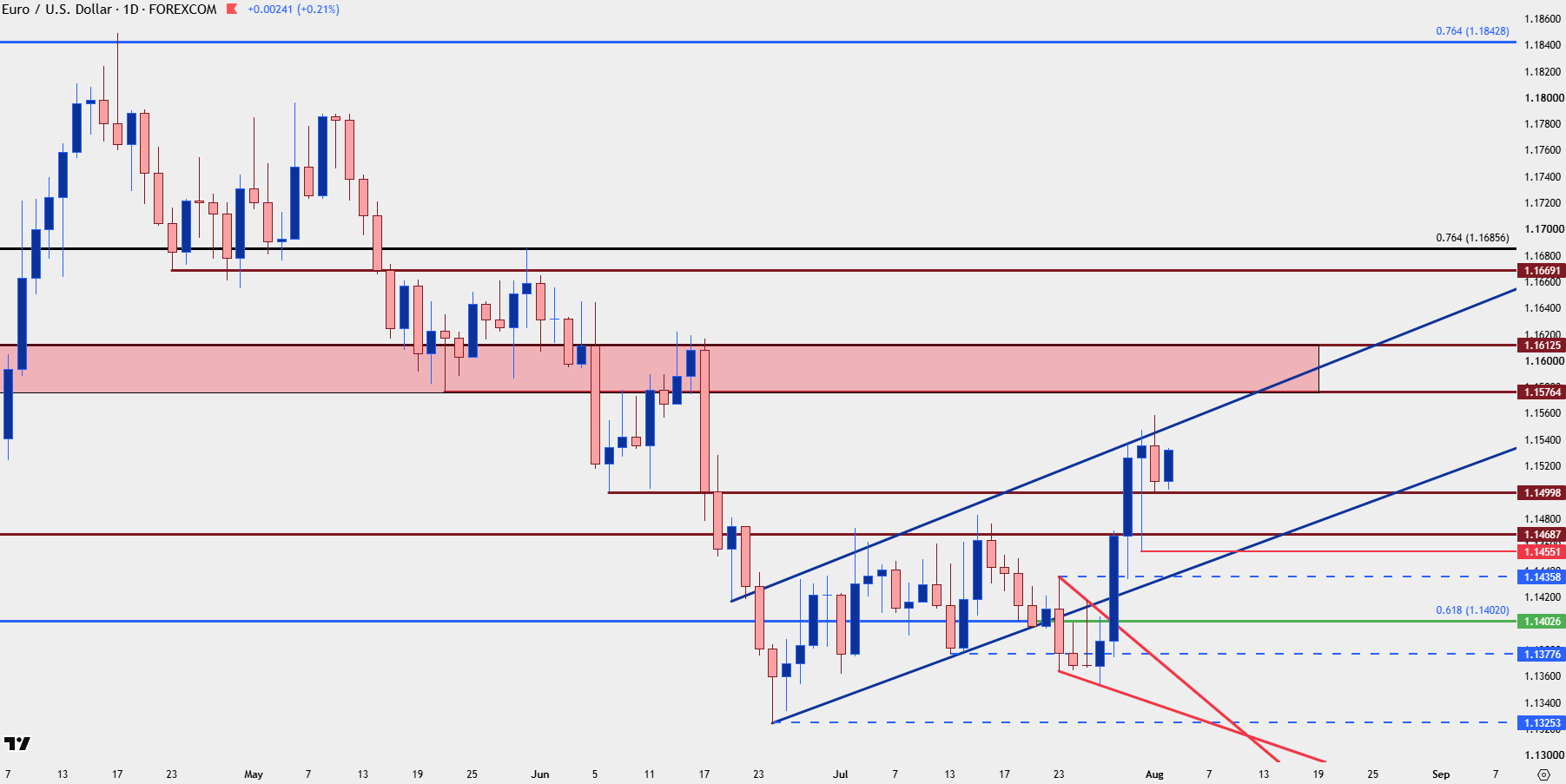
Chart prepared by James Stanley; data derived from Tradingview
GBP/USD
Cable built in a similar falling wedge into the Fed last week, and the response there was perhaps even more emphatic as buyers pounced on the bullish reversal. The challenge now for the pair is that 1.3500 level but there’s higher-low support potential around 1.3390 for bullish continuation scenarios.
GBP/USD Four-Hour Chart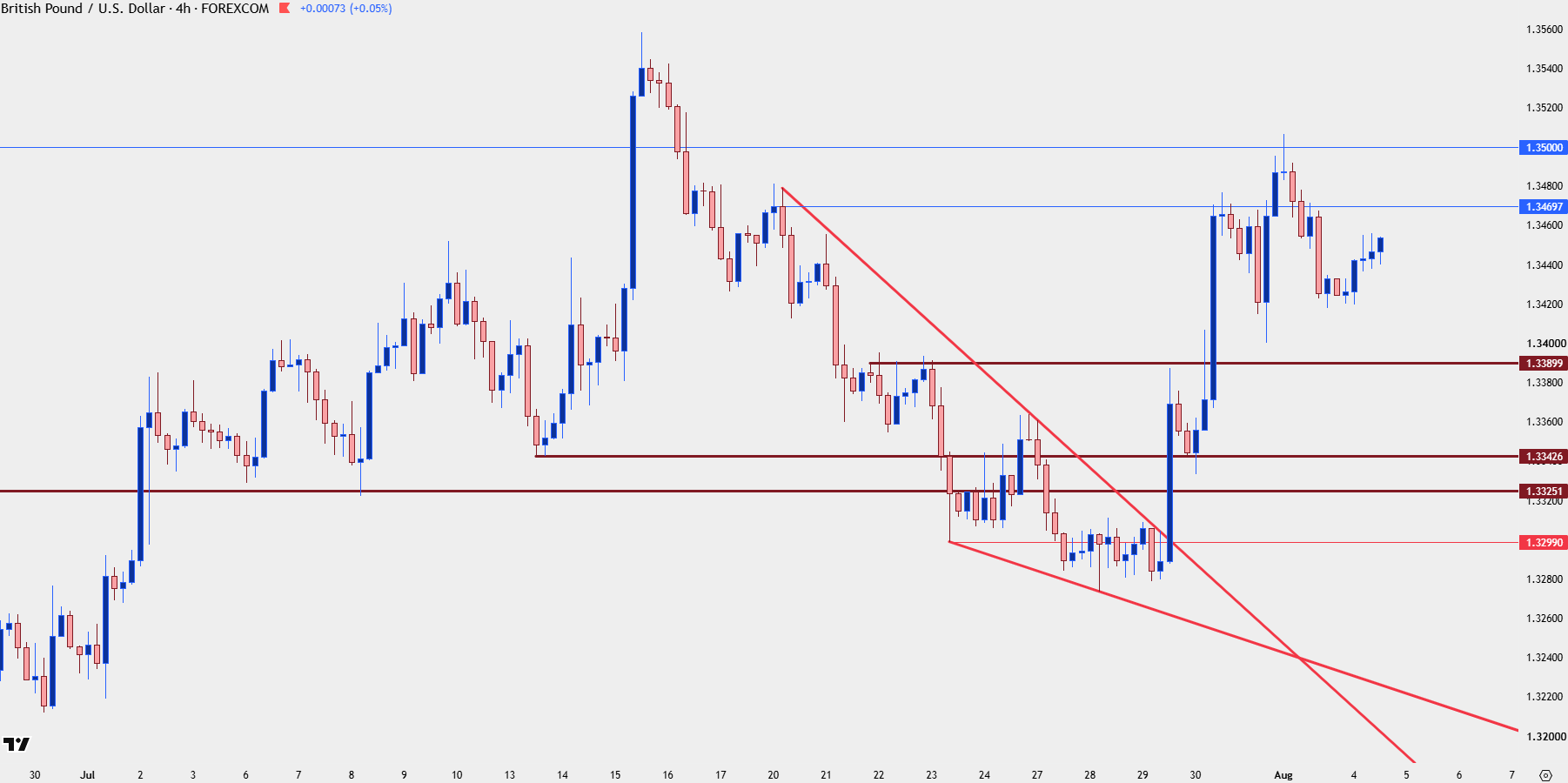
Chart prepared by James Stanley; data derived from Tradingview
USD/CAD
USD/CAD looks somewhat calm on a relative basis, following last week’s test and hold a the 1.4000 level. Following that test on Thursday, we’ve had higher lows, illustrating an element of bullish anticipation as buyers have stepped in with a bit more aggression over the past couple of days. This keeps the door open for short-term strength and for those looking for USD-strength, this may be a less chaotic backdrop than what showed in USD/JPY and perhaps a bit cleaner than EUR/USD or perhaps even GBP/USD which are vying for possible bullish trend scenarios.
USD/CAD Daily Chart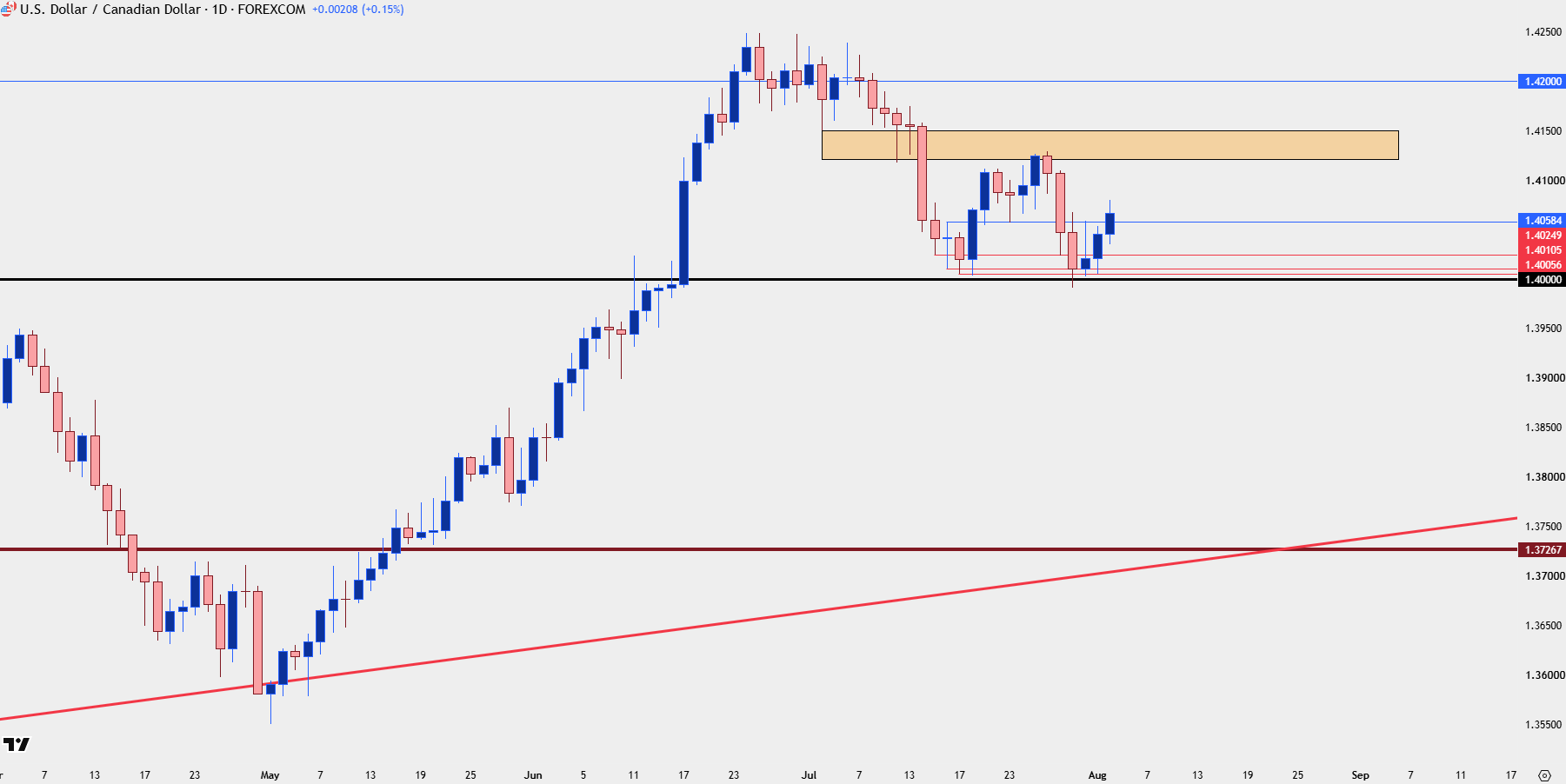
Chart prepared by James Stanley; data derived from Tradingview
--- written by James Stanley, Senior Market Analyst, Global Macro







Web Trader platform
Our sophisticated web-based platform is packed with features.
Open an account today
Experience award-winning platforms with fast and secure execution.
Economic calendar
Related articles

Euro Short-term Outlook: EUR/USD Pullback Nears Pivotal Uptrend Support 8 28 2026
Warsh's comments accelerated the EUR/USD selloff, raising the stakes as buyers look to stabilize the broader recovery.


Nasdaq 100 Forecast: NDX slips ahead of Fed Chair Warsh’s speech
U.S. stocks are edging lower on Friday, giving back some of yesterday's gains after Nvidia's strong outlook revived the tech trade. The focus has now shifted firmly to Fed Chair Kevin Warsh's Jackson Hole speech, with investors looking for more clarity on the outlook for interest rates.


EUR/USD forecast: All eyes on Warsh at Jackson Hole - Forex Friday
For much of this week, the EUR/USD has been edging lower with the US dollar regaining some ground after last week’s sell-off that was triggered, in part, by the bond market worries. Investors have been unwilling to bet further against the US dollar so far this week ahead of Kevin Warsh’s keynote speech at the Jackson Hole summit, due later today.
