


USD/JPY, EUR/USD outlook: A different Fed changes the FX outlook
A hawkish recalibration on inflation, multiple hikes priced into the curve and USD/JPY back at intervention levels. The Fed may be changing the rules for FX traders.
Written by
David Scutt
Market Analyst
- Warsh's Fed delivers a hawkish surprise
- Inflation, not jobs, steals the spotlight
- Markets price hike as soon as October
- USD/JPY tests intervention territory
- EUR/USD vulnerable below 1.1500
The bigger story may be the yen
The last time USD/JPY traded at these levels, the BOJ intervened.
A hawkish shift from the Federal Reserve has seen markets rapidly reprice the US rates outlook, pushing Treasury yields and US dollar higher in the process. The result is a widening in interest rate differentials, helping propel USD/JPY back towards levels that previously forced the Ministry of Finance into action.
That leaves Japanese authorities facing an uncomfortable question. If the Fed is serious about getting inflation back to target, and markets continue to price higher US rates as a result, how effective can intervention really be?
The bigger story from the latest Fed meeting may not be what it means for US interest rates. It may be what it means for the yen and carry trades.
Price stability takes centre stage
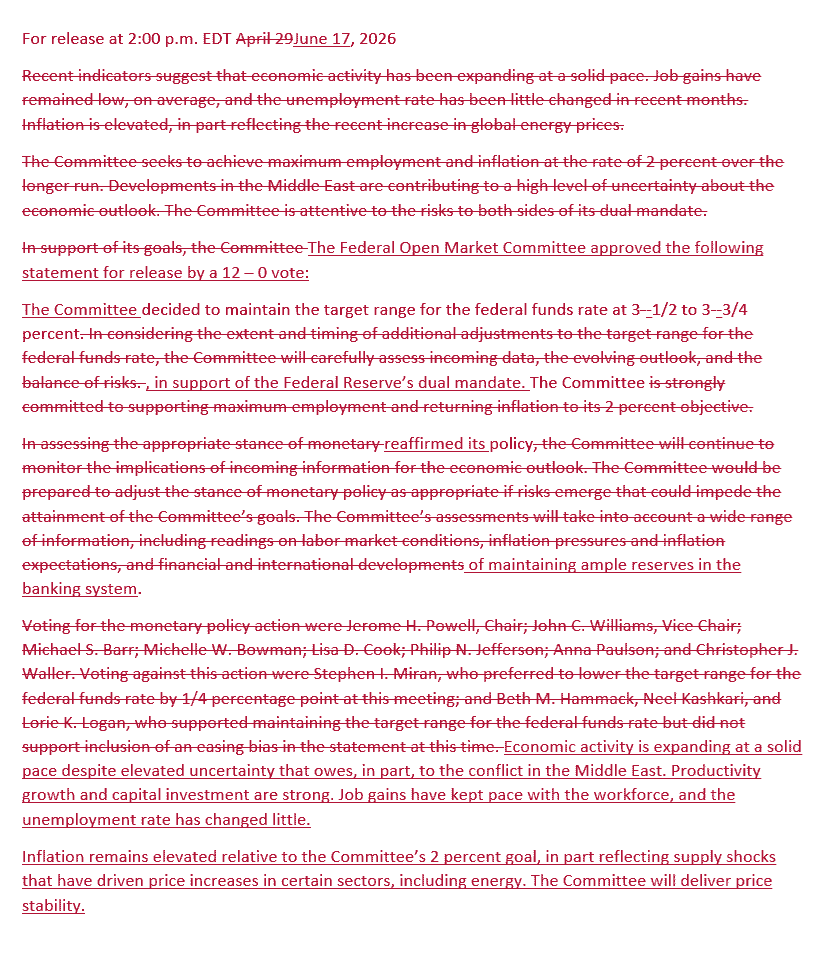
Looking at the June statement, the amount of change is laughable. It's basically been gutted compared to what we saw only six weeks ago, delivering on Kevin Warsh's promise to simplify Fed communication.
Source: Federal Reserve
What really stands out is the focus on inflation, and not just inflation driven by supply-side factors. The statement says inflation remains elevated "in part" due to supply shocks stemming from energy prices, implying there are also domestic factors helping to keep price pressures elevated.
Then comes the kicker: "The Committee will deliver price stability." That's about as hawkish as you can get without actually hiking rates.
The updated economic projections help explain why.
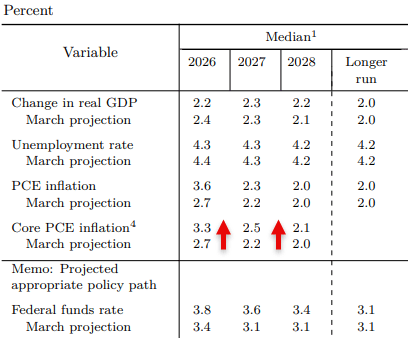
The inflation outlook shifts
Source: Federal Reserve
The biggest change from three months ago was inflation. Core PCE forecasts were revised sharply higher this year and next despite growing signs of labour market cooling. Yes, payrolls growth has remained resilient, but the household survey has painted a much softer picture, with underemployment moving higher and wages growth moderating. Yet none of that appears to have altered the Fed's thinking.
The other thing that stands out is that despite higher inflation and the prospect of higher rates, the Fed still expects the economy to keep chugging along at an above-trend pace, generating enough demand to sustain inflationary pressures.
A more divided Fed emerges
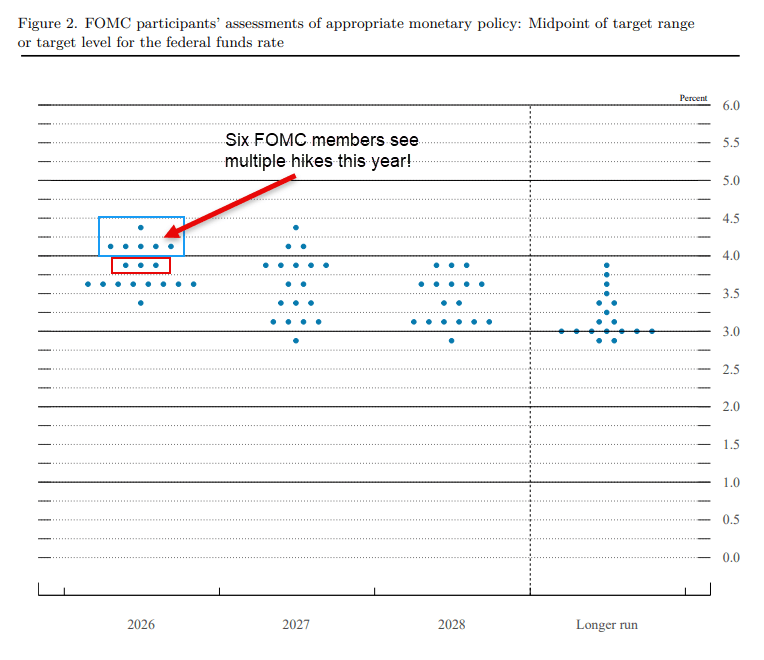
Then came what I suspect shocked markets most, including myself.
Of the 18 FOMC members who submitted projections, nine now see rates rising this year. Six see at least two hikes, while one sees three. Yes, the median profile still points to rates gradually drifting lower over coming years, but it's remarkable just how many committee members have turned hawkish.
Source: Federal Reserve
One important caveat is that we don't know where Kevin Warsh sits on the policy spectrum. He didn't submit his own economic projections or dot plot, which isn't entirely surprising given his criticism of forward guidance and the dot plot system itself.
But if the statement and press conference were anything to go by, the tone was undeniably hawkish. That's particularly interesting given the prevailing narrative when Warsh was appointed. Many assumed a Trump-backed Fed chair would lean dovish. Yet the messaging from this meeting pointed in the opposite direction.
What also struck me was what this potentially says about the Fed's reaction function. Under Powell, the Fed often appeared willing to tolerate inflation running above target provided the labour market remained healthy. If there was even a hint of weakness in employment data, they'd cut.
At face value, and I stress it's only one meeting, that appears to have been turned on its head. Taken together, the statement, projections and dot plots suggest a Fed that is once again trying to get inflation back to target rather than one primarily focused on cushioning any softening in labour market conditions.
What's also hard to ignore is how much more divided the committee suddenly appears. Powell chaired the FOMC for years with the committee often projecting a relatively unified front. Yet only three months into Warsh's tenure we're seeing a much wider dispersion of views emerge between hawks and doves.
Warsh said he wanted more debate. He's certainly got it!
But it does raise an interesting question. Was Powell the glue that held the committee together?
Donald Trump has made no secret of his views on the Fed, repeatedly criticising Powell and other policymakers. Is it possible some of that is now beginning to show up in voting intentions and policy preferences? I don't know. But the speed of the shift is what stands out.
Markets believe the message
Source: TradingView
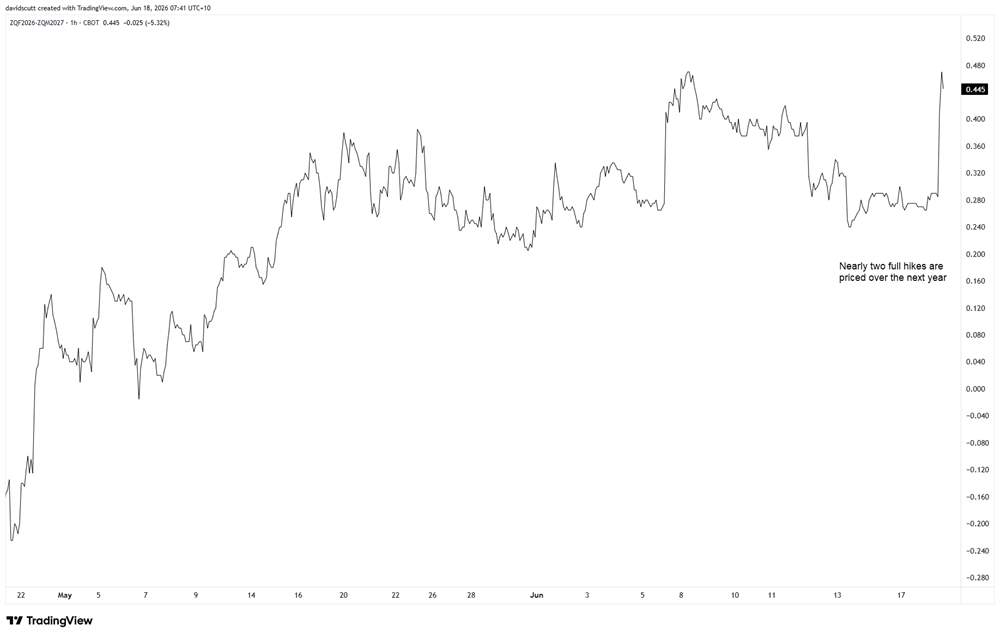
Markets didn't take long to respond. We now have a full rate hike priced by October and close to two hikes priced by the middle of next year. At face value, traders believe the Fed means business.
That's important because under Powell, markets often spent as much time trying to anticipate the Fed's reaction function as they did analysing the economic data itself. The assumption was that the Fed would prioritise employment over inflation.
This meeting suggests that may no longer be the case. If Warsh follows through on his pledge to make policy more data dependent, the focus should shift back to the data, which has been near uniformly strong.
And nowhere is that more important than in USD/JPY.
Japan’s intervention dilemma
Yield differentials are moving firmly in favour of the US dollar and despite markets still favouring another BOJ hike by year-end, it has done little to slow the advance in the pair. In my opinion, the only reason USD/JPY hasn't already broken out more aggressively is concern over intervention risk. And that’s likely preventing a greater unwind in other majors against the dollar.
But if the underlying driver is a widening interest rate differential in favour of the United States, intervention may do little more than provide better levels for bullish investors to buy back in, much like we saw earlier this year.
That's the problem facing Japanese authorities. They may be able to slow the move, but unless something changes on the rates front, stopping it altogether is a much harder proposition.
Pressure building beneath resistance
Source: TradingView
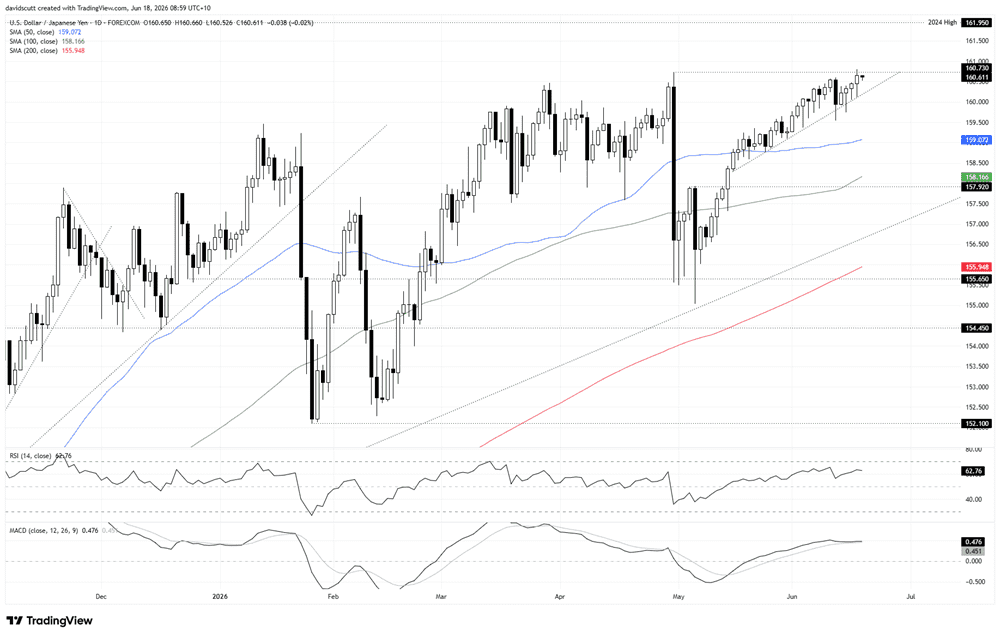
USD/JPY continues to grind higher within the shallow uptrend established in the middle of May, continuing to attract bids on dips towards and through it, as we saw on Wednesday. For now, it remains the key level beneath where the pair trades.
Overhead, it's all about 160.73, the prior year-to-date high from where the BOJ intervened back in late April. The pair traded through the level briefly immediately following the Fed but has since been shoved back beneath it. You can feel the pressure building.
If the pair manages to climb above 160.73 and hold there without the usual torrent of verbal intervention from MOF officials, it may embolden bulls to establish fresh longs with stops beneath, targeting a retest of the 2024 high at 161.95. I suspect traders are waiting to see whether verbal intervention arrives before deciding how to proceed. If it does, it may be enough to cap the pair. If there's none, it may act like a green light to charge higher.
If we were to see intervention, levels such as the May uptrend would likely become redundant immediately if the April and early May episode is anything to go by. The same applies to the 50-day moving average and former breakout zone at 157.92. Instead, you get a hunch that if the MOF instructs the BOJ to pull the trigger, the intersection of the Liberation Day uptrend, 200-day moving average and support at 155.65 will become far more important when assessing whether it's safe to reinitiate longs.
While I'm putting far less weight on them than normal, the bearish divergence between price and RSI (14) is providing a minor warning for bulls. MACD is also looking heavy, running largely parallel to the signal line after flattening out in recent weeks.
Euro wobbles return
Source: TradingView
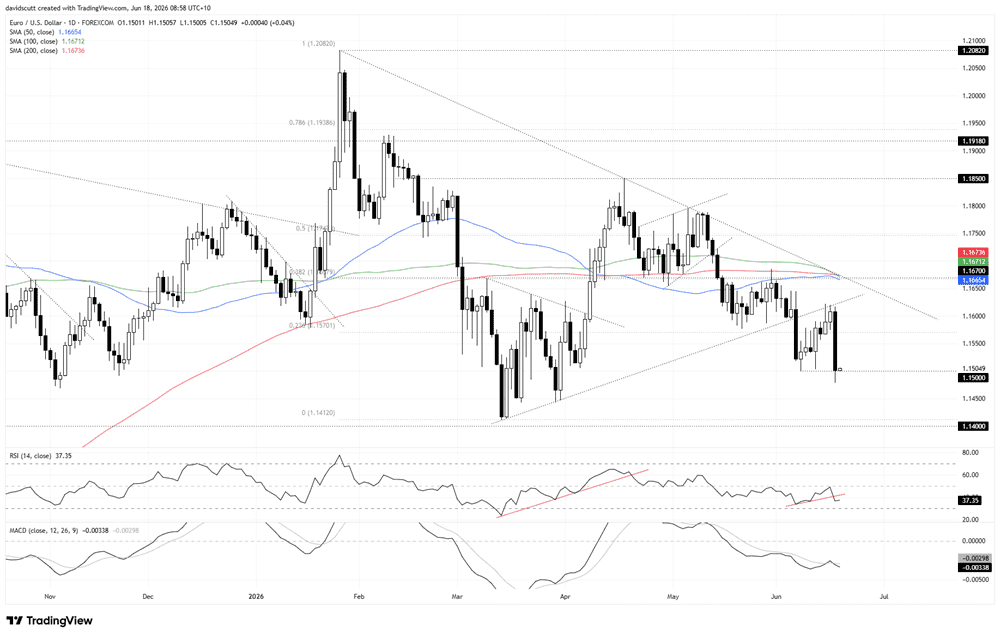
EUR/USD finds itself teetering above 1.1500 following the Fed, managing to recover the level after briefly trading through it. The yen's inability to break higher is undoubtedly helping this in my opinion.
However, with the oscillators flipping firmly bearish, with RSI (14) snapping its uptrend and sitting in the mid-30s with MACD confirming by staging a bearish crossover, the euro comes across very much as a sell on rallies prospect.
Should the pair slink beneath 1.1500 and hold there for a period of time, it may encourage bears to set shorts with a stop above, seeking a retest of the March lows at 1.1412. The 1.1400 figure is another level of note located just below.
Overhead, while it seems very unlikely near-term, the pair struggled above 1.1600 earlier this week, making it a reference point should we see a pop.






Web Trader platform
Our sophisticated web-based platform is packed with features.
Open an account today
Experience award-winning platforms with fast and secure execution.
Economic calendar
Related articles

Canadian Dollar Forecast: USD/CAD Weekly Reversal Puts Yearly Uptrend Back in Focus 8 29 2026
USD/CAD has staged its strongest weekly advance since June, shifting the focus to whether a more durable low is finally taking shape.


USD/JPY weekly outlook: Payrolls may challenge the Fed’s hawkish reset
USD/JPY has finally woken from its slumber. Payrolls now loom as the key test of whether the latest hawkish repricing sticks or sinks.

Euro Short-term Outlook: EUR/USD Pullback Nears Pivotal Uptrend Support 8 28 2026
Warsh's comments accelerated the EUR/USD selloff, raising the stakes as buyers look to stabilize the broader recovery.