

USD/JPY Outlook: Beyond the BOJ Hike
BOJ day has arrived, but the rate decision itself may be the least interesting part of it. With markets focused on guidance and QT, the yen faces another important test.
Written by
David Scutt
Market Analyst
- BOJ hike all but priced by markets
- Another dovish hike remains the key risk
- Yen still can't capitalise on ideal conditions for strength
- 160.59 and 160.72 remain in focus overhead
The Hike Is the Easy Part
Bank of Japan (BOJ) day has arrived with markets almost unanimous in expecting a 25bp hike to 1%. Yet after weeks of speculation, the decision that matters most may have little to do with the rate move itself. Instead, traders will be watching for clues on how committed the bank remains to further policy normalisation, whether quantitative tightening (QT) remains on track or needs to be slowed or halted altogether, and whether the yen can finally find support after repeatedly failing to do so elsewhere.
The Yen's Warning Shot
The price action on Monday rams home that last point. Reports that the US and Iran had electronically signed a memorandum of understanding over the weekend sent crude prices and Treasury yields sharply lower, while risk appetite surged. Yet after briefly dipping beneath 160 earlier in the session, USD/JPY reversed to finish higher.
As discussed in my week-ahead piece, even with an ideal window for downside created by lower energy prices and falling US yields, the yen's standing as a funding currency for carry trades has seemingly taken over, perhaps enhanced by the prospect of lower inflation, stronger global growth, low and largely stable borrowing costs in Japan and a bull market in global equities.
Another Dovish Hike?
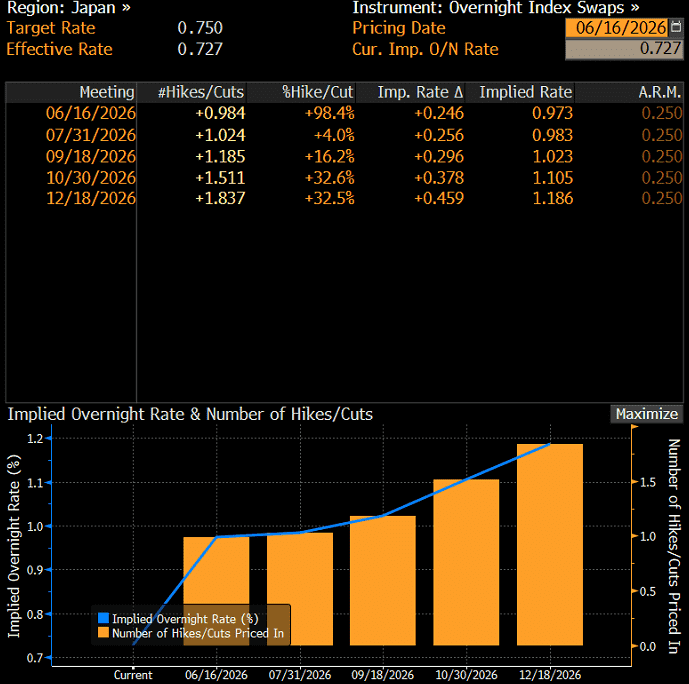
Source: Bloomberg
With overnight index swaps implying a 98.4% probability of a 25bp increase to 1%, the hike itself is unlikely to be the market mover. The risk of no change is so small it's barely worth entertaining, not least because failing to deliver after allowing expectations to become so entrenched would risk inflicting unnecessary damage on the BOJ's credibility. Instead, the focus will fall on the guidance accompanying the decision and what officials signal about the future pace of QT. Governor Ueda remains in hospital and will not participate in the vote, leaving Deputy Governor Uchida to front the post-meeting press conference.
When tightening policy in the past, the BOJ has often paired its actions with cautious messaging designed to minimise market disruption. That leaves the risk of another dovish hike, particularly if policymakers indicate that QT may proceed more slowly than previously flagged, or be paused altogether. If so, the move may reinforce perceptions that officials remain more concerned about preserving stability in the JGB market than providing additional support for the yen.
Waiting for Tokyo
One longstanding bugbear of mine with BOJ meetings is that while we know the post-meeting press conference is scheduled for 3:30pm JST, we still don't know when the policy decision itself will actually hit the wires. It's an unnecessary uncertainty, especially in a year where markets have already had enough shocks to contend with.
The rough rule of thumb is that when it's an easy meeting with broad agreement behind the decision, the announcement tends to arrive within a 10-minute window either side of the end of the Tokyo lunch break at 12:30pm JST. The longer it takes, the more traders start wondering whether there's been greater disharmony or a more complicated policy debate taking place behind closed doors.
The Trend Is Higher
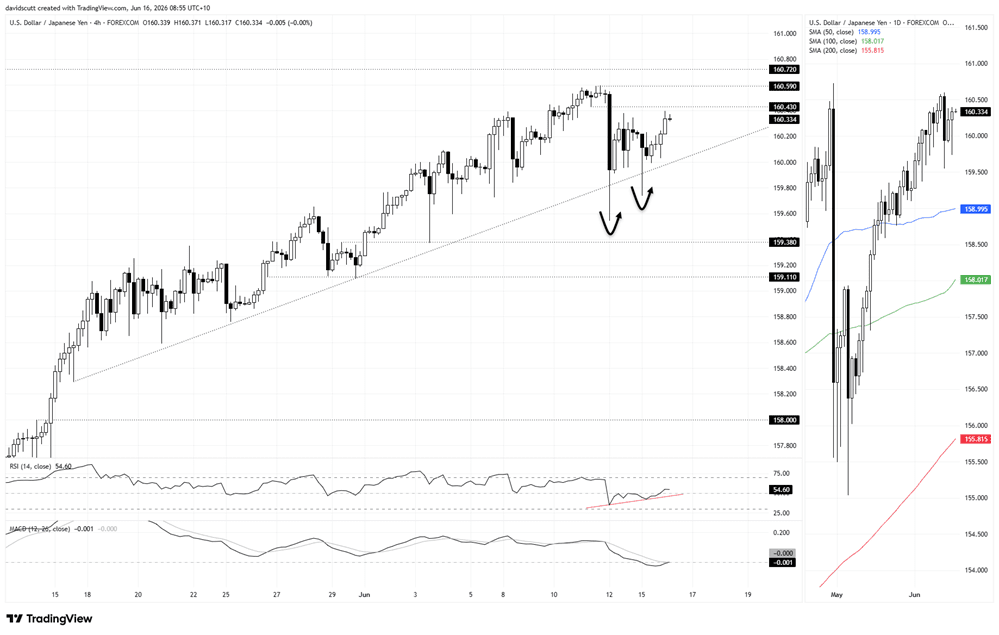
Source: TradingView
USD/JPY continues to grind higher within the shallow uptrend established in the middle of May, continuing to absorb offers whenever they arrive on probes beneath it. We've now seen two such probes on the H4 timeframe either side of the weekend, coinciding with steep declines in crude prices. However, neither has stuck, adding to the sense that even with a more palatable energy price and yield backdrop, and the persistent threat of intervention from Japanese authorities, the path of least resistance remains higher rather than lower in the near term.
Overhead, 160.43 is a minor resistance level to watch ahead of last week's high at 160.59 and the year-to-date peak of 160.72. All could come into play today should the BOJ fail to deliver a sufficiently hawkish message to markets.
On the downside, the mid-May uptrend remains the key area of focus, with the dips beneath it becoming sequentially more shallow. The most recent probe bottomed around 159.75, making it the immediate focus if we were to see another break beneath the trendline, marking the beginning of a broader support zone extending down to 159.38. Beyond that, minor support at 159.11 and the 50-day moving average, seen in the panel on the right, should be on the radar if we were to see a sustained downside break of the uptrend.
Like the buoyant price action, the momentum picture is also increasingly favouring a bullish bias, with RSI (14) trending higher above 50 while MACD looks set to deliver an imminent crossover of the signal line to reinforce the message.





Web Trader platform
Our sophisticated web-based platform is packed with features.
Open an account today
Experience award-winning platforms with fast and secure execution.
Economic calendar
Related articles

Euro Short-term Outlook: EUR/USD Pullback Nears Pivotal Uptrend Support 8 28 2026
Warsh's comments accelerated the EUR/USD selloff, raising the stakes as buyers look to stabilize the broader recovery.

EUR/USD forecast: All eyes on Warsh at Jackson Hole - Forex Friday
For much of this week, the EUR/USD has been edging lower with the US dollar regaining some ground after last week’s sell-off that was triggered, in part, by the bond market worries. Investors have been unwilling to bet further against the US dollar so far this week ahead of Kevin Warsh’s keynote speech at the Jackson Hole summit, due later today.


AUD/CAD breakout puts the Bradman barrier in sight
A bullish breakout has pushed AUD/CAD to its highest level since early 2021. Whether it can clear 0.9994 may determine if the move extends well above parity.