


USD/MXN Forecast: Neutrality Remains the Dominant Theme
Over recent trading sessions, a particularly relevant dynamic has begun to emerge around USD/MXN price action, as a growing phase of indecision and lack of clear direction becomes increasingly evident in the short term
Written by
Julian Pineda
Market Analyst
Over recent trading sessions, a particularly relevant dynamic has begun to emerge around USD/MXN price action, as a growing phase of indecision and lack of clear direction becomes increasingly evident in the short term. This can be seen in the fact that, over the last three trading sessions, price action has registered a move of only around 0.2%, a development that highlights an increasingly neutral environment within the chart.
For the moment, the balance of forces between the Mexican peso and the U.S. dollar remains largely driven by the recent behavior of the bond markets in both countries, which continues to create uncertainty regarding where capital flows may be directed in the short term. This is further reinforced by ongoing caution surrounding future Federal Reserve decisions. Together, these factors continue to favor a neutral environment and could keep a phase of indecision relevant around USD/MXN in the sessions ahead.
How Is the Bond Market Dynamic Evolving?
Since the release of the U.S. NFP report at the end of last week, expectations surrounding the Federal Reserve have started to shift. Employment data came in significantly stronger than expected, a situation that could provide room for a more aggressive central bank in the months ahead.
This development is relevant because expectations of higher interest rates tend to support demand for U.S. government bonds, and that is already being reflected in the behavior of 10-year Treasury yields. In recent sessions, yields have remained close to the 4.8% area, the highest level observed during 2026, reinforcing the relative attractiveness of this market.
At the same time, it is important to note that while uncertainty remains regarding Banco de México's next policy decision, the benchmark interest rate continues to hold around 6.5%, one of the highest levels among major central banks. Likewise, Mexican government bond yields remain relatively stable near 9.3%, continuing to offer attractive returns for peso-denominated investments.
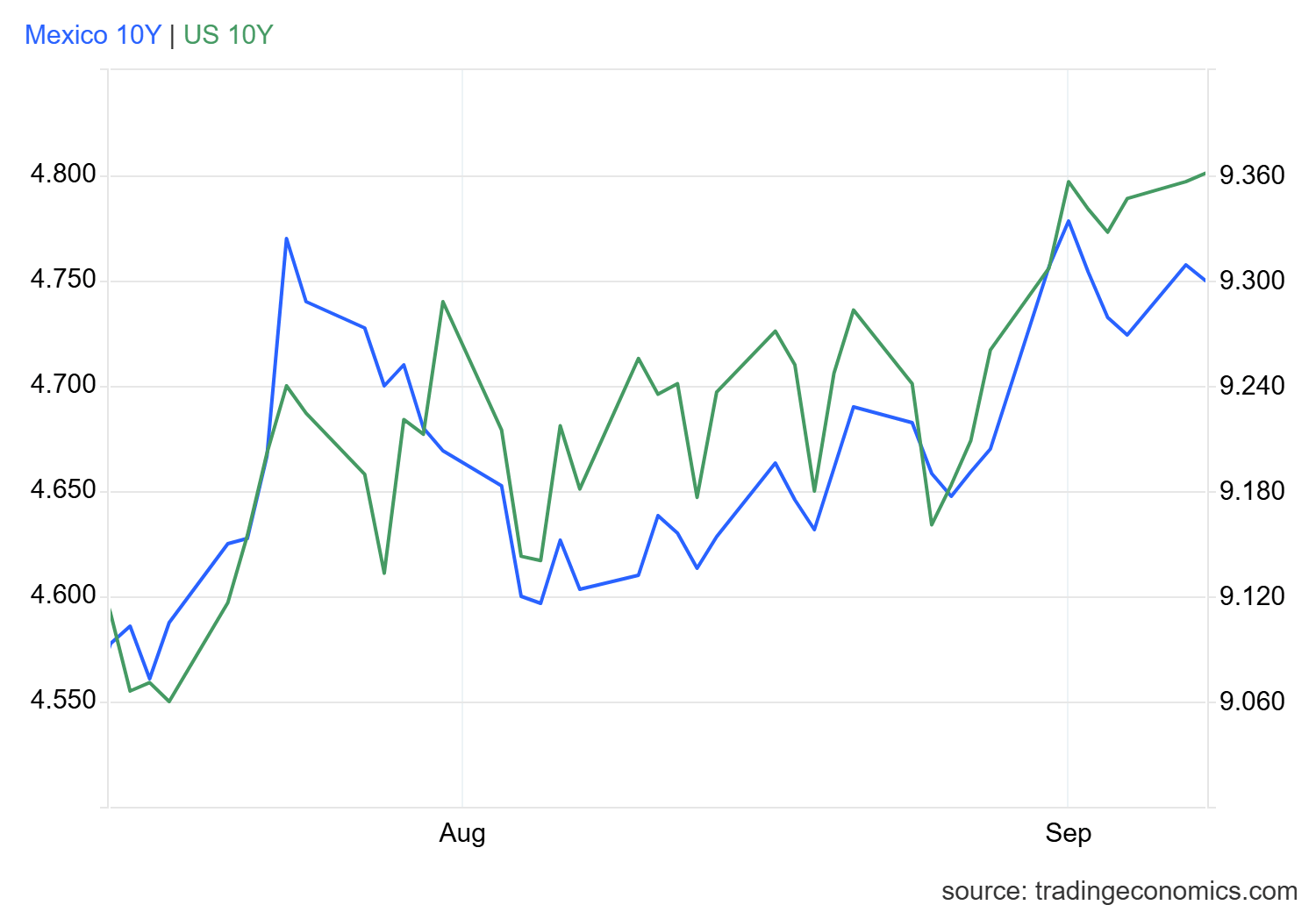
Source: TradingEconomics
This backdrop is particularly interesting because, on the one hand, markets are increasingly pricing in a more aggressive Federal Reserve, a factor that has strengthened the appeal of U.S. Treasury securities. On the other hand, Mexican bonds continue to offer considerably higher yields while maintaining relatively stable demand.
As a result, this combination may be limiting the ability of either currency to establish a dominant direction within USD/MXN and continues to explain part of the neutrality observed in recent sessions. As long as both markets remain relatively attractive, this phase of indecision could continue to be an important feature of the pair.
Could the Dollar Surprise the Market?
Another important factor to consider is the relatively muted reaction recently displayed by the U.S. dollar. This can be observed through the behavior of the DXY Index, which measures the dollar's performance against its main rivals and has managed to stabilize around the 98.86-point area without developing a clearly defined direction.
This situation remains relevant because investors are also becoming increasingly cautious ahead of the upcoming CPI release, which will provide a fresh reading on annual inflation in the United States later this week. Market participants continue evaluating whether inflationary pressures remain persistent and whether this could further support a more restrictive stance from the Federal Reserve.
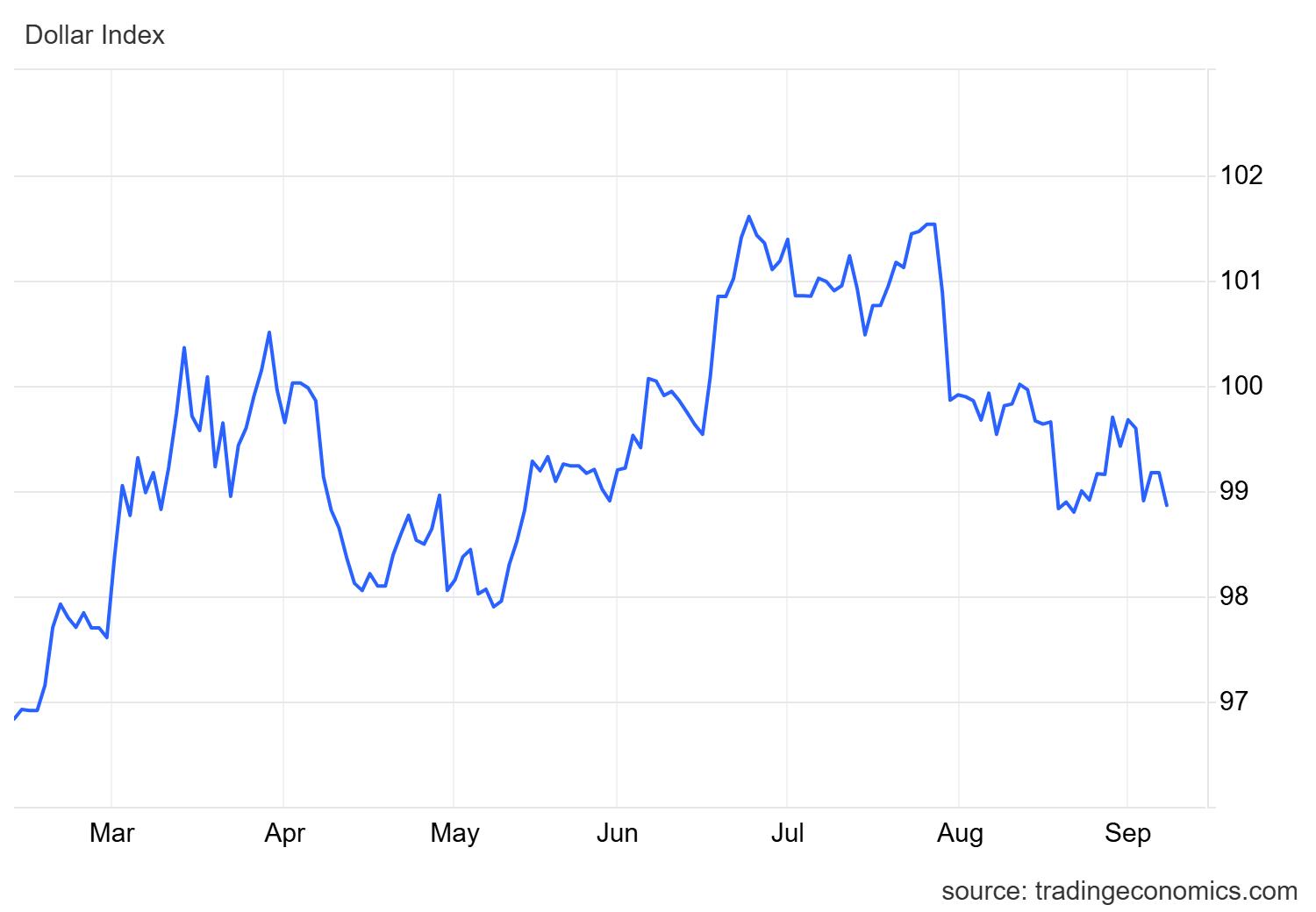
Source: TradingEconomics
This event could become a catalyst capable of changing the current outlook for USD/MXN. If inflation data comes in above expectations, it could reinforce the view that interest rates may remain elevated for longer and increase the attractiveness of dollar-denominated investments.
Under that scenario, the dollar could begin recovering momentum more consistently, making it more difficult for the Mexican peso to regain ground. Therefore, beyond maintaining the current phase of indecision, an upside surprise in inflation could even favor a more relevant bullish bias around USD/MXN during the coming weeks.
USD/MXN Technical Outlook
Source: StoneX, Tradingview
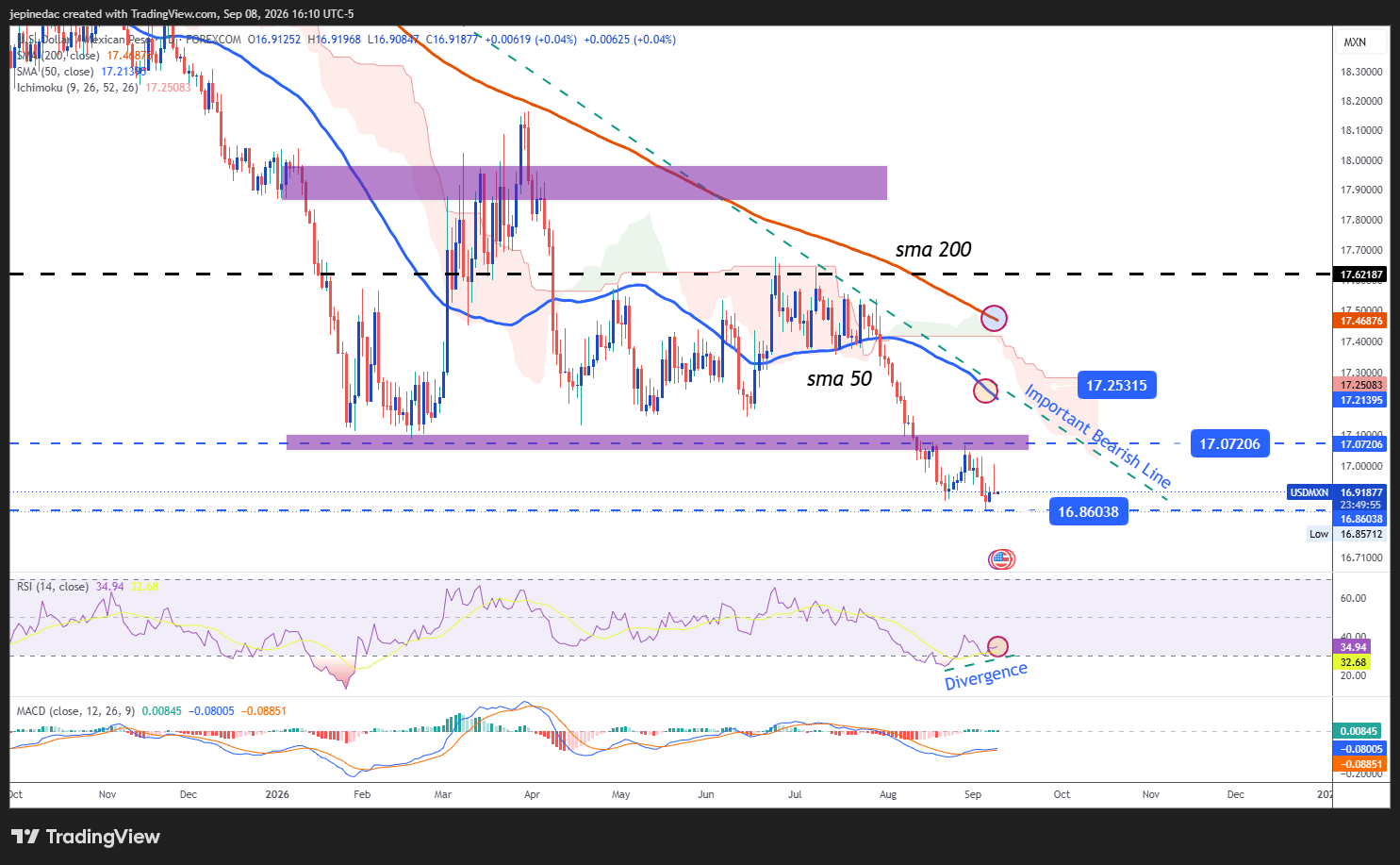
- The Downtrend Remains the Dominant Structure: Despite the indecisive movements observed recently near an important support area, price action remains closely tied to the broader bearish trendline that continues to dominate the chart. However, it is important to recognize that if price continues to stabilize and fails to establish new lows consistently, this structure could gradually begin losing strength and open the door to a more meaningful period of sideways trading in the weeks ahead.
- RSI: Although the indicator remains below the neutral 50 level, price action has started to develop lower lows while the RSI has been producing higher lows. This behavior is beginning to form a bullish divergence within the chart and could serve as an early warning that selling pressure has become excessive in recent weeks. As a result, it may create room for bullish corrective moves during upcoming sessions.
- MACD: The MACD histogram continues to fluctuate close to the neutral 0 line. This reading reflects balance within the average strength of short-term moving averages and supports the view that a phase of indecision continues to be relevant within recent USD/MXN price action.
Key Levels:
- 17.25 – Major Resistance: An important retracement area that coincides with the 50-period moving average and also aligns with the boundary of the Ichimoku Cloud. Price action that manages to establish itself above this area could put the current bearish structure at risk and open the door to a more consistent bullish bias in the weeks ahead.
- 17.07 – Current Barrier: A nearby retracement zone that could become the primary reference level to monitor should bullish corrective moves begin to develop over the coming sessions.
- 16.83 – Key Support: A low not seen since 2024 and one of the most important downside barriers within the current structure. A move back toward this area would reinforce bearish control and could favor a broader extension of the dominant downtrend over the coming weeks.
Written by Julian Pineda, CFA, CMT – Market Analyst
Follow him on: @julianpineda25
Latest market news










Web Trader platform
Our sophisticated web-based platform is packed with features.
Open an account today
Experience award-winning platforms with fast and secure execution.
Economic calendar
Related articles

FX Futures Positioning: Dollar Rebound Meets Diverging Forex Bets | COT Report
US dollar longs held firm into Jackson Hole, while euro, yen and commodity FX positioning diverged ahead of ISM and NFP.

EUR/USD forecast: All eyes on Warsh at Jackson Hole - Forex Friday
For much of this week, the EUR/USD has been edging lower with the US dollar regaining some ground after last week’s sell-off that was triggered, in part, by the bond market worries. Investors have been unwilling to bet further against the US dollar so far this week ahead of Kevin Warsh’s keynote speech at the Jackson Hole summit, due later today.


DAX and EUR/USD forecast: Lower energy prices, yields offer support
But the question, of course, is how much further oil prices and bond yields can fall. For now, the combination is supportive of risk assets and is helping to sustain a relatively benign decline in the dollar. The focus today will be on US core PCE inflation, due for release shortly, while Nvidia’s second-quarter earnings will provide another test for risk appetite after the US markets close – not just for US indices but for global tech-heavy indices given the influence Nvidia has over the global tech and AI names.