


AUD/USD Breakout Builds as Yen Strength Softens the Dollar
AUD/USD is trading at its highest since early May, with the yen’s continued rally helping soften the dollar and amplify the Aussie’s upside response.
Written by
David Scutt
Market Analyst
- AUD/USD breaks above 0.7200 to multi-month highs
- Yen strength helps soften the US dollar
- Aussie far more responsive to upside catalysts
- US CPI looms as the key breakout test
AUD/USD has pushed firmly above the .7200 level to trade at its highest since early May, continuing to benefit from buoyant risk appetite, hawkish RBA pricing and continued weakness in the US dollar, particularly against Asian currency names. With the technicals aligning with the fundamentals, the topside break will have bulls eyeing a potential retest of the year-to-date highs in the days ahead.
Upside Catalysts Getting More Traction
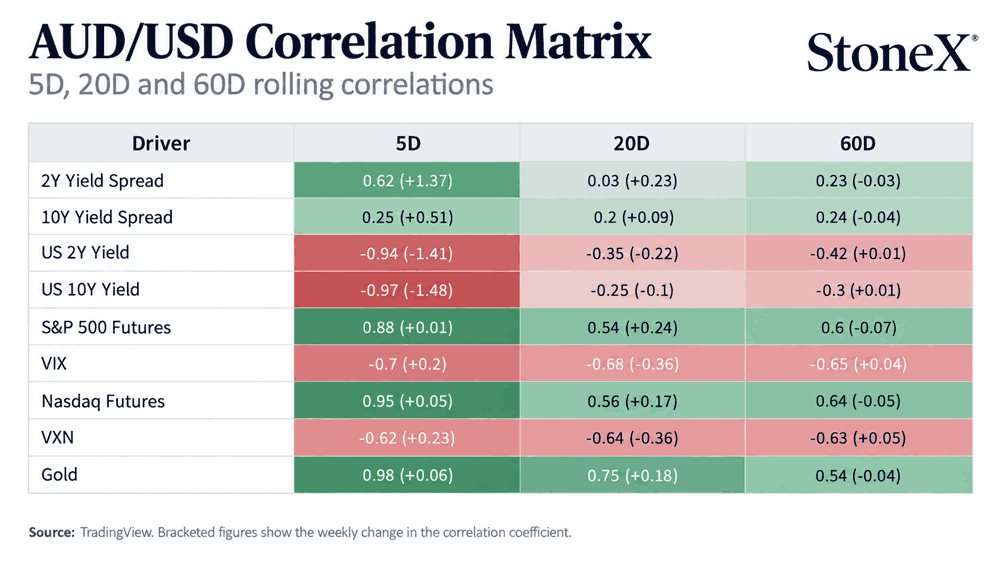
The matrix below reveals the Aussie’s consistent relationship with risk appetite across short, medium and longer-term timeframes. Correlations with S&P 500 futures stand at +0.88 over five days, +0.54 over 20 days and +0.60 over 60 days, while the relationship with Nasdaq futures sits at +0.95, +0.56 and +0.64 respectively. VIX and VXN show similarly consistent inverse relationships across all three periods.
Source: TradingView
More recently, however, there has been a rapid increase in the inverse correlation with US yields across the front end and belly of the curve. The five-day correlation with US two-year yields has strengthened to -0.94, while the relationship with US 10-year yields stands at -0.97, coinciding with a period where hawkish repricing has generally picked up, albeit not uniformly.
What has really stood out recently is the magnitude of the Aussie’s reaction to shifts in those markets. When US yields have risen and risk appetite has deteriorated, pullbacks in AUD/USD have been shallow. In contrast, when yields have eased and risk appetite has picked up, the upside response has tended to be considerably larger.
Yen Strength Adds to Dollar Pressure
When trying to assess the Aussie’s asymmetric reaction function, you can’t help but notice what’s been going on in USD/JPY, which has continued to unwind following the record intervention episode seen in late July and early August, along with potential intervention at the start of this month. That has sent the yen to its strongest level against the US dollar since February this year.
That, in turn, is helping other Asian currencies strengthen against the USD, perhaps explaining why the Aussie has been far more sensitive to minor pullbacks in US yields and subsequent improvements in risk appetite than it has been to moves in the opposite direction over the recent period.
On Monday, we saw another abrupt move lower in USD/JPY, which helped the Aussie push cleanly above the 0.7200 level. While there were headlines about potential GPIF repatriation flows, carry-trade unwinds and continued chatter around hawkish BOJ repricing, which has now seen more than three hikes priced into the curve by the middle of next year, including a strong possibility of two this year, none of those factors could be described as anything remotely new, having been known for weeks beforehand.
Instead, the move had all the usual hallmarks of what we saw during the previous intervention episode, with another big dump occurring in early European trade. Regardless of what factor it was, be it one or many, as USD/JPY unwound, the Aussie perked up on what was an otherwise quiet session.
US Inflation Data Looms Large
Source: TradingView
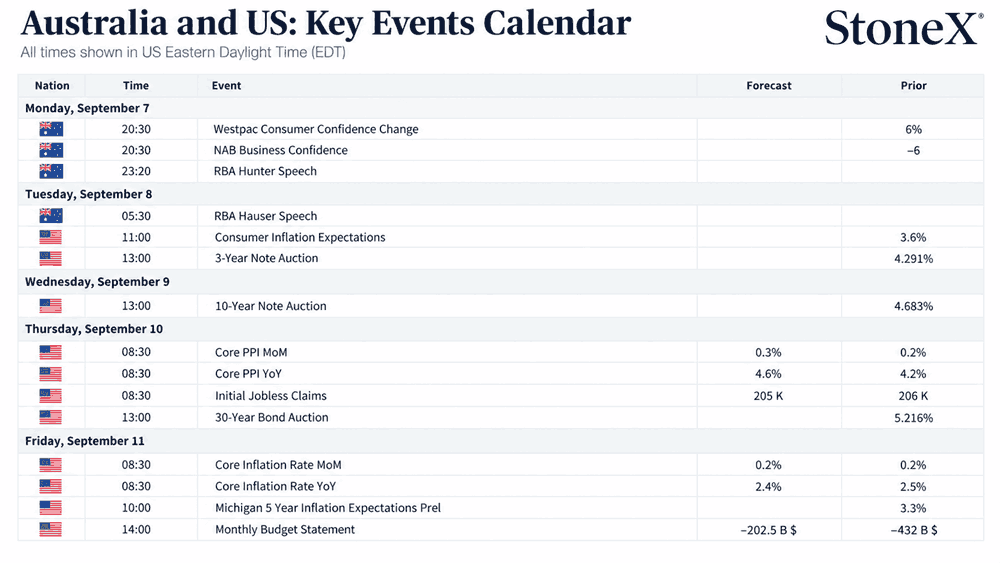
There’s little in the US calendar today that screams we’ll see a major shift in Fed pricing and, therefore, the US yield curve. We also don’t know how risk appetite is going to behave, leaving the known knowns for the Aussie largely on the domestic side.
Rather than the NAB Business or Westpac Consumer Confidence surveys, which have rarely demonstrated the ability to dial up volatility in the Aussie, the more likely catalysts for movement come from RBA Chief Economist Sarah Hunter's fireside chat along with Deputy Governor Andrew Hauser's appearance on a prominent Australian TV show later in the session. With market pricing now around two in three for an RBA rate hike later this month, any nod towards that pricing or attempt to push back against it looms as the most likely candidate to spark near-term volatility in the Aussie.
Of course, the key event not only for AUD/USD but broader markets arrives later in the week, with US PPI on Thursday and CPI on Friday. The latter in particular looms as the key market catalyst that could determine whether the Aussie’s break higher morphs into a breakout or an abrupt reversal.
Technicals Favour Bullish Bias
Source: TradingView
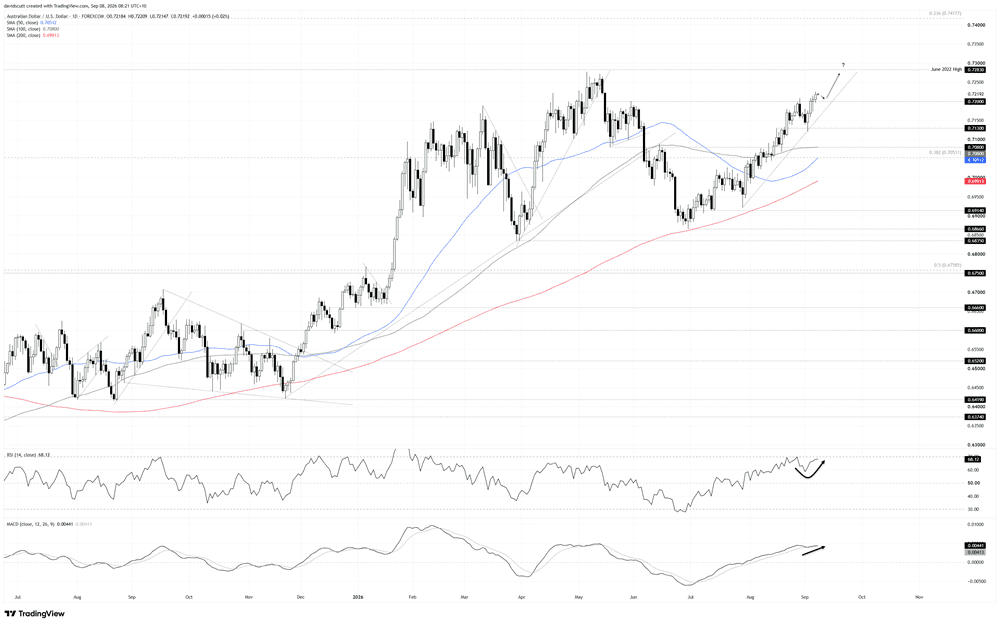
As seen on the daily chart, AUD/USD sits above its key medium and long-term moving averages, all of which carry a positive slope. It remains in a strong uptrend and, while we haven’t seen a higher high set in RSI 14 yet, it still sits at levels that suggest upside momentum is starting to rebuild, a message confirmed by MACD, which remains above the signal line in positive territory.
Be it the price action or the oscillators, the backdrop favours longs over shorts, with the move above 0.7200 opening the door for fresh long positions to be established. Entry could be placed above the level with a tight stop beneath for protection, targeting either the year-to-date high of 0.7276 or the June 2022 high of 0.7283. Both screen as potential targets.
A break above the latter would see the pair enter something of an air pocket, with very little resistance evident until 0.7418, marking the 23.6% Fibonacci retracement of the pandemic low-high move.
If AUD/USD were to reverse back beneath 0.7200, downside levels to watch include the uptrend running from the low set in late July, found today just above 0.7150, along with 0.7130 and 0.7080, where the 100-day moving average is also found.
Latest market news










Web Trader platform
Our sophisticated web-based platform is packed with features.
Open an account today
Experience award-winning platforms with fast and secure execution.
Economic calendar
Related articles

FX Futures Positioning: Dollar Rebound Meets Diverging Forex Bets | COT Report
US dollar longs held firm into Jackson Hole, while euro, yen and commodity FX positioning diverged ahead of ISM and NFP.


Gold and S&P 500 analysis: What now after Warsh’s hawkish speech?
The dollar surged across the board after the Fed Chair Kevin Warsh surprised with a hawkish-leaning speech at the Jackson Hole summit. All the bearish dollar bets that had been accumulated since last Friday on the back of data weakness and bond market troubles had to be squared and that triggered a short squeeze rally for the dollar. Gold and silver dropped, as a result, as too did bitcoin, while US indices were giving back earlier gains.


EUR/USD forecast: All eyes on Warsh at Jackson Hole - Forex Friday
For much of this week, the EUR/USD has been edging lower with the US dollar regaining some ground after last week’s sell-off that was triggered, in part, by the bond market worries. Investors have been unwilling to bet further against the US dollar so far this week ahead of Kevin Warsh’s keynote speech at the Jackson Hole summit, due later today.