


USDCAD Analysis Canadian dollar weakens as tariff risks return
It has not been an easy start to the week for the Canadian dollar. Now, renewed weakness in the currency is becoming evident, while USD/CAD has gained more than 0.6% over the last 2 trading sessions, reflecting U.S. dollar strength and a new loss of momentum in the CAD.
Written by
Julian Pineda
Market Analyst
It has not been an easy start to the week for the Canadian dollar. Now, renewed weakness in the currency is becoming evident, while USD/CAD has gained more than 0.6% over the last 2 trading sessions, reflecting U.S. dollar strength and a new loss of momentum in the CAD.
Although buying pressure in the pair had already started to emerge after the release of CPI inflation data in Canada, it has become more evident following recent comments about possible new tariffs on the country. This event has started to reduce confidence and could continue to affect the Canadian dollar in the short term, keeping relevant buying pressure in USD/CAD over the next few trading sessions.

Are new tariffs on the way?
Recently, the United States announced a new package of tariffs on goods coming from Canada, with rates that could reach up to 50% of the value of some products, including items ranging from wine to sporting goods. In addition, it has been mentioned that these new tariffs could include goods that are part of the North American trade agreement, the USMCA.
This event has not been favorable for confidence around the Canadian economy. Although Canada has tried to make progress on trade agreements with other countries, its economy remains strongly linked to trade activity with the United States. The latest trade balance data show that, by the end of 2025, more than 72% of Canadian exports were still directed to the United States compared with the rest of the world.
This keeps concerns around Canada’s economic dependence on its main trading partner in focus, especially if recent comments about new tariffs materialize and affect this relationship in the short term.
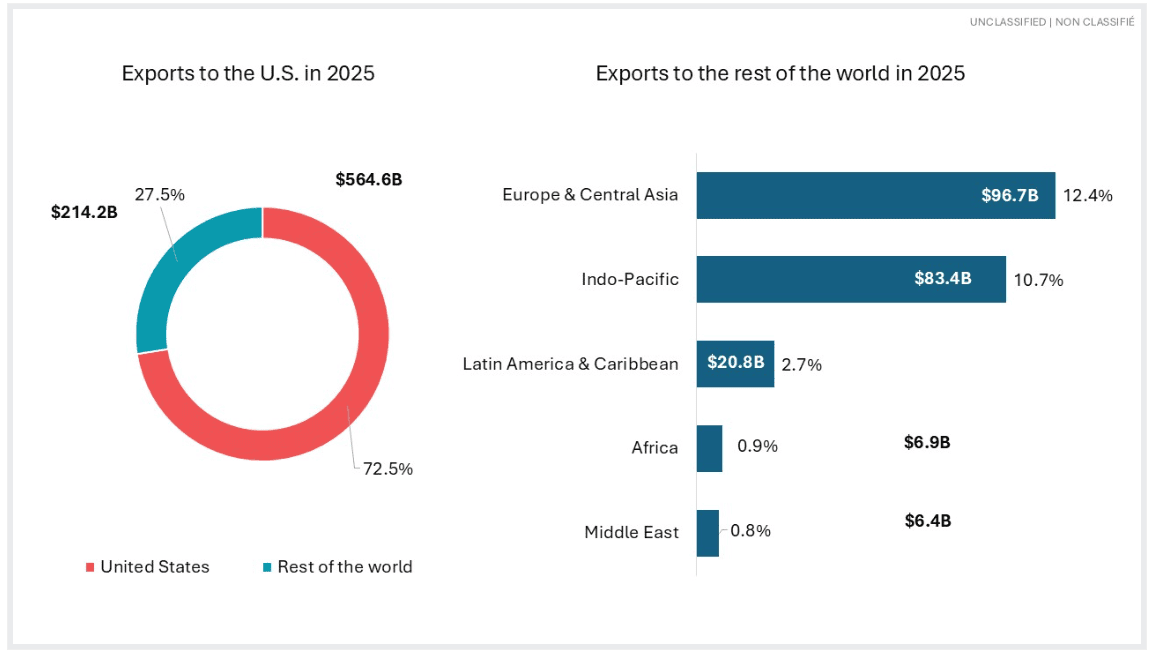
Source: InternationalCanada
With all of this in mind, the situation remains difficult for Canadian dollar strength. If the new tariffs materialize, they could affect growth expectations in Canada and limit the flow of foreign currency into the country.
For this reason, uncertainty could remain relevant, especially if recent comments turn into concrete measures. In this scenario, the Canadian dollar could struggle to gain ground consistently against the U.S. dollar, which would continue to favor possible buying pressure in USD/CAD over the next few sessions.
Do inflation data also have an impact?
During the previous session, CPI inflation data in Canada was released. Although the market expected an annual reading of 2.9%, the figure came in at 2.8%, showing a slight slowdown from the recent high of 3.2% observed in May.
This moderation brings inflation closer again to the approximate 2.00% target and reduces concerns about a stronger acceleration in Canadian prices. For this reason, the Bank of Canada could face less pressure to adopt a more aggressive stance over the coming months.
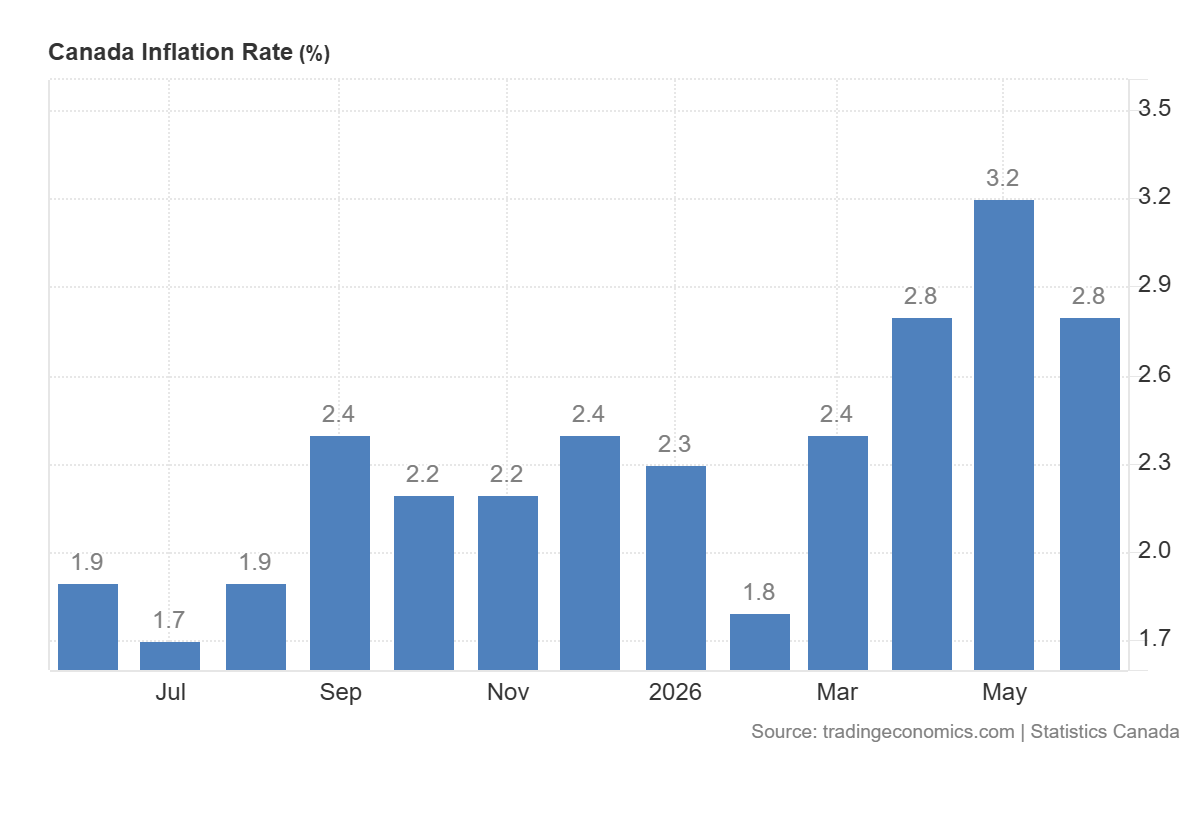
Source: TradingEconomics
Market expectations point in the same direction. For the September and October decisions, the probability table shows more than a 60% chance that interest rates will remain without relevant changes.
This limits the appeal of the Canadian dollar against the U.S. dollar. Canada’s reference rate, at 2.25%, remains considerably lower than the U.S. rate, which stands at 3.75%. This difference favors USD-denominated investments, especially due to the higher yield offered by the U.S. fixed-income market.
For this reason, the inflation reading could continue to weigh on the CAD and maintain relevant buying pressure in USD/CAD over the next few trading sessions.
Technical forecast for USD/CAD
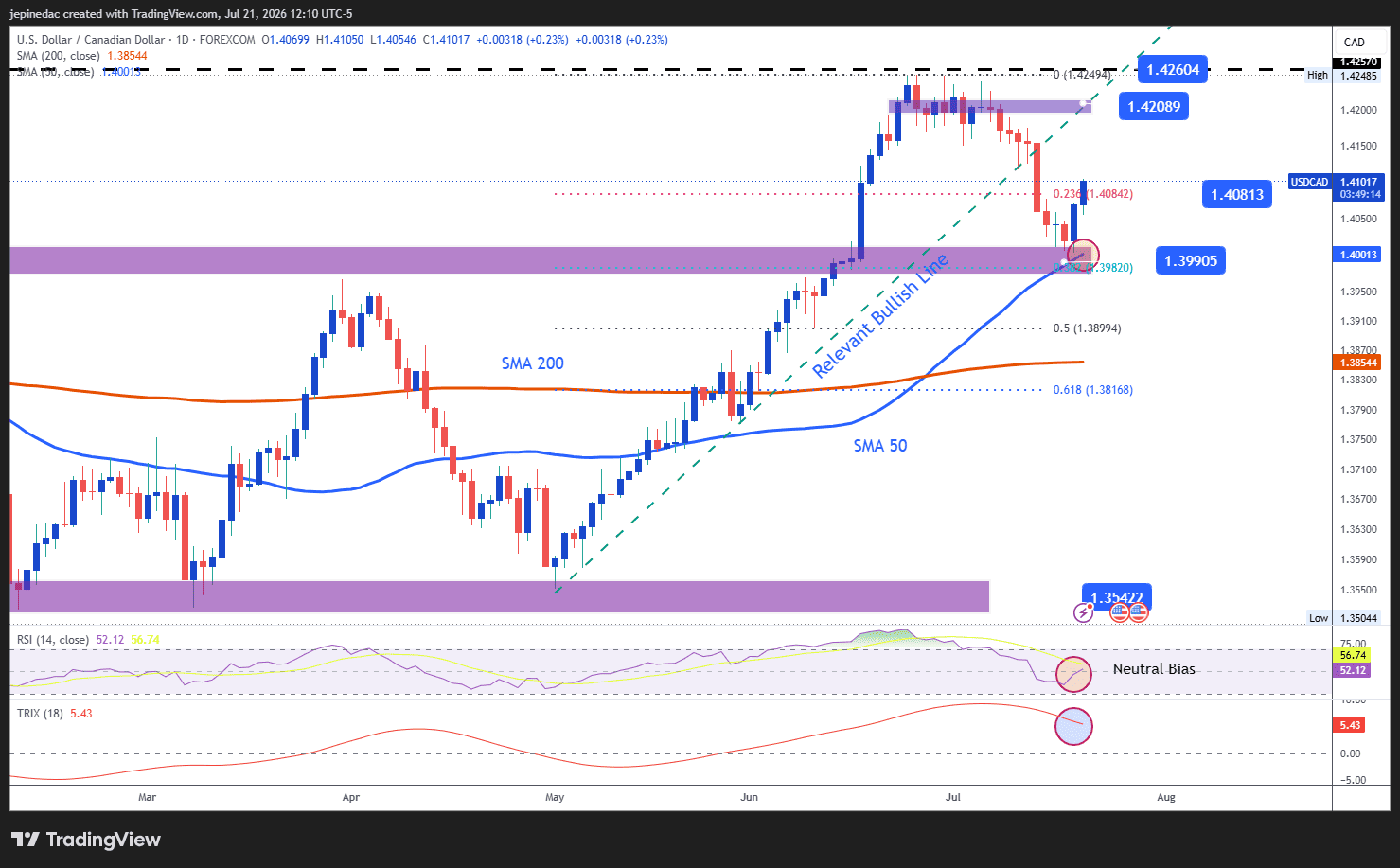
Source: StoneX, Tradingview
- New recovery becomes relevant: For several trading sessions, USD/CAD managed to break a long bullish trend line that had been in place for several months. However, selling strength has not fully dominated the chart. The new recovery has pushed price back above the 50-period simple moving average, indicating that the buying bias seen in previous months has not fully disappeared. If this behavior continues, room could open for a more relevant phase of indecision or even for an attempt to recover the previous bullish trend line.
- RSI: The RSI line remains close to the 50 level. This indicates that, for now, there is still a balance between bullish and bearish impulses in the market over the last 14 sessions. This reading shows that a possible indecision bias could remain relevant in USD/CAD movements over the next few trading sessions.
- TRIX: Now, the TRIX line has started to show relevant declines, although it still remains above the neutral 0 level. This reflects that bullish strength remains dominant on average across long-term exponential moving averages. For this reason, the broader buying bias from previous months may not have fully disappeared from the long-term chart.
Key levels:
- 1.42089 – Relevant resistance: This 2026 high remains the most important buying barrier on the chart. Price movements toward this area could reactivate a buying bias and restore relevance to the bullish trend line that was important in previous weeks.
- 1.40813 – Near-term barrier: This nearby area corresponds to the most relevant 23.6% Fibonacci level on the chart. Price movements that fail to move consistently away from this level could continue to highlight an important neutral phase and even open room for the formation of a short-term sideways range over the next few sessions.
- 1.39905 – Crucial support: This relevant bearish barrier corresponds to the 38.2% Fibonacci retracement area and also aligns with the 50-period simple moving average. Price movements below this level could reaffirm a more consistent selling bias and open room for a possible short-term bearish trend line over the next few sessions.
Written by Julian Pineda, CFA, CMT – Market Analyst
Follow him on: @julianpineda25







Web Trader platform
Our sophisticated web-based platform is packed with features.
Open an account today
Experience award-winning platforms with fast and secure execution.
Economic calendar
Related articles

Euro Short-term Outlook: EUR/USD Pullback Nears Pivotal Uptrend Support 8 28 2026
Warsh's comments accelerated the EUR/USD selloff, raising the stakes as buyers look to stabilize the broader recovery.


EUR/USD forecast: All eyes on Warsh at Jackson Hole - Forex Friday
For much of this week, the EUR/USD has been edging lower with the US dollar regaining some ground after last week’s sell-off that was triggered, in part, by the bond market worries. Investors have been unwilling to bet further against the US dollar so far this week ahead of Kevin Warsh’s keynote speech at the Jackson Hole summit, due later today.


AUD/CAD breakout puts the Bradman barrier in sight
A bullish breakout has pushed AUD/CAD to its highest level since early 2021. Whether it can clear 0.9994 may determine if the move extends well above parity.
