


USDCAD Forecast Fed expectations keep pressure on the Canadian dollar
Despite the Canadian dollar’s recovery attempts in previous weeks, a renewed loss of strength against the U.S. dollar is becoming evident. This is reflected in USD/CAD, which has gained more than 0.2% over the last 2 trading sessions, including the close of last week and the first session of this week.
Written by
Julian Pineda
Market Analyst
Despite the Canadian dollar’s recovery attempts in previous weeks, a renewed loss of strength against the U.S. dollar is becoming evident. This is reflected in USD/CAD, which has gained more than 0.2% over the last 2 trading sessions, including the close of last week and the first session of this week.
For now, buying pressure remains stable, in a context where the behavior of U.S. bonds and expectations around the Federal Reserve continue to limit a consistent recovery in the CAD. This is also being reinforced by uncertainty around possible trade tariffs on Canada, a factor that could remain relevant for the pair over the next few trading sessions.

Is the Federal Reserve still relevant?
When analyzing USD/CAD expectations, it is important to consider the central bank dynamic in both the United States and Canada. On one hand, the Bank of Canada maintains an outlook of unchanged rates near 2.25%. On the other hand, the United States continues to hold a higher reference rate at 3.75%.
What is relevant is that the Federal Reserve’s interest rate decision is expected this week, and market probabilities have started to gain importance. The event could reinforce expectations of a more aggressive monetary policy stance in the United States and widen the rate differential with Canada, favoring the relative appeal of USD-denominated investments.
For this week’s decision, the market assigns a probability close to 62.00% that there will be no change in interest rates. However, this probability was close to 83% one week ago, while the probability of a possible hike at the July 29 decision now stands near 38%.
In addition, for the September 16 meeting, the probability remains above 50% that the United States could raise interest rates toward a new area close to 4.00%.
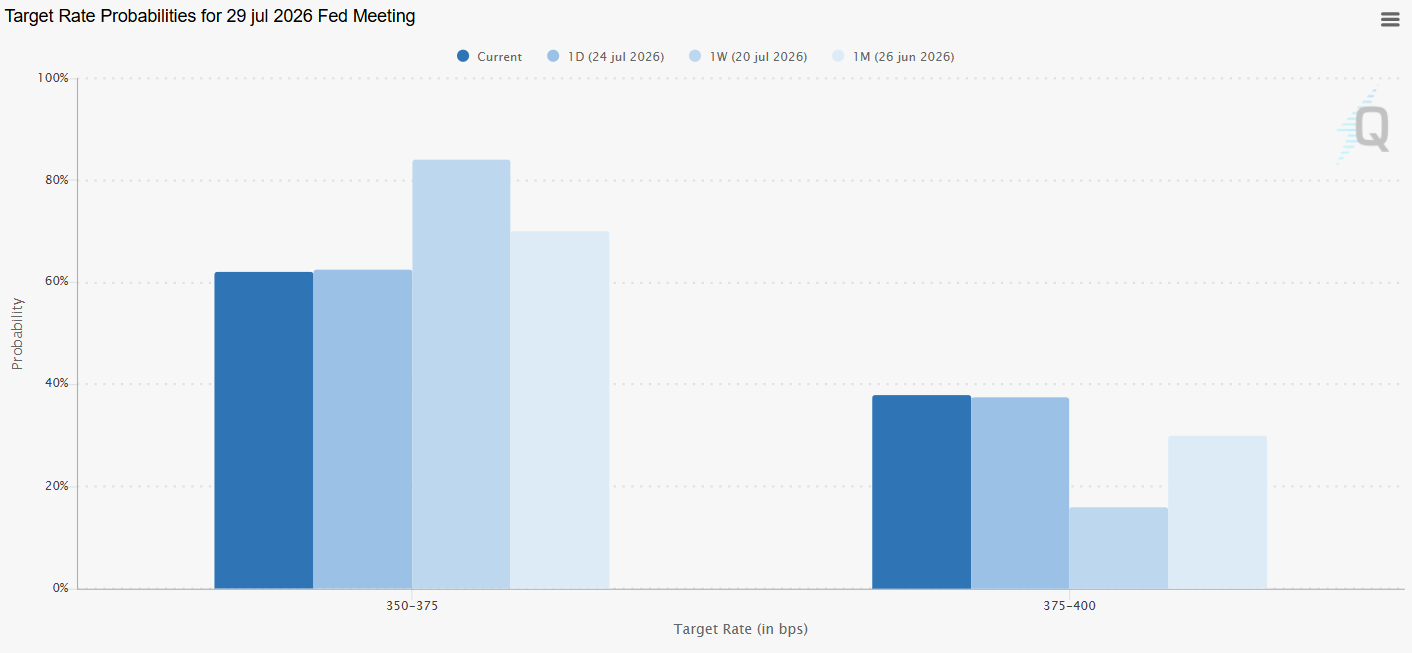
Source: CMEGROUP
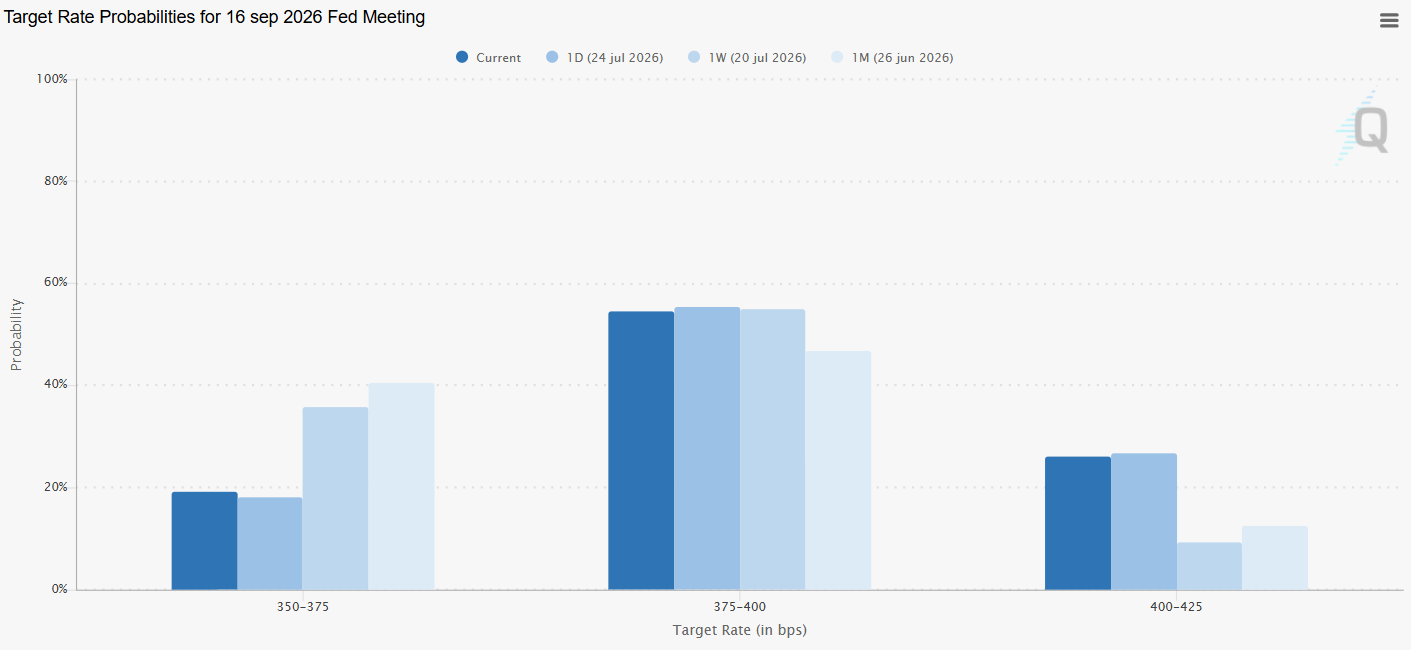
Source: CMEGROUP
With this in mind, and unlike the more neutral outlook from the Bank of Canada, the market is starting to consider a potentially more aggressive Federal Reserve over the coming months. This possibility could be confirmed by this week’s decision and continue to support the relative appeal of USD-denominated assets.
This scenario also helps sustain strength in the U.S. 10-year Treasury market. Now, these securities maintain a yield near the upper 4.6% area, around 2026 highs, representing a robust return for one of the safest markets in the world.
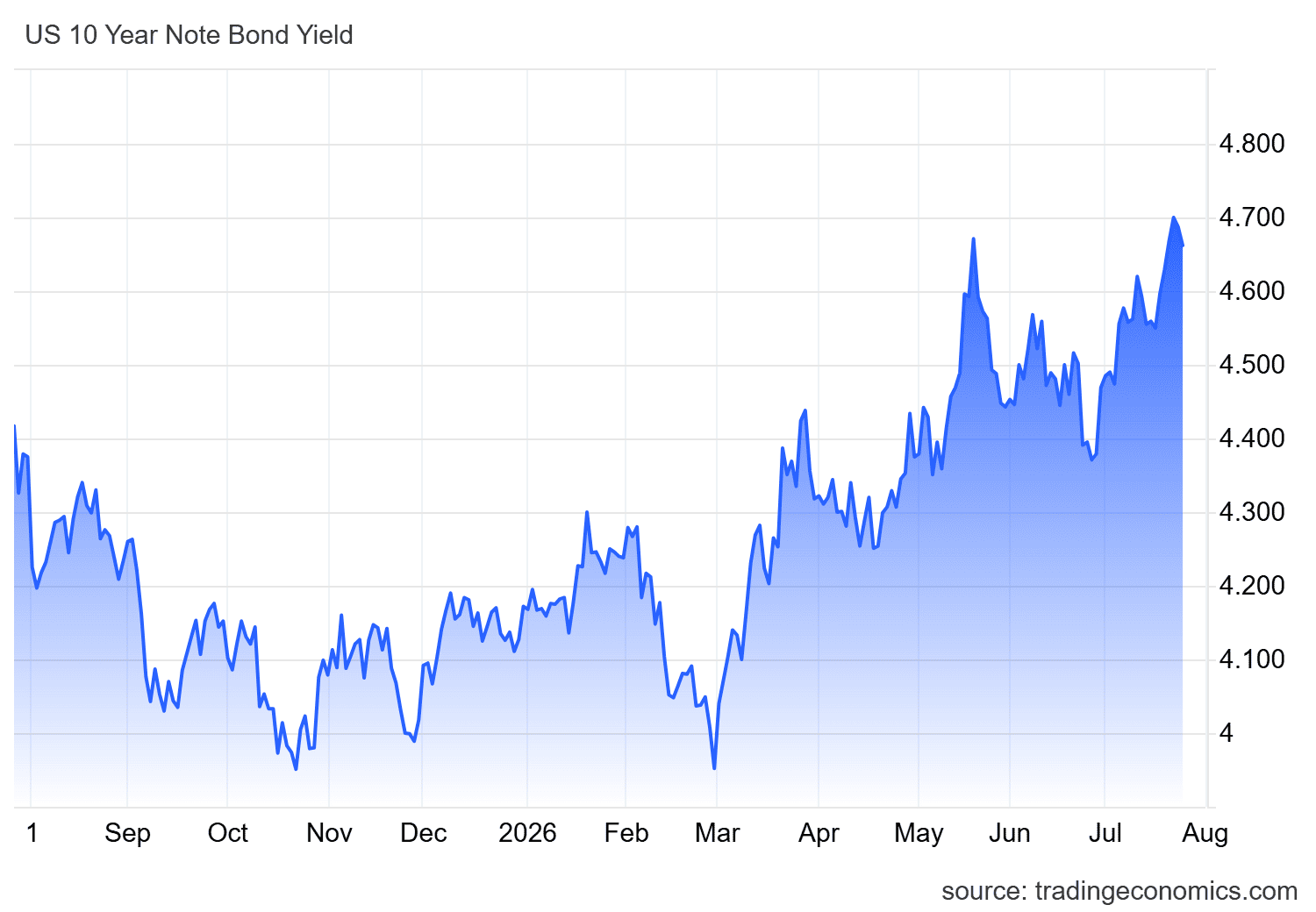
Source: TradingEconomics
Therefore, the situation remains complicated for the Canadian dollar. If the Bank of Canada maintains a neutral stance and the market continues to anticipate a more aggressive Fed, USD-denominated investments could preserve a relative advantage. This would make a clearer recovery in the CAD more difficult and could continue to support buying pressure in USD/CAD over the next few sessions.
Does the tariff threat remain in place?
So far, the threat of a 50% tariff on Canadian goods imposed by the United States last week remains relevant. The latest update is that Canada has not responded immediately with retaliatory measures, as Mark Carney announced that the country is intensifying negotiations with the United States before the tariffs come into effect.
However, no major progress has been seen yet that would reduce this threat in the short term. Trade uncertainty remains elevated, especially because the goods directly affected are estimated to represent nearly 28 billion Canadian dollars in exports. This could significantly affect Canadian trade and confidence around investments in Canada.
For this reason, the tariff issue could continue to weigh on the Canadian dollar. If no solid negotiations are seen that remove the threat of new tariffs, the appeal of the CAD could remain limited, and USD/CAD could maintain relevant buying pressure over the next few trading sessions.
Technical forecast for USD/CAD
Source: StoneX, Tradingview
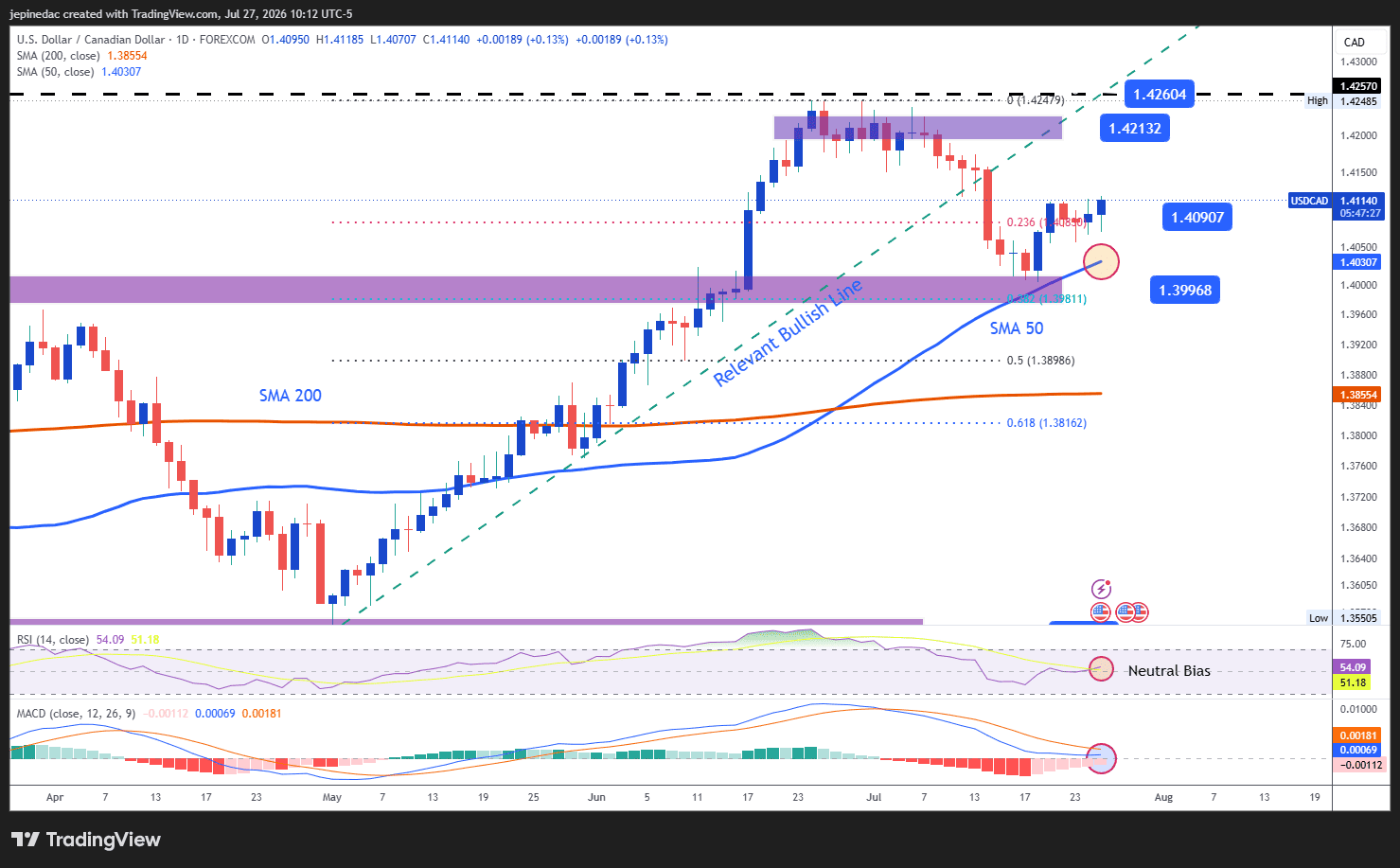
- Lack of direction begins to become evident: Over the last few weeks, USD/CAD has started to show a phase of neutrality on the chart, with most movements taking place between an upper area near 1.42132 and a lower area around 1.39968. For now, price continues to move within these levels. If it fails to break consistently out of this possible range, indecision could continue to gain relevance in the short term.
- RSI: Now, the RSI remains close to the neutral 50 level and shows important flattening. This reflects a balance between buying and selling impulses over the last few sessions. If this behavior continues, the indicator could continue to highlight a relevant neutral phase over the next few sessions.
- MACD: The MACD also maintains a histogram close to the neutral 0 level, suggesting balance in the strength of short-term moving averages. This reading reinforces the possibility that the indecision phase could remain important for USD/CAD over the next few sessions.
Key levels:
- 1.42132 – Relevant resistance: This area corresponds to 2026 highs and remains the main bullish barrier on the chart. Price movements toward this level could reactivate a buying bias and open room for a possible recovery of the bullish trend line that was relevant in previous weeks.
- 1.40907 – Near-term barrier: This area corresponds to the most relevant 23.6% Fibonacci level on the chart. Price movements that fail to move consistently away from this level could continue to highlight an important neutral phase and even open room for a more relevant short-term sideways range.
- 1.39968 – Crucial support: This relevant bearish barrier corresponds to the 38.2% Fibonacci retracement and also aligns with the 50-period simple moving average. Price movements below this level could reaffirm a more consistent selling bias and open room for a possible short-term bearish trend line over the next few sessions.
Written by Julian Pineda, CFA, CMT – Market Analyst
Follow him on: @julianpineda25







Web Trader platform
Our sophisticated web-based platform is packed with features.
Open an account today
Experience award-winning platforms with fast and secure execution.
Economic calendar
Related articles

Euro Short-term Outlook: EUR/USD Pullback Nears Pivotal Uptrend Support 8 28 2026
Warsh's comments accelerated the EUR/USD selloff, raising the stakes as buyers look to stabilize the broader recovery.


Nasdaq 100 Forecast: NDX slips ahead of Fed Chair Warsh’s speech
U.S. stocks are edging lower on Friday, giving back some of yesterday's gains after Nvidia's strong outlook revived the tech trade. The focus has now shifted firmly to Fed Chair Kevin Warsh's Jackson Hole speech, with investors looking for more clarity on the outlook for interest rates.


EUR/USD forecast: All eyes on Warsh at Jackson Hole - Forex Friday
For much of this week, the EUR/USD has been edging lower with the US dollar regaining some ground after last week’s sell-off that was triggered, in part, by the bond market worries. Investors have been unwilling to bet further against the US dollar so far this week ahead of Kevin Warsh’s keynote speech at the Jackson Hole summit, due later today.
