


USDMXN Forecast Mexican peso stays neutral as uncertainty persists
Although USD/MXN has declined more than 0.8% over the last few sessions, favoring the Mexican peso, the broader chart still does not show a clear direction. For now, the Mexican currency remains in an important neutral phase, in a context where the renewed threat of tariffs in North America and the lack of strong signals continue to limit confidence.
Written by
Julian Pineda
Market Analyst
Although USD/MXN has declined more than 0.8% over the last few sessions, favoring the Mexican peso, the broader chart still does not show a clear direction. For now, the Mexican currency remains in an important neutral phase, in a context where the renewed threat of tariffs in North America and the lack of strong signals continue to limit confidence.
In this scenario, a phase of indecision could continue to be part of USD/MXN movements over the next few trading sessions, at least until relevant economic data is released.

Is the Mexican peso failing to stabilize confidence?
Over the last few sessions, the relationship between the U.S. dollar and the Mexican peso has continued to be shaped by bond market dynamics. In both countries, yields have shown consistent increases, with Mexico’s 10-year bonds above 9.00% and U.S. 10-year bonds above 4.6%.
This differential still provides some relative appeal for peso-denominated investments, especially compared to dollar-denominated assets. This has been one of the reasons why the Mexican peso has not lost value consistently against the dollar in recent months. In addition, the difference between both central banks’ reference rates, with 6.5% in Mexico versus 3.75% in the United States, remains an important factor for the pair’s behavior.
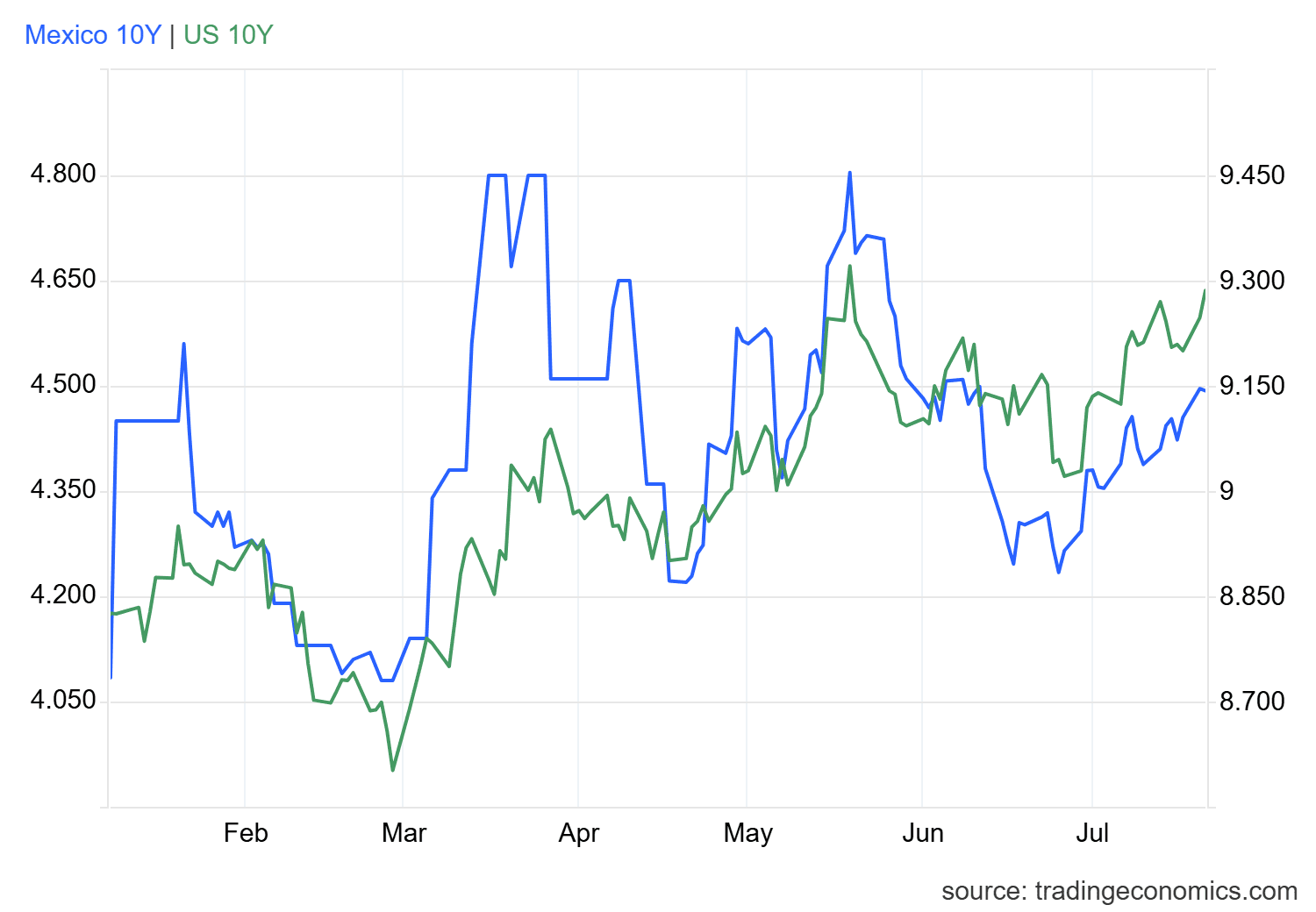
Source: TradingEconomics
However, this relative appeal has not been enough to generate dominant strength in the Mexican peso. Part of this is explained by the moderation of inflation in Mexico, which has led the Bank of Mexico to maintain a more neutral tone in recent comments. For now, monetary policy appears focused on waiting and avoiding relevant short-term changes.
At this point, the dynamic could start to shift. While Banxico maintains a more neutral outlook, the Federal Reserve could still adopt a more aggressive tone over the coming months. According to the CME Group probability table, for the September 2026 decision, there is still a probability above 54% that the United States could deliver its first rate hike of the year, taking the rate toward a new area near 4.00%.
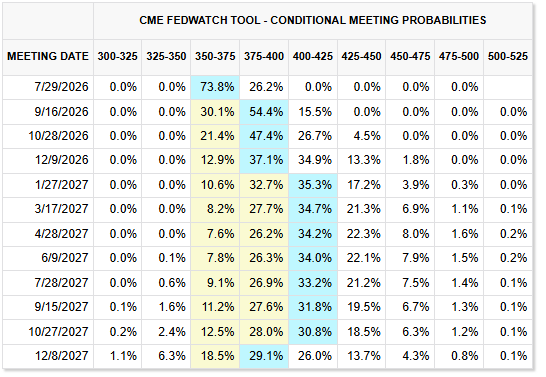
Source: CMEGROUP
This shift is relevant because a more aggressive Fed stance could reduce the rate differential that has favored Mexican bonds and, by extension, the Mexican peso for several months. At the same time, if dollar-denominated assets begin to offer higher yields, they could become more attractive than peso-denominated investments, which are usually perceived as riskier.
For this reason, the possibility of a more aggressive Fed continues to generate uncertainty and limits a clearer recovery in the peso. If Banxico’s comments continue to point to a neutral stance and the market maintains expectations of higher rates in the United States, the phase of indecision could remain relevant in USD/MXN over the coming weeks.
Could new tariffs have an impact?
Recently, the possibility of renewed trade tensions in North America gained traction again after the United States signaled new tariffs on several Canadian products, with rates of up to 50% in the short term.
Although this event does not directly affect the Mexican economy, it does serve as a warning signal. In previous rounds of trade tension, both Canada and Mexico were exposed to tariff measures, and for now, there have been no major advances in negotiations related to the USMCA between Mexico and the United States.
This point is relevant because close to 80% of Mexican exports are directed to the United States. For this reason, any trade escalation that includes Mexico could quickly affect confidence in the Mexican peso, as has already happened during previous periods of tension. If more aggressive comments or measures against the Mexican economy emerge, USD/MXN could start to show more relevant buying pressure over the coming weeks.
Technical forecast for USD/MXN
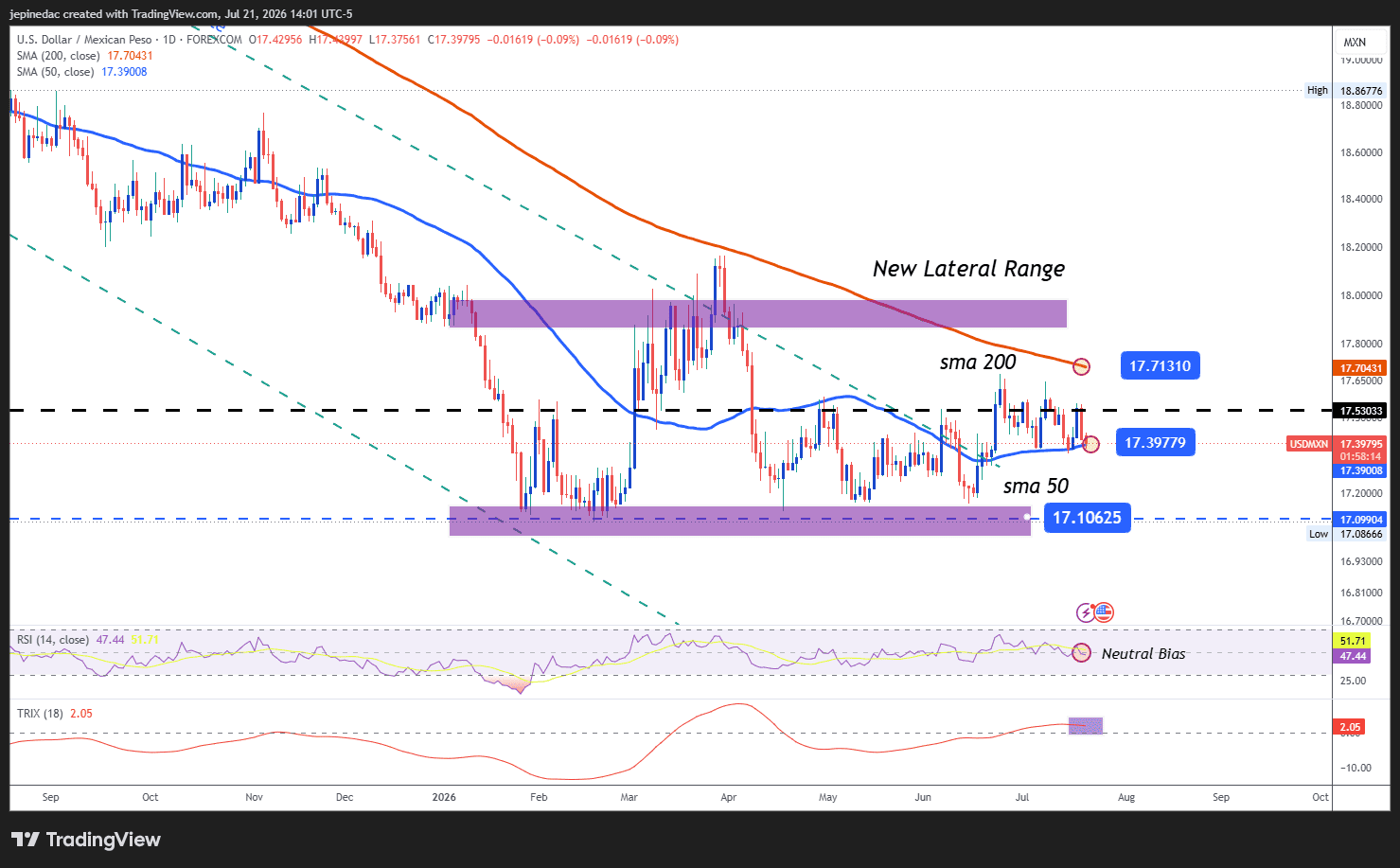
Source: StoneX, Tradingview
- Sideways range continues to dominate: For several months, USD/MXN has continued to trade within a broad long-term sideways range. Despite price movement attempts, neutrality remains the dominant feature on the chart. For now, this range remains the most important technical structure to watch and could continue to reflect a lack of direction over the next few trading sessions.
- RSI: Now, the RSI line remains close to the neutral 50 level. This indicates a balance between buying and selling impulses in the market. This reading confirms that the phase of indecision remains relevant for short-term USD/MXN movements.
- TRIX: The TRIX line shows a similar dynamic, with movements close to the neutral 0 level. This reflects balance in the strength of long-term exponential moving averages. As long as this behavior continues, price neutrality could remain important over the next few sessions.
Key levels:
- 17.71 – Main resistance: This recent high zone coincides with the 200-period simple moving average. Sustained movements toward this area could mark the beginning of a more consistent buying bias and open room for the possible formation of a bullish trend line over the coming weeks.
- 17.39 – Current barrier: This relevant retracement level from recent weeks and important neutral zone coincides with the 50-period simple moving average. If price fails to move away from this level, the phase of indecision could be reinforced and the sideways range could extend over the medium term.
- 17.10 – Relevant support: This area corresponds to the 2026 lows and remains the main bearish barrier for now. Moves toward this level could bring the selling bias back into focus and open the way for a continuation of the descending channel that had remained the dominant structure months ago.
Written by Julian Pineda, CFA, CMT – Market Analyst
Follow him on: @julianpineda25







Web Trader platform
Our sophisticated web-based platform is packed with features.
Open an account today
Experience award-winning platforms with fast and secure execution.
Economic calendar
Related articles

Euro Short-term Outlook: EUR/USD Pullback Nears Pivotal Uptrend Support 8 28 2026
Warsh's comments accelerated the EUR/USD selloff, raising the stakes as buyers look to stabilize the broader recovery.


EUR/USD forecast: All eyes on Warsh at Jackson Hole - Forex Friday
For much of this week, the EUR/USD has been edging lower with the US dollar regaining some ground after last week’s sell-off that was triggered, in part, by the bond market worries. Investors have been unwilling to bet further against the US dollar so far this week ahead of Kevin Warsh’s keynote speech at the Jackson Hole summit, due later today.


AUD/CAD breakout puts the Bradman barrier in sight
A bullish breakout has pushed AUD/CAD to its highest level since early 2021. Whether it can clear 0.9994 may determine if the move extends well above parity.
