


AUD/USD Analysis: What's Next for the Australian Dollar After the RBA Decision?
Recent trading sessions have reflected a more neutral tone around the Australian dollar. This can be seen in AUD/USD price action, which has posted moves of roughly 0.2% over the last two sessions without establishing a clear direction. Much of this lack of momentum is linked to expectations surrounding the next policy moves from both the Reserve Bank of Australia (RBA) and the Federal Reserve.
Written by
Julian Pineda
Market Analyst
Recent trading sessions have reflected a more neutral tone around the Australian dollar. This can be seen in AUD/USD price action, which has posted moves of roughly 0.2% over the last two sessions without establishing a clear direction. Much of this lack of momentum is linked to expectations surrounding the next policy moves from both the Reserve Bank of Australia (RBA) and the Federal Reserve. As the RBA decision approaches, markets appear increasingly cautious while assessing whether Australian policymakers will maintain a sufficiently hawkish stance to counterbalance the recent strength of the U.S. dollar.
The RBA Decision Takes Center Stage
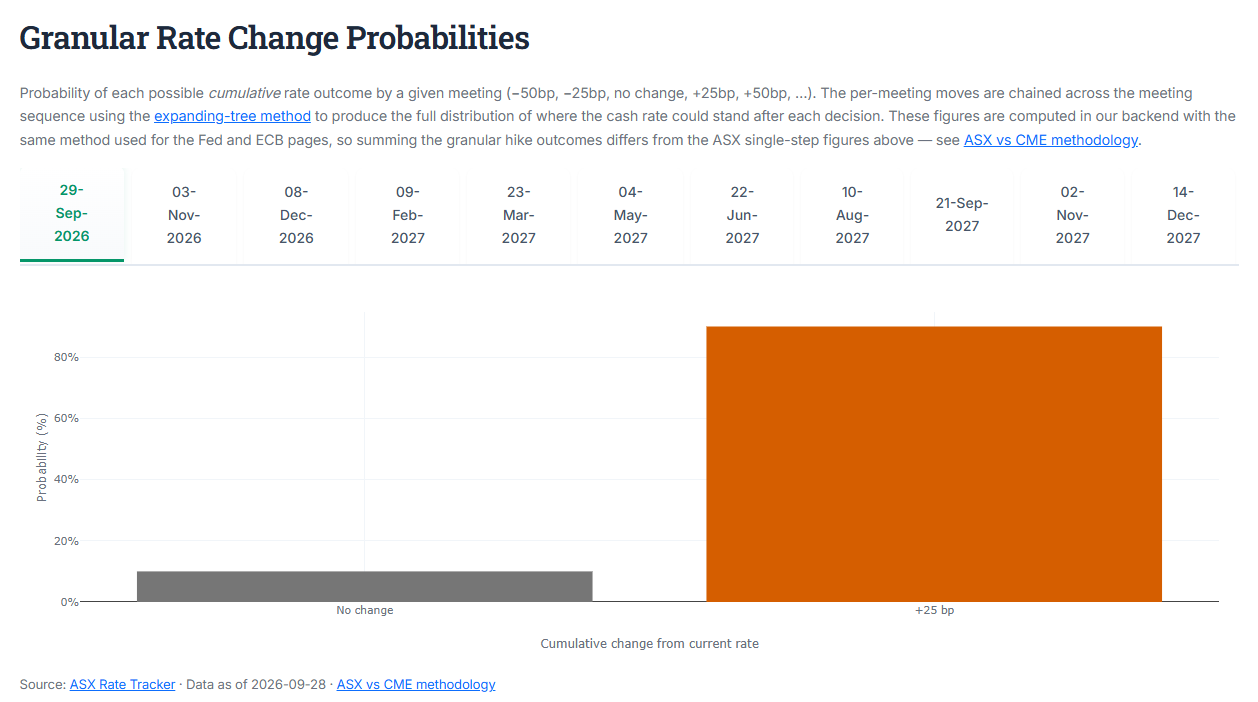
The September 29 monetary policy decision from the Reserve Bank of Australia is due later today and, for now, market expectations remain firmly tilted toward another interest rate increase. Investors are largely pricing in a move from 4.35% to 4.60%, with implied probabilities showing more than a 90% chance of such an outcome. This suggests that markets continue to believe the RBA will maintain a restrictive policy stance as inflation remains above desired levels.
Source: Centralbankwatch
However, the decision itself is only part of the story. What may ultimately matter more is the message that accompanies the announcement. The expected rate hike appears largely priced in, meaning traders will likely focus on any signals regarding the future path of monetary policy. In that regard, inflation remains the key variable.
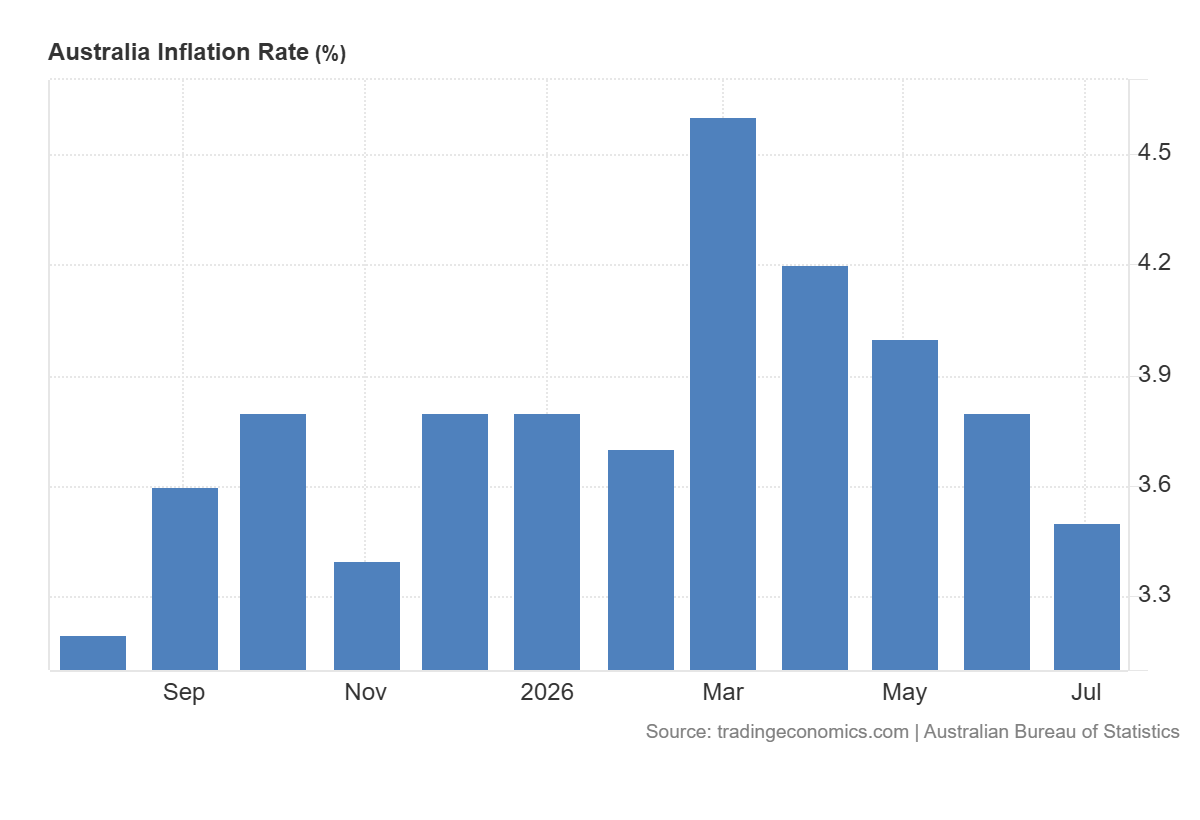
Australia's latest inflation figures, published for July, showed a gradual slowdown from the previous peak near 4.6%, but inflation still remained around 3.5%, well above the central bank's 2.00% target. More importantly, August inflation figures are scheduled for release later this week, and consensus expectations point to a rebound toward 4.1%. If confirmed, this could reinforce the view that inflation pressures remain persistent and that restrictive monetary policy may need to stay in place for longer, especially if the RBA maintains a hawkish tone following its decision.
Source: TradingEconomics
This situation is particularly important because the Australian dollar spent much of 2026 recovering ground against the U.S. dollar. More recently, however, part of that strength has faded as markets increasingly price in a more aggressive Federal Reserve.
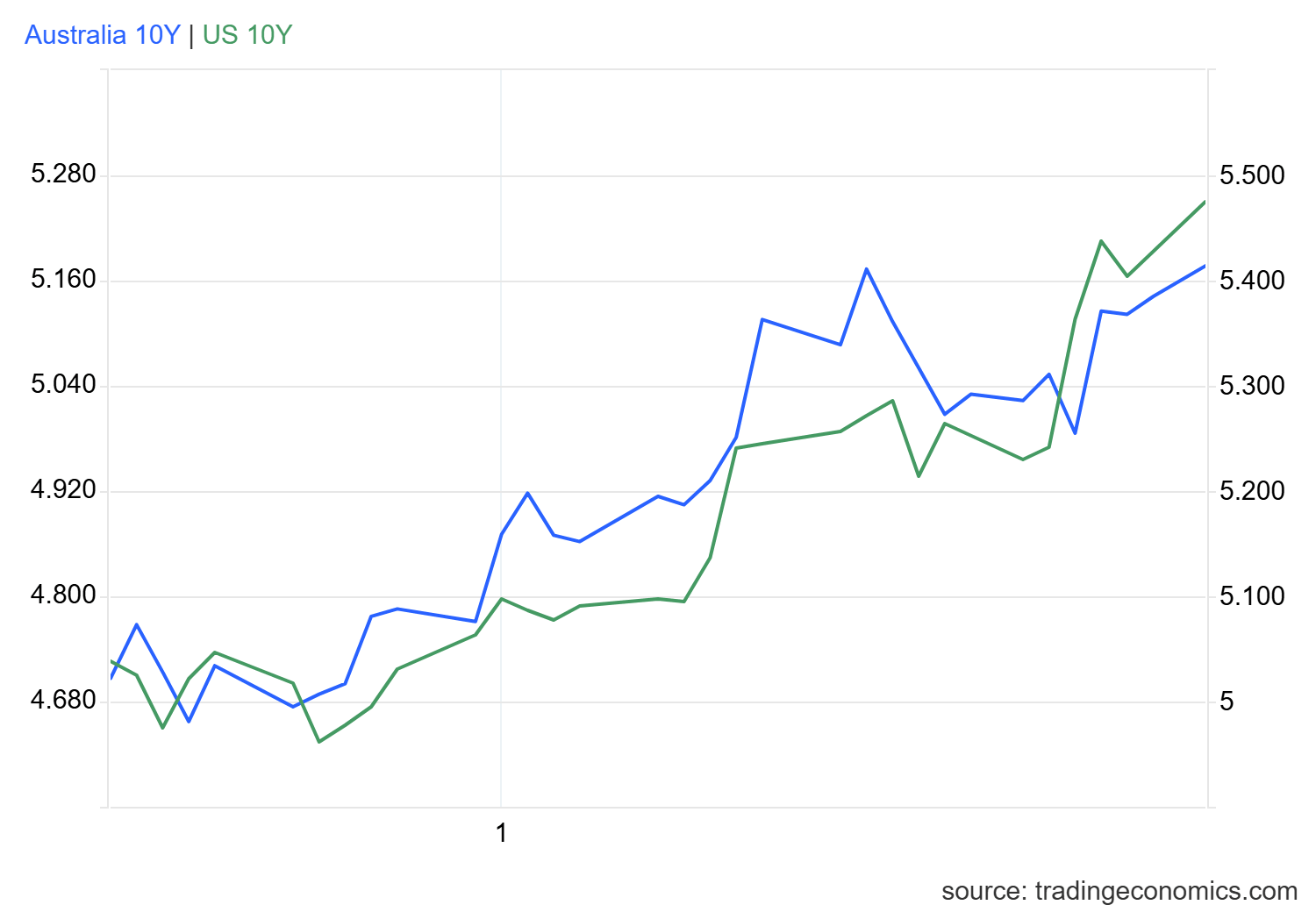
Even so, bond markets are beginning to show some interesting similarities. While U.S. 10-year Treasury yields continue to move higher and have already climbed above 5.2%, Australian 10-year government bond yields have also posted meaningful gains, rising above 5.4%. This matters because, although U.S. assets continue to benefit from a lower perceived risk profile, higher Australian yields are helping preserve the relative attractiveness of AUD-denominated investments.
Source: TradingEconomics
For this reason, if the RBA maintains a stance as hawkish as markets currently expect or even leaves the door open to additional tightening in the months ahead, the recent advance of the U.S. dollar may begin to face greater resistance against the Australian dollar. This could help support a more balanced trading environment around AUD/USD in the short term.
With this in mind, the next few sessions could prove especially important. Between the central bank decision and the release of inflation data, markets will receive key information to determine whether Australia can sustain a restrictive monetary policy stance for longer. If both events reinforce that narrative and continue to support Australian bond yields, the AUD may preserve some of its recent stability against the U.S. dollar. As a result, the lack of direction observed in recent sessions could remain a defining characteristic of AUD/USD in the near term.
AUD/USD Technical Forecast
Source: StoneX, Tradingview
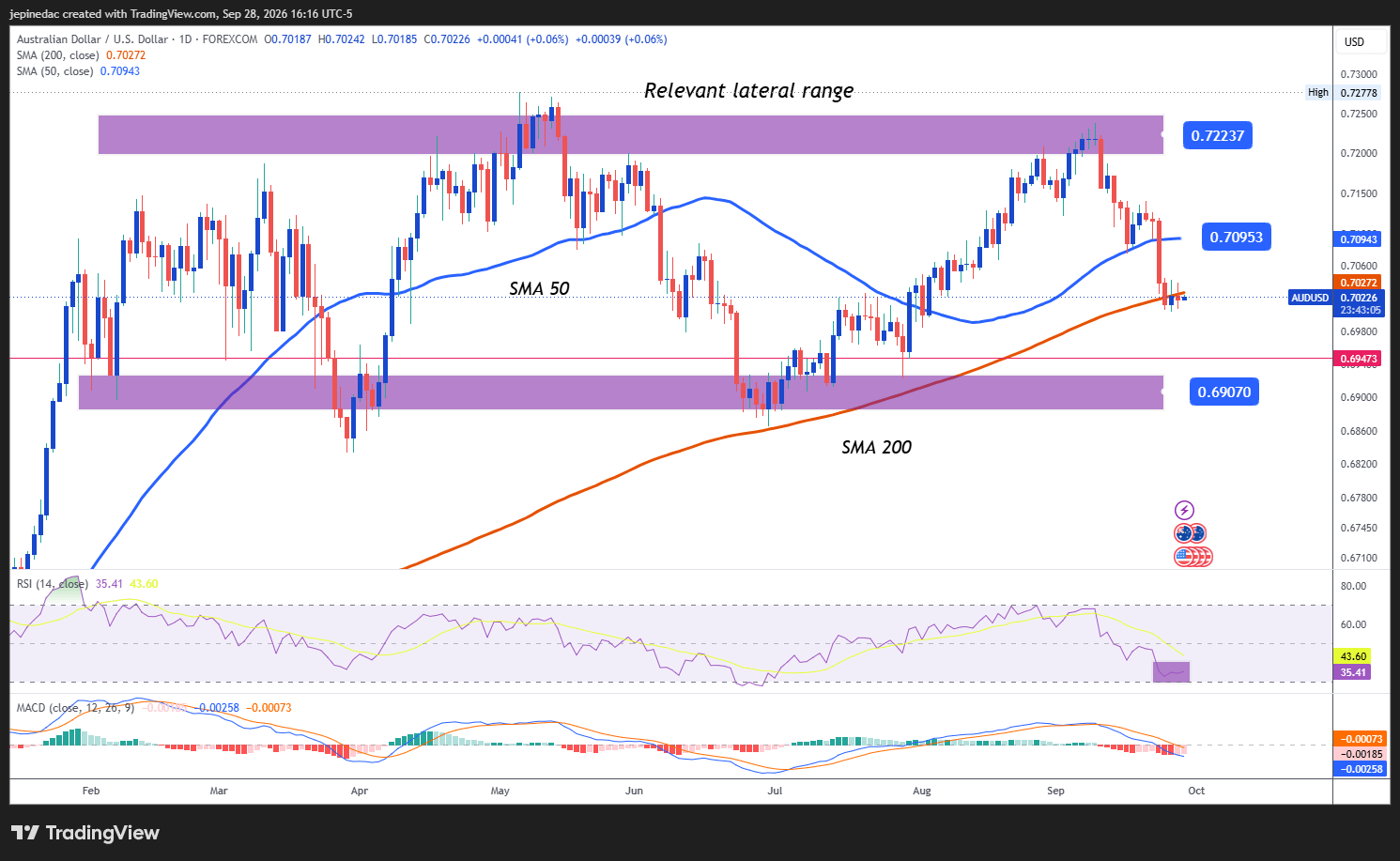
- The trading range remains the dominant structure: For several months, AUD/USD has struggled to establish a sustained directional trend. Instead, price action continues to develop within a broad trading range that remains the most important technical structure on the chart. As long as the key boundaries of this range continue to hold, the market may remain trapped in a largely directionless environment over the coming weeks.
- RSI: Although the RSI remains slightly below the 50 neutral level, the indicator has begun to flatten noticeably in recent sessions. This behavior reflects a growing balance between buying and selling pressure and suggests that short-term directional momentum is beginning to fade, a reading that aligns with the neutral backdrop currently dominating AUD/USD.
- MACD: A similar picture can be observed in the MACD, whose histogram continues to trade very close to the 0 neutral line. This reading also reflects a lack of clear direction in short-term moving averages and supports the possibility that this equilibrium phase remains relevant in the sessions ahead.
Key Levels:
- 0.72237 – Key Resistance: A major 2026 high that coincides with the upper boundary of the broader trading range. Sustained price action above this level could bring an end to the current consolidation structure and open the door to a more dominant bullish bias.
- 0.70953 – Near-Term Barrier: A level that coincides with the 50-period simple moving average and remains the closest technical reference to monitor in the event of short-term bullish corrections.
- 0.69070 – Major Support: An important retracement zone established in previous weeks and currently the most significant downside barrier on the chart. A move below this level could bring an end to the current neutral environment and pave the way for a more established bearish trend in the weeks ahead.
Written by Julian Pineda, CFA, CMT – Market Analyst
Follow him on: @julianpineda25
Latest market news










Web Trader platform
Our sophisticated web-based platform is packed with features.
Open an account today
Experience award-winning platforms with fast and secure execution.
Economic calendar
Related articles

EUR/USD forecast: All eyes on Warsh at Jackson Hole - Forex Friday
For much of this week, the EUR/USD has been edging lower with the US dollar regaining some ground after last week’s sell-off that was triggered, in part, by the bond market worries. Investors have been unwilling to bet further against the US dollar so far this week ahead of Kevin Warsh’s keynote speech at the Jackson Hole summit, due later today.


DAX and EUR/USD forecast: Lower energy prices, yields offer support
But the question, of course, is how much further oil prices and bond yields can fall. For now, the combination is supportive of risk assets and is helping to sustain a relatively benign decline in the dollar. The focus today will be on US core PCE inflation, due for release shortly, while Nvidia’s second-quarter earnings will provide another test for risk appetite after the US markets close – not just for US indices but for global tech-heavy indices given the influence Nvidia has over the global tech and AI names.

AUD/USD Shorts Bear the Brunt of Hot CPI, Renewed RBA Hike Bets
Hot Australian CPI revives RBA hike bets, lifts bond yields and adds fresh pressure to crowded AUD/USD short positions.
