


US Dollar Bulls Return as Euro and Pound Shorts Build | COT Report
US dollar net-longs surged at their fastest pace in seven years as futures traders added bearish exposure to the euro and British pound.
Written by
Matt Simpson
Market Analyst
US dollar bulls returned in force last week, with net-long exposure rising by $12.5 billion to $17.3 billion – the fastest weekly increase in seven years. Meanwhile, futures traders increased bearish exposure to both the euro and British pound as the dollar rally gathered momentum.
US Dollar Longs Surge as Euro and Pound Positioning Turns Bearish
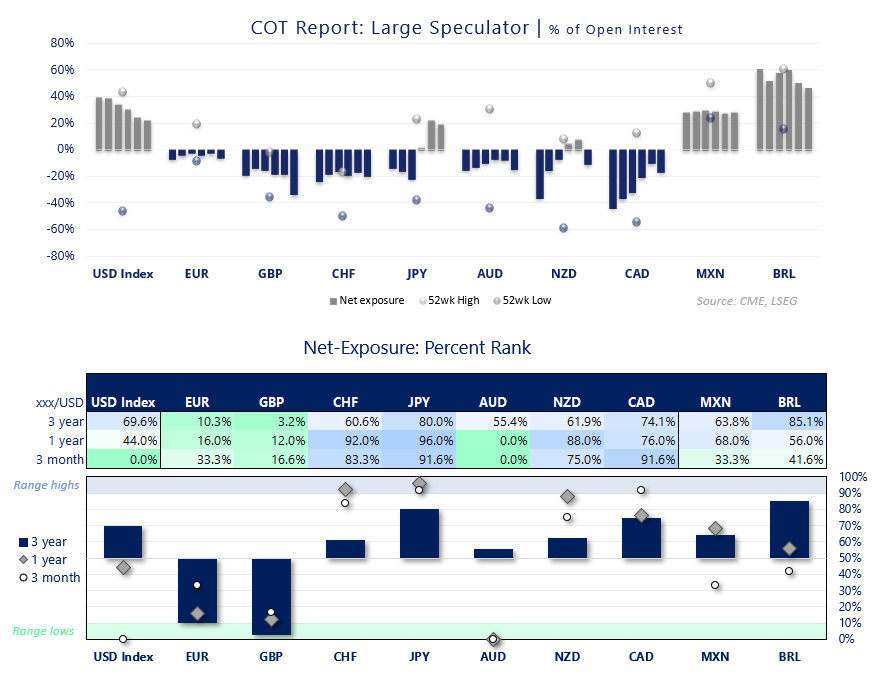
Large Speculator Positioning from the COT report
Source: CFTC (COT), LSEG
- US Dollar: Net-longs rose at their fastest weekly pace in seven years by $12.5 billion to $17.3 billion
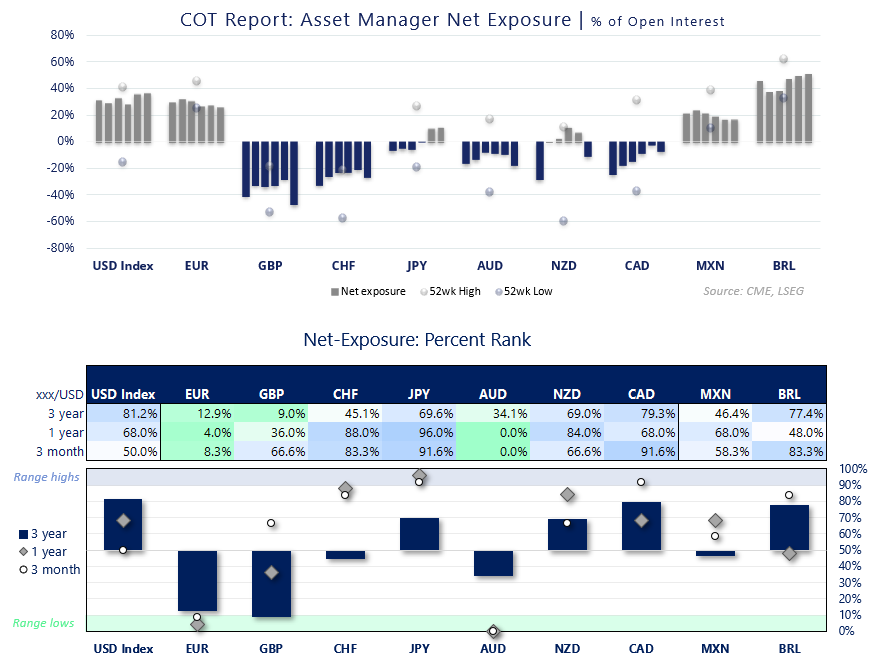
- EUR/USD: Asset managers reduced net-longs by 35k contracts and large specs increased net-shorts by 25k contracts
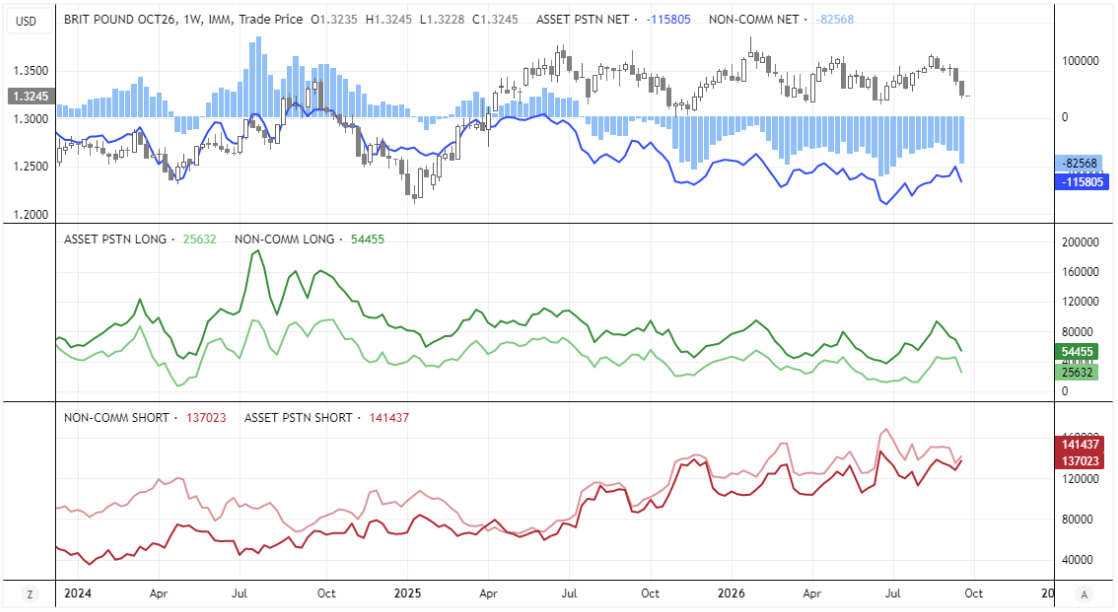
- GBP/USD: Net-shorts increased a combined 50.5k contracts to mark their fastest weekly rise in three months
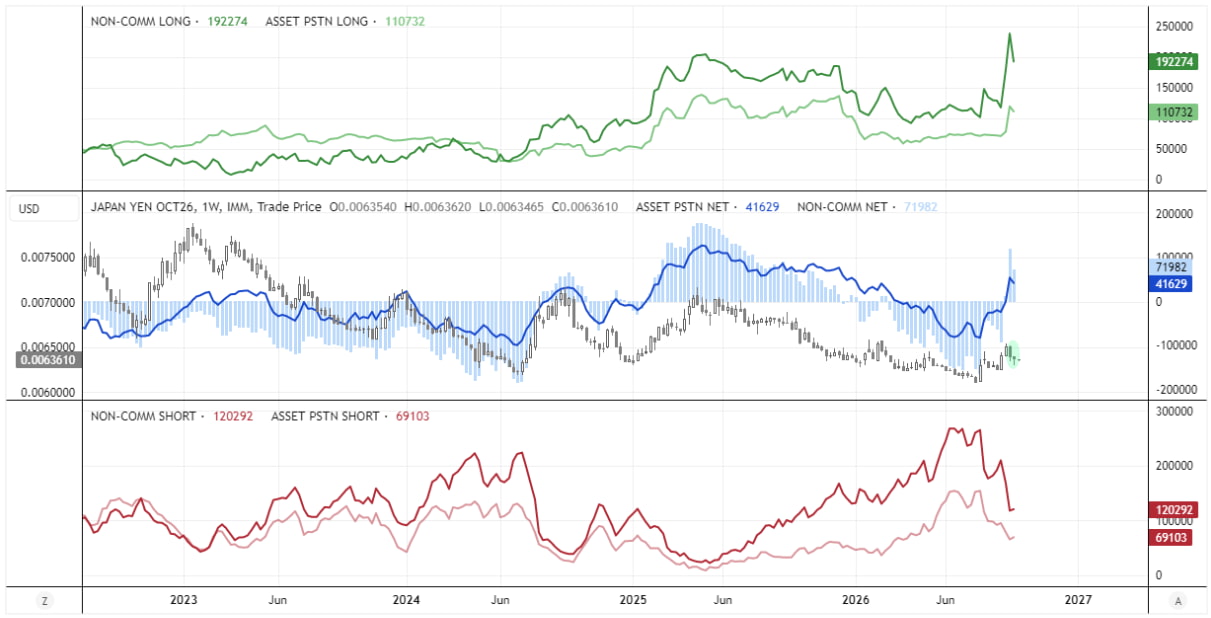
- USD/JPY: Traders remained net-long by a combined 113k, despite a reduction of around 58k contracts last week
- USD/CHF: Only minor adjustments kept net-short exposure to the Swiss franc by a combined 62.2k contracts
- USD/CAD: Prices continued to fall at a faster pace than net-shorts increased, suggesting the late surge of gross-longs have since been forced to cover
- AUD/USD: Open interest fell at the fastest weekly pace on record, though net-short exposure only increased marginally
- NZD/USD: Large specs and Asset managers reverted to net-short exposure
Asset Manager Positioning | COT Report
Source: CFTC (COT), LSEG
FX Futures Positioning | COT Report (IMM Data)
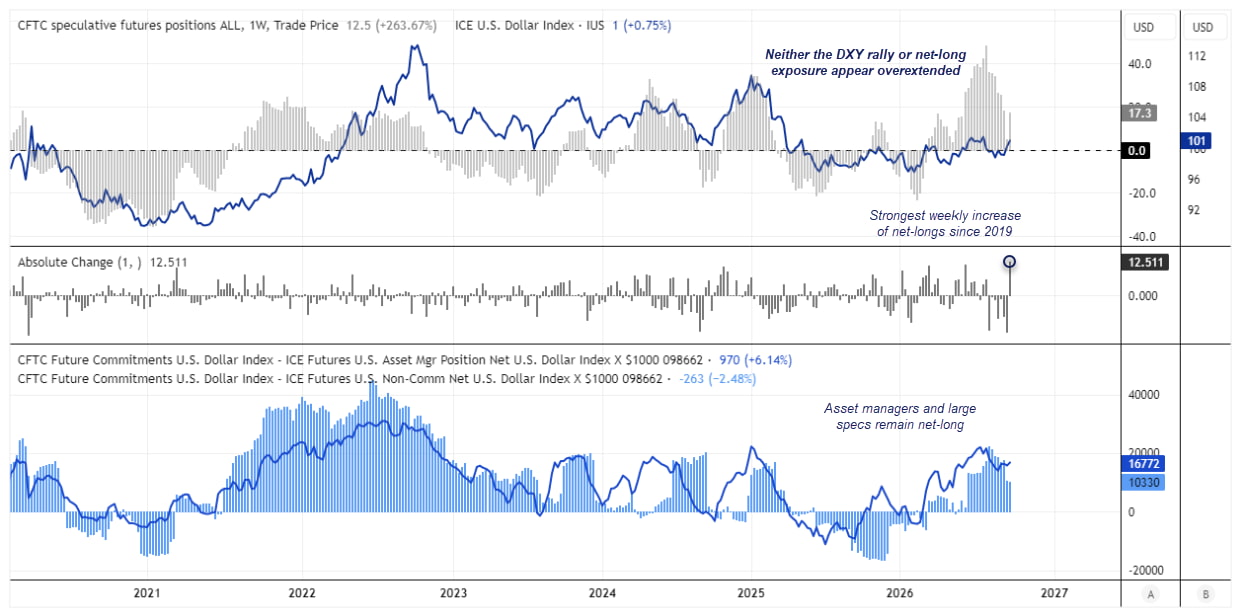
US Dollar Index (DXY) Futures Positioning | COT Report
We saw a strong influx of bullish bets on the US dollar last week, with net-long exposure rising by $12.5 billion to $17.3 billion – the fastest weekly increase in seven years. And I suspect we’ll see a further increase by the time the next COT report drops, given DXY was only up 0.4% by Tuesday’s close – and went on to rise a further 0.8% by Thursday’s high.
The US dollar index has now rallied 2.6% in 11 days, so I do not think Friday’s pullback is enough to call an end to this rally. Especially since neither the US dollar index nor net-long exposure is near a sentiment extreme.
Traders have a plethora of Fed members speaking this week, alongside ISM, NFP and PCE inflation. My guess at this stage is that they will show a strong economy with inflationary pressures, which leaves little room for Fed members to be any less hawkish than they have been since their last hike.
Source: CFTC (COT), ICE, LSEG
This content was created by an affiliate of FOREX.com and represents the views and opinions of the author/speakers, not the views and opinions of FOREX.com, StoneX Group Inc., or its subsidiaries. The content has not been independently reviewed by FOREX.com.
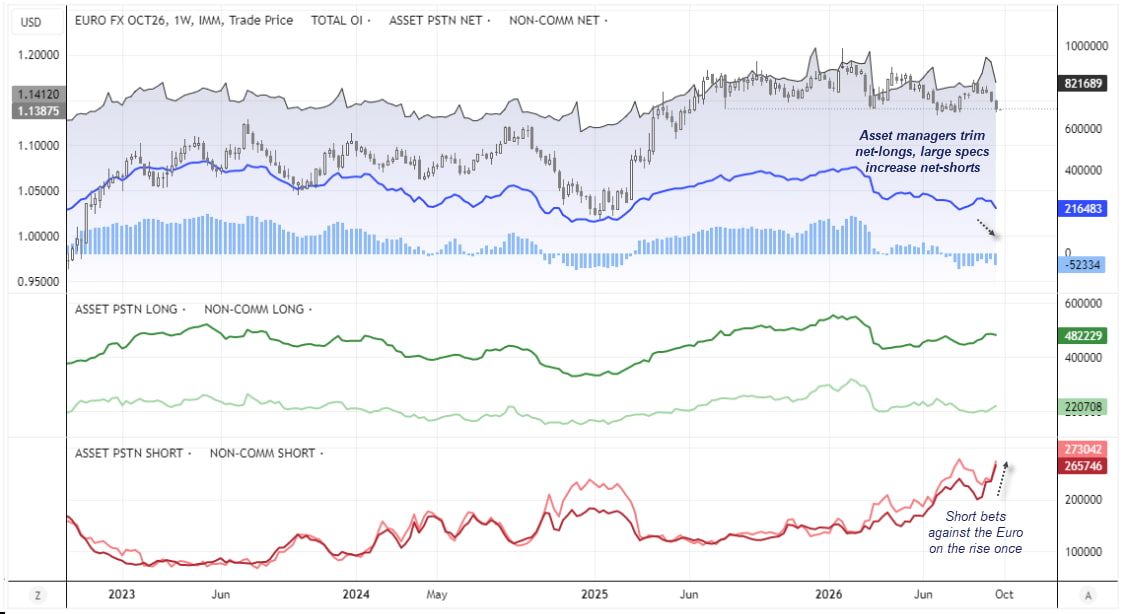
EUR/USD Futures Positioning | COT Report
My assumption over the past few months that the euro had bottomed is on the brink of being invalidated. But with momentum moving aggressively towards those swing lows, we may not need to wait for the break to invalidate it. The way prices move to or from a level can sometimes be just as, or even more, important than the level itself.
Net-short exposure to EUR/USD futures rose to a five-week high among large speculators, nearly doubling after increasing by 25k contracts over the week. Asset managers reduced net-longs by 35k, resulting in an effective combined shift of around 60k contracts towards a more bearish euro position.
Source: CFTC (COT), CME, LSEG
GBP/USD Futures Positioning | COT Report
It appears the British pound wants to head for its range lows around 1.3150, judging by how bearish momentum is accelerating towards the June low. Gross shorts have been trending higher for a couple of years, yet interestingly, net-short exposure is not flashing an imminent sentiment-extreme warning. The US dollar remains in the driving seat, though diminishing odds of a BOE hike could also decide how quickly GBP/USD breaks that June low – if it takes that route.
Source: CFTC (COT), CME, LSEG
USD/JPY Futures Positioning | COT Report
I stand by my long-held assumption that we saw the low for the Japanese yen this year back in June. While it retraced lower for a second week, a bullish hammer formed on the weekly chart, suggesting the yen is trying to form a swing low.
While large speculators and asset managers trimmed gross longs, they’re not exactly in a rush to short this market after several rounds of intervention. Both sets of traders remain net-long, which supports my ‘buy the dip’ bias for the yen and translates into a ‘fade the rally’ bias for USD/JPY.
Source: CFTC (COT), CME, LSEG
Related tags:
Latest market news











Web Trader platform
Our sophisticated web-based platform is packed with features.
Open an account today
Experience award-winning platforms with fast and secure execution.
Economic calendar
Related articles

EUR/USD forecast: All eyes on Warsh at Jackson Hole - Forex Friday
For much of this week, the EUR/USD has been edging lower with the US dollar regaining some ground after last week’s sell-off that was triggered, in part, by the bond market worries. Investors have been unwilling to bet further against the US dollar so far this week ahead of Kevin Warsh’s keynote speech at the Jackson Hole summit, due later today.


DAX, GBP/USD Forecast: Two trades to watch 2708
DAX rises as Nvidia boosts AI trade ahead of Jackson Hole. GBP/USD slips below 1.36 as Fed expectations shift.


DAX and EUR/USD forecast: Lower energy prices, yields offer support
But the question, of course, is how much further oil prices and bond yields can fall. For now, the combination is supportive of risk assets and is helping to sustain a relatively benign decline in the dollar. The focus today will be on US core PCE inflation, due for release shortly, while Nvidia’s second-quarter earnings will provide another test for risk appetite after the US markets close – not just for US indices but for global tech-heavy indices given the influence Nvidia has over the global tech and AI names.