


Australian Dollar Outlook: AU and US Inflation Test AUD/USD Resilience
Australian and US inflation data take centre stage as AUD/USD holds above 70c despite a hawkish Fed and a softer RBA outlook.
Written by
Matt Simpson
Market Analyst
AUD/USD enters a pivotal week as Australian and US inflation data test the pair's resilience around the 70c level. A growing case for an extended RBA pause contrasts with a hawkish Federal Reserve and elevated US inflation expectations. With key inflation and employment data due, traders may soon gain greater clarity on whether AUD/USD can stage a recovery or resume its broader move lower.
View related analysis:
Australian and US Inflation Data Put AUD/USD at a Crossroads
The RBA delivered a mildly hawkish hold, pausing its tightening cycle after three consecutive rate hikes. There is considerable disagreement among traders and economists over where the cash rate goes from here. The RBA’s own forecast of 4.7% by year-end now appears optimistic, with cash rate futures implying only an 80% chance of another hike by December. While Governor Bullock has said the Board is prepared to tighten further if necessary, the case for doing so appears to be weakening. Inflationary pressures stemming from tensions in the Middle East look set to recede, while domestic economic data has also been underwhelming. That places extra emphasis on this week’s data releases, which have significant potential to shift expectations for RBA policy.
Australian Dollar Performance
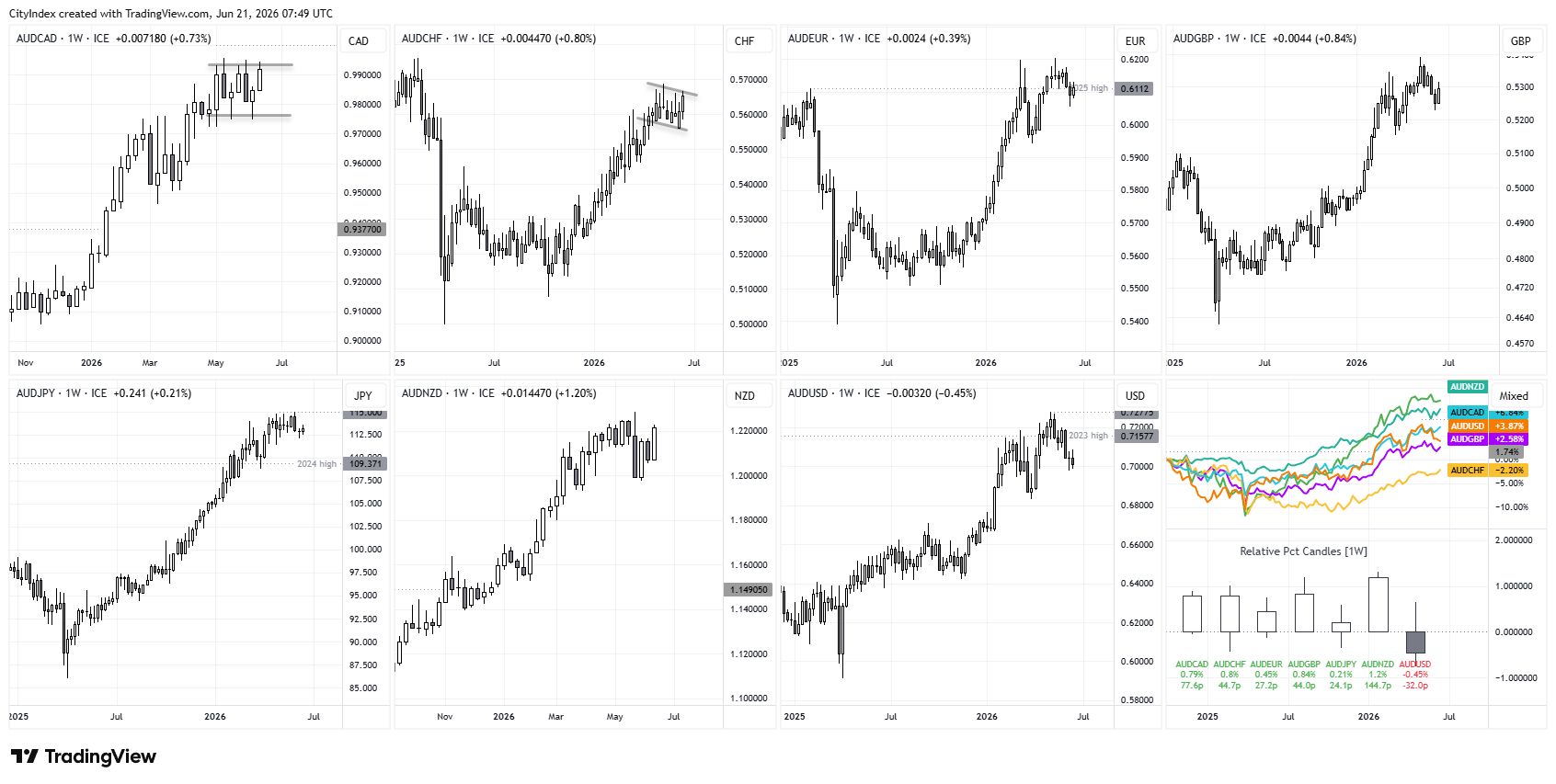
It was a positive week overall for the Australian dollar, which rose against all major currencies except the US dollar. Positive risk sentiment has been a key pillar of support for the Aussie and continues to provide a bullish undertone heading into this week.
- AUD/USD held up well despite the stronger US dollar, hinting at a minor bounce from the 70c area.
- AUD/CAD appears on the verge of a bullish breakout, closing above 0.99 and near the top of its sideways range following a strong rally.
- AUD/CHF is gaining bullish traction after a shallow pullback, hinting at a bull flag breakout.
- AUD/EUR continues to trade around its 2025 high, with another positive week suggesting it is not ready to roll over yet.
- AUD/GBP formed a small bullish engulfing week, also indicating it is not ready to roll over just yet.
- AUD/JPY traded in a narrow range for a second consecutive week, with neither bulls nor bears willing to break the deadlock.
- AUD/NZD formed a bullish engulfing week, bringing it within striking distance of its cycle highs.
Source: TradingView
Australia This Week: Economic Data and Events for AUD/USD Traders
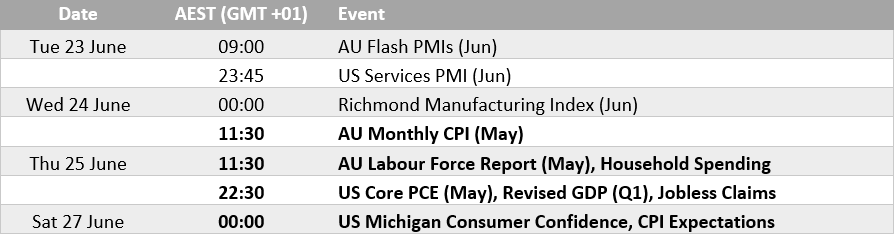
It’s a small but important week on the economic calendar for AUD/USD traders. Domestic data includes inflation, employment and household spending, which collectively are likely to have a far greater influence on RBA policy expectations than the central bank's latest meeting. In the US, PCE inflation is the headline event, although PMI surveys for both Australia and the US will also be closely watched on Tuesday.
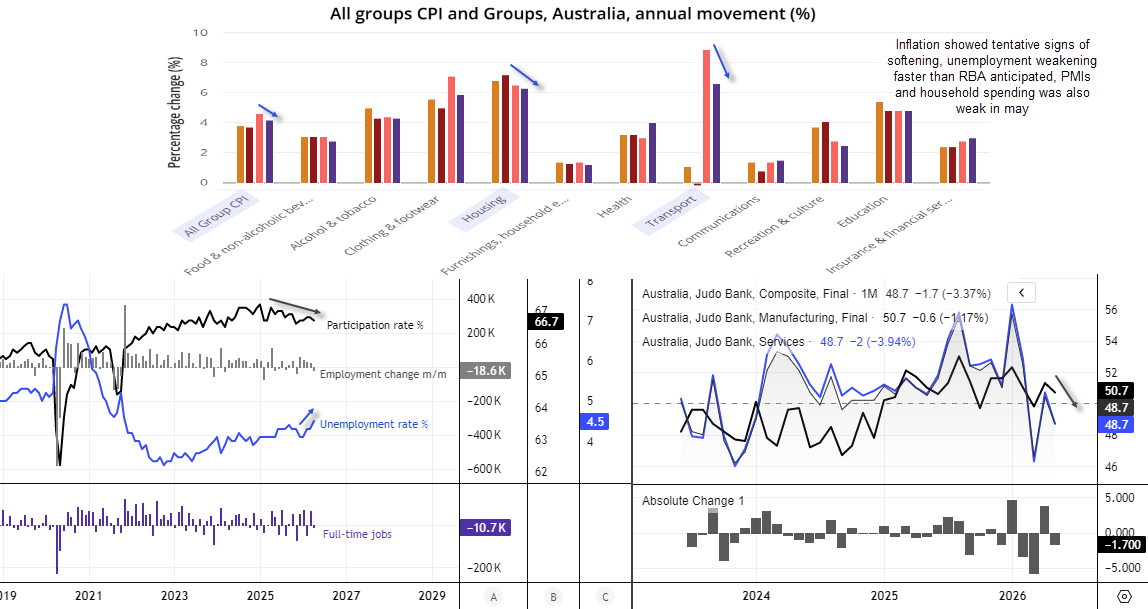
Looking through recent report, a case is building for the RBA to be on hold for a while longer – with some even speculating the next move may actually be a cut.
Recent Data Supports the Case for an Extended RBA Pause
There are tentative signs that inflation is slowing, even if trimmed mean CPI remains above the RBA’s band. Every turning point must start somewhere. Headline CPI shows a loss of momentum with housing and transport slowing. And with a peace deal and the reopening of the Straits of Hormuz to remove a key pillar odf higher inflation expectations, it bodes well for the case of no more hikes.
Employment is also deteriorating faster than the RBA expected. Unemployment rose to a 4-year high of 4.5%, and has been trending higher for over two years. The participation rate topped January 2025, and job growth stalled with a loss of -18.6k contracts in April - -10.7k of which were full-time jobs. A further deterioration in this week’s employment report could weigh on AUD/USD.
Household spending also fell by 1.1% in April, marking the sharpest contraction since October 2023. Meanwhile, the services PMI remained in contractionary territory, highlighting ongoing weakness in the services sector.
Source: ABS, S&P Global, LSEG

Inflation and Expectations Keep the Fed on a Hawkish Path
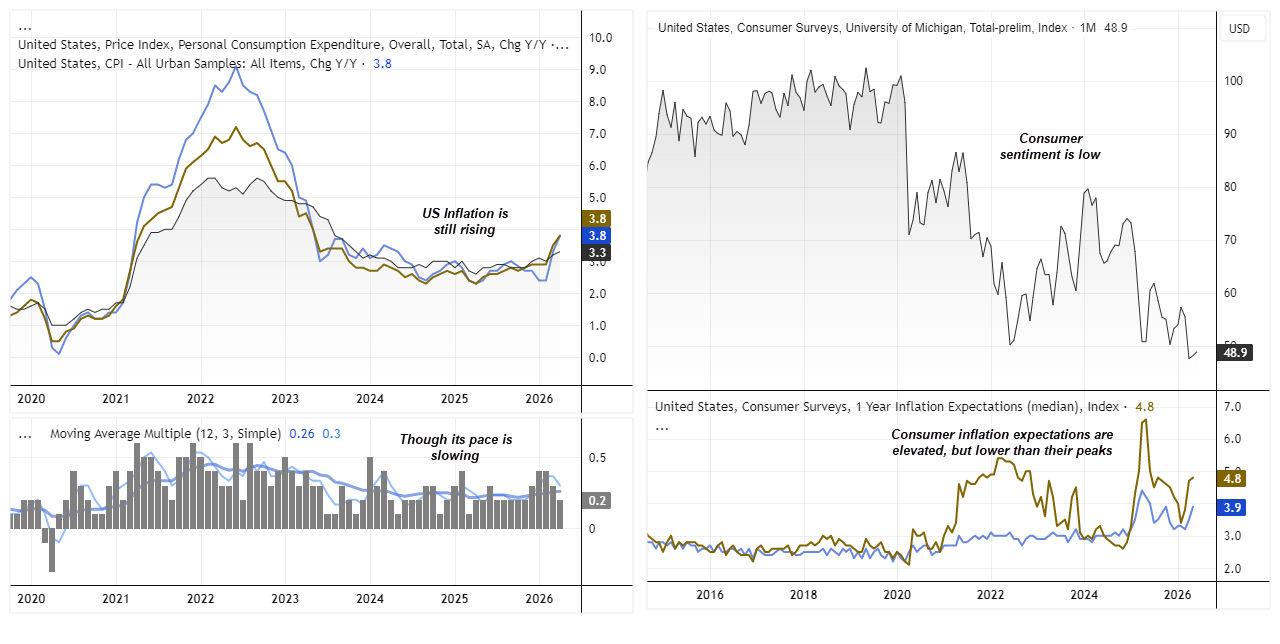
The Fed’s first meeting with Jevin Warsh as chair resulted in a hawkish hold. Fed funds futures now imply the next move could be a rate hike as soon as September, with a 51.2% probability, while another hike by December is priced at 39.1%. Those odds could rise further if inflation heats up this week.
The PCE price index will be closely watched to see if it extends its move above 3.3%. Inflation is already running well above the Fed’s 2% target, and even a 0.2 percentage point increase is considered a meaningful move for the PCE measure, particularly at these elevated levels. Inflation expectations also remain elevated according to the University of Michigan consumer survey, while sentiment remains subdued.
That combination points to a more challenging inflation backdrop for the Fed in the near term, supporting a stronger US dollar and a hawkish policy stance. Longer term, weak consumer sentiment could prove disinflationary, but for now the data continues to favour the dollar. Until something breaks.
GDP is the final release for Q1 and is unlikely to be a major market mover, although it will still warrant a look.
Source: BEA, University of Michigan, LSEG
AUD/USD Technical Analysis: Australian Dollar vs US Dollar
AUD/USD Remains Driven by the US Dollar, China and Commodities
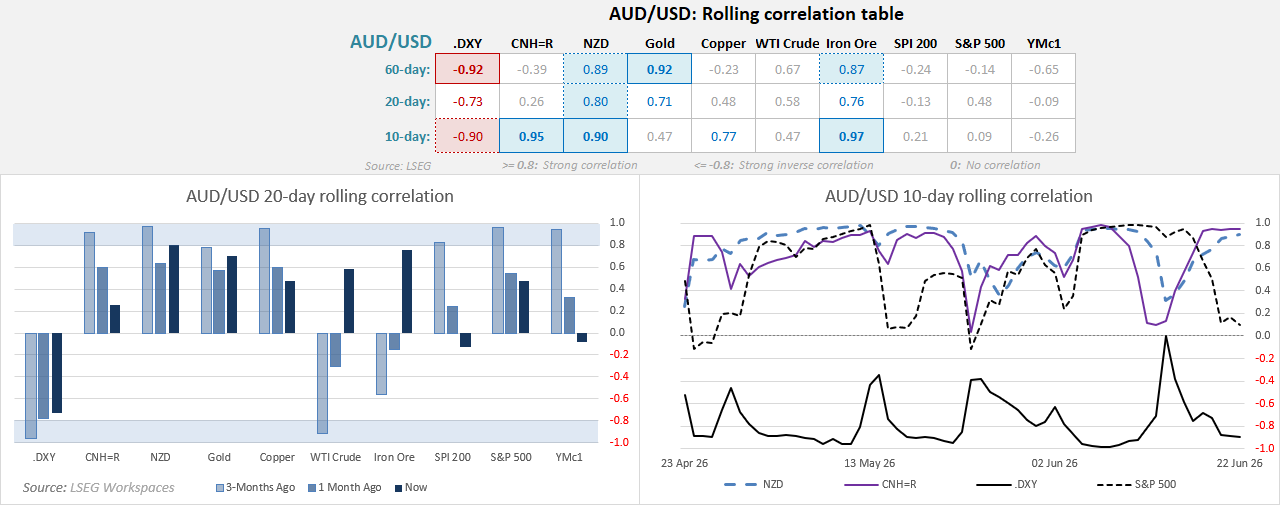
- AUD/USD remains primarily a US dollar trade, with its inverse correlation to the DXY strengthening back to -0.90 over the past 10 days.
- China has reasserted itself as a key driver, with the 10-day correlation to CNH surging to 0.95 after being relatively weak over the prior two months.
- Commodity correlations remain firm, particularly with WTI crude oil (0.97), copper (0.77) and gold, reinforcing the Aussie’s role as a commodity-linked currency.
- Equity market correlations are comparatively modest, suggesting AUD/USD is currently being driven more by the US dollar, China and commodities than broader risk sentiment.
- AUD/USD correlation matrix shows strongest links to the US dollar, Chinese yuan, WTI crude oil and New Zealand dollar.
Source: LSEG
US Dollar Rally Shows Early Signs of Fatigue
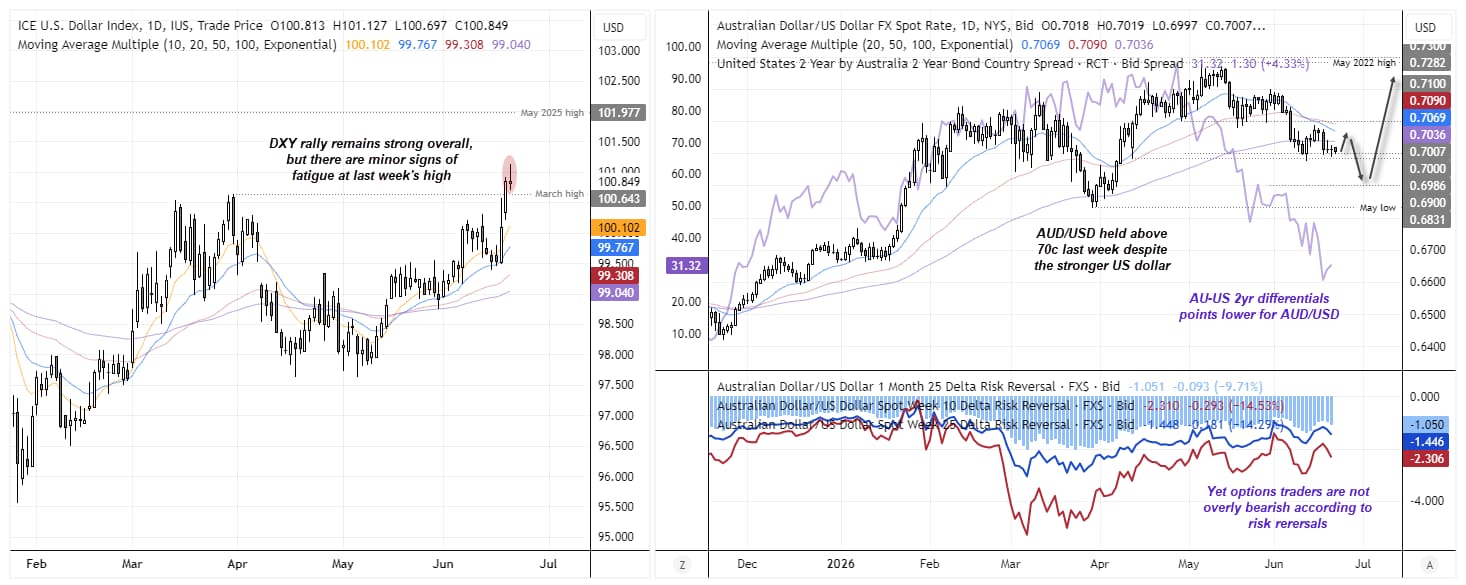
The US Dollar Index (left) remains in a solid uptrend, although Friday’s bearish pin bar around 101 warns of near-term exhaustion. Prices are also extended above the 10-day EMA, which hints at the potential for a period of consolidation or a minor pullback. A break beneath the March high (100.64) would strengthen the case for a pullback and could provide a tailwind for AUD/USD bulls in the near term. However, the broader USD trend remains firmly bullish, and buyers are likely to view any dips as an opportunity to position for the next leg higher.

AUD/USD May Bounce Before Resuming Its Downtrend
AUD/USD did well to hold above 70c last week despite the hawkish FOMC meeting. With minor signs of exhaustion emerging on the US dollar rally and signs of strength across other AUD crosses, the pair may be due a bounce before eventually breaking below 70c and heading towards 69c.
Risk reversals also remain relatively elevated despite AUD/USD's pullback, suggesting options traders are not overly bearish on the pair. Yield differentials, however, continue to point lower, which supports my broader view that AUD/USD is ultimately heading towards 69c in a strong US dollar environment. Once the US dollar rally peaks, AUD/USD should be able to benefit from improving yield dynamics once again. For now, though, near-term price signals suggest a minor bounce before a move lower towards 69c.
Source: ICE, TradingView
View the full economic calendar
-- Written by Matt Simpson
Follow Matt on Twitter @cLeverEdge
How to trade with City Index
You can trade with City Index by following these four easy steps:
- Open an account, or log in if you’re already a customer
• Open an account in the UK
• Open an account in Australia
• Open an account in Singapore
- Search for the market you want to trade in our award-winning platform
- Choose your position and size, and your stop and limit levels
- Place the trade







Web Trader platform
Our sophisticated web-based platform is packed with features.
Open an account today
Experience award-winning platforms with fast and secure execution.
Economic calendar
Related articles

Canadian Dollar Forecast: USD/CAD Weekly Reversal Puts Yearly Uptrend Back in Focus 8 29 2026
USD/CAD has staged its strongest weekly advance since June, shifting the focus to whether a more durable low is finally taking shape.


USD/JPY weekly outlook: Payrolls may challenge the Fed’s hawkish reset
USD/JPY has finally woken from its slumber. Payrolls now loom as the key test of whether the latest hawkish repricing sticks or sinks.


Euro Short-term Outlook: EUR/USD Pullback Nears Pivotal Uptrend Support 8 28 2026
Warsh's comments accelerated the EUR/USD selloff, raising the stakes as buyers look to stabilize the broader recovery.