


Australian Dollar Outlook: AUD/USD Rally Meets ISM, NFP and DXY Support
AUD/USD begins the week on a four-week winning streak, but DXY support and US ISM and nonfarm payrolls could dictate the next move.
Written by
Matt Simpson
Market Analyst
The Australian dollar enters the week on a four-week winning streak after broad US dollar weakness following the FOMC meeting and coordinated yen intervention lifted AUD/USD. But with the US dollar index testing a major support zone and ISM and nonfarm payrolls due this week, the Aussie may need a fresh catalyst to extend its gains.
View related analysis:
AUD/USD Rally Meets DXY Support Ahead of ISM and NFP
The Australian dollar largely escaped the extreme volatility seen in the Japanese yen late last week, when several yen crosses unwound moves that had accumulated over the previous three months. The BOJ's suspected intervention shook out what had arguably become crowded long-yen positions, before another bout of yen strength emerged after the US Treasury threw its support behind Japan's efforts.
Meanwhile, expectations for another RBA rate hike eased after Australia's softer-than-expected CPI report. Markets have effectively ruled out a September move, although the cash rate curve is still pricing a small chance of one final 25bp hike by December.
Australia This Week: Economic Data and Events for AUD/USD Traders
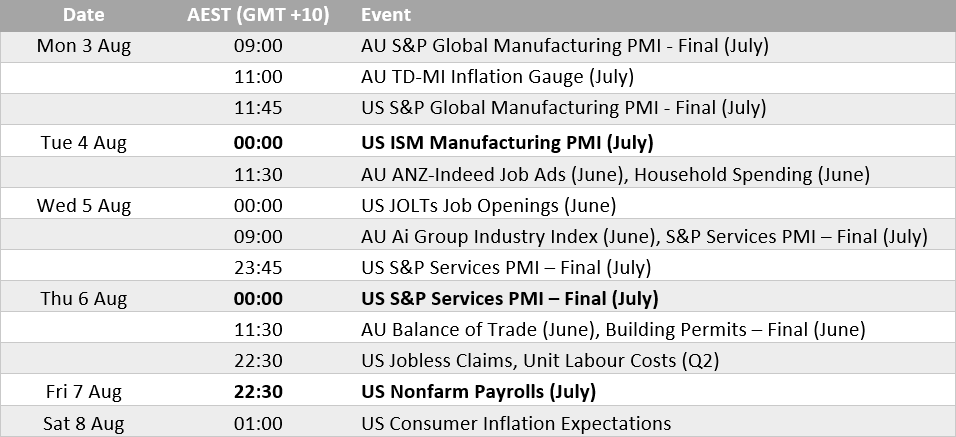
Nonfarm Payrolls and ISM Data Could Reshape Fed Expectations
The nonfarm payrolls and ISM reports are the main calendar events this week, as they could help reshape Fed policy expectations following last week's slightly less-hawkish than expected decision to leave interest rates on hold. The Middle East flare-up also raises concerns about potential inflationary pressures, with Fed funds futures continuing to price a 74% probability of a September hike and a 41% chance of another in December.
But if recent trends in the ISM services and nonfarm payrolls reports are repeated, it could still leave some doubt over that second hike. Headline job growth has slowed for three consecutive months, from 214k to 57k, although unemployment has edged back to a healthy 4.2%. ISM PMIs also eased slightly while prices paid retreated from their multi-year highs. The risk, of course, is that nonfarm payrolls delivers another strong upside surprise and prices paid rebound on the back of higher crude oil prices in recent weeks. That could lift the probability of a December hike above 50%, support the US dollar, and weigh on AUD/USD.
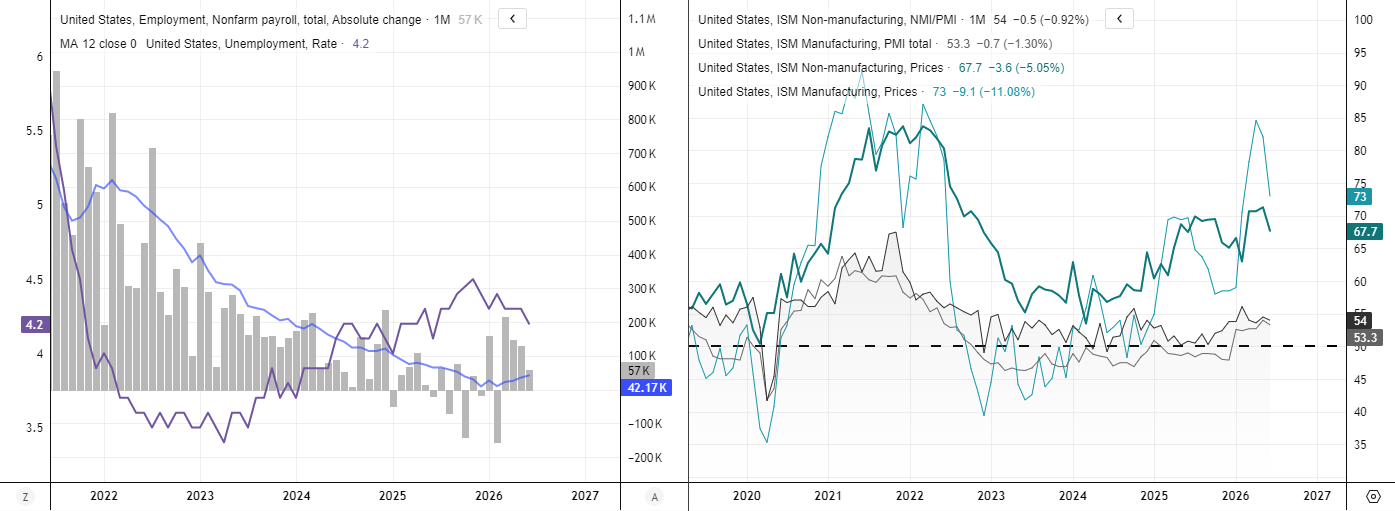
Source: BLS, ISM, LSEG

AUD/USD Technical Analysis: Australian Dollar vs US Dollar
AUD/USD Correlations Face a DXY Reality Check
AUD/USD remains most inversely correlated with the US dollar, with the 10-day correlation strengthening to -0.86. Positive correlations with the New Zealand dollar (0.92), copper (0.98) and the yuan (0.83) also remain firm, highlighting the importance of China sentiment and industrial metals. The S&P 500 has swung back to a strong positive correlation (0.89), while WTI crude has flipped negative, suggesting higher oil prices are currently weighing on AUD/USD rather than supporting commodity currencies.
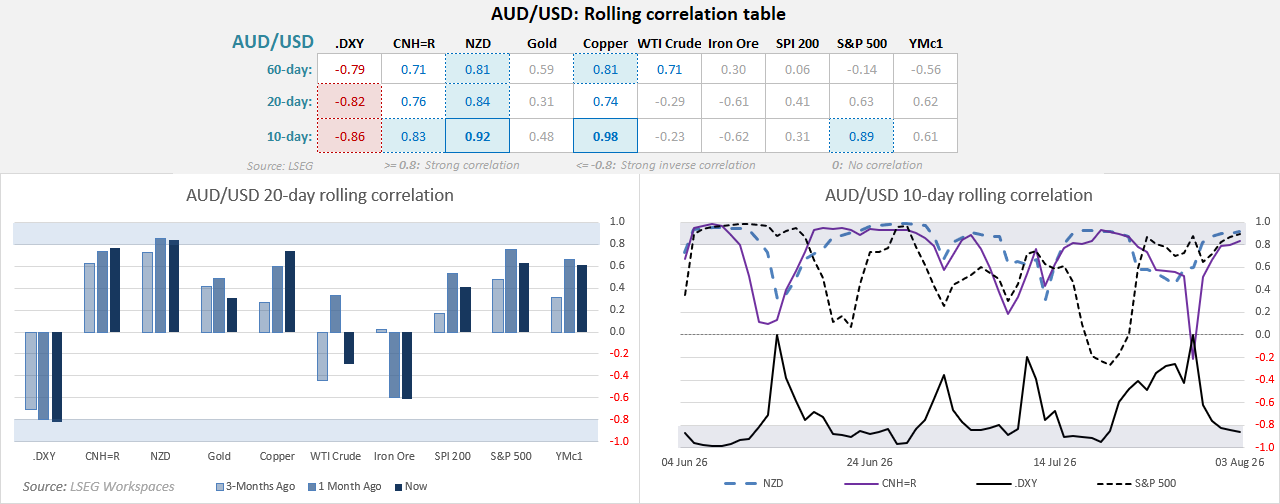
Source: LSEG
AUD/USD Futures Positioning | COT Report
The Aussie has continued to defy the bears, rising for a fourth consecutive week and is out of the gates trying to notch up a fifth. Gross shorts continued to trend higher among large speculators and asset managers, dragging speculators' net-short exposure to a seven-month high of nearly 40k contracts.
Yet we should also note the gradual rise in gross longs among asset managers, who have added nearly 14k contracts over the past three weeks (26.4%) to take their gross-long exposure to 13.8k contracts.
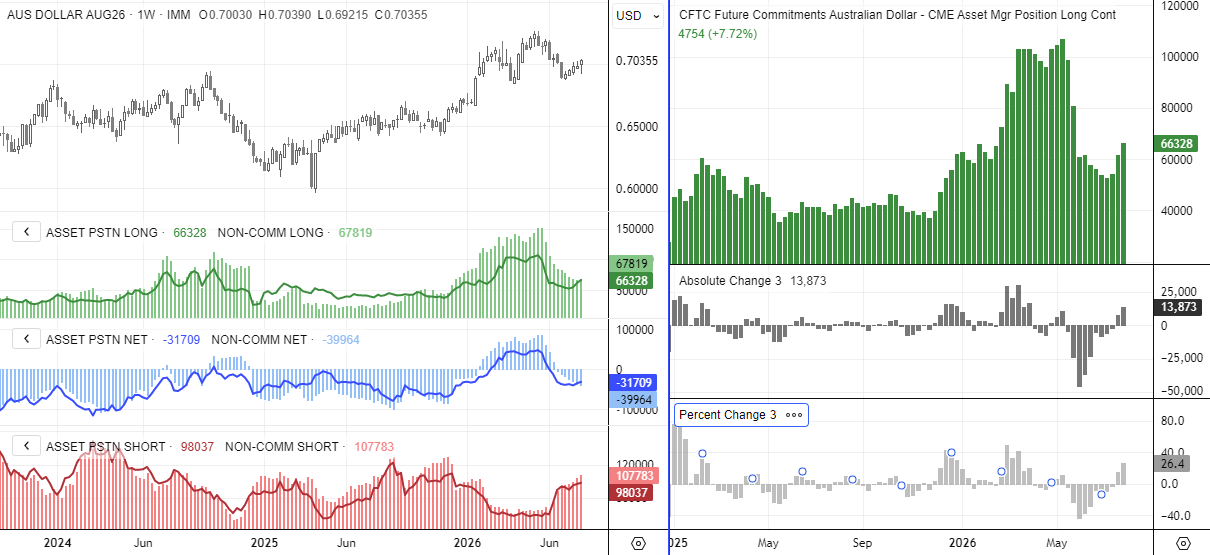
Source: CFTC (COT) CME, LSEG
AUD/USD Options and Volatility Analysis (Risk Reversals, HVN Levels)
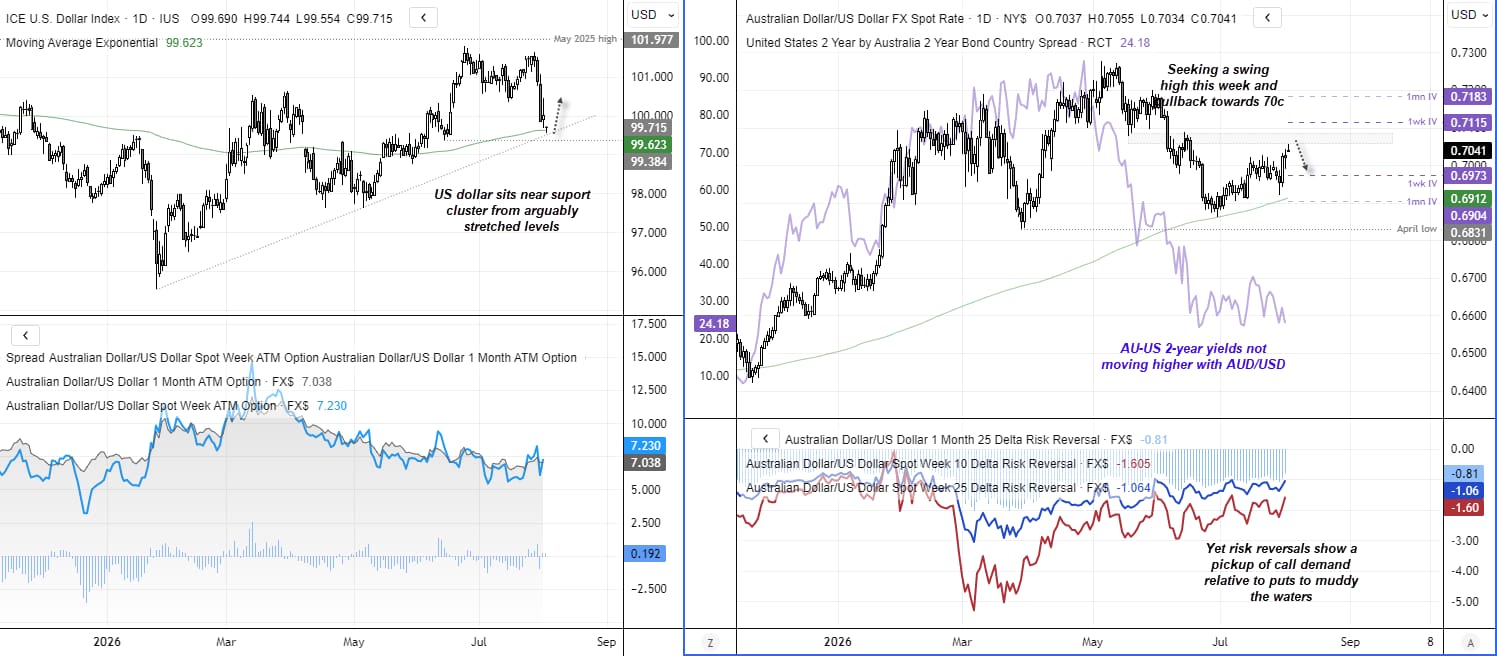
With the US dollar index falling sharply following the FOMC meeting and coordinated yen intervention, AUD/USD has gained another source of support. But with the US dollar now sitting near a key support cluster, a runaway rally is far from assured.
Note that the US dollar index (left) is testing its 200-day EMA, sitting just above the 2026 bullish trendline and the 99.384 swing low. Given the speed of last week's selloff, this support area could prove favourable for dollar bulls over the near term, potentially capping AUD/USD's upside.

US Dollar Support Could Limit AUD/USD Gains
AUD/USD (right) is also approaching its prior swing high while the Australia-US 2-year yield spread continues to point lower. That divergence also suggests upside may be limited, particularly if the ISM or nonfarm payrolls reports surprise to the upside, as I suspect they might.
For now, AUD/USD risk reversals continue to edge higher, suggesting demand for calls is increasing relative to puts. Even so, bears may be looking for evidence of a swing high and a pullback towards 70c. A break below that level would bring Thursday's low near 0.6950 into focus.
The most bullish scenario for AUD/USD this week would likely require a combination of weaker-than-expected US economic data and further rounds of yen intervention. For now, the latter appears to be weighing on the US dollar while supporting the Japanese yen.
Source: ICE, TradingView
Latest market news









Web Trader platform
Our sophisticated web-based platform is packed with features.
Open an account today
Experience award-winning platforms with fast and secure execution.
Economic calendar
Related articles

EUR/USD forecast: All eyes on Warsh at Jackson Hole - Forex Friday
For much of this week, the EUR/USD has been edging lower with the US dollar regaining some ground after last week’s sell-off that was triggered, in part, by the bond market worries. Investors have been unwilling to bet further against the US dollar so far this week ahead of Kevin Warsh’s keynote speech at the Jackson Hole summit, due later today.


Gold Falters at Resistance, Grappling With PCE, Month-End Flows and Jackson Hole
Gold has pulled back from resistance after sticky PCE data, with month-end flows and Jackson Hole now shaping the near-term outlook.

DAX and EUR/USD forecast: Lower energy prices, yields offer support
But the question, of course, is how much further oil prices and bond yields can fall. For now, the combination is supportive of risk assets and is helping to sustain a relatively benign decline in the dollar. The focus today will be on US core PCE inflation, due for release shortly, while Nvidia’s second-quarter earnings will provide another test for risk appetite after the US markets close – not just for US indices but for global tech-heavy indices given the influence Nvidia has over the global tech and AI names.