
EUR/AUD, GBP/AUD face growing Aussie tailwinds
A likely RBA hawkish hold and higher energy prices are strengthening the fundamental case for the Australian dollar against European currencies. EUR/AUD and GBP/AUD are in focus as traders assess whether those macro tailwinds translate to fresh downside.
Written by
David Scutt
Market Analyst
- Softer inflation lowers urgency for immediate RBA hike
- Markets still favour one more hike this cycle
- Renewed energy price strength delivers Aussie terms-of-trade tailwind
- EUR/AUD and GBP/AUD trade setups in focus
A likely hawkish hold from the RBA and renewed geopolitical tensions in the Gulf driving energy prices higher have swung the fundamental backdrop in favour of the Aussie relative to the European crosses.
Inflation undershoots, unemployment overshoots
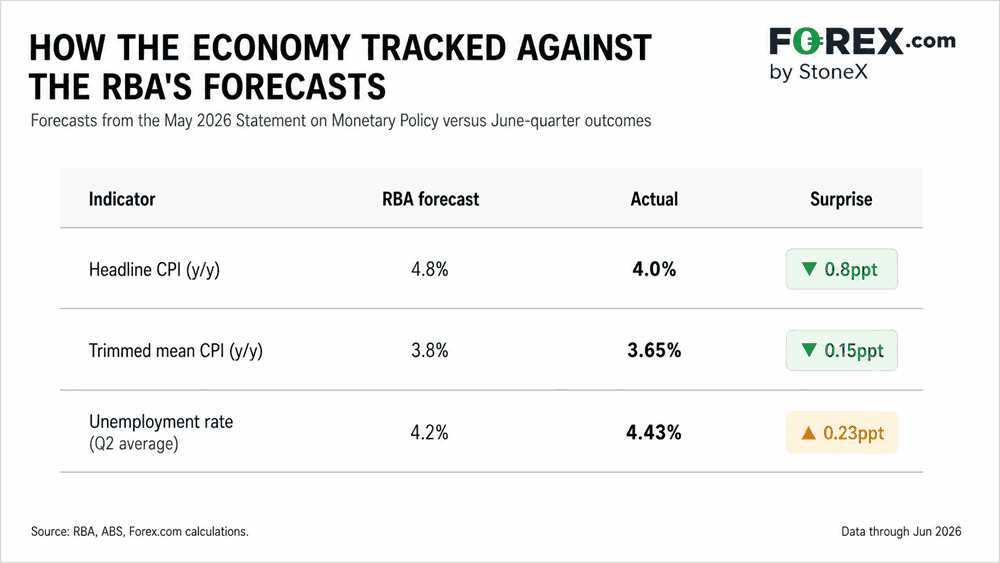
The RBA clearly thought there was more momentum in the economy in May than what eventually showed up in the data. It overestimated the inflationary pulse and underestimated the increase in unemployment, with both headline and trimmed mean inflation undershooting its May forecasts while unemployment overshot.
Source: FOREX.com
At face value, that suggests the path towards getting inflation back to acceptable levels may be a little more advanced than the Bank thought three months ago. But inflation is still too high, which is why the risk of another hike has not been completely snuffed out.
Markets push tightening risk further out
Source: TradingView, FOREX.com
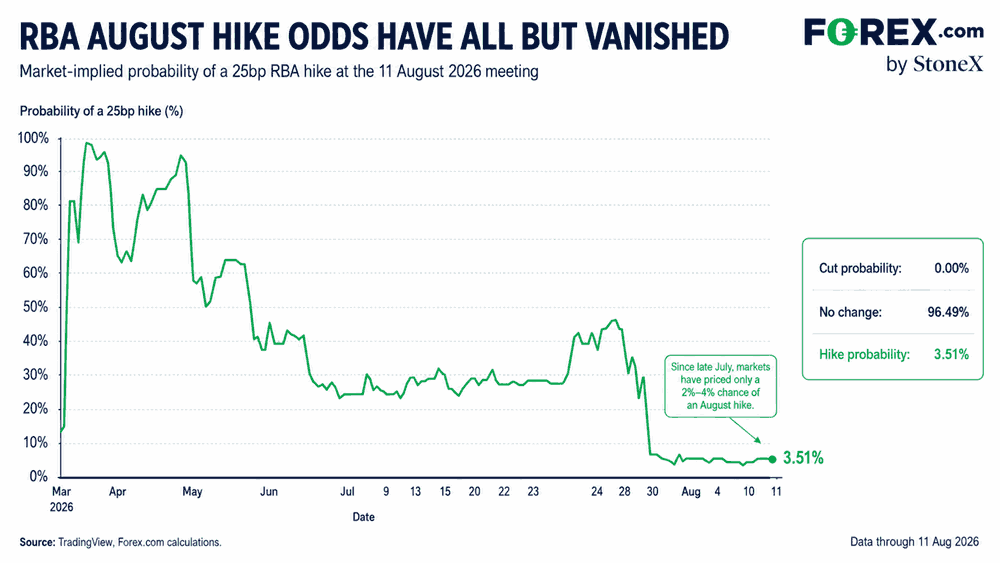
While there is little probability attached to a hike today, making this meeting look very much like a placeholder with a hawkish hold, go further out the curve and the risk of tightening is still there. By November, when the next set of forecasts after today will be released, markets are basically at a coin flip on another hike. That lifts to 82% by February next year.
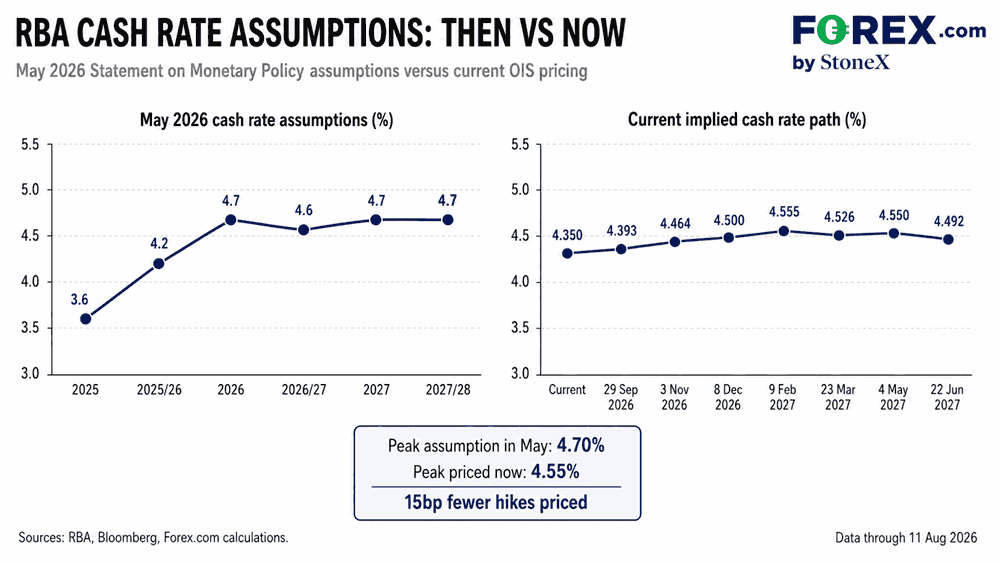
So while the amount of tightening priced by traders has been pared back relative to what underpinned the RBA’s May forecasts, the market still thinks there is a decent chance the Bank will need to go again this cycle.
Source: FOREX.com
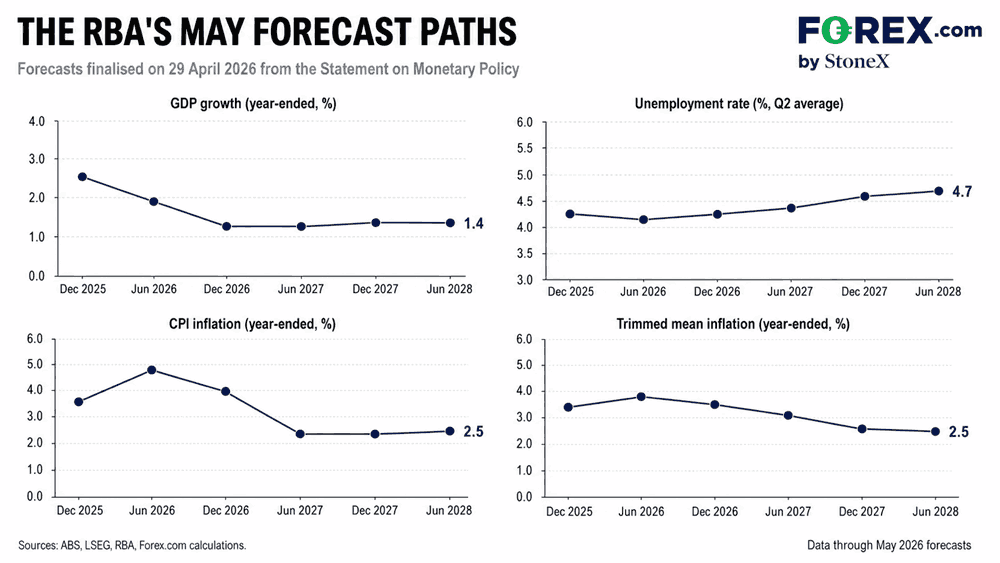
The question is what that means for the RBA’s updated forecasts for GDP growth, unemployment and inflation released today. My suspicion is that the slight unwind in hawkish pricing will not have a particularly meaningful impact, with outcomes similar to those forecast in May.
Source: FOREX.com
Spending resilience meets housing weakness
One area where the Bank’s language may be upgraded is household spending. At the June meeting, the RBA said it was “slowing as expected”, but recent data has been quite strong, particularly in discretionary areas, questioning whether that view is still warranted.
However, that potential upgrade could be offset by the housing market, where the decline in house prices has accelerated and broadened since the Bank met six weeks ago. What had been weakness in some capital cities is now more widespread, potentially becoming a larger drag on household demand.
Given the data trend and potential statement tweaks, it’s very likely the RBA will retain the guidance used in July that it “will do what it considers necessary to achieve that outcome, including increasing the cash rate target further if required.” That basically gives the Bank room to sit comfortably for now while keeping the tightening option firmly on the table.
Terms of trade tailwinds favour the Aussie
When it’s all said and done, I expect the RBA will be aiming to keep market pricing relatively unchanged, avoiding an unnecessary loosening in financial conditions that would make the task of reducing inflationary pressures more difficult. That points to the Aussie dollar continuing to be underpinned by hawkish rate expectations.
And when it comes to the European crosses, the Aussie also has the advantage of being a major energy exporter, meaning higher energy prices due to ongoing geopolitical tensions in the Gulf deliver a positive terms-of-trade shock, the exact opposite of what we see in Europe. When you throw energy insecurity into the mix, it points to tailwinds building for the Aussie relative to the European crosses.
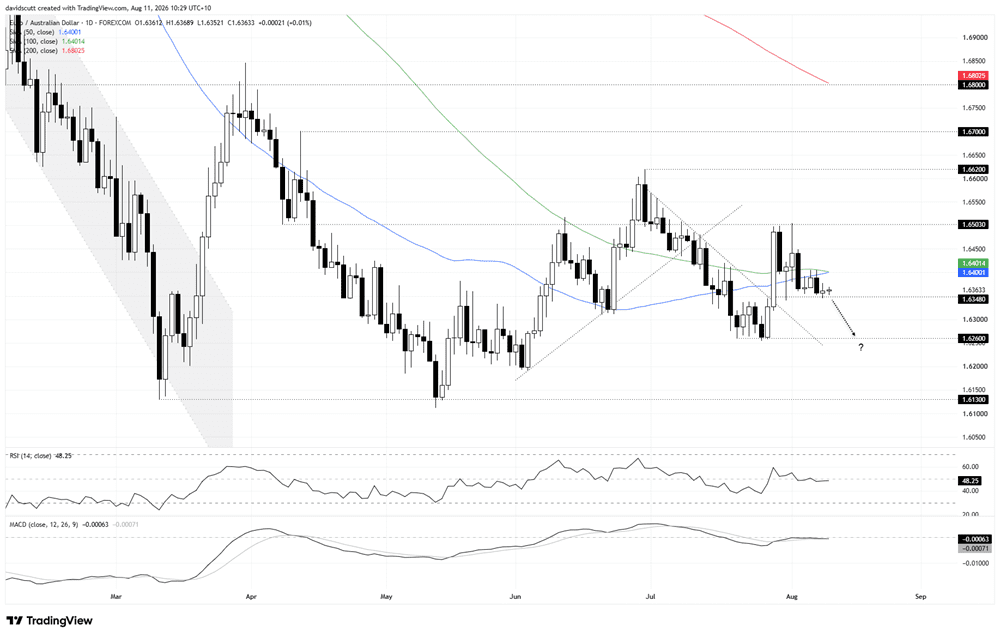
EUR/AUD bears eye 1.6340 break
Source: TradingView
EUR/AUD looks heavy on the charts, sitting just above support at 1.6340. If the pair breaks beneath 1.6340 support and holds there, shorts could be set with a tight stop above the level for protection, targeting 1.6260, where the pair bottomed in July. Beyond that, a break of 1.6260 would open the door for a retest of 1.6130, where the price has bottomed and bounced on multiple occasions going back several years.
The message from the oscillators at this point is neutral. RSI (14) has been setting sequentially lower highs and now sits marginally below the neutral 50 level. MACD has also turned negative and is on the cusp of a bearish crossover. But neither indicator is providing a strong steer, placing more emphasis on price action.
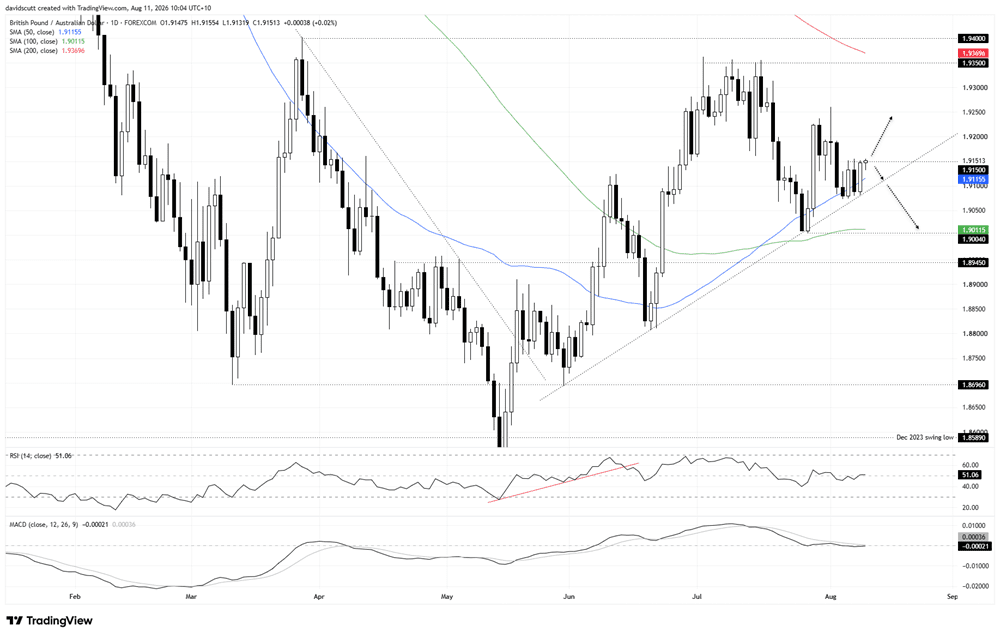
GBP/AUD squeeze risk builds near 1.9150
Source: TradingView
While the fundamental backdrop favours downside for GBP/AUD, the price action warns of a potential squeeze and near-term topside break ahead of the RBA. The level in focus today is 1.9150, which has repeatedly acted as support and resistance in recent weeks. The pair is now squeezing up against that level while remaining within the broader uptrend running from the low set in late May.
With an engulfing candle printing on Monday, a clean break above 1.9150 could put the August 3 high at 1.9260 in play. Beyond that, resistance sits at 1.9350, with the 200-day simple moving average around 1.9370 and the March swing high at 1.9400 just above. If the pair breaks cleanly above 1.9150, longs could be set with a tight stop beneath the level for protection, targeting those upside levels.
Alternatively, if 1.9150 continues to cap gains, as has been the case over recent sessions, shorts could be set with a tight stop above the level, targeting a retest of the May uptrend, followed by 1.9004, the swing low set on July 28. Beyond that, 1.8945 comes into focus, having acted as resistance earlier this year.
Mirroring EUR/AUD, the oscillators are neutral for GBP/AUD. RSI (14) sits just above 50, while MACD is running parallel to the signal line around breakeven, placing more emphasis on price action for guidance.
Latest market news










Web Trader platform
Our sophisticated web-based platform is packed with features.
Open an account today
Experience award-winning platforms with fast and secure execution.
Economic calendar
Related articles

Gold and S&P 500 analysis: What now after Warsh’s hawkish speech?
The dollar surged across the board after the Fed Chair Kevin Warsh surprised with a hawkish-leaning speech at the Jackson Hole summit. All the bearish dollar bets that had been accumulated since last Friday on the back of data weakness and bond market troubles had to be squared and that triggered a short squeeze rally for the dollar. Gold and silver dropped, as a result, as too did bitcoin, while US indices were giving back earlier gains.


EUR/USD forecast: All eyes on Warsh at Jackson Hole - Forex Friday
For much of this week, the EUR/USD has been edging lower with the US dollar regaining some ground after last week’s sell-off that was triggered, in part, by the bond market worries. Investors have been unwilling to bet further against the US dollar so far this week ahead of Kevin Warsh’s keynote speech at the Jackson Hole summit, due later today.

Bitcoin Forecast: BTC/USD Back to $80K Ahead of Warsh’s Jackson Hole Speech
After surging over $15,000 in the past 10 days alone, there is risk of a near-term pullback if Warsh says anything remotely hawkish at Jackson Hole - what are the levels to watch from here?