


EUR/USD forecast: Growth and geopolitics to decide breakout fate
The Fed may have triggered the rally, but today's GDP releases and developments in the Middle East are likely to decide whether EUR/USD can sustain it.
Written by
David Scutt
Market Analyst
- Fed-driven breakout confronts resistance near 1.1480
- Relative growth likely to determine EUR/USD's next directional move
- US consumer spending data may prove more important than core PCE
- Middle East tensions complicate EUR/USD breakout above resistance
EUR/USD jumped on Wednesday after the Federal Reserve left interest rates unchanged, prompting traders to unwind the tightening that had been priced into the front end of the US rates curve ahead of the decision. The resulting decline helped the pair break above the minor downtrend it had been trading beneath since the middle of July.
However, before traders consider chasing the move, seeking a breakout of the broader sideways range EUR/USD has been stuck in for the past six weeks, it's worth asking whether there has really been a meaningful shift in the macro backdrop. With geopolitical tensions escalating once again, energy prices surging and month-end flows potentially distorting price action, there are plenty of reasons to question whether Wednesday's move tells the full story.
Front-end repricing lifts EUR/USD
Source: TradingView
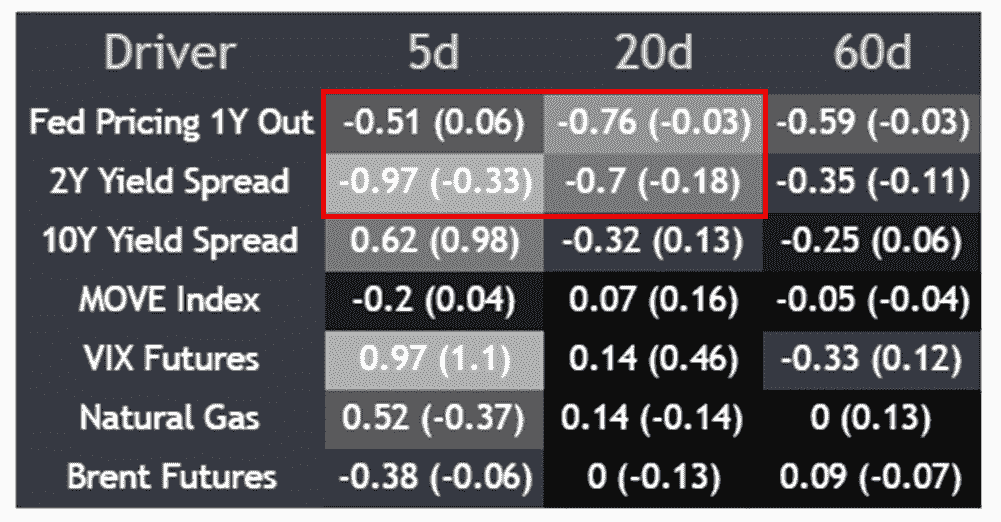
The correlation matrix above does a good job explaining why EUR/USD rallied following the Fed decision. Ahead of the meeting, overnight index swaps had priced around nine basis points of tightening into the front end of the US rates curve, implying roughly a one-in-three chance of a 25 basis point rate hike. When that failed to eventuate, traders unwound those expectations, sending front-end Treasury yields sharply lower. Given the close relationship between EUR/USD and front-end US rate pricing over the past month, the euro's rally was exactly what market mechanics would have suggested.
Source: TradingView
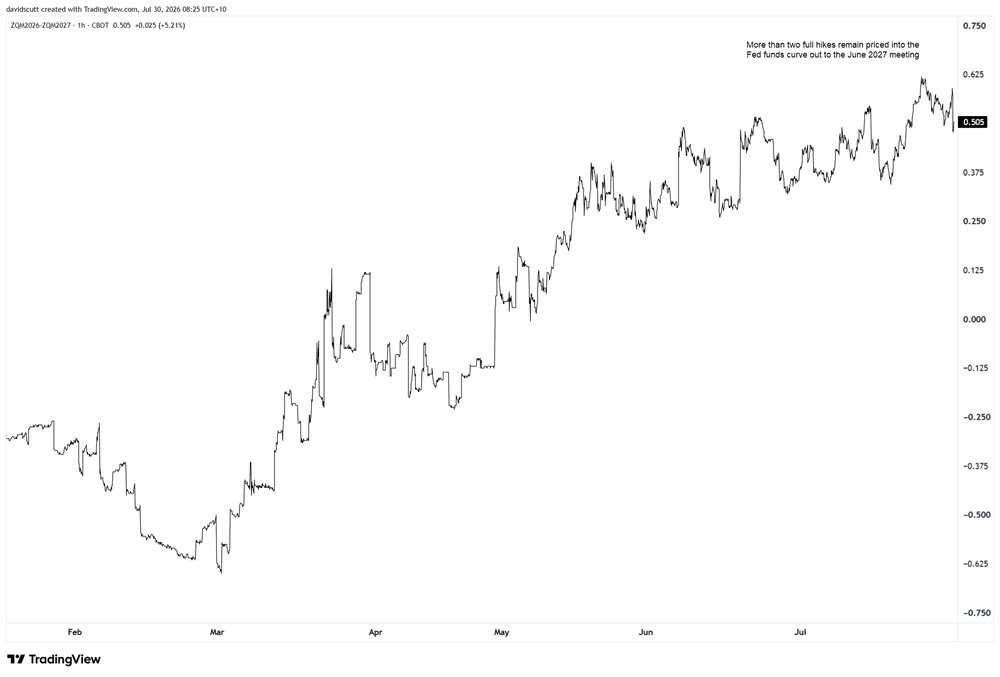
The bigger question is whether that move has much further to run. Despite the Fed opting to keep policy unchanged, overnight index swaps continue to price around 50 basis points of tightening by the June meeting next year. That suggests markets still believe the Committee will ultimately have to do more if it is to restore price stability.
For now, Kevin Warsh is still getting the benefit of the doubt from traders. His preference is clearly to let markets do much of the heavy lifting by adjusting broader financial conditions in response to incoming data rather than explicit forward guidance. As things stand, markets are doing exactly that, continuing to price a meaningful amount of additional tightening.
But that approach has a finite lifespan. If markets eventually move to fully price another rate hike, or more, and the Fed again declines to deliver, strategic uncertainty will start looking less like a deliberate policy tool and more like reluctance to adjust policy settings.
Source: TradingView
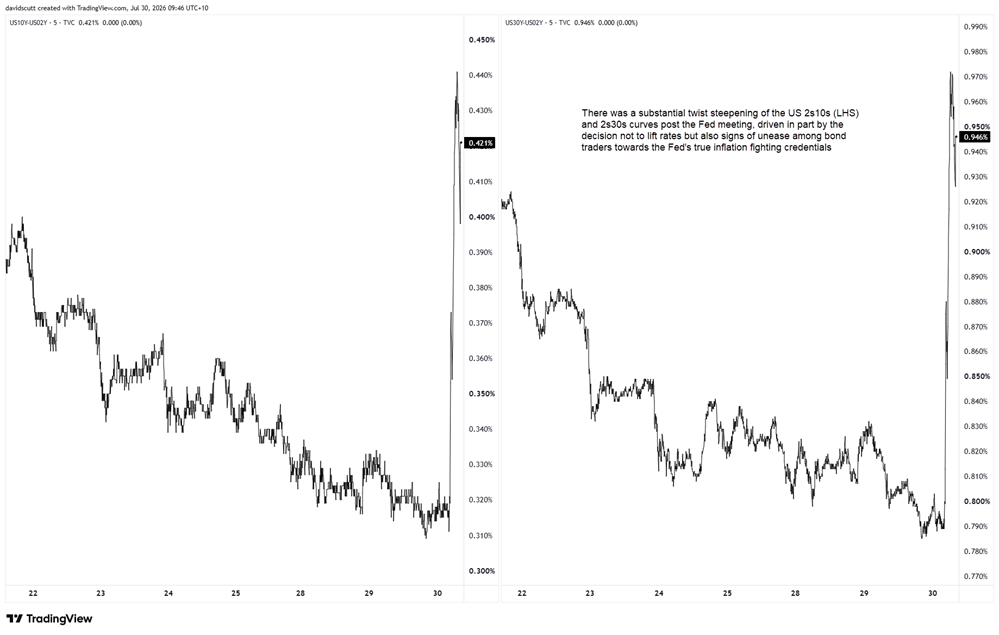
If that were to take place, it would be terminal for the US dollar as traders rightfully question the Fed's inflation-fighting credentials. But for now, with meaningful tightening priced into the curve, it questions how long the current bout of US dollar weakness can be sustained.
Relative growth comes into focus
Attention now shifts to a heavy run of economic data from both sides of the Atlantic. While Germany's inflation report will attract attention ahead of tomorrow's euro area CPI release, today's bigger story for EUR/USD is likely to be growth.
Source: TradingView
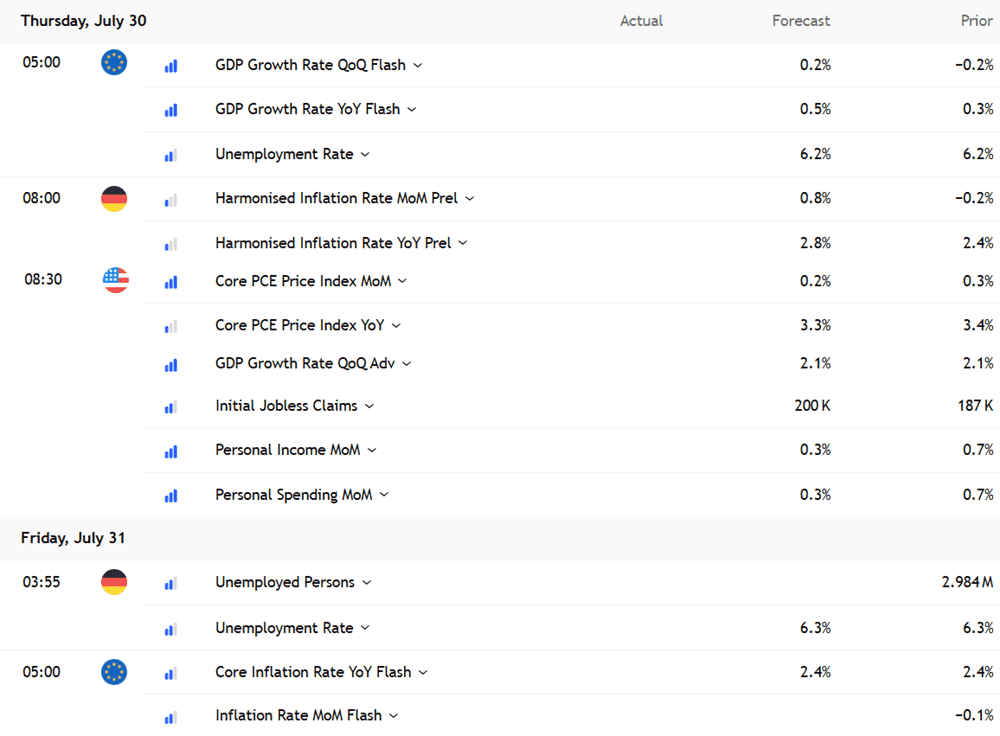
Markets expect the euro area economy to have expanded by 0.2% in the June quarter, which, barring revisions, would lift annual growth to 0.5%. In the United States, GDP is forecast to increase at a seasonally adjusted annualised rate of 2.1%, matching the pace seen in the first quarter. While the preliminary US GDP report relies on several assumptions and is subject to revision, history suggests it can still be a notable market mover.
While June core PCE inflation, the Federal Reserve's preferred inflation measure, will also be released during today's session, it rarely surprises nowadays given economists can forecast it with a high degree of confidence using the CPI and PPI reports released earlier in the month. As such, greater attention is likely to fall on the personal income and spending data, providing fresh evidence on whether the resilience in US consumer spending can continue. With households continuing to underpin economic growth, any signs income growth is slowing or the savings rate is falling further would raise questions about how much longer consumers can continue carrying the economy.
Ultimately, for EUR/USD, it's the relative growth picture that matters. Any meaningful deviation from expectations on either side of the Atlantic has the potential to shift interest rate expectations and, by extension, the direction of the pair.
Until those releases arrive, the technical picture provides the clearest guide to the levels worth watching.
Bulls confront the next hurdle
Source: TradingView
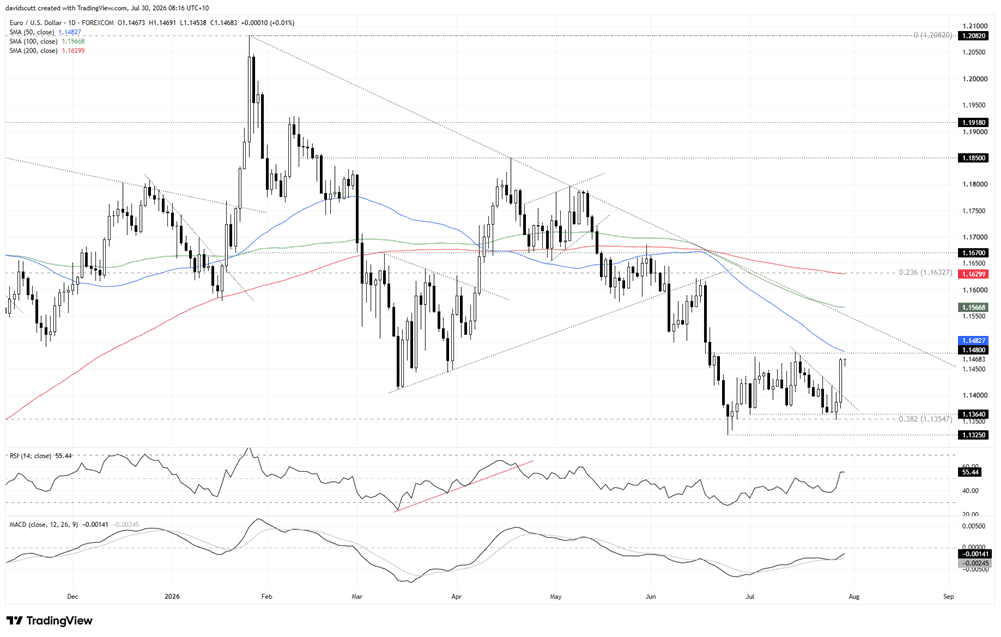
More broadly, EUR/USD has been rangebound since the middle of June, capped by resistance around 1.1480, with bids repeatedly emerging around 1.1364 and the 38.2% Fibonacci retracement of the January 2025 to January 2026 bull move at 1.1355. Sellers tested that support zone earlier this week but failed, paving the way for the pair to break above the minor downtrend that had capped rallies since the middle of July.
EUR/USD now sits back near the top of that broader range. Resistance around 1.1480 is reinforced by the 50-day simple moving average sitting just above. Should price break convincingly through both, 1.1500 is the next level to watch. Beyond that, attention shifts to the longer-term downtrend, currently found just above 1.1550, with the 100-day simple moving average also located nearby. That creates what looks like a formidable resistance zone, especially if geopolitical tensions in the Middle East remain elevated.
On the downside, having broken above the July downtrend, the former resistance line becomes initial support. It sits around 1.1400 today. Below that, attention shifts back to the top of the broader support zone at 1.1364, followed by the late June swing low of 1.1325.
Momentum indicators offer little conviction either way. RSI (14) has pushed back above the neutral 50 level but sits at only 55, while MACD has crossed above the signal line but remains negative. Taken together, they point to neutral rather than directional momentum.
Beyond technicals, my gut feel is that EUR/USD may struggle to deliver a sustained break above 1.1480 unless we see a meaningful improvement in the geopolitical backdrop or today's data materially weaken the US dollar.







Web Trader platform
Our sophisticated web-based platform is packed with features.
Open an account today
Experience award-winning platforms with fast and secure execution.
Economic calendar
Related articles

Euro Short-term Outlook: EUR/USD Pullback Nears Pivotal Uptrend Support 8 28 2026
Warsh's comments accelerated the EUR/USD selloff, raising the stakes as buyers look to stabilize the broader recovery.


EUR/USD forecast: All eyes on Warsh at Jackson Hole - Forex Friday
For much of this week, the EUR/USD has been edging lower with the US dollar regaining some ground after last week’s sell-off that was triggered, in part, by the bond market worries. Investors have been unwilling to bet further against the US dollar so far this week ahead of Kevin Warsh’s keynote speech at the Jackson Hole summit, due later today.


AUD/CAD breakout puts the Bradman barrier in sight
A bullish breakout has pushed AUD/CAD to its highest level since early 2021. Whether it can clear 0.9994 may determine if the move extends well above parity.