


EUR/USD Forecast Weighed by Crude Oil, Dollar Upsurge - Currency Pair of The Week
Energy prices are once again setting the tone for currency markets, with the renewed tensions in the Middle East reinforcing the dollar’s appeal while weighing on low-yielding and energy-importing currencies. As oil and natural gas prices climb, investors are becoming increasingly reluctant to price out further Fed tightening, providing the greenback with another tailwind.
Written by
Fawad Razaqzada
Market Analyst
Energy prices are once again setting the tone for currency markets, with the renewed tensions in the Middle East reinforcing the dollar’s appeal while weighing on low-yielding and energy-importing currencies. As oil and natural gas prices climb, investors are becoming increasingly reluctant to price out further Fed tightening, providing the greenback with another tailwind. This is keeping the near-term EUR/USD forecast tilted to the downside.
Dollar remains bid as oil climbs on fresh escalation
At the weekend, the US launched fresh strikes on dozens of Iranian military targets after Iran attacked commercial shipping in the Strait of Hormuz. Targets reportedly included air-defense systems, radar installations, missile and drone capabilities, and naval assets. In retaliation, Iran said it targeted US military bases in Jordan, Bahrain, and Kuwait, as well as radar systems in Oman.
The latest exchanges mark a significant intensification of tensions between Washington and Tehran. Last week, US President Donald Trump declared that the US-Iran ceasefire was “over” and sharply criticized Iran’s leadership. What it means for the markets is that the re-escalation has disrupted maritime traffic through the Strait of Hormuz. No commercial vessels have transited the waterway since Sunday evening, according to reports tracking shipping data. In turn, oil prices have surged higher again.
With crude oil rising once again, the obvious question is: what does this mean for the US dollar?
Given that the Fed’s new chairman has made it clear that he wants to keep inflation under control, another spike in oil prices is likely to reinforce expectations that US interest rates will stay higher for longer. Even if some of the near-term economic data softens, persistently high energy prices would make it difficult for the Fed to adopt a more dovish stance.
That is one of the reasons why we’re seeing the US dollar regain momentum, particularly against currencies whose economies are heavily reliant on imported energy, such as the euro and the Japanese yen.
Should Iran succeed in disrupting shipping through the Strait of Hormuz for al lengthy period of time once again, the US is likely to be viewed as relatively insulated thanks to its energy independence. At the same time, higher oil prices would add to inflationary pressures, making it harder for the Fed not to signal intentions of policy tightening.
US CPI and Warsh testimony in focus
The focus now turns to a busy week for US economic data and Federal Reserve officials. Tuesday’s inflation report will be closely watched, with headline CPI expected to ease 0.1% on a monthly basis, lowering the year-over-year rate to 3.8% from 4.2%. However, firmer energy prices and sticky core inflation, still hovering around 2.9% year-on-year, suggest it remains premature to rule out at least one rate increase before the end of the year.
Markets will also hear from Fed Chair Kevin Warsh as he begins two days of testimony before Congress. Investors will be looking for any clues on the policy outlook. With energy prices firming and little evidence that the US economy is slowing enough to offset inflation risks, Warsh is unlikely to sound dovish at all. So, the fundamental backdrop continues to favour the dollar.
That leaves low-yielding, energy-dependent currencies such as the euro and the yen particularly vulnerable, meaning that the EUR/USD forecast is tilted to the downside. Of particular concern for Europe is the renewed strength in natural gas prices, especially with inventories still relatively low and demand rising (for air cooling systems) amid elevated summer temperatures.
Technical EUR/USD forecast and key levels to watch
That combination leaves the euro exposed. In the near term, the EUR/USD could drift back towards the 1.1350 region, with a follow-up move into the 1.1300 area looking increasingly plausible over the coming days and weeks.
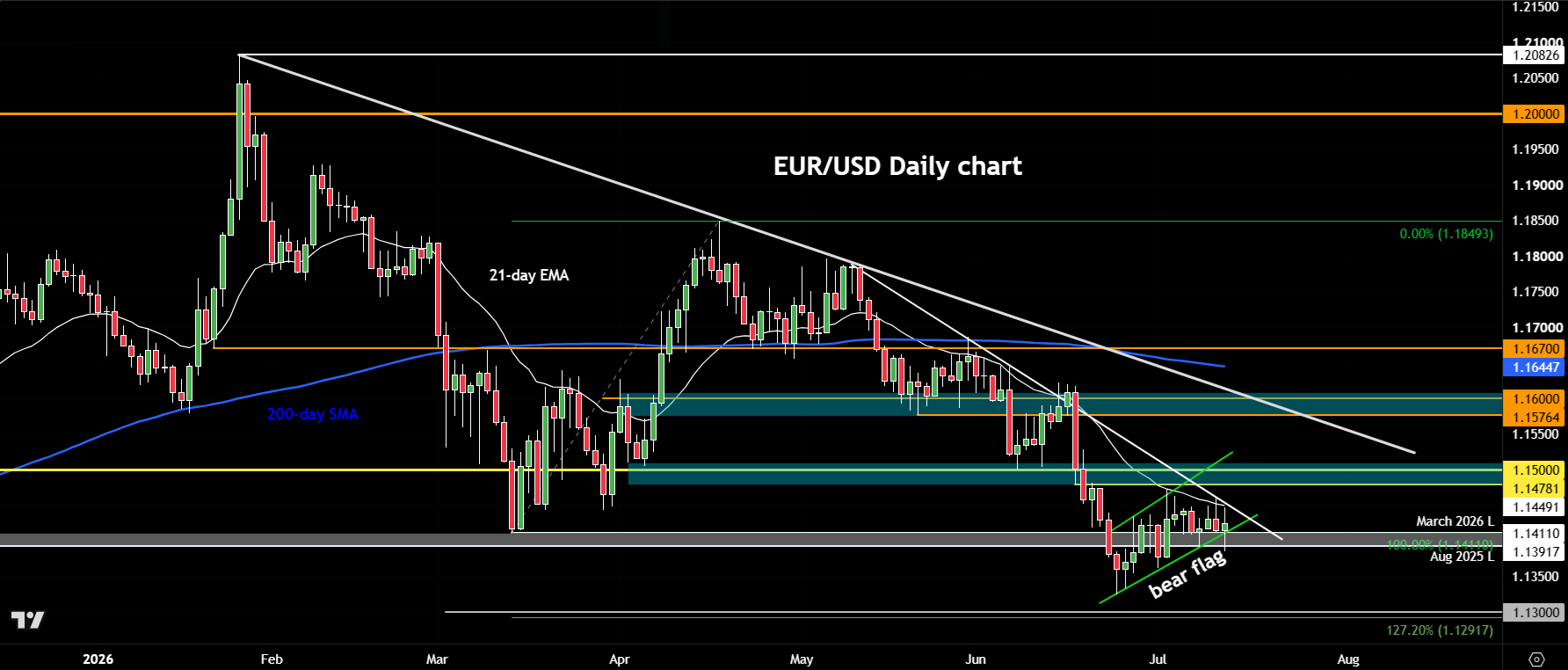
There is also a bearish flag pattern to consider, too. If there EUR/USD breaks below the support trend of the pattern, which is what I expect, then at the very least I’d anticipate a retest of the recent lows around 1.1324.
Below that the 1.1300 area would come into focus. This level also lines up with the 127.2% Fibonacci extension of the major advance we saw between March and April. Given what’s happening in the oil market, together with the prospect of a more hawkish Fed, the path of least resistance for EUR/USD still appears to be to the downside.
Resistance is seen around 1.1450, followed by the 1.1480-1.1500 region.
Meanwhile, the European data calendar is relatively quiet this week, meaning short-term moves in the euro are likely to be driven more by developments in energy markets and shifts in US rate expectations than by domestic fundamentals.
-- Written by Fawad Razaqzada, Market Analyst
Follow Fawad on Twitter @Trader_F_R






Web Trader platform
Our sophisticated web-based platform is packed with features.
Open an account today
Experience award-winning platforms with fast and secure execution.
Economic calendar
Related articles

Euro Short-term Outlook: EUR/USD Pullback Nears Pivotal Uptrend Support 8 28 2026
Warsh's comments accelerated the EUR/USD selloff, raising the stakes as buyers look to stabilize the broader recovery.


Gold and S&P 500 analysis: What now after Warsh’s hawkish speech?
The dollar surged across the board after the Fed Chair Kevin Warsh surprised with a hawkish-leaning speech at the Jackson Hole summit. All the bearish dollar bets that had been accumulated since last Friday on the back of data weakness and bond market troubles had to be squared and that triggered a short squeeze rally for the dollar. Gold and silver dropped, as a result, as too did bitcoin, while US indices were giving back earlier gains.

EUR/USD forecast: All eyes on Warsh at Jackson Hole - Forex Friday
For much of this week, the EUR/USD has been edging lower with the US dollar regaining some ground after last week’s sell-off that was triggered, in part, by the bond market worries. Investors have been unwilling to bet further against the US dollar so far this week ahead of Kevin Warsh’s keynote speech at the Jackson Hole summit, due later today.