EUR/USD Outlook: AI sentiment returns as French debt fears fades
French debt was the market's obsession a week ago. Now, short-term correlations suggest technology sentiment may be calling more of the shots, with central bank decisions and heavyweight tech earnings threatening to accelerate the euro's decline.
Written by
David Scutt
Market Analyst
- French yield correlations fade sharply
- AI sentiment increasingly linked to dollar strength
- Fed, ECB face hawkish pricing test
- EUR/USD downside risks build below 1.1130
EUR/USD's fascination with French debt looks to have disappeared, with growing evidence that AI sentiment is once again influencing not only the pair, but also the broader US dollar.
While the Federal Reserve meeting later Wednesday provides an obvious macro risk event, it could well be earnings from Microsoft and Alphabet after the US market close that end up being more important for the direction of the pair.
French debt fears fade
As is so often the case, what seemed to be the most important thing in the world for the euro just a week ago now appears almost irrelevant, at least judging by recent correlations.
The focus on rioting, failed budget negotiations and the sharp rise in French government bond yields, which had demonstrated an increasingly strong inverse relationship with EUR/USD, now appears to have all but gone by the wayside. Whether that's down to Moody's surprise decision to leave France's sovereign credit rating unchanged last Friday, or simply markets moving on to something else, is anyone's guess.
Source: LSEG
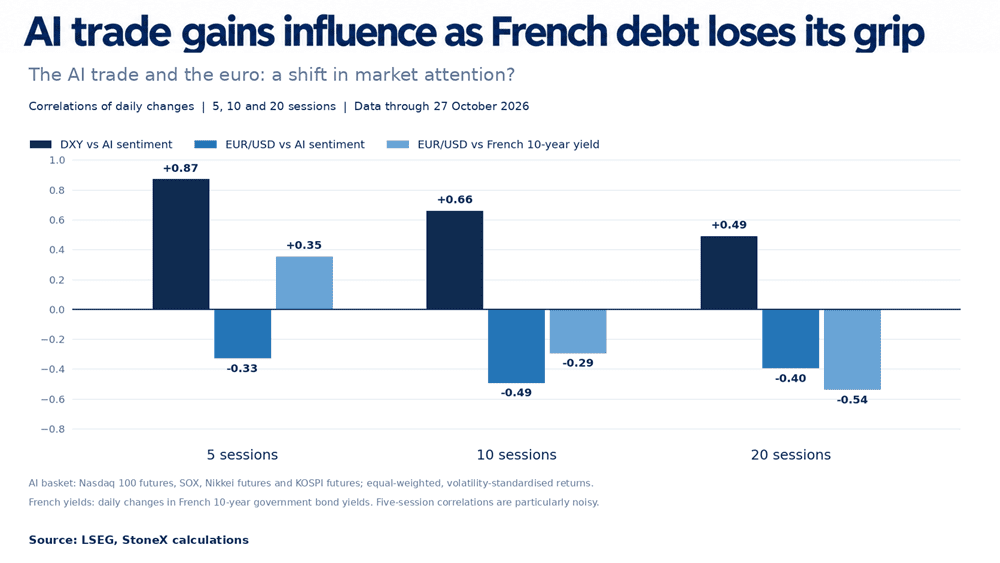
But what is evident is that the short-term relationship between French longer-dated bond yields and EUR/USD has all but collapsed. Instead, as the graphic below shows, our equally weighted basket of AI-related markets, comprising Nasdaq 100 futures, SOX, KOSPI futures and Nikkei futures, appears to be having a growing influence on the broader US dollar and, to a lesser degree, EUR/USD.
Considering the evidence that AI sentiment is once again influencing the US dollar, perhaps as a proxy for the US growth outlook, earnings updates from Microsoft and Alphabet after Wednesday's market close may well be influential on the dollar's broader performance as we move into Thursday's session.
Fed and ECB face hawkishness hurdle
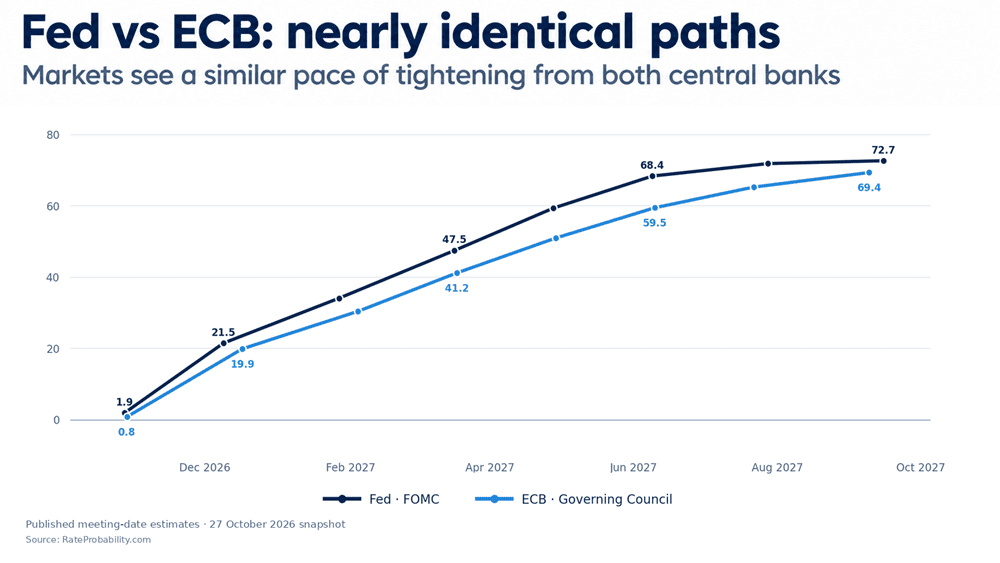
Before that, of course, we have the small matter of the Fed's October interest rate decision. However, after being guided by several senior Fed officials that the broader FOMC is likely to remain patient when it comes to tightening policy, the meeting is viewed as very much a placeholder, with markets assigning just an 8% probability to a 25bp hike.
Looking ahead to December, however, that pricing flips sharply towards the prospect of a hike, with markets assigning around a 93% probability that rates will be at least 25bp higher by then. For EUR/USD today, it will likely come down to whether the tone of the statement, the voting split and Kevin Warsh's press conference are hawkish enough to justify that near-term rate outlook.
Source: TradingView
Less than 24 hours later, we'll also get the ECB's October rate decision, which, like the Fed, is seen as a placeholder ahead of an expected hike in December.
With no updated economic forecasts accompanying the decision, the focus for EUR/USD will again be on communication, particularly whether the policy statement and Christine Lagarde's press conference can reinforce the hawkish pricing already embedded in the curve, or give markets reason to question it.
EUR/USD downside risks building
Source: TradingView
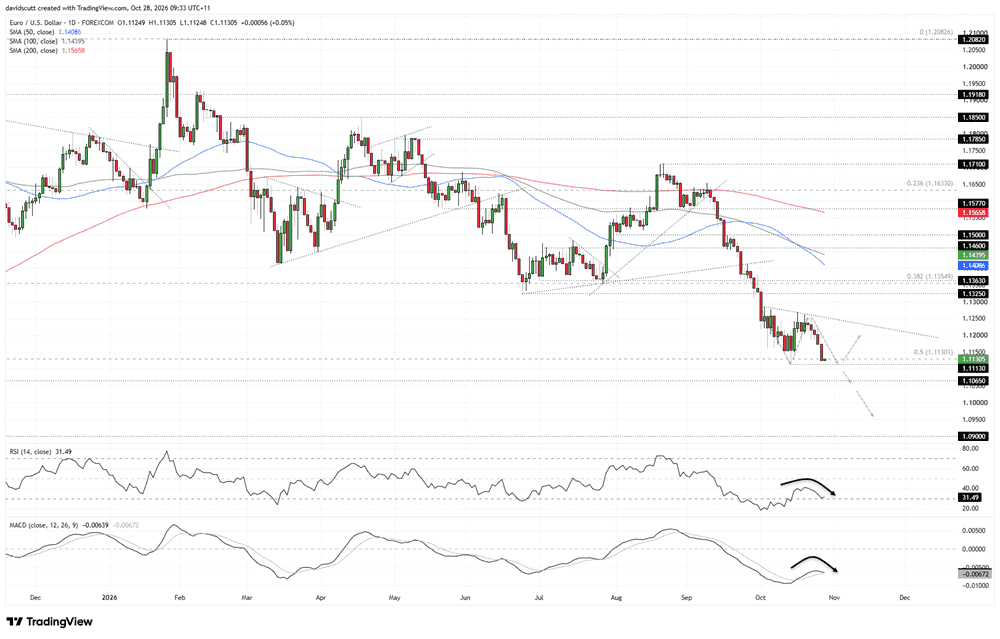
After managing to bounce from the 50% retracement of the January 2025 to January 2026 bull move earlier this month, EUR/USD has once again come under selling pressure. The pair struggled to sustain moves above 1.1250 on several occasions before selling accelerated over recent sessions, taking the price back beneath the 50% retracement at 1.1130 and leaving it within touching distance of the October 14 low at 1.1113.
That now becomes the immediate focal point beneath where the pair trades, with 1.1065 the next level of note, marking the swing low set back in May 2025. Beneath that, there's almost no visible support until 1.0900, a level the pair has often gravitated towards and traded either side of over recent years.
Looking at the recent price action, there's early evidence of a descending triangle beginning to form, with a series of lower highs pressing down towards support around 1.1113. While it's still early doors, the price action is showing signs of compressing, suggesting that selling pressure is building and the risk of a downside break is elevated over the short to medium term.
That assessment is reinforced by the fact that EUR/USD continues to trade beneath all its key medium and long-term moving averages, while the message from the oscillators is also firmly bearish. RSI (14) is rolling back towards oversold territory, although it's yet to revisit the extreme reading seen earlier this month. MACD also remains negative and is closing in on its signal line, threatening another bearish crossover. Taken together, momentum looks to be rebuilding on the downside.
Should we see a bounce from the nearby support zone, the immediate focal point would be the minor downtrend resistance around 1.1250, where the pair struggled earlier this month. Above that, 1.1325 comes into view, followed by the 38.2% Fibonacci retracement at 1.1355 and former support at 1.1363, which gave way during the latest leg lower.
Overall, the price action looks heavy, and selling into strength remains the preferred approach. Until the US economic exceptionalism story really starts to break down, the euro comes across as being firmly in the too hard basket to get excited about.
Latest market news











Web Trader platform
Our sophisticated web-based platform is packed with features.
Open an account today
Experience award-winning platforms with fast and secure execution.
Economic calendar
Related articles

USD/JPY Weekly Outlook: AI earnings could overshadow the Fed and BoJ
AI sentiment has become a major driver of US Treasury yields and USD/JPY. With Microsoft, Alphabet and Amazon reporting this week, central bank decisions may have competition for traders' attention.

EUR/USD forecast: All eyes on Warsh at Jackson Hole - Forex Friday
For much of this week, the EUR/USD has been edging lower with the US dollar regaining some ground after last week’s sell-off that was triggered, in part, by the bond market worries. Investors have been unwilling to bet further against the US dollar so far this week ahead of Kevin Warsh’s keynote speech at the Jackson Hole summit, due later today.


Bitcoin Forecast: BTC/USD Back to $80K Ahead of Warsh’s Jackson Hole Speech
After surging over $15,000 in the past 10 days alone, there is risk of a near-term pullback if Warsh says anything remotely hawkish at Jackson Hole - what are the levels to watch from here?