


EURUSD Analysis Euro Loses Momentum Following the US PCE Release
Today's session has not been particularly favorable for the euro. Recent EUR/USD price action shows a decline of approximately 0.2% in favor of the U.S. dollar, a move largely driven by the release of the U.S. PCE inflation report and the recent recovery seen in the bond market.
Written by
Julian Pineda
Market Analyst
Today's session has not been particularly favorable for the euro. Recent EUR/USD price action shows a decline of approximately 0.2% in favor of the U.S. dollar, a move largely driven by the release of the U.S. PCE inflation report and the recent recovery seen in the bond market. Both factors have limited the euro's ability to extend its gains in the short term and, as long as markets remain cautious ahead of upcoming Federal Reserve decisions, a broader period of indecision could begin to play a more important role in EUR/USD trading over the coming sessions.
PCE Data and Bond Yields Shift Market Dynamics
During today's session, both the Headline PCE and Core PCE reports were released in the United States. These indicators measure changes in personal consumption expenditures and consumer prices, with the core reading excluding more volatile categories such as food and energy.
Overall, July's Headline PCE increased by 0.2% month-over-month, exceeding market expectations of 0.1%, while the annual reading stood near 3.7%. Meanwhile, Core PCE remained in line with expectations at 3.3%, producing no significant surprises and continuing to reflect relatively stable inflationary pressures over recent months.
Taken together, the data does not point to a meaningful acceleration in inflation, but neither does it show sufficient cooling to reinforce expectations of interest rate cuts in the near term. As a result, the report continues to support a scenario in which the Federal Reserve may keep interest rates elevated for longer, although it does not necessarily suggest a more aggressive policy stance.

Source: TradingEconomics
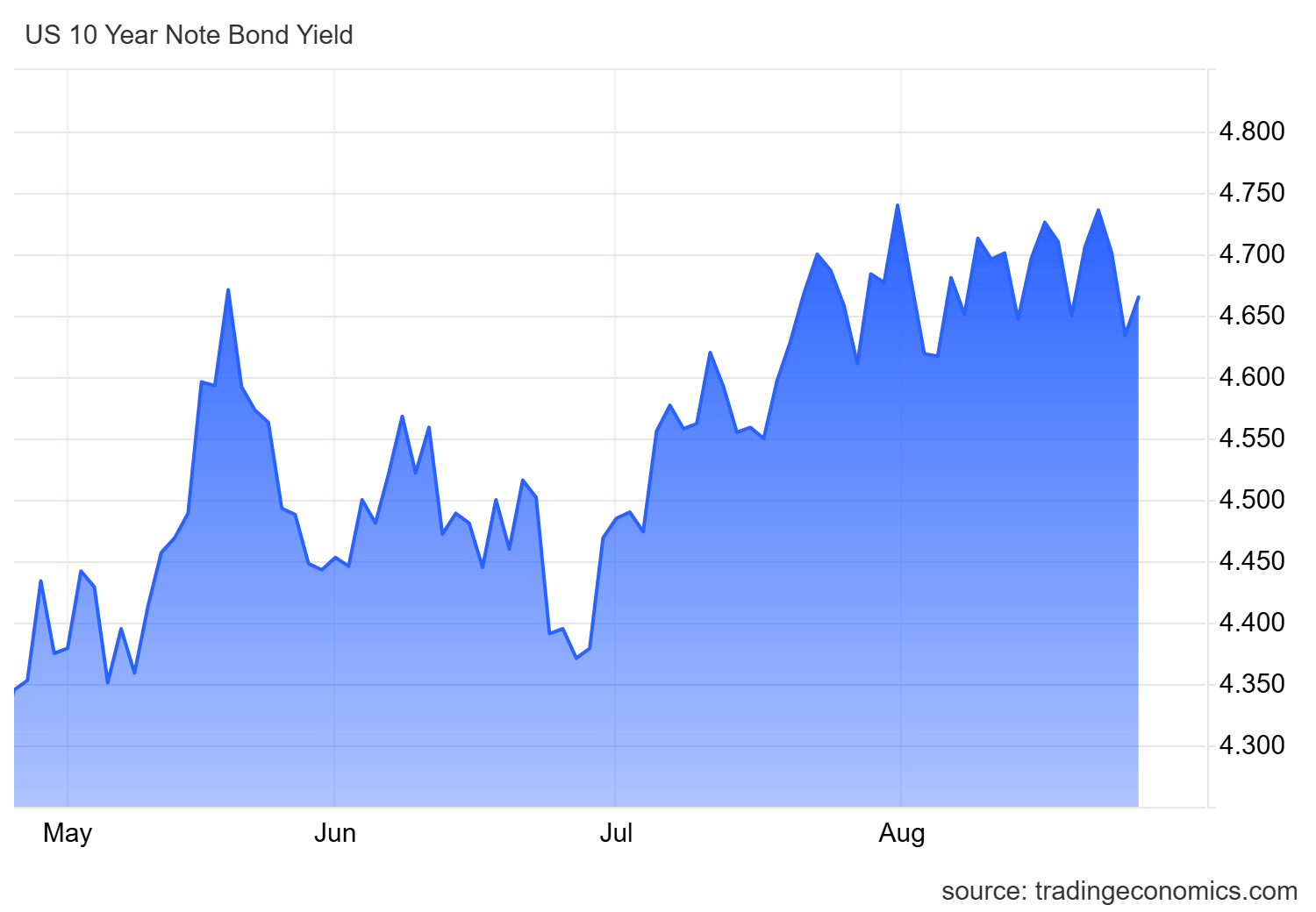
The PCE release was also accompanied by a moderate recovery in U.S. Treasury yields. The 10-year Treasury yield has resumed an upward trajectory in recent sessions and is once again approaching the 4.7% area, reflecting a partial recovery in the relative attractiveness of the bond market.
This behavior also suggests that investors continue to price in a relatively high interest rate environment for the months ahead. For now, yields have not shown a meaningful downward trend that would strengthen expectations for a more accommodative monetary policy stance.
Source: TradingEconomics
The combination of these factors may be supporting a modest recovery in the U.S. dollar. On one hand, inflation data is not slowing enough to justify imminent monetary easing. On the other, higher bond yields continue to support the appeal of U.S. dollar-denominated investments. Together, these developments have started to strengthen demand for the greenback and may make it more difficult for the euro to regain ground consistently in the short term.
In addition, markets remain focused on upcoming events at Jackson Hole, where Federal Reserve officials are expected to provide important policy guidance. Depending on the tone adopted by policymakers, the U.S. dollar could receive additional support. In this environment, current catalysts may continue to favor a period of greater balance and indecision within EUR/USD price action over the next several sessions.
EUR/USD Technical Outlook
Source: StoneX, Tradingview
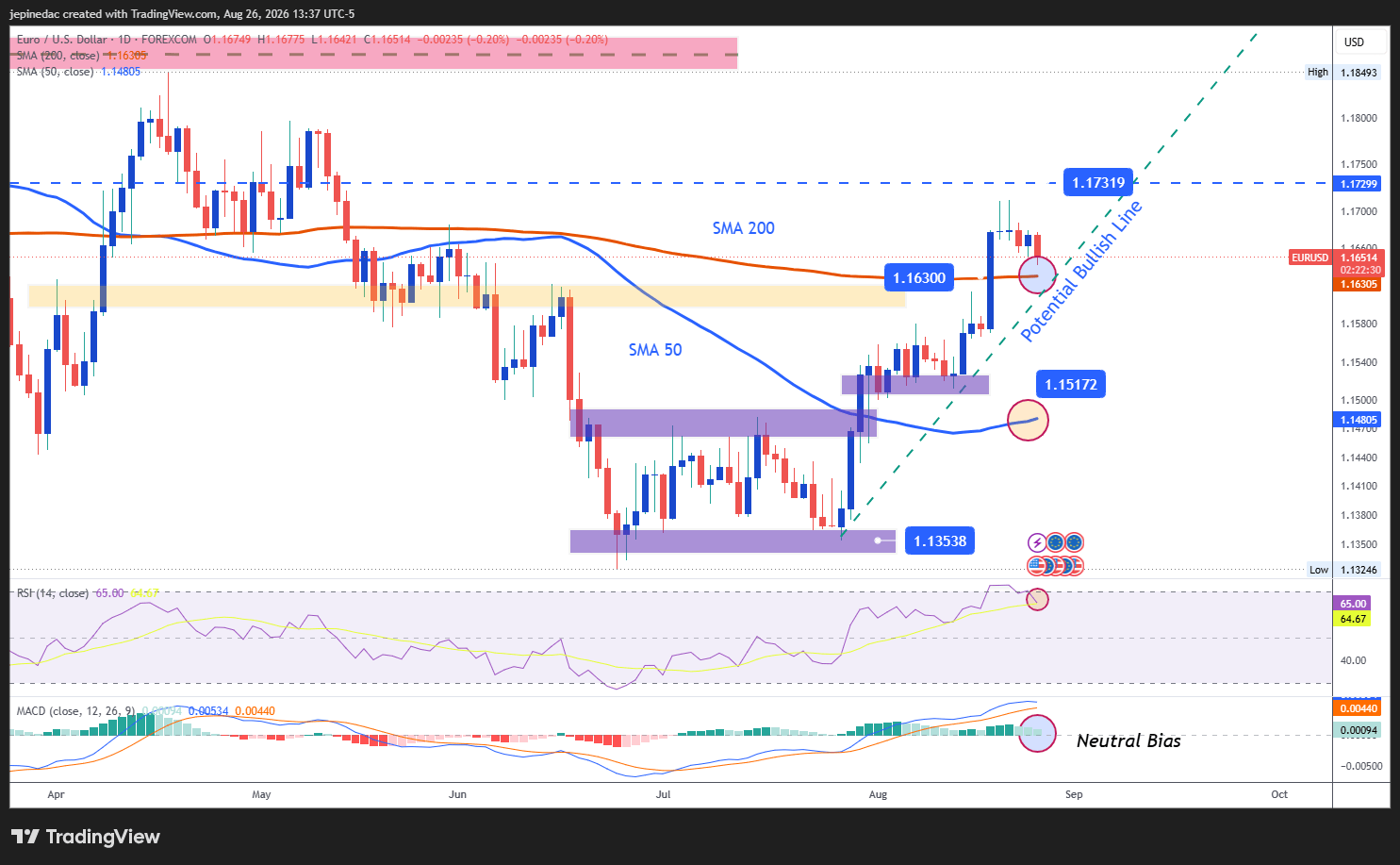
- The Emerging Bullish Trendline Is Trying to Hold: Since late July, a bullish trendline has been developing, supported by the euro's recovery over recent weeks. For now, this structure remains the most important technical reference on the chart. However, recent sessions have also shown increasing signs of market neutrality and, unless buying pressure can regain momentum, the strength of the uptrend may begin to come under pressure. This could eventually open the door to a more defined period of sideways trading in the weeks ahead.
- RSI: The indicator has maintained a downward slope in recent sessions, reflecting a slowdown in the bullish momentum that dominated previous weeks. This reading suggests that buying pressure may be entering a consolidation phase, supporting a more balanced market environment.
- MACD: Meanwhile, the MACD histogram continues to fluctuate very close to the neutral 0 level. This behavior reflects increasing balance in the average strength of short-term moving averages and supports the possibility that a neutral market phase could become more prominent over the coming sessions.
Key Levels to Watch:
- 1.17319 – Key Resistance:: This level marks highs not seen since May and remains the most important upside barrier within the current structure. Price action that approaches or breaks above this area could reinforce the bullish bias and help establish the rising trendline as the dominant technical pattern.
- 1.16300 – Nearby Barrier: An important equilibrium zone that coincides with significant retracements from previous weeks and the 200-period Simple Moving Average. As long as prices continue to fluctuate around this level, the perception of a directionless market may strengthen, potentially leading to the development of a short-term sideways range.
- 1.15172 – Critical Support: This level corresponds to one of the most relevant lows recorded in recent weeks and also aligns with the base of the current bullish trendline. Price action below this area could invalidate the structure and open the door to a more dominant bearish bias in upcoming sessions.
Written by Julian Pineda, CFA, CMT – Market Analyst
Follow him on: @julianpineda25
Latest market news










Web Trader platform
Our sophisticated web-based platform is packed with features.
Open an account today
Experience award-winning platforms with fast and secure execution.
Economic calendar
Related articles

EUR/USD forecast: All eyes on Warsh at Jackson Hole - Forex Friday
For much of this week, the EUR/USD has been edging lower with the US dollar regaining some ground after last week’s sell-off that was triggered, in part, by the bond market worries. Investors have been unwilling to bet further against the US dollar so far this week ahead of Kevin Warsh’s keynote speech at the Jackson Hole summit, due later today.


DAX and EUR/USD forecast: Lower energy prices, yields offer support
But the question, of course, is how much further oil prices and bond yields can fall. For now, the combination is supportive of risk assets and is helping to sustain a relatively benign decline in the dollar. The focus today will be on US core PCE inflation, due for release shortly, while Nvidia’s second-quarter earnings will provide another test for risk appetite after the US markets close – not just for US indices but for global tech-heavy indices given the influence Nvidia has over the global tech and AI names.

Oil, EUR/USD Forecast: Two trades to watch 2608
Oil falls further on diplomatic hopes for a Middle East resolution. EUR/USD consolidates ahead of U.S. inflation and Jackson Hole.
