

NZD/USD forecast: Jobs report weakens case for aggressive RBNZ hikes
Stronger employment wasn't enough to offset a surge in labour force participation, leaving unemployment at its highest level in more than a decade. The report keeps a September RBNZ hike in play but casts doubt on the rate path beyond.
Written by
David Scutt
Market Analyst
- Unemployment hits highest level since June 2015
- Underutilisation jumps despite stronger-than-expected hiring\
- Kiwi swaps retreat as rate bets unwind
- AUD/NZD rebounds after support holds
Labour market slack builds
New Zealand's unemployment rate climbed to its highest level in over a decade in the June quarter, reinforcing the view that abundant labour market slack leaves little risk of a wage breakout that could reignite domestic inflationary pressures.
The unemployment rate climbed to 5.6% in the June quarter, the highest level since the June quarter of 2015, comfortably above the 5.4% expected by both markets and RBNZ. Broader measures softened too, with the underutilisation rate climbing to 13.8% from 12.9%. This measure includes unemployed, people wanting more hours and those on the sidelines available for work, making it a broader gauge of spare capacity in the labour market.
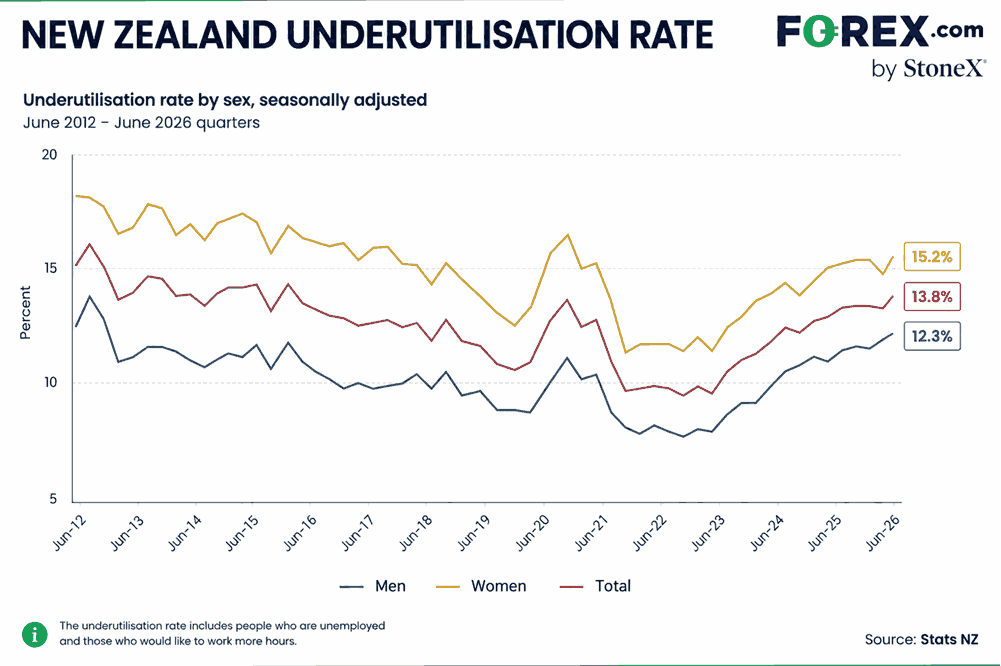
Source: StatsNZ, FOREX.com
Despite the increase in slack, the report masked what was a strong quarter for hiring. Employment increased 0.5%, more than double the 0.2% gain expected by markets and well above the 0.1% increase forecast by the RBNZ. Over the year, it grew by 1.2%.
The reason unemployment increased was a sharp lift in labour force participation, with the rate jumping to 70.7%, well above the 70.3% expected by both markets and the RBNZ. More people entered the workforce than the economy was able to absorb, leaving unemployment and underutilisation higher.
Wage growth wasn't a game changer either. While private sector labour cost inflation edged above the RBNZ's forecast at 2.0% year-on-year, it remains at levels inconsistent with the type of wage breakout that could fuel domestic inflationary pressures.
Markets may have overcooked the RBNZ
Despite the softness of the report, it is unlikely to derail the near-term RBNZ outlook with another 25 basis point rate increase still highly likely at next month's meeting, fitting with the hawkish bias delivered in July when policymakers began the tightening cycle.
At the conclusion of that meeting, the RBNZ said "with inflation still above target and economic activity expected to strengthen, some further reduction in monetary stimulus is likely to be required to return inflation to the 2 percent target mid-point", while adding that future cash rate decisions would depend on incoming data, price-setting behaviour and the strength of economic activity.
Beyond next month's meeting, today's data does raise fresh questions over how far rates will ultimately need to move beyond neutral, estimated by the RBNZ to be around 3%.
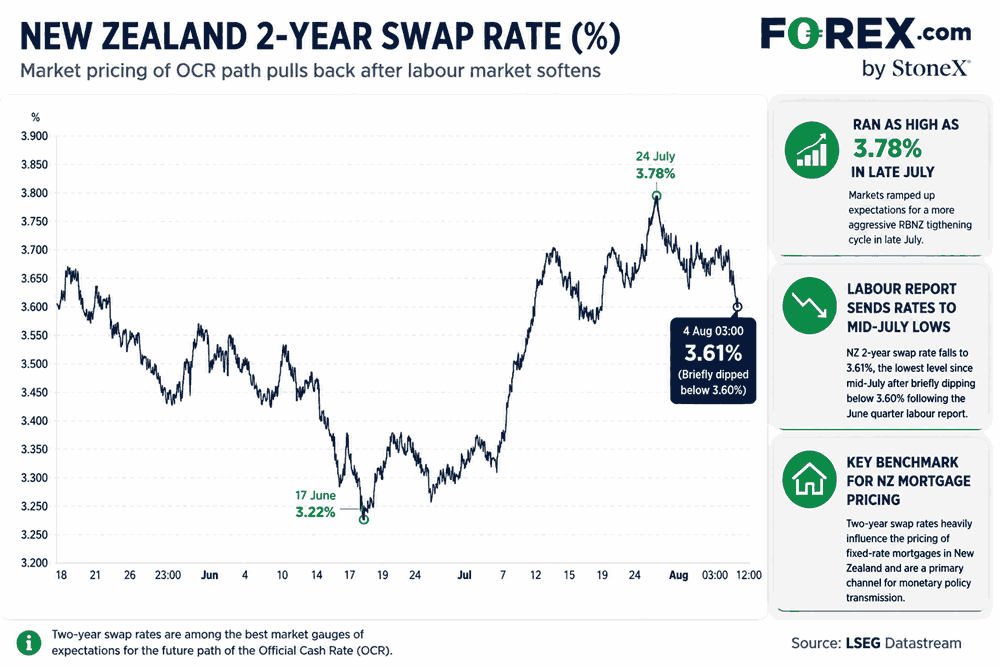
Source: LSEG, FOREX.com
That was reflected in New Zealand's two-year swap rate, a key market gauge of expectations for the future path of the cash rate. The rate fell to 3.61% following the release, the lowest level since mid-July after briefly dipping beneath 3.60%. That's a notable reversal given it traded as high as 3.78% in late July as markets ramped up expectations for a more aggressive tightening cycle.
The move matters because two-year swap rates heavily influence the pricing of fixed-rate mortgages in New Zealand, making them one of the primary channels through which changes in RBNZ policy are transmitted to households and the broader economy.
Risk appetite calls the shots for NZD/USD
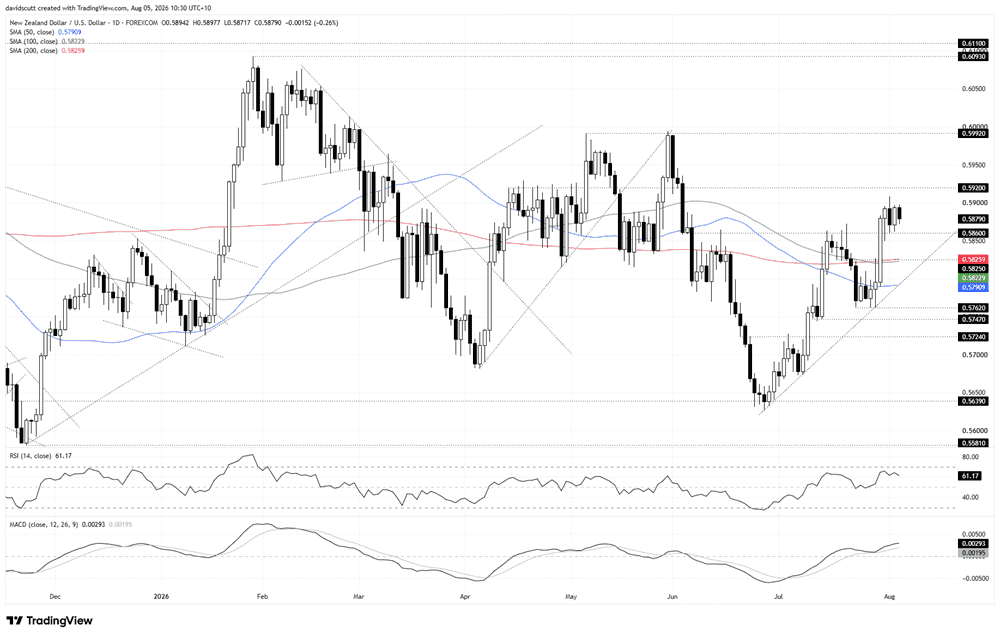
Source: TradingView
For NZD/USD, the domestic rates story is superseded by broader risk appetite as the primary directional driver, helping to explain why the Kiwi has only edged lower following the labour market report.
More importantly, the pullback has done little to threaten last week's break above resistance at 0.5860. Having bounced from around that level in each of the past two sessions, it remains the immediate level to watch on the downside. Below, the confluence of the 50 and 100-day moving averages, along with minor support at 0.5825, marks the next downside zone of note before the uptrend from the June lows comes into view.
On the topside, the pair stalled above 0.5900 on Monday, leaving that and more persistent resistance at 0.5920 as the immediate hurdles. A break above the latter would open the door for a retest of the 0.5992 double top established earlier this year.
Momentum indicators continue to favour buying dips over selling rallies. RSI (14) remains above the neutral 50 level despite losing some upside momentum in recent sessions, while MACD continues to hold above both its signal line and zero, maintaining the bullish bias established in early July.
AUD/NZD tries to turn the tide
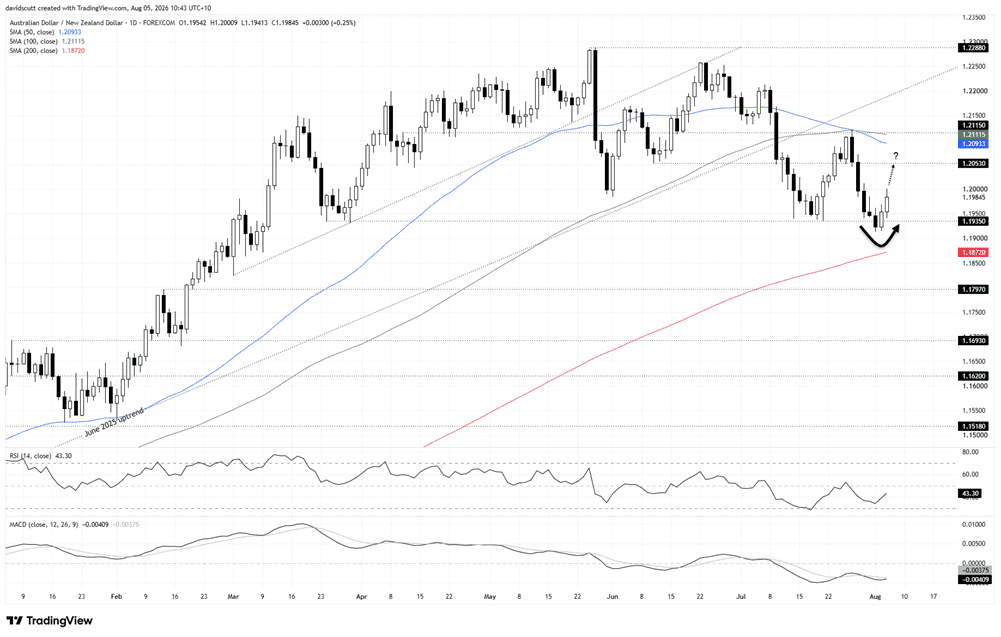
Source: TradingView
Where relative rate expectations matter far more is in the crosses, including AUD/NZD. Combined with stronger-than-expected Australian household spending data for June released on Tuesday, New Zealand's soft labour market report has helped the pair rebound after a failed attempt to break below support at 1.1935.
Having held on this occasion, AUD/NZD is now pushing back towards 1.2000. Above there, former support at 1.2053 is the next hurdle, followed by the confluence of the 50 and 100-day moving averages and horizontal resistance at 1.2115.
Should the broader downtrend reassert itself, the recent lows beneath 1.1935 and the nearby 200-day moving average remain the immediate downside focus.
Momentum indicators have become less bearish in recent sessions. RSI (14) has turned higher from oversold territory and is pushing back towards the neutral 50 level, while MACD has started to curl back towards its signal line while remaining in negative territory. It suggests downside momentum is fading, leaving the near-term directional outlook looking far more balanced than it did only a few days ago.
Latest market news










Web Trader platform
Our sophisticated web-based platform is packed with features.
Open an account today
Experience award-winning platforms with fast and secure execution.
Economic calendar
Related articles

EUR/USD forecast: All eyes on Warsh at Jackson Hole - Forex Friday
For much of this week, the EUR/USD has been edging lower with the US dollar regaining some ground after last week’s sell-off that was triggered, in part, by the bond market worries. Investors have been unwilling to bet further against the US dollar so far this week ahead of Kevin Warsh’s keynote speech at the Jackson Hole summit, due later today.


Bitcoin Forecast: BTC/USD Back to $80K Ahead of Warsh’s Jackson Hole Speech
After surging over $15,000 in the past 10 days alone, there is risk of a near-term pullback if Warsh says anything remotely hawkish at Jackson Hole - what are the levels to watch from here?


DAX and EUR/USD forecast: Lower energy prices, yields offer support
But the question, of course, is how much further oil prices and bond yields can fall. For now, the combination is supportive of risk assets and is helping to sustain a relatively benign decline in the dollar. The focus today will be on US core PCE inflation, due for release shortly, while Nvidia’s second-quarter earnings will provide another test for risk appetite after the US markets close – not just for US indices but for global tech-heavy indices given the influence Nvidia has over the global tech and AI names.