


US Dollar Bulls Await FOMC as Japan's MOF Faces an Intervention Dilemma
US dollar bulls await Warsh's first FOMC meeting as USD/JPY nears intervention territory and Japan's MOF weighs its options.
Written by
Matt Simpson
Market Analyst
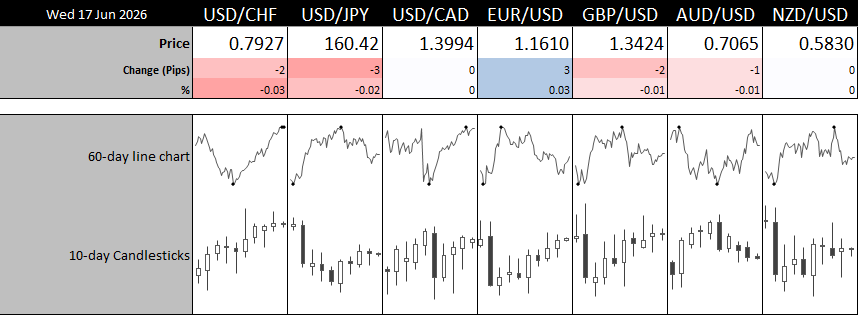
The Federal Reserve's latest policy decision arrives at a pivotal moment for both the US dollar and USD/JPY. With the US Dollar Index pressing against its March high and speculative traders piling into bullish USD positions at the fastest pace in six years, a hawkish outcome could provide the catalyst for a fresh breakout. That would leave Japan's Ministry of Finance (MOF) facing an uncomfortable dilemma: intervene against a strengthening US dollar and risk fighting market momentum, or stand aside and watch USD/JPY push deeper into territory that has previously triggered intervention.
Source: LSEG
View related analysis:
- Australian Dollar Softens, ASX Perks Up After Mildly Hawkish RBA Hold
- US Dollar Longs Surge, Yen Shorts Hit Record High | COT Report
- Nasdaq 100 Leads Wall Street Rebound as Middle East Peace Boosts Risk
- Euro Technical Analysis: EUR/USD, EUR/JPY, EUR/AUD
- How to Read the COT Report to Track Forex Market Sentiment
FOMC Meeting Tests the US Dollar as USD/JPY Nears Intervention Territory
Fed Expected to Hold Rates at Warsh's First Meeting
Kevin Warsh will chair his first FOMC meeting, so what he says during the press conference will be closely scrutinised, to say the least. It has also been speculated that he may not submit his own dot in the Summary of Economic Projections (SEP), either because he does not feel ready or simply does not like the process. Let’s hope that is not the case, as it would imply he is either underprepared for the role or not particularly transparent.
Fed funds futures imply near certainty that rates will remain unchanged today, with a 99% implied probability of a hold. The first move is expected to be a 25bp hike in December, although the probability currently stands at just 49%. The updated Summary of Economic Projections (SEP) could, of course, alter both the timing and odds of the next move.
I do not expect any significant changes to the statement or the Fed's overall tone, which is likely to remain hawkish given the strength of recent economic data and persistent inflationary pressures.
While inflationary pressures are expected to ease over time following the Middle East peace deal, it should be remembered that the US economy has thus far withstood elevated inflation. Moreover, some inflationary pressures are likely to linger for longer than previously anticipated.
This content was created by an affiliate of FOREX.com and represents the views and opinions of the author/speakers, not the views and opinions of FOREX.com, StoneX Group Inc., or its subsidiaries. The content has not been independently reviewed by FOREX.com.
Dot Plot Holds the Key for US Dollar Direction
Any changes to the dot plot and Fed funds forecasts will be among the first details traders scrutinise. The March dot plot showed seven officials expecting rates to remain unchanged this year, while twelve anticipated cuts. Given that five policymakers projected at least two cuts, there is scope for a meaningful hawkish shift in this release.
The Fed has already revised its core PCE inflation forecast higher to 2.7% for this year, although there may be scope for a further upgrade. In short, the risks appear skewed towards a hawkish outcome from both the statement and the dot plot.
The bigger question is whether any officials now foresee a rate hike. Even if Warsh withholds his dot, a higher distribution of dots among the remaining participants could still provide support for the US dollar. Whether the US dollar can hold onto those gains will then depend on the hawkishness of Warsh’s press conference.

US Dollar Bulls Piled into the Futures Market Last Week | COT Report
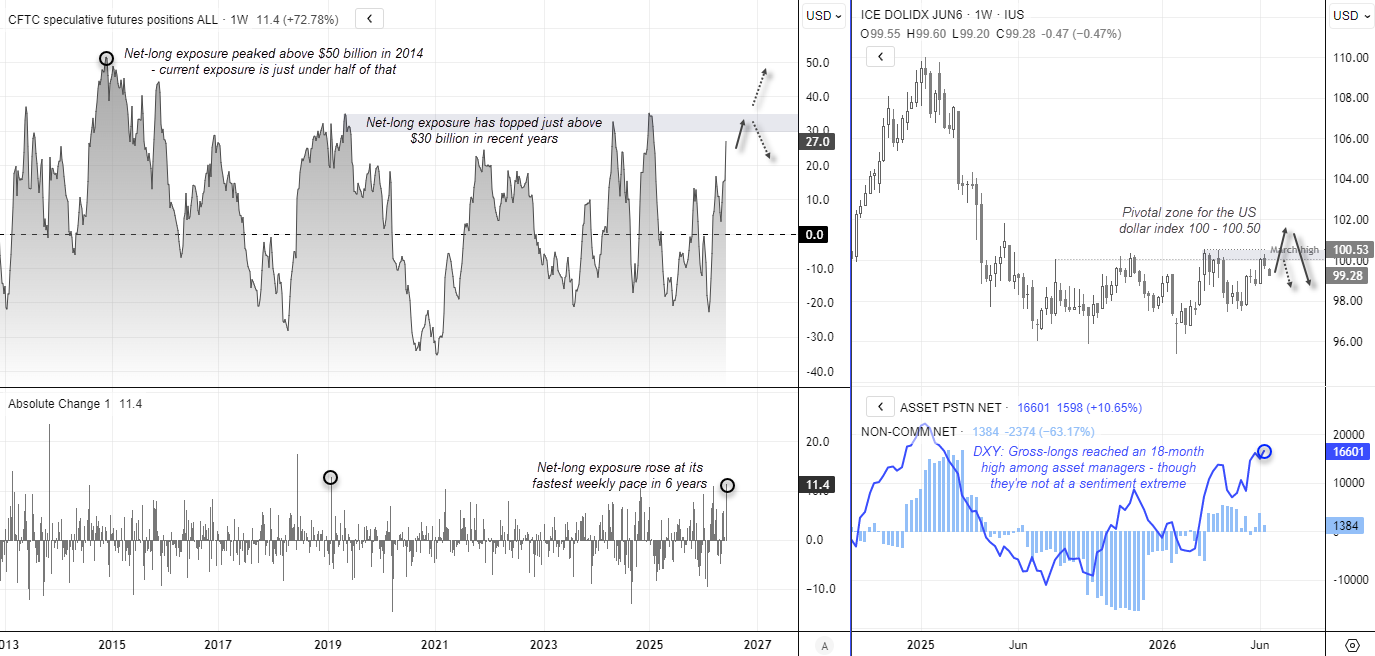
Now is a good time to remember that US dollar futures traders were not holding back with their bullish bets, according to the latest Commitment of Traders (COT) report. Net-long exposure to the US dollar increased by $11.4 billion, marking the largest weekly rise in six years and taking total net-long exposure to $27 billion.
While positioning is elevated by recent standards, there is still scope for it to push above $30 billion. For context, net-long exposure exceeded $50 billion during the 2014 bull run. With a potentially hawkish FOMC meeting on tap and the US Dollar Index teasing a bullish breakout, the odds favour another influx of bullish USD bets.
Source: CME, IMM, CFTC (COT, LSEG)
For traders wanting a deeper understanding of futures positioning, I’ve also published a guide on how to read and interpret weekly COT data in forex markets.
FOMC Decision Puts USD/JPY and MOF Intervention in Focus
Naturally, if the US dollar rises, so too should USD/JPY — much to the annoyance of Japan’s Ministry of Finance (MOF). Given USD/JPY is already trading above the May 6 intervention level just below 158 and is close to retesting the April 30 high near 160.70, it is a safe bet that today’s FOMC meeting is firmly on the MOF’s radar.
Yet to some degree, their hands are tied. Trying to support the yen in the face of aggressive bullish US dollar bets would not be wise, as even the might of the MOF would be swimming against the tide. We have seen in the past that they prefer to strike during periods of low liquidity, and preferably when fundamentals are behind them. However, a hawkish FOMC meeting may not allow that. In that case, they may simply have to watch USD/JPY break higher while throwing in the occasional jawbone, even if it proves futile.
However, if the Fed delivers a less hawkish outcome than markets expect, it could ironically pave the way for intervention. In that scenario, the MOF could benefit from the bearish momentum generated by unwound US dollar bets.
Positioning Suggests USD/JPY Reversal Risks Are Building
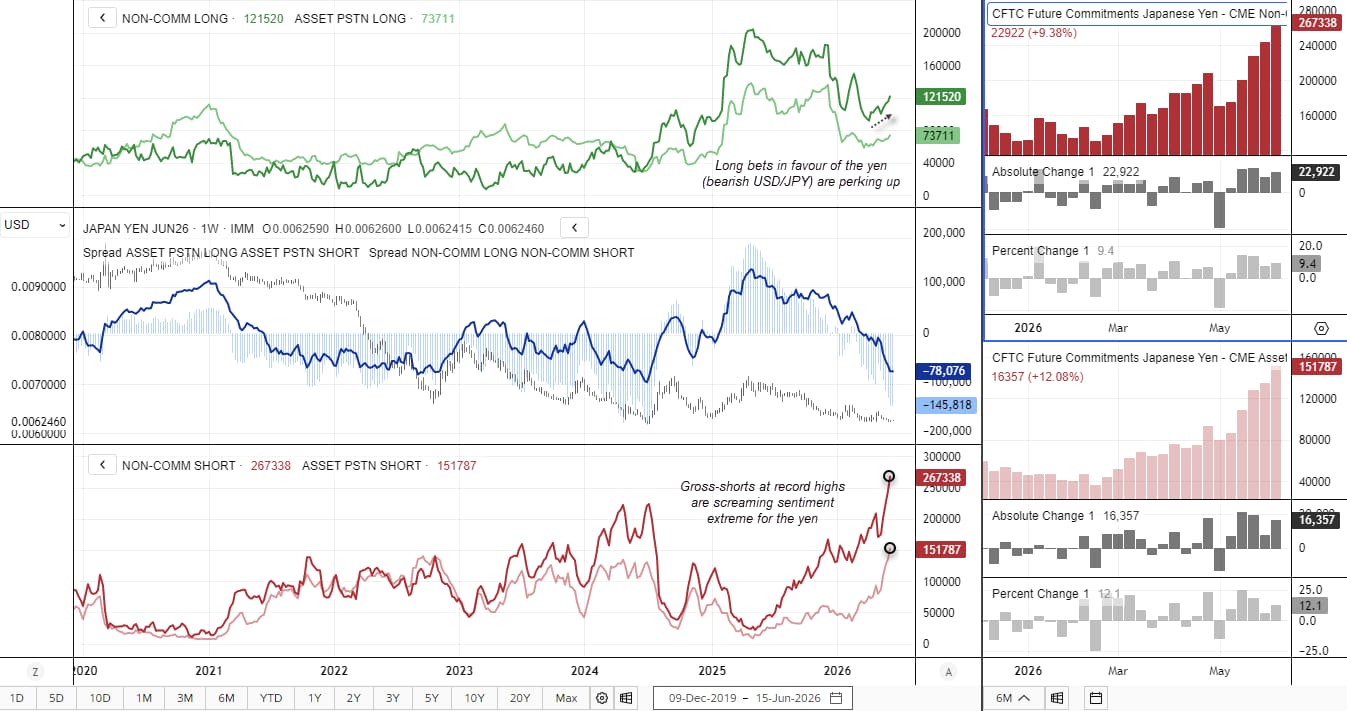
Note that gross-shorts against the Japanese yen have reached a record high among large speculators and asset managers on the CME futures exchange. Gross-longs are also perking up among both sets of traders. This hints at a potential sentiment extreme for the yen short trade and brings the potential for mean reversion lower on USD/JPY. But for a sharp reversal lower to happen any time soon on USD/JPY, the Fed need to allow it.
Source: CME, IMM, CFTC (COT, LSEG)
View the full economic calendar
-- Written by Matt Simpson
Follow Matt on Twitter @cLeverEdge
How to trade with City Index
You can trade with City Index by following these four easy steps:
- Open an account, or log in if you’re already a customer
• Open an account in the UK
• Open an account in Australia
• Open an account in Singapore
- Search for the market you want to trade in our award-winning platform
- Choose your position and size, and your stop and limit levels
- Place the trade
Related tags:







Web Trader platform
Our sophisticated web-based platform is packed with features.
Open an account today
Experience award-winning platforms with fast and secure execution.
Economic calendar
Related articles

Euro Short-term Outlook: EUR/USD Pullback Nears Pivotal Uptrend Support 8 28 2026
Warsh's comments accelerated the EUR/USD selloff, raising the stakes as buyers look to stabilize the broader recovery.


EUR/USD forecast: All eyes on Warsh at Jackson Hole - Forex Friday
For much of this week, the EUR/USD has been edging lower with the US dollar regaining some ground after last week’s sell-off that was triggered, in part, by the bond market worries. Investors have been unwilling to bet further against the US dollar so far this week ahead of Kevin Warsh’s keynote speech at the Jackson Hole summit, due later today.


AUD/CAD breakout puts the Bradman barrier in sight
A bullish breakout has pushed AUD/CAD to its highest level since early 2021. Whether it can clear 0.9994 may determine if the move extends well above parity.
