


US jobs suffer sharp setback, but it is all about inflation – Forex Friday
Today’s US jobs report was the first of the four major releases before the Fed’s next meeting in September. As it turned out, this was a pretty bad report and as a result, the odds of a September rate hike fell to around 44% from north of 55% before the data was released.
Written by
Fawad Razaqzada
Market Analyst
Today’s US jobs report was the first of the four major releases before the Fed’s next meeting in September. As it turned out, this was a pretty bad report and as a result, the odds of a September rate hike fell to around 44% from north of 55% before the data was released. The US dollar took a tumble, while gold and silver gained further ground. Still, the reaction in FX was not as significant as you would have expected. Markets’ focus will now turn to US CPI release next week, while oil prices are also in focus with the weekend approaching and still no sign of a deal. That could be a catalyst to help alleviate pressure on the US dollar heading deeper into the US session today.
NFP disappoints badly
The US labour market delivered another disappointing update, with non-farm payrolls rising by just 23,000 in July. That marked a sharp slowdown from June’s downwardly revised gain of 20,000, previously reported as 57,000, and represented the weakest reading since February’s 156,000 decline.
The picture was made considerably worse by substantial revisions to prior months. May payroll growth was cut to 63,000 from an initially reported 129,000, while June’s figure was lowered to 20,000 from 57,000. Taken together, the revisions removed a further 103,000 jobs from previously published estimates. This is reinforcing signs that hiring momentum has been fading for several months.
Despite the soft payroll numbers, the headline unemployment rate unexpectedly edged lower to 4.1% from 4.2%. This was because of another drop in the labour force participation rate, which fell to 61.4%, its lowest in more than five years.
Further evidence of cooling labour market conditions came from earnings data. Average hourly earnings increased by just 0.1% month-on-month, missing expectations for a 0.3% rise. On an annual basis, wage growth eased to 3.2%, well below the consensus forecast of 3.5%. The softer wage figures will provide some reassurance to policymakers concerned about persistent inflationary pressures, while also adding to evidence that labour demand is gradually losing steam.
How will data-dependant Fed react?
As today’s market reaction shows, economic data has become the predominant driver of US dollar moves of late, rather than just crude oil and geopolitical developments of the past. This is all because of Federal Reserve Chair Kevin Warsh’s decision to drop forward guidance. His recent mixed messages means that there is now more flexibility for markets to interpret incoming data from the Fed’s lens than in the past.
But until the FOMC’s September 16th meeting, we will have one more NFP report and two more CPI releases, including one next week. It is indeed inflation that the Fed is now trying to address and will react more forcefully to any surprises in CPI and employment. That’s why today’s weak jobs data hasn’t triggered a massive slide in the US dollar.
Focus turns to CPI
Undoubtedly US CPI report is next week’s key event. A stronger-than-expected inflation reading would reinforce expectations that the Fed may need to keep interest rates elevated for longer, supporting the dollar. Conversely, another soft inflation print could place renewed pressure on the US currency, especially in light of the recent data misses including today’s jobs report. In June, headline CPI fell more than expected to 3.5% compared a prior reading of 4.2%, while core CPI was also softer at 2.6%. Let’s see how prices evolved last month.
So, there are basically 3 really important data releases until the Fed’s next meeting which, along with oil prices, could help determine whether September hike expectations are reinforced or reduced.
USD/CHF best pair to play dollar on long side?
If the US dollar now manages to regain its poise heading deeper into the US session, its best bet would be against currencies where interest rates at low or zero. The Swiss franc comes to mind.
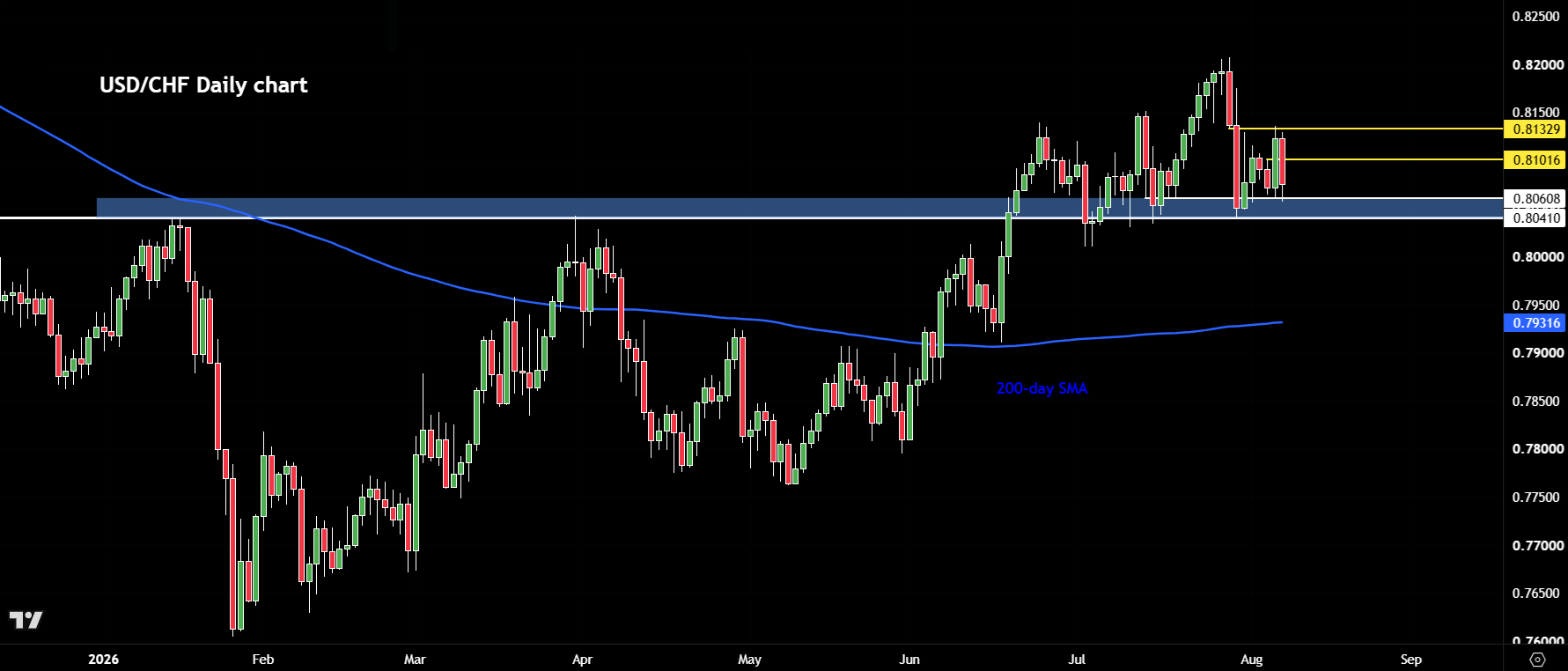
The USD/CHF pair has dropped to test key support in the 0.8040-0.8060 zone, which was previously major resistance. If it can hold its own above here, then we could see a recovery back towards short-term resistance levels such as 0.8100 and 0.8130 ahead of US CPI next week. Else, if the dollar selling continues, a bigger drop to 0.8000 cannot be ruled out. All told, I expect limited further downside in the US dollar owing to weekend risks of re-escalation in the US-Iran conflict and the potential for CPI to overshoot expectations next week.
-- Written by Fawad Razaqzada, Market Analyst
Follow Fawad on Twitter @Trader_F_R
Related tags:
Latest market news








Web Trader platform
Our sophisticated web-based platform is packed with features.
Open an account today
Experience award-winning platforms with fast and secure execution.
Economic calendar
Related articles

EUR/USD forecast: All eyes on Warsh at Jackson Hole - Forex Friday
For much of this week, the EUR/USD has been edging lower with the US dollar regaining some ground after last week’s sell-off that was triggered, in part, by the bond market worries. Investors have been unwilling to bet further against the US dollar so far this week ahead of Kevin Warsh’s keynote speech at the Jackson Hole summit, due later today.

DAX and EUR/USD forecast: Lower energy prices, yields offer support
But the question, of course, is how much further oil prices and bond yields can fall. For now, the combination is supportive of risk assets and is helping to sustain a relatively benign decline in the dollar. The focus today will be on US core PCE inflation, due for release shortly, while Nvidia’s second-quarter earnings will provide another test for risk appetite after the US markets close – not just for US indices but for global tech-heavy indices given the influence Nvidia has over the global tech and AI names.

AUD/USD Shorts Bear the Brunt of Hot CPI, Renewed RBA Hike Bets
Hot Australian CPI revives RBA hike bets, lifts bond yields and adds fresh pressure to crowded AUD/USD short positions.
