


USD/CAD forecast: Breakout gathers pace as US rates take over
US front-end rates have taken over as the dominant short-term driver for USD/CAD, with the price now testing a level that may determine whether the bullish breakout has legs.
Written by
David Scutt
Market Analyst
- USD/CAD sensitivity to US two-year yields has surged
- 1.3991 in focus on Friday
- US data surprises improve as Canadian outperformance starts reversing
- BOJ and Fed speak could amplify dollar volatility
USD/CAD breakout runs into Fib test
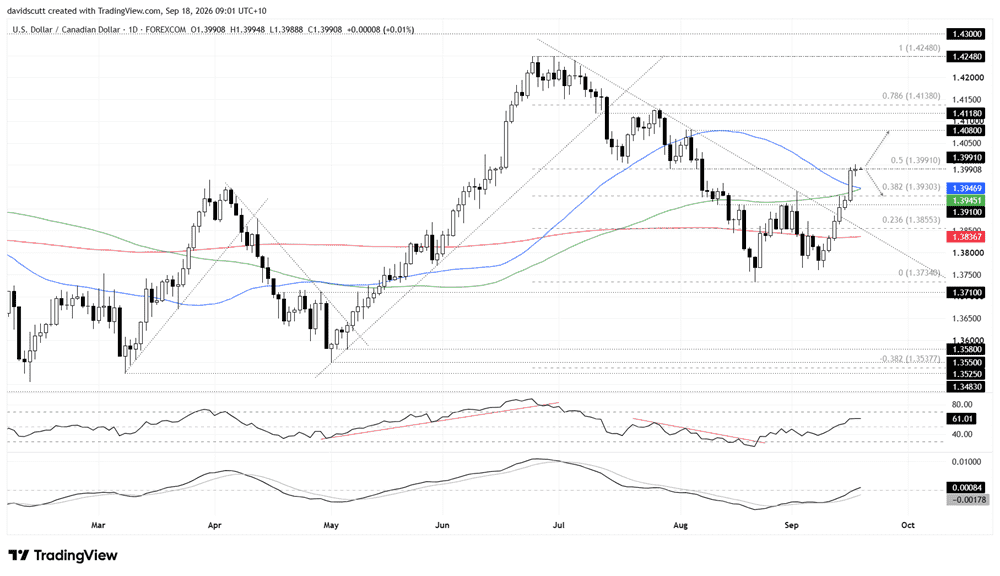
Of all the G10 FX pairs, few trend better than USD/CAD, and one look at the chart below suggests that is once again the case now. A bullish break of the downtrend established in early July has resulted in nearly a fortnight of gains, taking the pair above each of its key medium- and long-term moving averages before stalling at the 50% retracement of the June-August bear move, a level the price has respected on several occasions over recent months.
As such, it now looms as the key level to watch when assessing possible setups in USD/CAD as we head towards the weekend.
Source: TradingView
US front-end rates take over
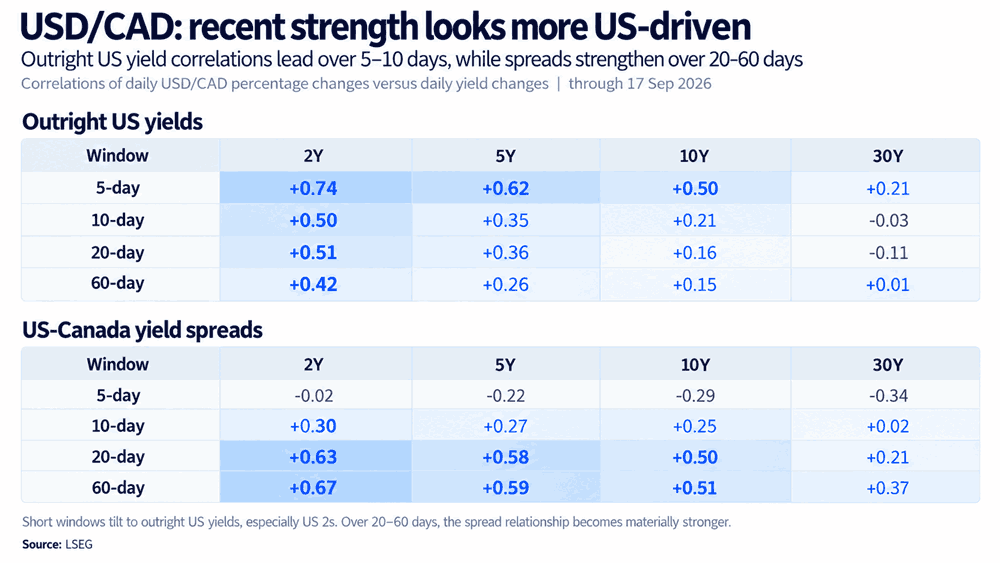
While technicals largely explain the pair’s recent movements, you can’t dismiss fundamental factors as a contributing force behind USD/CAD’s rebound. The pair has become increasingly sensitive to shifts in US front-end rates, with that relationship particularly strong over the past week.
While there has been evidence of a relatively strong relationship between fluctuations in crude prices and movements in longer-dated US Treasury yields and the DXY, for this particular pair, it really is the front-end rate show that's helped underpin this move.
Source: LSEG
Over the past five sessions, the correlation between daily changes in USD/CAD and US two-year yields has risen to around +0.74, comfortably stronger than the relationship with longer-dated US yields. In contrast, its correlation with the US-Canada two-year spread over the same period has been effectively zero, suggesting the latest leg higher has been driven far more by developments on the US side of the ledger.
Source: LSEG
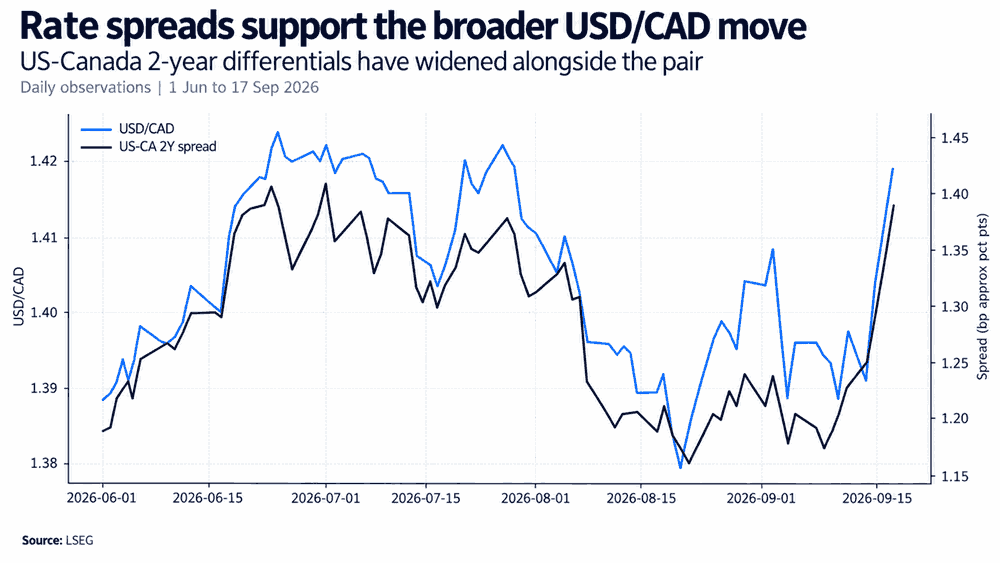
That differs from the broader picture. Over 20 and 60-day windows, movements in US-Canada front-end yield spreads have maintained a relatively strong relationship with USD/CAD, particularly at the two and five-year tenors.
US data surprises regain momentum
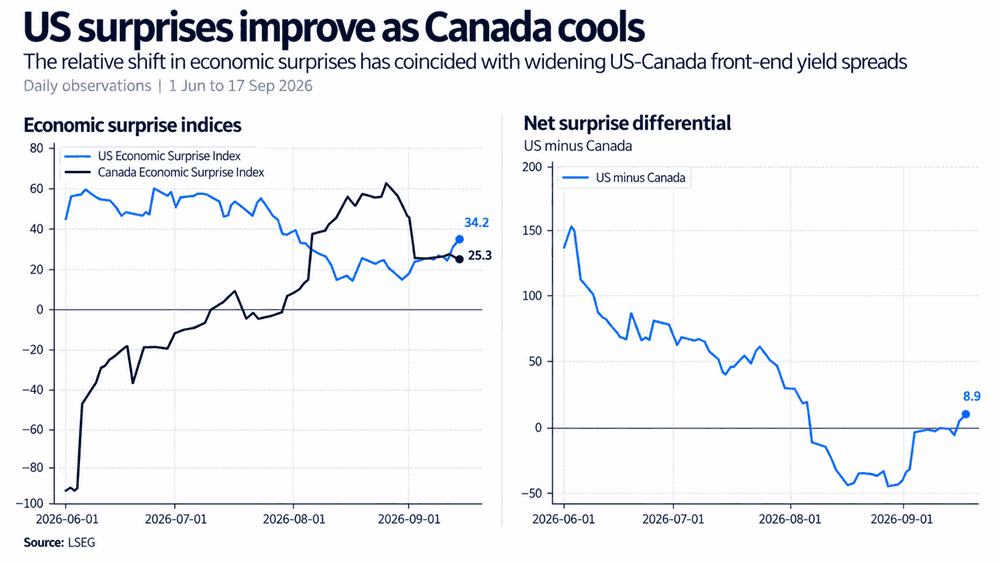
While it may not be a major factor behind the widening in US-Canada yield spreads, USD/CAD’s rebound has also coincided with a relative improvement in US economic data compared with expectations versus that seen in Canada, as shown in the graphic below.
Source: LSEG
Data surprises in the United States have once again become more positive after a period of fewer upside shocks, the exact opposite of what has been seen in Canada over the same period. On an outright basis, economic data in both nations continues to come in above forecast overall, but the broader trend towards Canadian outperformance relative to the US has not only stalled but started to reverse.
BOJ decision adds to dollar risk
With little in the way of top-tier US or Canadian data until later next week, the near-term focus will be on Fed speak, with Governor Michelle Bowman scheduled to speak later Friday and several other influential officials slated to be in action early next week. Given how sensitive USD/CAD has become to movements in US front-end rates, any remarks that differ from the hawkish message delivered at the September FOMC meeting could have a meaningful impact on the pair.
Nearer term, the US dollar continues to show a moderately strong relationship with crude fluctuations, making that another useful reference point for traders when assessing directional risk. Today’s Bank of Japan interest rate decision also carries the potential to generate significant volatility not only in USD/JPY, but the US dollar more broadly. Markets have more than three rate hikes priced in from the BOJ out to the middle of next year, meaning the statement and Governor Ueda’s press conference will need to be hawkish enough to justify those expectations, or risk the yen sliding and providing some support to the US dollar at the margin against other currencies.
Trade setup scenarios
From a setup perspective, 1.3991 remains the focal point on Friday. The bullish breakout and move above the key moving averages shows bulls have the ascendancy right now, a message backed up by the oscillators, with RSI (14) trending higher above 60 while MACD has flipped positive, having already crossed the signal line from below earlier this month.
While that favours long setups over shorts, until we see a definitive move above the 50% retracement, I’m keeping an open mind when it comes to potential setups. If the pair was to extend the bullish move we’ve seen from early September, levels to watch on the topside include 1.4080, where the pair stalled briefly in early August, along with 1.4118, a breakdown zone from early July. The 78.6% Fib is another level of note, given the pair’s recent adherence to Fib levels, found at 1.4138.
If we see a reversal that pushes the pair towards the 38.2% Fib at 1.3930, that would provide an early warning to bulls that the current trend may be at risk of reversing, with the doji print on Thursday completing two out of three candles of a potential evening star pattern. So price action today will be important.
Underneath where the pair now trades, the confluence of the 50- and 100-day moving averages around 1.3947, the 38.2% Fib at 1.3930 and 1.3910 are the immediate levels to watch, with the 23.6% Fib at 1.3855 and 200-day moving average the next after that.
Depending on which direction the price deviates from the 50% retracement, the level can be used for trade construction, allowing for entry on one side with a stop on the other for protection should the trade move against you.
Latest market news











Web Trader platform
Our sophisticated web-based platform is packed with features.
Open an account today
Experience award-winning platforms with fast and secure execution.
Economic calendar
Related articles

FX Futures Positioning: Dollar Rebound Meets Diverging Forex Bets | COT Report
US dollar longs held firm into Jackson Hole, while euro, yen and commodity FX positioning diverged ahead of ISM and NFP.


Gold and S&P 500 analysis: What now after Warsh’s hawkish speech?
The dollar surged across the board after the Fed Chair Kevin Warsh surprised with a hawkish-leaning speech at the Jackson Hole summit. All the bearish dollar bets that had been accumulated since last Friday on the back of data weakness and bond market troubles had to be squared and that triggered a short squeeze rally for the dollar. Gold and silver dropped, as a result, as too did bitcoin, while US indices were giving back earlier gains.

EUR/USD forecast: All eyes on Warsh at Jackson Hole - Forex Friday
For much of this week, the EUR/USD has been edging lower with the US dollar regaining some ground after last week’s sell-off that was triggered, in part, by the bond market worries. Investors have been unwilling to bet further against the US dollar so far this week ahead of Kevin Warsh’s keynote speech at the Jackson Hole summit, due later today.