

USD/JPY intervention changes little as yen headwinds remain
The intervention may have delivered a sharp reversal, but the forces that drove USD/JPY higher haven't gone away. Until they do, betting against the broader trend remains a risky proposition.
Written by
David Scutt
Market Analyst
- BOJ misses chance to back stronger yen
- Weak JGB demand reinforces higher yield pressure
- Intervention changes little beneath the surface
- 200DMA becomes pivotal for USD/JPY
The macro backdrop hasn't changed
Despite all the headlines, speculation and the artificial move lower in yen pairs over the past week following the first coordinated intervention between the US and Japan in decades, the truth is that the fundamental backdrop that drove USD/JPY and other yen crosses higher has barely changed. That leaves me thinking it's only a matter of when, not if, USD/JPY and other yen crosses resume the gradual grind higher that was underway before the intervention episode.
Japan's policy problem
It's hardly a revolutionary view, but Japan continues to run some of the loosest monetary policy settings in the developed world. Interest rates remain well below those elsewhere, real rates are still negative and the Bank of Japan passed up what looked like the perfect opportunity last week to send a shot across the bows that it was serious about continuing to normalise policy, instead producing another muddled and cautious performance even though markets have more than one full hike priced into the OIS curve by December.
Why not just get on with it? Inflation has been above target for years and the yen has been weakening for even longer. Yet instead of tackling one of the underlying drivers through faster policy normalisation, Japanese authorities, backed by the United States, opted to intervene in the FX market instead.
Fiscal policy isn't helping the yen's cause either. While Japan isn't running the most expansionary fiscal settings relative to other developed economies, it's the starting point that matters. Government debt is already enormous, leaving the country far more vulnerable than most if an external shock were to emerge. That's one reason investors continue demanding higher yields to own Japanese government debt.
Yesterday's weak 10-year JGB auction reinforced that message. Demand softened noticeably, with the bid-to-cover ratio slipping to 2.56 from 3.13 at the previous sale, while the auction tail blew out to its widest since August 2024, signalling investors demanded greater compensation to absorb the debt ahead of Thursday's 30-year auction.
Then there's the buoyancy of global markets. Risk appetite continues to rip higher, encouraging investors to borrow in one of the world's cheapest funding currencies and invest elsewhere. That's carry trade 101. As long as Japan continues to offer ultra-low interest rates, volatility suppressed while asset prices remain well supported, one of the structural forces that has weighed on the yen remains firmly in place.
No such thing as a free lunch
US Treasury Secretary Scott Bessent attempted to justify the rationale behind US involvement in the first coordinated intervention with Japan in decades during a CNBC interview overnight. He spoke about preserving financial stability across Asia, giving Japan the breathing room to continue investing overseas and expressed confidence that the BOJ would ultimately do what was right for the Japanese economy.
But if I'm being honest, I don't think the explanation stacks up, or at least not entirely. The most interesting part of the interview wasn't what Bessent said, it was what he didn't. There was no mention whatsoever of the risk that Japan, left to defend the yen on its own, may eventually have been forced to sell US dollar assets to fund further intervention.
Instead, he repeatedly returned to Japan's ability to continue investing in the United States, immediately catching my attention given the enormous investment commitments made under last year's trade agreement. Call me cynical, but this administration has shown time and again there's no such thing as a free lunch. If it's prepared to scratch your back, it's usually because there's something much larger in it for the US. Protecting those investment flows while the long end of the US Treasury curve is already under pressure may have been every bit as important as stabilising the yen itself.
Where did the correlations go?
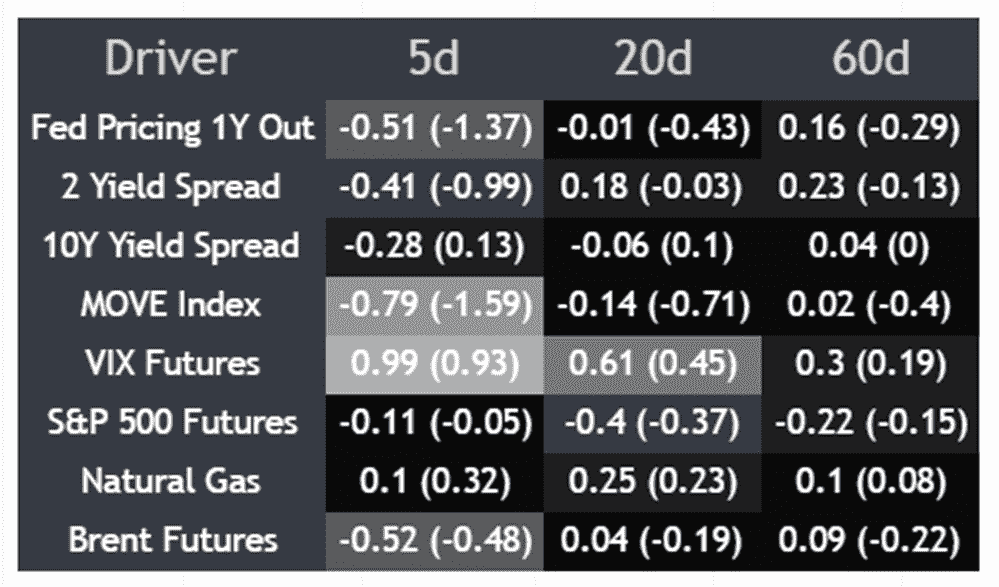
Looking ahead, despite the apparent rationale behind the decision, there's no guarantee the intervention marks the start of a more sustained move lower in USD/JPY. Traditional macro drivers have shown little to no relationship with the pair recently.
Source: Tradingview
As the correlation matrix above highlights, yield differentials, Fed pricing, index futures and energy prices have shown little to no relationship with USD/JPY over both the short and medium-term, while volatility measures are providing mixed and incoherent messaging. That suggests the argument that a softer run of US economic data or stronger Japanese data will be enough to trigger a sustained decline in USD/JPY is not overly convincing.
Eyes on the US calendar
Source: TradingView
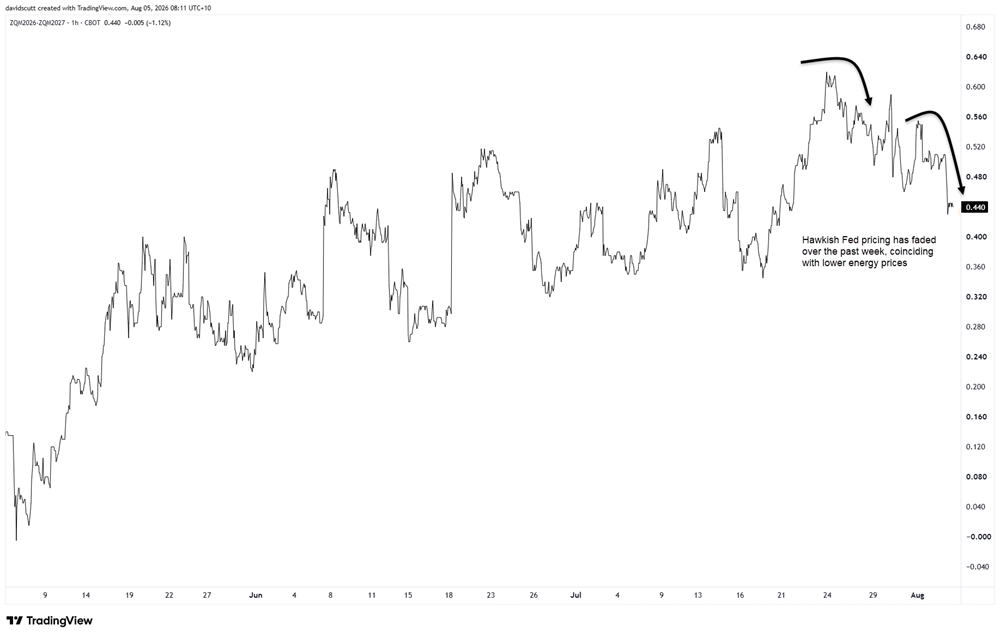
More broadly, the direction of the US dollar is likely to be influenced by the incoming economic data flow. Some of the softness overnight coincided with a notable pullback in Fed rate expectations, with pricing for the June meeting next year falling to around 44 basis points, down more than 10 basis points from where it sat a week ago. That likely reflects the sharp decline in energy prices over recent days rather than anything contained in Tuesday's JOLTS report.
Source: TradingView
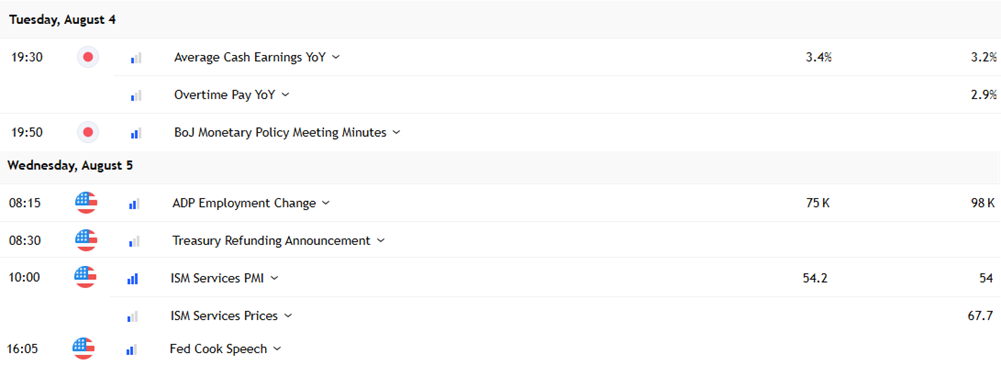
ADP employment will be watched closely after doing a reasonable job of predicting private sector payrolls growth in the official government figures in recent months. ISM services PMI is also important given the sector's significance to the broader US economy, with the prices paid and new orders components likely to provide the best read on inflationary pressures and the near-term growth outlook.
In Japan, wages data is unlikely to move the dial on its own. However, it remains a necessary ingredient if the BOJ is to continue normalising policy, relying on firmer wage growth to support demand, generate inflationary pressures and create the virtuous cycle policymakers have been trying to encourage.
Déjà vu for USD/JPY
Source: TradingView
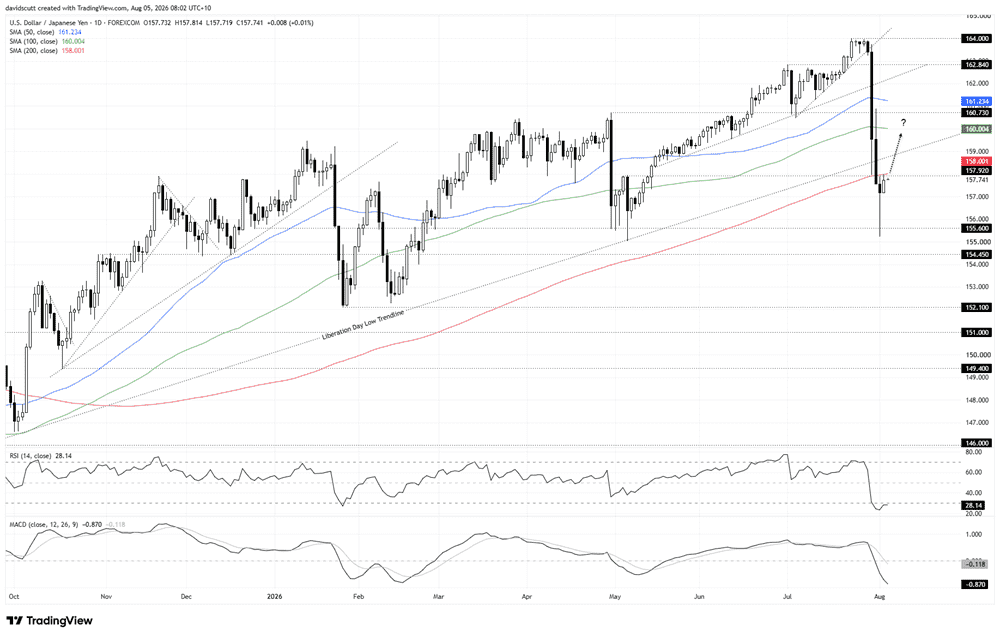
USD/JPY staged a dramatic bounce from the support zone beneath 155.60 on Monday after what looked like a third straight day of intervention. Importantly, that's almost exactly where the pair stabilised after the intervention episode in late April and early May before going on to fully retrace the move over subsequent weeks.
Monday's capitulation-style candle was followed immediately by a bullish engulfing candle on Tuesday, suggesting selling pressure may already be fading. The price now finds itself wedged beneath an important resistance zone formed by the 200-day simple moving average and 157.92, the breakout level that paved the way for the surge to fresh multi-decade highs following the April-May intervention episode.
Given the historical significance of those levels, I get the sense the resistance zone overhead, particularly the 200-day moving average, will act like a dam wall. If the price can break and hold above it, it would reinforce the view the intervention episode is over for now, opening the door for a push towards the 100-day moving average near 160 before bringing the former record high at 160.73, a level that has acted as both support and resistance this year, into view.
While RSI (14) and MACD have weakened sharply following the intervention-induced flush of speculative longs, that alone shouldn't be interpreted as a signal the downside move will persist. If anything, the violent washout leaves positioning looking far less stretched than it did only a week ago. If renewed selling does emerge, which at this stage feels like the less likely outcome, the support zone beneath 155.60 remains the level to watch.
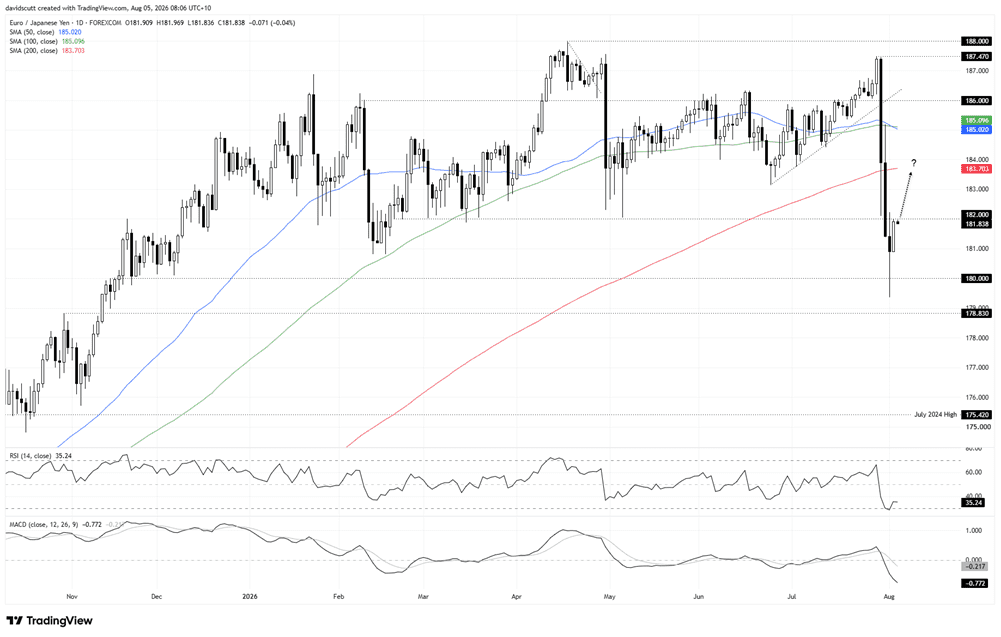
EUR/JPY eyes further retracement
Source: TradingView
The technical picture for EUR/JPY is similar, with a bullish engulfing candle printing on Tuesday and the pair now sitting just beneath 182, a level that acted as support for extended periods earlier this year before giving way during the intervention episode.
Like USD/JPY, that resistance zone feels like a dam wall. If the price can break and hold above 182, it would reinforce the bullish engulfing signal, opening the door for a push towards the 200-day simple moving average at 183.70. Beyond that, the confluence of the 50 and 100-day simple moving averages around 185 comes into view, followed by 186, another level of note given it acted as resistance for extended periods before flipping to support ahead of the intervention episode.
On the downside, the pair bounced violently after a brief foray beneath 180 during Monday's likely intervention. That leaves the area around 180 as the first support zone to watch, followed by 178.83, the breakout level from October last year.
Latest market news










Web Trader platform
Our sophisticated web-based platform is packed with features.
Open an account today
Experience award-winning platforms with fast and secure execution.
Economic calendar
Related articles

EUR/USD forecast: All eyes on Warsh at Jackson Hole - Forex Friday
For much of this week, the EUR/USD has been edging lower with the US dollar regaining some ground after last week’s sell-off that was triggered, in part, by the bond market worries. Investors have been unwilling to bet further against the US dollar so far this week ahead of Kevin Warsh’s keynote speech at the Jackson Hole summit, due later today.


Bitcoin Forecast: BTC/USD Back to $80K Ahead of Warsh’s Jackson Hole Speech
After surging over $15,000 in the past 10 days alone, there is risk of a near-term pullback if Warsh says anything remotely hawkish at Jackson Hole - what are the levels to watch from here?


DAX and EUR/USD forecast: Lower energy prices, yields offer support
But the question, of course, is how much further oil prices and bond yields can fall. For now, the combination is supportive of risk assets and is helping to sustain a relatively benign decline in the dollar. The focus today will be on US core PCE inflation, due for release shortly, while Nvidia’s second-quarter earnings will provide another test for risk appetite after the US markets close – not just for US indices but for global tech-heavy indices given the influence Nvidia has over the global tech and AI names.