


USD/JPY Weekly Outlook: Payrolls hold the key as 161.95 beckons
USD/JPY is knocking on the door of a major breakout, but BOJ intervention risk continues to keep traders on edge. Can Fed Chair Kevin Warsh or Thursday's US payrolls report finally provide the catalyst?
Written by
David Scutt
Market Analyst
- Payrolls and Warsh speech set to dominate the week
- USD/JPY remains pinned below 161.95
- BOJ intervention continues to cap upside
- Buying dips still favoured over selling rallies
The US still drives the bus
The US side of the equation continues to drive USD/JPY. With little new from Japan, Thursday's US payrolls report looms as the week's defining event. Unless Kevin Warsh or Japanese authorities deliver a genuine surprise beforehand, the labour market report is likely to determine whether markets continue to build on the hawkish Fed repricing seen in recent months, or start to unwind it.
Weekend headlines briefly threatened to inject fresh volatility after Iran and the United States traded fresh strikes, raising questions over whether the memorandum of understanding agreed earlier this month would hold. While Brent and WTI crude futures have bounced modestly from Friday's depressed levels, an Axios report suggesting both sides will resume talks in Qatar on Tuesday has helped temper fears of a renewed escalation, limiting what may have been a catalyst for renewed USD/JPY upside.
Source: TradingView
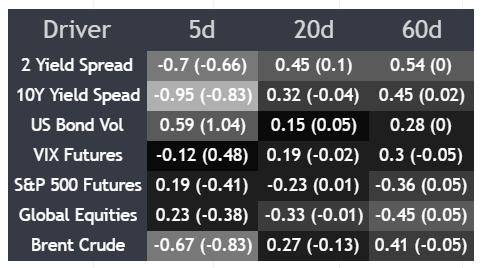
The correlation matrix above paints a messy picture, particularly over the past week. Relationships that would normally be expected to move in tandem have diverged, with both front-end and 10-year US-Japan yield spreads showing moderately strong to strong inverse correlations with USD/JPY. Crude has also flipped to a negative correlation despite normally providing support for the pair when prices rise.
Rather than reading too much into those moves, they may simply reflect quarter-end positioning during the final full trading week of June.
Plenty before payrolls
Source: TradingView (US EDT)
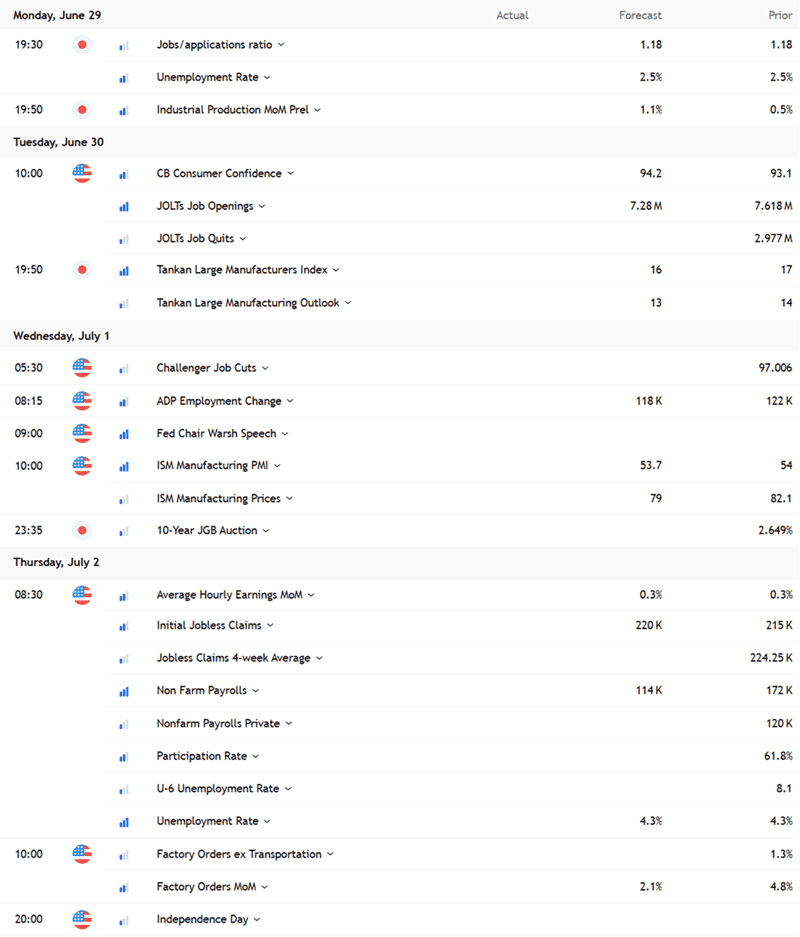
While Thursday's payrolls report is the headline act this week, Fed Chair Kevin Warsh's appearance at the ECB's annual forum in Sintra may prove just as important beforehand. With no forward guidance provided following June's FOMC meeting, markets are still trying to piece together the Fed's reaction function and what will ultimately drive future policy decisions. Any clues from Warsh on that front have the potential to meaningfully move USD/JPY.
Beyond those two events, several releases have the potential to generate short-term volatility. Tuesday's JOLTS job openings survey is worth watching after April's surprise jump in vacancies, while the Conference Board's consumer confidence report will be scrutinised for the jobs plentiful measure given its strong relationship with movements in the unemployment rate.
Wednesday brings the ADP employment report, which has recently done a respectable job signalling changes in private payrolls growth, along with the ISM manufacturing PMI. While the headline PMI is expected to remain in modest expansion territory, the prices paid component will again be in focus after remaining elevated in recent months.
Ultimately, however, the payrolls report should supersede all of those releases. While the headline jobs figure often grabs the attention, the unemployment rate remains the labour market gauge the Fed cares most about. The strongest market reaction would likely come if both payrolls and the unemployment rate surprise in the same direction.
A lower unemployment rate alongside another blowout payrolls print would likely see markets ramp up expectations for another Fed rate hike, potentially providing the catalyst for USD/JPY to finally break above 161.95. Conversely, a weaker payrolls report accompanied by a higher unemployment rate could see recent hawkish Fed pricing unwind further, weighing on the pair.
The Japanese calendar is comparatively light. The Tankan survey will attract attention and remains an input into the BOJ's policy deliberations, but recent price action suggests it is the US side of the equation that continues to exert the greatest influence on USD/JPY.
Hawkish repricing hits a speed bump
Source: TradingView
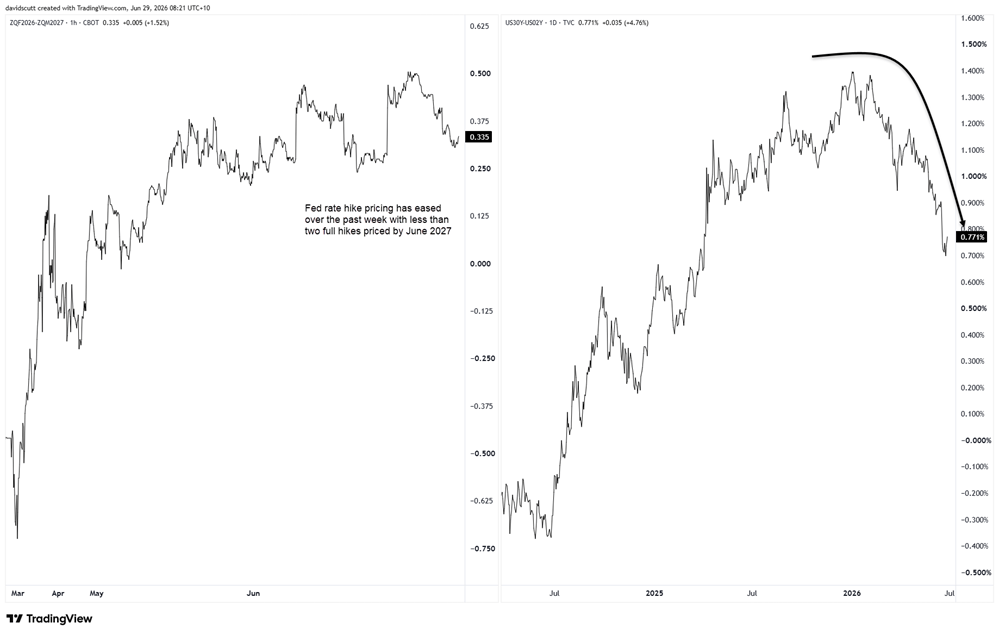
Despite the Fed's increasingly hawkish rhetoric, futures markets have pared back expectations for further policy tightening over the past week. Implied hikes through to June next year have eased from around 50 basis points to 33.5, suggesting falling energy prices have done more to temper inflation expectations than recent messaging from policymakers.
Whether that moderation extends further or reverses will likely hinge on Thursday's payrolls report, which will also test whether the recent flattening in the US 2s30s curve has further to run.
The battle for 161.95
Source: TradingView
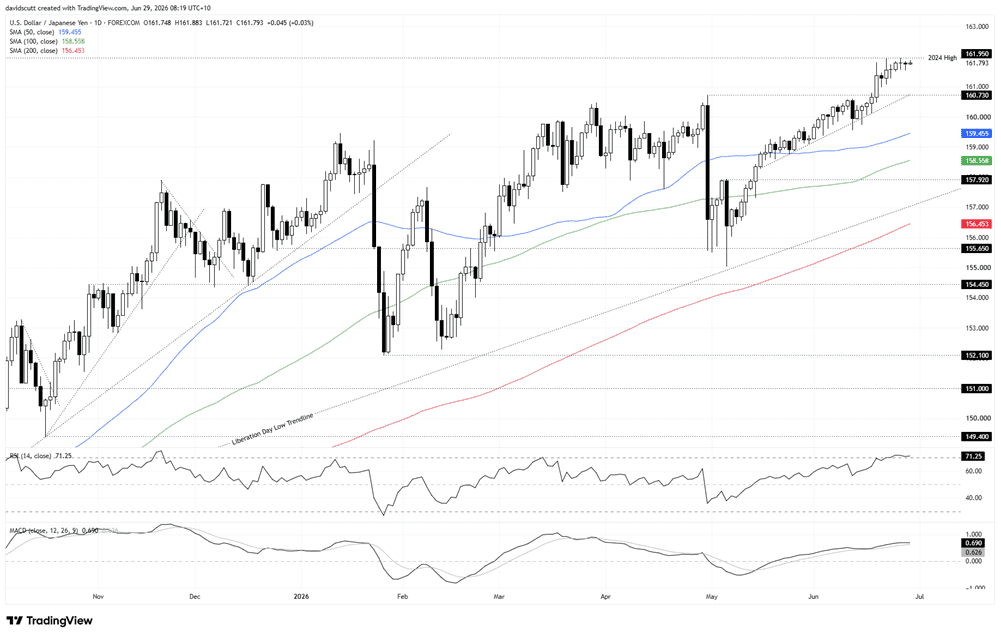
There is little new to report from a technical perspective. USD/JPY continues to knock on the door of a breakout above the 2024 high at 161.95, but there remains a clear reluctance to push through that level given the ever-present risk of BOJ intervention on behalf of Japan's Ministry of Finance.
The result is an ongoing stalemate. The fundamental and technical backdrop continues to point higher, but the threat of intervention has prevented that view from fully playing out. As outlined in the H2 2026 Outlook Guide released last week, that tension remains the dominant feature of the technical landscape.
Should 161.95 finally give way, the breakout has the potential to be significant. It would put USD/JPY at fresh multi-decade highs, opening the door to longer-term technical targets around 164, 168 and even 180, all derived from price action last seen in 1986. Momentum indicators continue to favour upside, even if they are no longer strengthening, leaving buying dips and bullish breakouts as the preferred strategy.
On the downside, initial support is located at 160.73, the previous year-to-date high, followed by the uptrend in place since mid-May and the 50-day moving average, currently found at 159.45.







Web Trader platform
Our sophisticated web-based platform is packed with features.
Open an account today
Experience award-winning platforms with fast and secure execution.
Economic calendar
Related articles

Euro Short-term Outlook: EUR/USD Pullback Nears Pivotal Uptrend Support 8 28 2026
Warsh's comments accelerated the EUR/USD selloff, raising the stakes as buyers look to stabilize the broader recovery.


AUD/CAD breakout puts the Bradman barrier in sight
A bullish breakout has pushed AUD/CAD to its highest level since early 2021. Whether it can clear 0.9994 may determine if the move extends well above parity.

Australian Dollar Forecast: AUD/USD Breakout Rally Nears Pivotal Resistance 8 27 2026
Aussie has advanced in eight of the past nine weeks, but the next technical hurdle could determine whether bulls can sustain the broader advance.