

USD/JPY Weekly Outlook: Yen shorts cleansed as US inflation takes over
Speculative yen shorts are far less stretched, but the focus now shifts to US inflation. Another hot print could quickly revive Fed hike expectations and support USD/JPY.
Written by
David Scutt
Market Analyst
- US CPI, PPI takes centre stage
- Fed rate hike bets have been whittled back
- Retail sales test resilience in household spending
- Yen shorts slashed 40% after intervention
- USD/JPY price signals point to upside directional risks
USD/JPY weekly outlook summary
USD/JPY heads into the week with yen shorts far less stretched than before the intervention episode of late July, reducing positioning risk. The key event this week is US inflation, which could materially shift expectations for Fed hikes over the next 12 months. Technically, the price signals are starting to point bullish, even with intervention still a very real risk.
US inflation takes centre stage
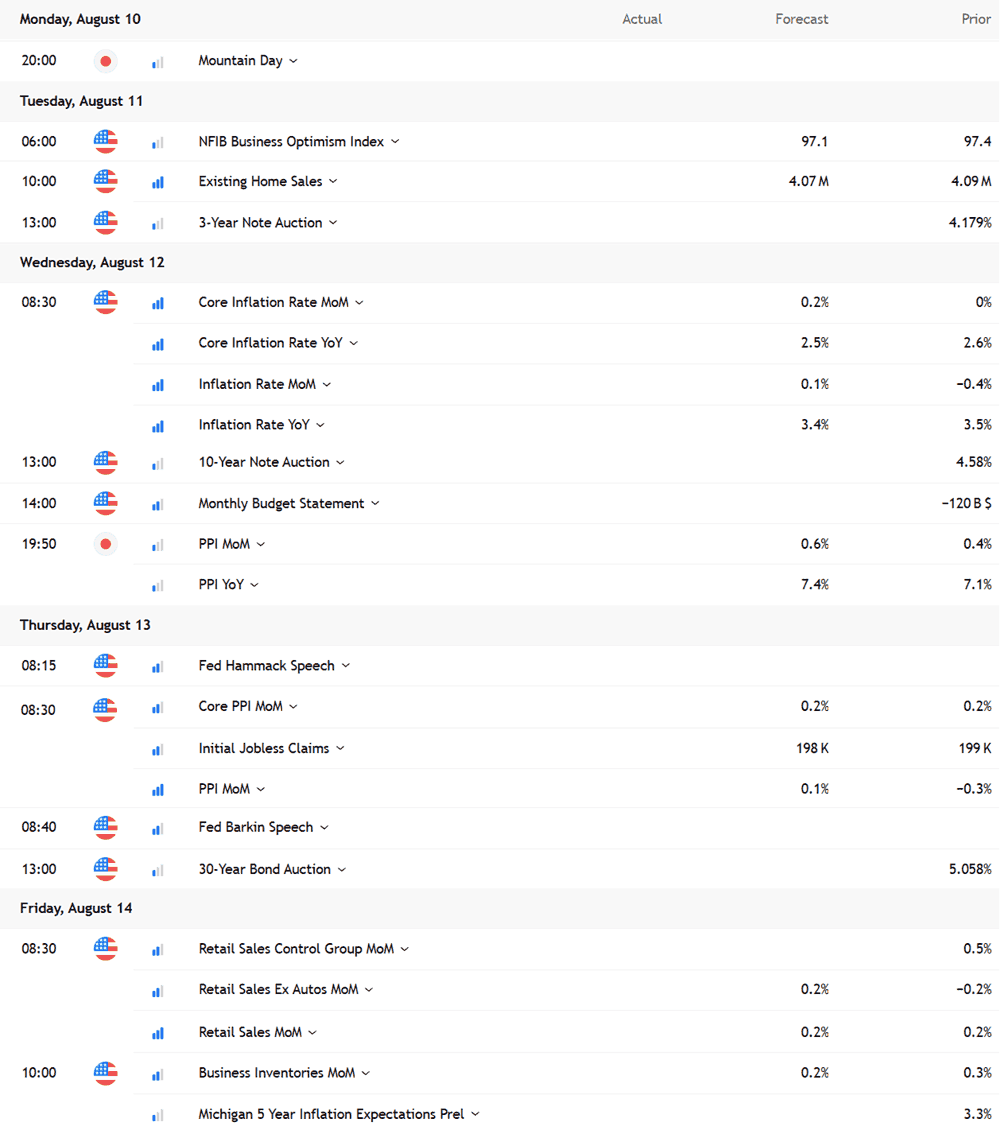
Wednesday’s US CPI report is the main event of the week for USD/JPY, with Thursday’s PPI release also important given both will help shape expectations for core PCE later this month.
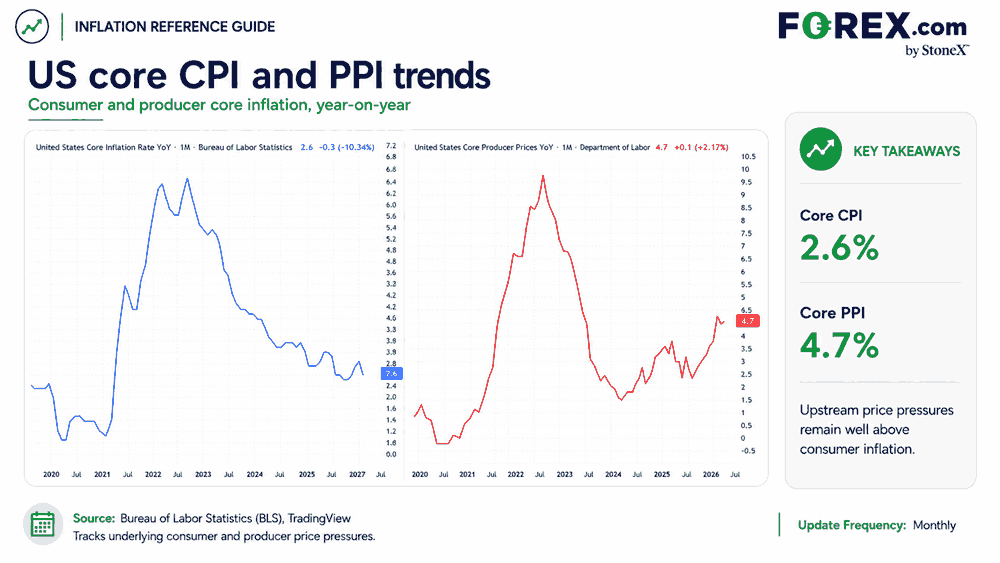
Underlying consumer inflation has been running above the Fed’s 2% target for around five years, while upstream producer price pressures have re-accelerated. Both core CPI and PPI are also expected to remain well above levels consistent with the Fed’s inflation target.
Source: TradingView, FOREX.com
Kevin Warsh may have ditched forward guidance, but other Fed members have made it clear their focus remains on the inflation side of the dual mandate. That puts a lot of emphasis on this week’s inflation data, especially given the question marks over the signal from Friday’s payrolls report.
The undershoot in payrolls is reminiscent of what we’ve seen in each of the past two years, with pronounced seasonal weakness through the summer months reversing towards the end of the year. In both instances, it made the easing the Fed delivered in response look silly in hindsight.
Source: TradingView, FOREX.com
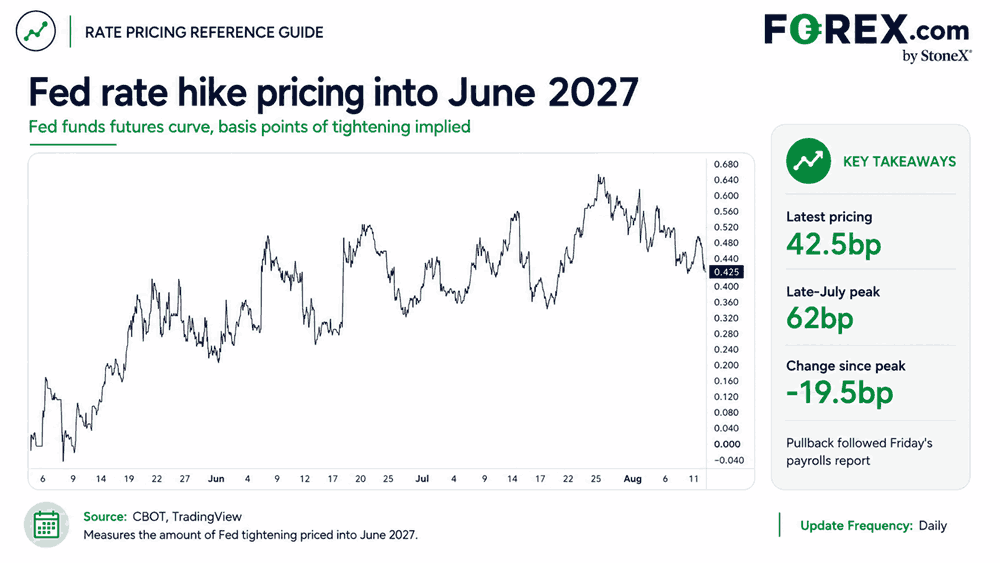
So while there is still plenty of important data to come before the Fed's September meeting, another hot inflation print would make it much harder for markets to keep whittling away at rate hike expectations, which according to futures markets have retraced from as much as 62 basis points of hikes out to the June meeting next year to 42.5 basis points following Friday’s payrolls report.
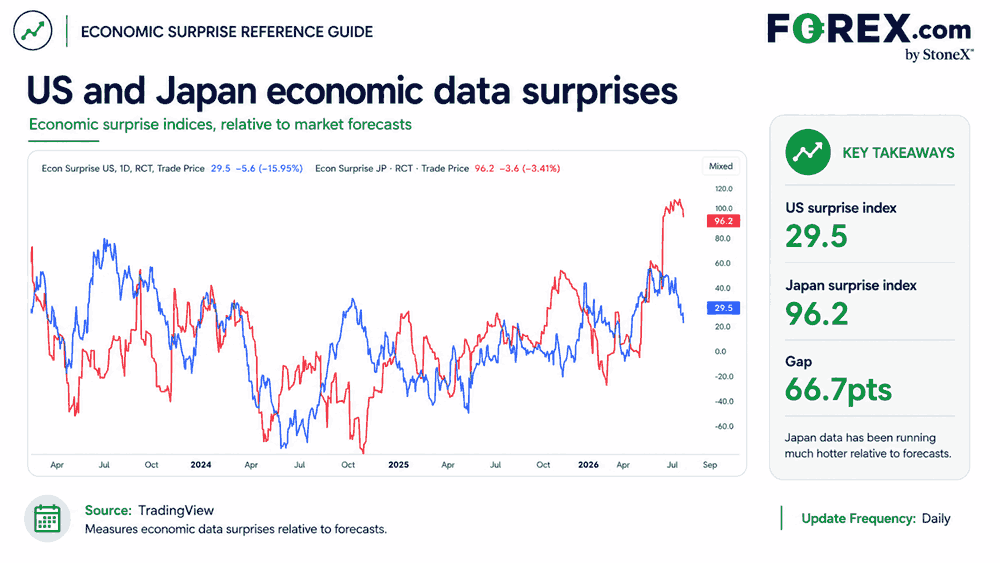
It is also worth noting that while the US economy is hardly weak on a levels basis, data is no longer smashing expectations as it was earlier this year. Citi’s US economic surprise index has rolled over over recent weeks, showing the run of upside surprises has slowed. In contrast, key data out of Japan has been running hot relative to forecasts.
Source: TradingView, FOREX.com
Retail sales, Treasury auctions provide wildcards
Outside of the inflation data, Friday’s US retail sales report is probably the next most important release on the US calendar, providing a read on how consumers are holding up in this inflationary environment. The key question is whether we see a continuation of the strength evident in broader household spending during the second quarter.
Traders should also keep an eye on demand at this week’s Treasury auctions, particularly the 10 and 30-year tenors. Yields at the back end of the curve have lifted to multi-year highs, so the question is whether those higher yields are enough to bring investors back to the table.
If they aren’t, that would speak volumes about how Treasuries are being perceived by the investment community. Weak demand despite materially higher yields would only reinforce concerns that something more structural may be at play.
Source: TradingView (US EDT shown)
Little on the Japanese calendar to shake things up
On the Japanese side of the ledger, there is not a lot to get excited about. We do get the corporate goods price index, where upstream inflationary pressures have remained very elevated, particularly on the import side, but rarely does the release move the yen meaningfully.
More recently, the factors out of Japan that have had the greatest influence have been fiscal announcements, major JGB auction results and leaks to the media in the lead-up to important BOJ meetings, where they are often used to massage market expectations. We don’t really have any of those factors this week.
Outside of renewed intervention, it is therefore hard to see much on the Japanese calendar shaking things up, especially with a public holiday on Tuesday which may mean volumes and activity are weaker than normal.
Geopolitics and energy still matter
Japan’s dependence on imported energy means USD/JPY remains sensitive to any major development in the Gulf that pushes energy prices sharply higher. From a terms of trade perspective, that would typically be negative for the yen, while energy security also remains an economic risk even with Japan holding large stockpiles.
The influence of the conflict on broader markets has diminished, but any major positive or negative development around peace talks still has the potential to move energy prices quickly and, by extension, USD/JPY.
Yen shorts have taken a hit
Source: LSEG Workstation, FOREX.com
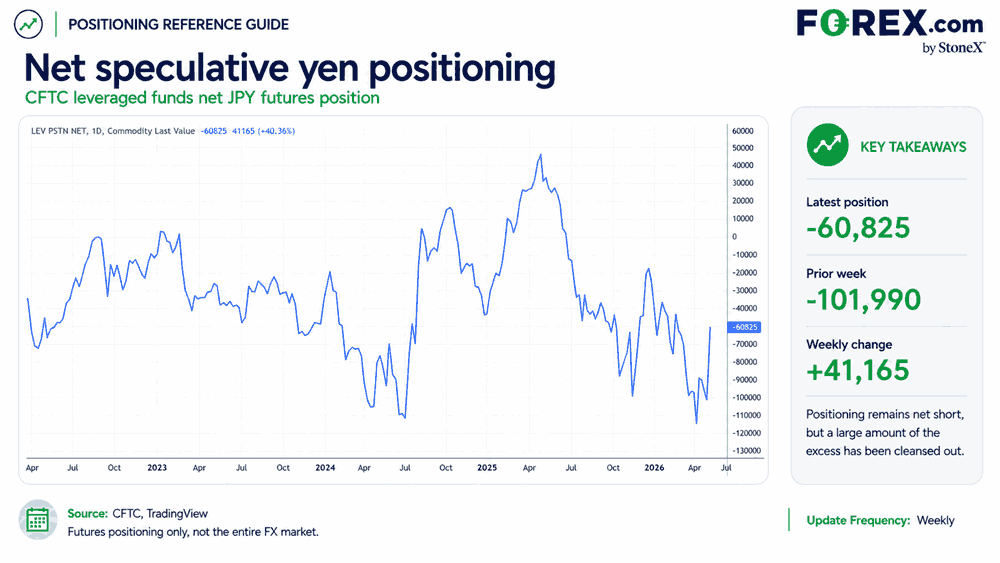
The latest CFTC positioning data gives a sense of the damage done to yen shorts following the dual intervention from Japan’s Ministry of Finance and the US Treasury in late July, and potentially again very early last week.
This only captures futures positioning reported through the CFTC’s Commitments of Traders report, so it is not a complete read on positioning across the entire market. Even so, leveraged funds cut their net short yen position from 101,990 contracts the week before to 60,825 in the latest report, a retracement of around 40%.
So while positioning remains quite short, a sizeable amount of the excess has already been cleansed out of the market. That suggests the positioning backdrop is no longer as lopsided or as vulnerable to another sharp squeeze as it was before the intervention episode.
USD/JPY dips still being bought aggressively
Source: TradingView
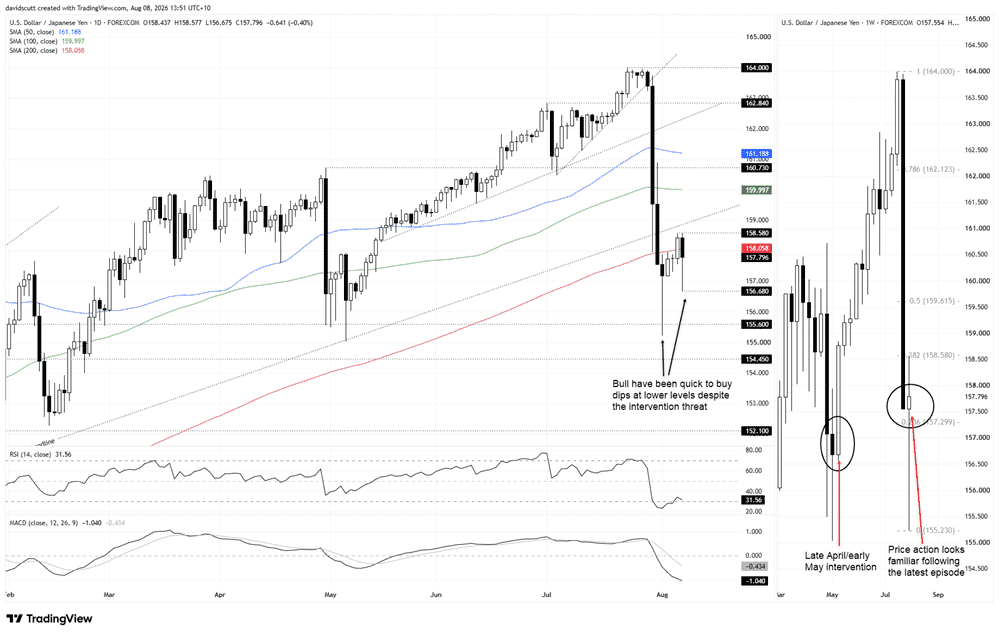
Intervention in late July saw USD/JPY take out multiple long-running uptrends, including the one dating back to the April 2025 Liberation Day risk rout. But, as was the case earlier this year, the initial knee-jerk move lower has already started to reverse.
Monday’s daily candle looked like capitulation, suggesting weak hands had been flushed out while warning of the potential for upside. That started to materialise over the latter part of the week and, even with Friday’s payrolls report soft on the surface, USD/JPY still managed to close the week above where it started.
On the daily chart, the 200-day moving average at 158.06 is the important level to watch around where the pair now trades. USD/JPY spent time either side of it last week before breaking higher, only to push back below it on Friday. Even with the initial move lower following payrolls, the size of the downside wick on Friday’s candle was noticeable. It was also an inside day, so there was no major technical signal generated. The price action suggests dips are still being bought aggressively.
RSI (14) and MACD remain bearish when it comes to directional risks, but those signals have been distorted by intervention. The price action is telling a different story. Unless we get a soft US inflation print this week, the near-term directional risks look skewed higher, even with the threat of renewed intervention.
The weekly chart also points in that direction. Following the intervention episode earlier this year, USD/JPY printed a large bearish candle, followed by a long-legged doji, before pushing sharply higher. We now have the first two parts of a broadly similar sequence again, although this time the latest candle is closer to a dragonfly doji. After such a pronounced move lower, that warns the path of least resistance may again be higher rather than lower in the near term.
On the topside, 158.58 is the first level to watch. That was around the high hit last week and also corresponds roughly with the 38.2% Fibonacci retracement of the July-August unwind. Beyond that, the broken uptrend from the April 2025 low comes in around 159, followed by the 100-day moving average near 160, also a key psychological level. Above that, 160.73, the former record high set earlier this year that later flipped to support in June, is another important level to watch. A move much beyond there would likely raise the risk of renewed intervention, making further upside look difficult near term.
On the downside, Friday’s low around 156.68 is the first level to watch. Beneath that, 155.60 remains important, having repeatedly soaked up supply when USD/JPY traded beneath it earlier this year.
Latest market news










Web Trader platform
Our sophisticated web-based platform is packed with features.
Open an account today
Experience award-winning platforms with fast and secure execution.
Economic calendar
Related articles

EUR/USD forecast: All eyes on Warsh at Jackson Hole - Forex Friday
For much of this week, the EUR/USD has been edging lower with the US dollar regaining some ground after last week’s sell-off that was triggered, in part, by the bond market worries. Investors have been unwilling to bet further against the US dollar so far this week ahead of Kevin Warsh’s keynote speech at the Jackson Hole summit, due later today.


Bitcoin Forecast: BTC/USD Back to $80K Ahead of Warsh’s Jackson Hole Speech
After surging over $15,000 in the past 10 days alone, there is risk of a near-term pullback if Warsh says anything remotely hawkish at Jackson Hole - what are the levels to watch from here?


DAX and EUR/USD forecast: Lower energy prices, yields offer support
But the question, of course, is how much further oil prices and bond yields can fall. For now, the combination is supportive of risk assets and is helping to sustain a relatively benign decline in the dollar. The focus today will be on US core PCE inflation, due for release shortly, while Nvidia’s second-quarter earnings will provide another test for risk appetite after the US markets close – not just for US indices but for global tech-heavy indices given the influence Nvidia has over the global tech and AI names.