


USDMXN Update Mexican Peso Shows Limited Reaction to Preliminary Inflation Data
Despite the selling pressure that has dominated USD/MXN price action in recent weeks, a period during which the pair has declined roughly 0.6% over the last four trading sessions, today's session has been marked by a modest recovery in favor of the U.S. dollar.
Written by
Julian Pineda
Market Analyst
Despite the selling pressure that has dominated USD/MXN price action in recent weeks, a period during which the pair has declined roughly 0.6% over the last four trading sessions, today's session has been marked by a modest recovery in favor of the U.S. dollar. This move has begun to limit the recent gains of the Mexican peso, even after the release of Mexico's preliminary inflation figures, which so far have not been strong enough to trigger a significant positive reaction in the currency. As a result, if the dollar manages to hold part of the recovery seen at the start of the week, the market could enter a more pronounced period of indecision during the upcoming trading sessions.
Mexico Releases Inflation Data
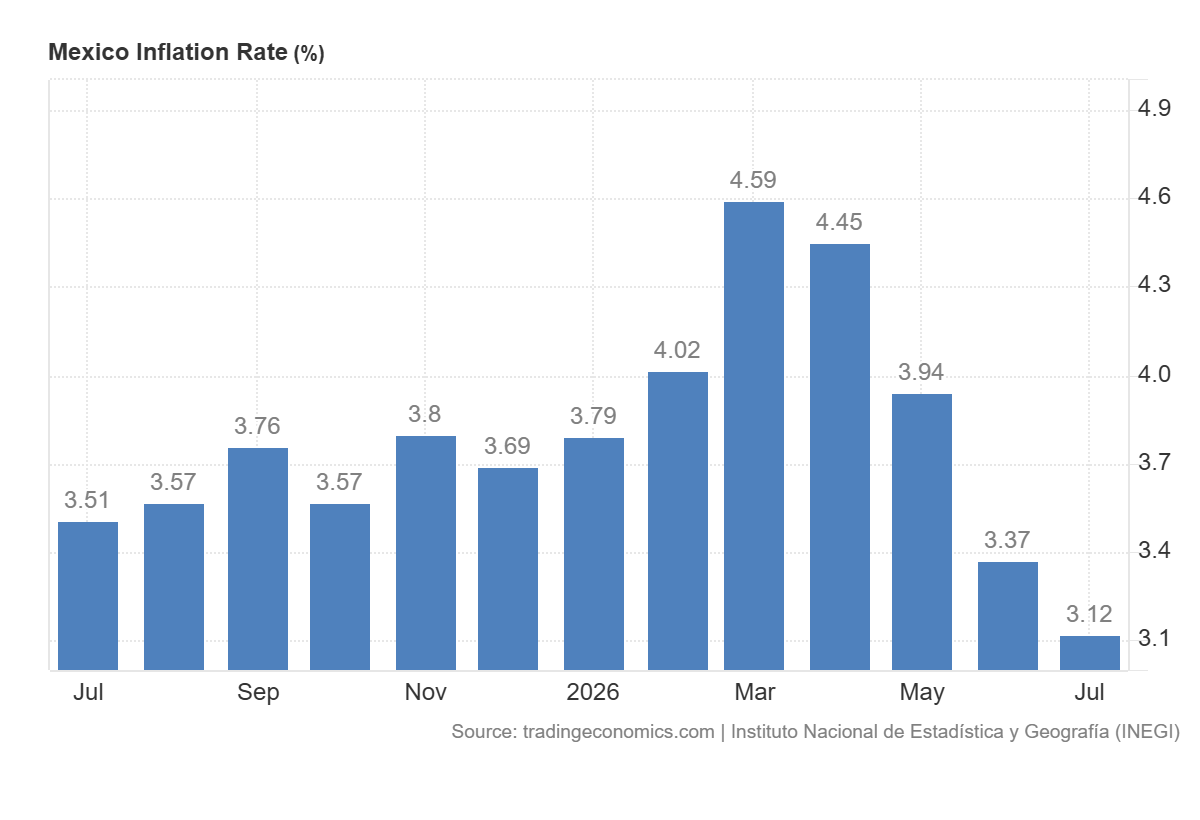
During today's session, investors received the latest update of Mexico's Consumer Price Index (CPI), which showed a slight increase during the first half of August, rising approximately 0.1% compared with the 0.02% decline recorded during the same period in 2025. As a result, annual inflation is now approaching 3.26%, up from the 3.12% level reported at the end of July.
For now, the figures point to a modest acceleration in price pressures over the short term. This development could begin to signal somewhat stronger inflationary pressures in the Mexican economy after several months of moderation, particularly considering that inflation had been declining from the 4.59% highs recorded in March. The latest reading partially interrupts that disinflationary trend.
Source: TradingEconomics
However, the most important aspect of the report is that it does not appear to send a clear signal that Banco de México will need to adopt a more aggressive stance. On one hand, the central bank has repeatedly stated in recent months that there is no need to alter its monetary policy outlook unless inflation accelerates more meaningfully. On the other hand, annual inflation remains within the institution's target range of 3.0% ± 1 percentage point, meaning that the latest release does not represent a significant deviation from the central bank's objective.
Additionally, the Mexican peso had already delivered relatively strong performance during previous sessions, suggesting that part of the positive impact associated with stable inflation may have already been reflected in market pricing. Investors also continue to monitor mixed economic growth indicators, a factor that does not necessarily support expectations of a more aggressive stance from Banco de México in the months ahead. For now, the inflation report appears to have generated more of a pause in the peso's recent strength, a scenario that could lead to a more pronounced period of indecision around USD/MXN.
Has the U.S. Dollar Stopped Losing Ground?
Another important factor influencing USD/MXN is the recent performance of the U.S. dollar. At the start of the week, the greenback has shown some ability to recover, supported by expectations surrounding the upcoming Jackson Hole central banking conference and a modest increase in geopolitical caution after the United States announced a new initiative involving potential sanctions against Iran.
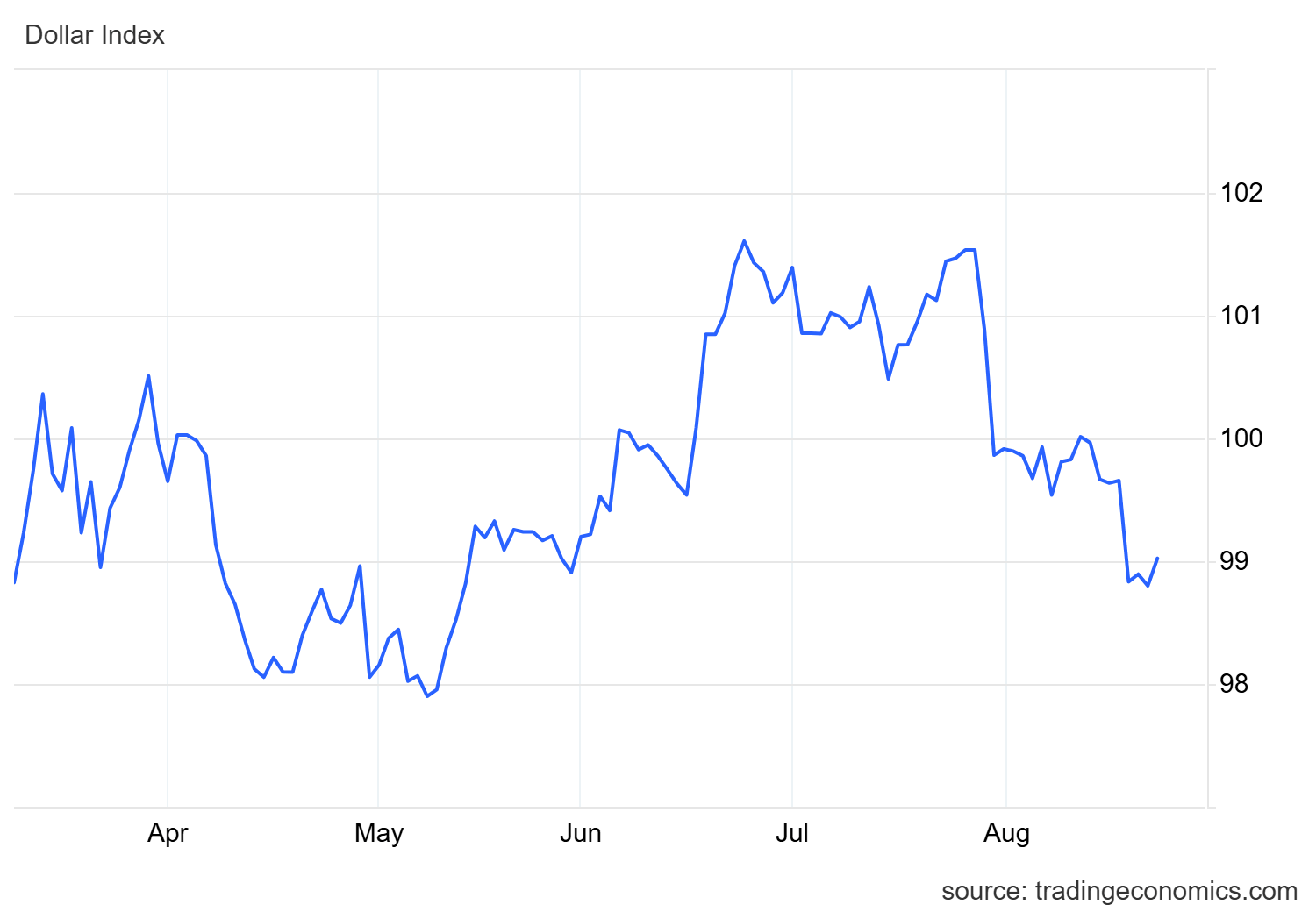
Against this backdrop, the DXY Index, which measures the U.S. dollar's performance against a basket of major currencies, has managed to halt the downtrend that dominated previous weeks and has moved back slightly above the 99-point level. While this move does not yet reflect broad-based dollar strength, it does suggest that the sharp weakness seen recently has begun to stabilize.
Source: TradingEconomics
This development remains relevant for USD/MXN, as a partial recovery in the dollar could limit some of the favorable momentum that had supported the Mexican peso in recent weeks. As long as the dollar manages to maintain this stabilization, price action in USD/MXN could begin to reflect a more balanced and indecisive environment in the short term.
USD/MXN Technical Outlook
Source: StoneX, Tradingview
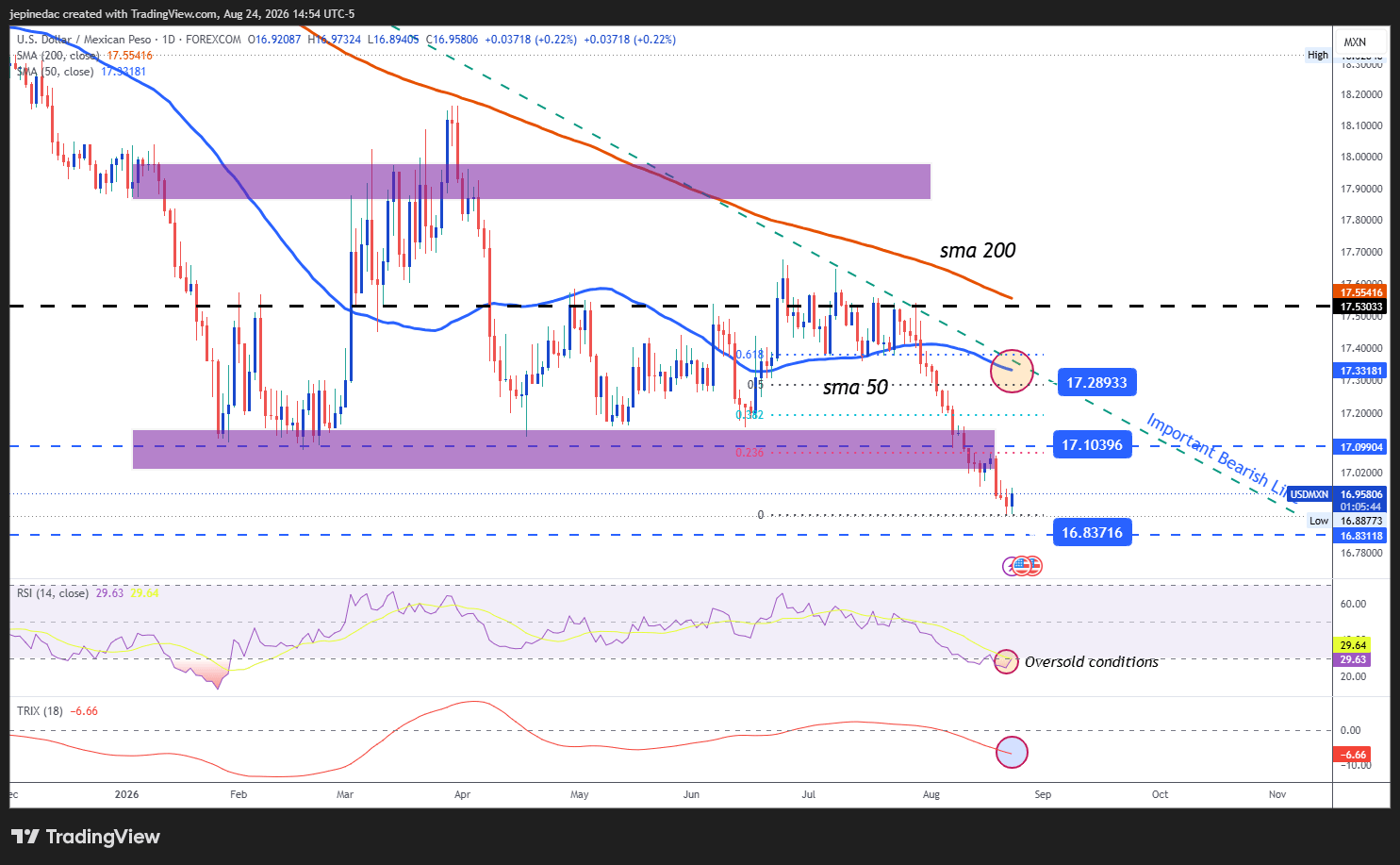
- Nothing Stops the Dominant Downtrend: Despite today's modest recovery attempt, USD/MXN continues to respect a well-established bearish trendline that has been in place for several weeks. For now, the rebound lacks the strength needed to alter the prevailing technical structure, meaning the broader downtrend remains the most important feature of the chart.
- TRIX: The indicator continues to display a downward slope below the neutral 0 level, signaling that the average strength of exponential moving averages remains in bearish territory. This suggests that the dominant bias in the broader trend continues to favor downside price action in USD/MXN.
- RSI: The RSI presents a somewhat different picture in the short term, as it remains around oversold levels below the 30 threshold. This suggests that the selling pressure accumulated in previous weeks may be creating room for temporary bullish corrections, which could become relevant during the coming trading sessions.
Key Levels to Watch:
- 17.28 – Major Resistance: A recent high that coincides with the 50-period Simple Moving Average and the 50% Fibonacci retracement of the most relevant move on the chart. Sustained trading above this level could threaten the dominant downtrend and favor a more neutral market structure in the weeks ahead.
- 17.10 – Current Barrier: A nearby reference level that previously acted as an important low in 2026 and coincides with the 23.6% Fibonacci retracement of the most significant move on the chart. It could become the primary level to monitor if short-term bullish corrections begin to develop.
- 16.83 – Key Support: A low not seen since 2024 and one of the most important downside barriers on the chart. A return toward this level would reinforce seller control and could extend the dominant bearish trend over the coming weeks.
Written by Julian Pineda, CFA, CMT – Market Analyst
Follow him on: @julianpineda25
Related tags:
Latest market news










Web Trader platform
Our sophisticated web-based platform is packed with features.
Open an account today
Experience award-winning platforms with fast and secure execution.
Economic calendar
Related articles

EUR/USD forecast: All eyes on Warsh at Jackson Hole - Forex Friday
For much of this week, the EUR/USD has been edging lower with the US dollar regaining some ground after last week’s sell-off that was triggered, in part, by the bond market worries. Investors have been unwilling to bet further against the US dollar so far this week ahead of Kevin Warsh’s keynote speech at the Jackson Hole summit, due later today.


DAX and EUR/USD forecast: Lower energy prices, yields offer support
But the question, of course, is how much further oil prices and bond yields can fall. For now, the combination is supportive of risk assets and is helping to sustain a relatively benign decline in the dollar. The focus today will be on US core PCE inflation, due for release shortly, while Nvidia’s second-quarter earnings will provide another test for risk appetite after the US markets close – not just for US indices but for global tech-heavy indices given the influence Nvidia has over the global tech and AI names.

AUD/USD Shorts Bear the Brunt of Hot CPI, Renewed RBA Hike Bets
Hot Australian CPI revives RBA hike bets, lifts bond yields and adds fresh pressure to crowded AUD/USD short positions.