


AUD/USD Outlook: Risk Appetite Refuses to Let Go
Correlations reveal a simple message: when the dust settles after the Fed, risk appetite matters more than rates.
Written by
David Scutt
Market Analyst
- Risk appetite remains the dominant driver for AUD/USD
- Tech-led equity gains continue to support the Aussie
- Japanese yen intervention risks loom in thin holiday trade
- EUR/AUD tests support as momentum fades
The Fed's fading influence
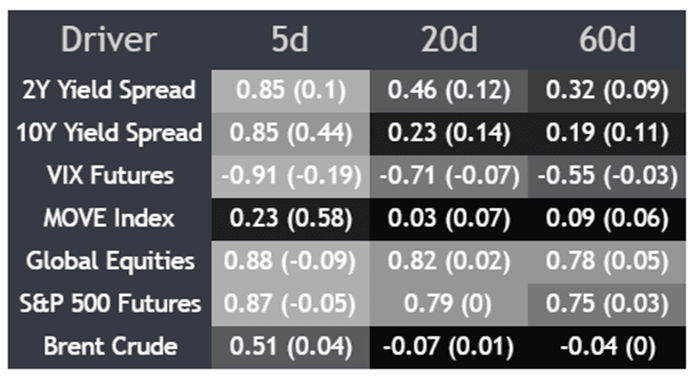
The Aussie dollar's ability to hold up following Wednesday's hawkish Fed meeting may seem strange given the accompanying strength in the greenback. But the correlation matrix below offers a clue as to why.
The initial decline in AUD/USD made perfect sense. Aussie-US two-year yield spreads narrowed sharply following the Fed, falling from around 40 basis points in Australia's favour to as little as 25 basis points. With AUD/USD showing a five-day correlation of 0.85 with the spread, it's no surprise the pair came under pressure.
Source: TradingView
However, the more interesting takeaway is what happens once the tail effect from the Fed begins to fade. While the relationship with yield spreads weakens noticeably over longer periods, the correlations with global equities, S&P 500 futures and VIX futures remain remarkably consistent. The message is simple: AUD/USD tends to revert to trading as a risk proxy.
That's exactly what we've seen since the Fed. Risk appetite has remained buoyant, led by the tech sector, while FX volatility remains exceptionally subdued. Put the two together and it helps explain why the Aussie has held up so well despite a stronger US dollar backdrop.
With little on Friday's calendar, attention may turn to equity markets across Asia. The Nikkei, Kospi and Taiex stand out given their exposure to the technology sector. If those markets continue to perform, the same forces helping to support the Aussie since the Fed may remain in play.
Thin liquidity, bigger risks
One risk to that view is USD/JPY. The pair has pushed sharply higher over the past 12 hours, moving back towards the 161.95 high struck in the middle of 2024. A break above that level would leave the pair trading at multi-decade highs.
With US markets closed for the Juneteenth holiday, liquidity conditions will be thinner than usual, potentially creating an opportunity for Japanese authorities to intervene should the Ministry of Finance deem it necessary.
Any intervention episode would likely weigh on the US dollar more broadly, something that would normally be supportive for AUD/USD. However, the relationship may not be that straightforward.
If a stronger yen were to weigh on the Nikkei and broader risk appetite, it could offset some of the benefit from a weaker greenback. Given the Aussie continues to trade largely as a risk proxy, that's a risk worth keeping in mind today.
The battle around 0.70
Source: TradingView
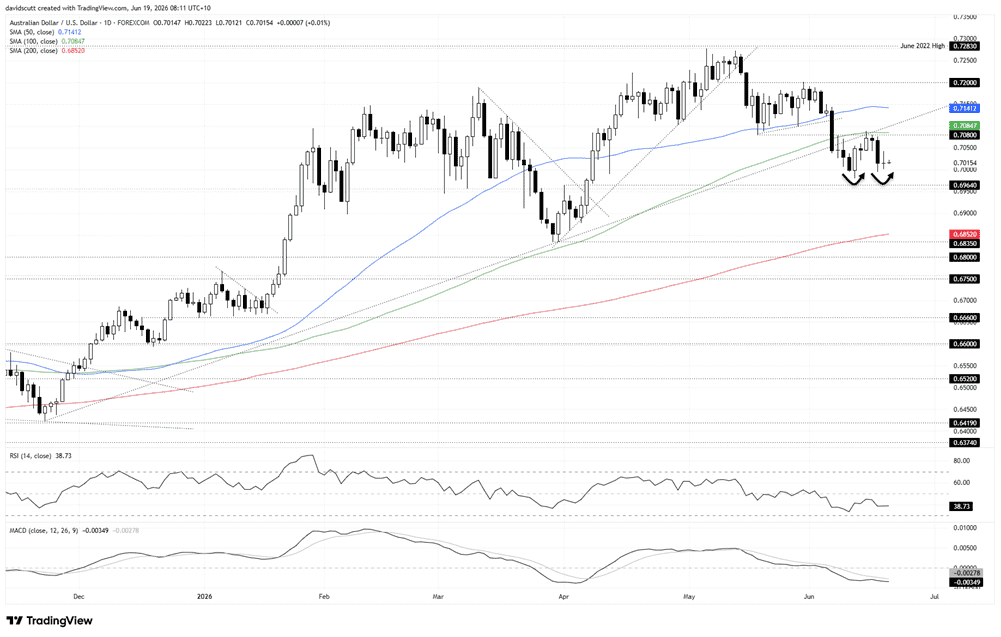
AUD/USD ran into trouble earlier this week at the intersection of the November uptrend, 100-day moving average and resistance at 0.7080. The rejection culminated in a three-candle evening star reversal pattern, warning that downside risks were building.
While we've seen some follow-through selling since, there has been little to suggest a sustained downside move is underway. AUD/USD continues to attract bids beneath 0.70, while Thursday's doji candle offers few clues on near-term direction. It could be interpreted as a gravestone doji, but without forming at a market peak the signal lacks conviction.
The oscillators continue to favour shorts over longs. RSI (14) remains below the neutral 50 level, while MACD sits in negative territory, moving in parallel with the signal line.
Should AUD/USD break below 0.70, support is found at 0.6964, the breakout level from early April. Beyond that, there's not a lot to hang your hat on until the 200-day moving average at 0.6852. On the topside, 0.7080 remains the key level. A break would expose the 50-day moving average at 0.7141, followed by 0.7200.
Euro bulls lose their grip
Source: TradingView
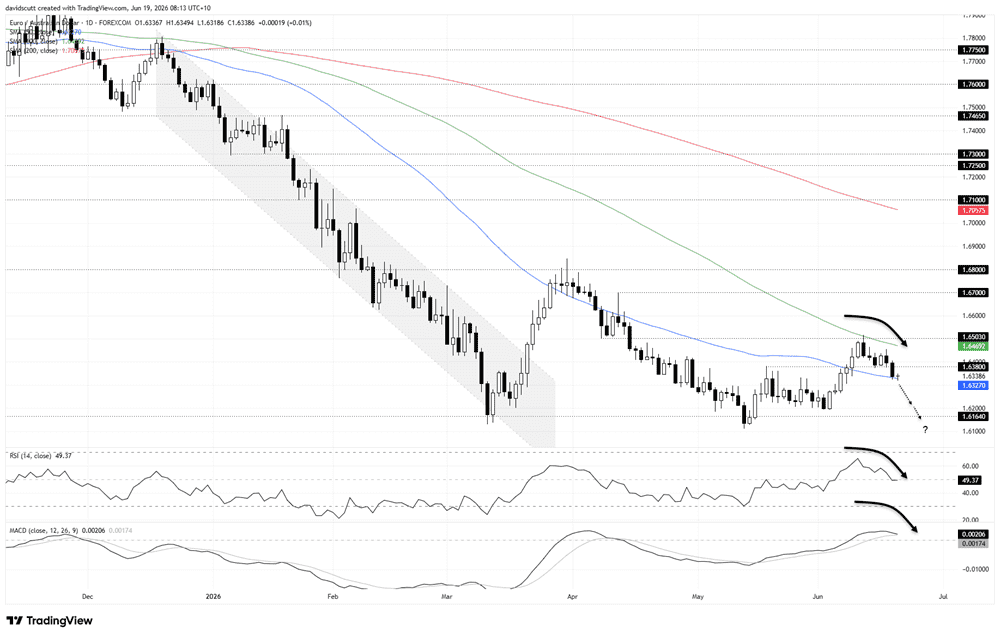
While AUD/USD remains stuck in a range, there's a cleaner picture emerging in the crosses, including EUR/AUD.
The pair was rejected late last week at the intersection of former support at 1.6503 and the 100-day moving average. Since then, it has worked its way back towards former resistance at 1.6380 before breaking beneath that level on Thursday to test the 50-day moving average, currently found at 1.6327.
One look at the price interaction with the 50-day moving average earlier this year tells you it's the immediate focal point. If we see a break beneath that level, 1.63 is a level of note. More realistically, though, the pair bottomed around 1.62 earlier this month, making that the initial downside target for shorts. Beneath that, 1.6164 remains a support zone where bids have been nibbling away over recent months.
On the topside, 1.6380 may now flip to offering resistance. If the pair can reclaim that level, attention shifts back towards the 100-day moving average and 1.6503.
The momentum picture has also shifted noticeably over the past couple of weeks. Earlier this month the bulls were enjoying all the momentum. That's no longer the case.
RSI (14) is back at the neutral 50 level and trending lower. MACD is on the verge of staging a crossover from above, albeit marginally, in positive territory. That suggests the strong upside momentum evident earlier this month has now all but dissipated, putting more emphasis on price action when assessing trade setups.
As long as risk appetite holds up, short setups are preferred over longs.







Web Trader platform
Our sophisticated web-based platform is packed with features.
Open an account today
Experience award-winning platforms with fast and secure execution.
Economic calendar
Related articles

Euro Short-term Outlook: EUR/USD Pullback Nears Pivotal Uptrend Support 8 28 2026
Warsh's comments accelerated the EUR/USD selloff, raising the stakes as buyers look to stabilize the broader recovery.


Gold and S&P 500 analysis: What now after Warsh’s hawkish speech?
The dollar surged across the board after the Fed Chair Kevin Warsh surprised with a hawkish-leaning speech at the Jackson Hole summit. All the bearish dollar bets that had been accumulated since last Friday on the back of data weakness and bond market troubles had to be squared and that triggered a short squeeze rally for the dollar. Gold and silver dropped, as a result, as too did bitcoin, while US indices were giving back earlier gains.


EUR/USD forecast: All eyes on Warsh at Jackson Hole - Forex Friday
For much of this week, the EUR/USD has been edging lower with the US dollar regaining some ground after last week’s sell-off that was triggered, in part, by the bond market worries. Investors have been unwilling to bet further against the US dollar so far this week ahead of Kevin Warsh’s keynote speech at the Jackson Hole summit, due later today.