


Australian Dollar Jumps as Employment Data Backs RBA Hawkish Bias
The Australian dollar outperformed its G10 peers after stronger employment data reinforced the RBA's hawkish stance and lifted AUD/USD towards key resistance.
Written by
Matt Simpson
Market Analyst
The Australian dollar led gains across the G10 after a stronger-than-expected employment report reinforced expectations that the Reserve Bank of Australia can maintain its hawkish bias. With employment growth driven by full-time jobs and unemployment holding at 4.4%, traders are assessing whether AUD/USD has the momentum to break above key resistance while AUD/JPY and AUD/CHF continue to outperform.
View related analysis:
Strong Jobs Data Strengthens the Australian Dollar and Supports the RBA's Hawkish Bias
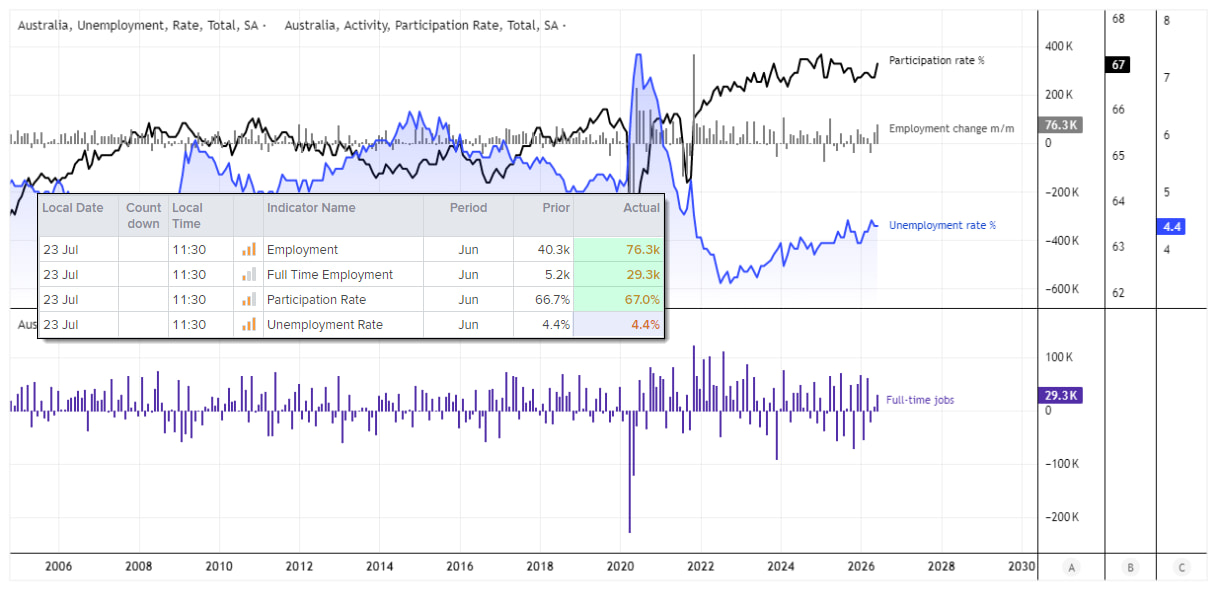
The Australian dollar jumped after today’s employment report showed the economy is yet to show any meaningful signs of rolling over.
Ultimately, these figures should allow the RBA to retain its hawkish bias without making any firm commitment to raise rates again.
Employment growth was driven predominantly by full-time positions, while the unemployment rate held steady at 4.4%. Although unemployment has been creeping higher over the past year, it remains low by historical standards, suggesting labour market conditions remain relatively tight.That combination should provide policymakers with confidence that inflation risks have not disappeared, allowing the RBA to keep the prospect of further policy tightening on the table should incoming data warrant it.
Source: ABS, LSEG
Key Takeaways from the July Labour Force Report
- Employment-to-population ratio edged up 0.3 percentage points to 64.0%
- 76.3k jobs were created, the strongest monthly increase in 14 months, with 29.3k (38%) being full-time positions
- Around 250k jobs (1.7%) have been created over the past year, while the number of unemployed has increased by only 30.2k (4.6%)
- That equates to 8.3 jobs created for every additional unemployed person
- The unemployment rate held steady at 4.4%, remaining well below its long-run average of 6.54%, although it sits close to its average since the post-pandemic peak

Strong performance from the Australian dollar
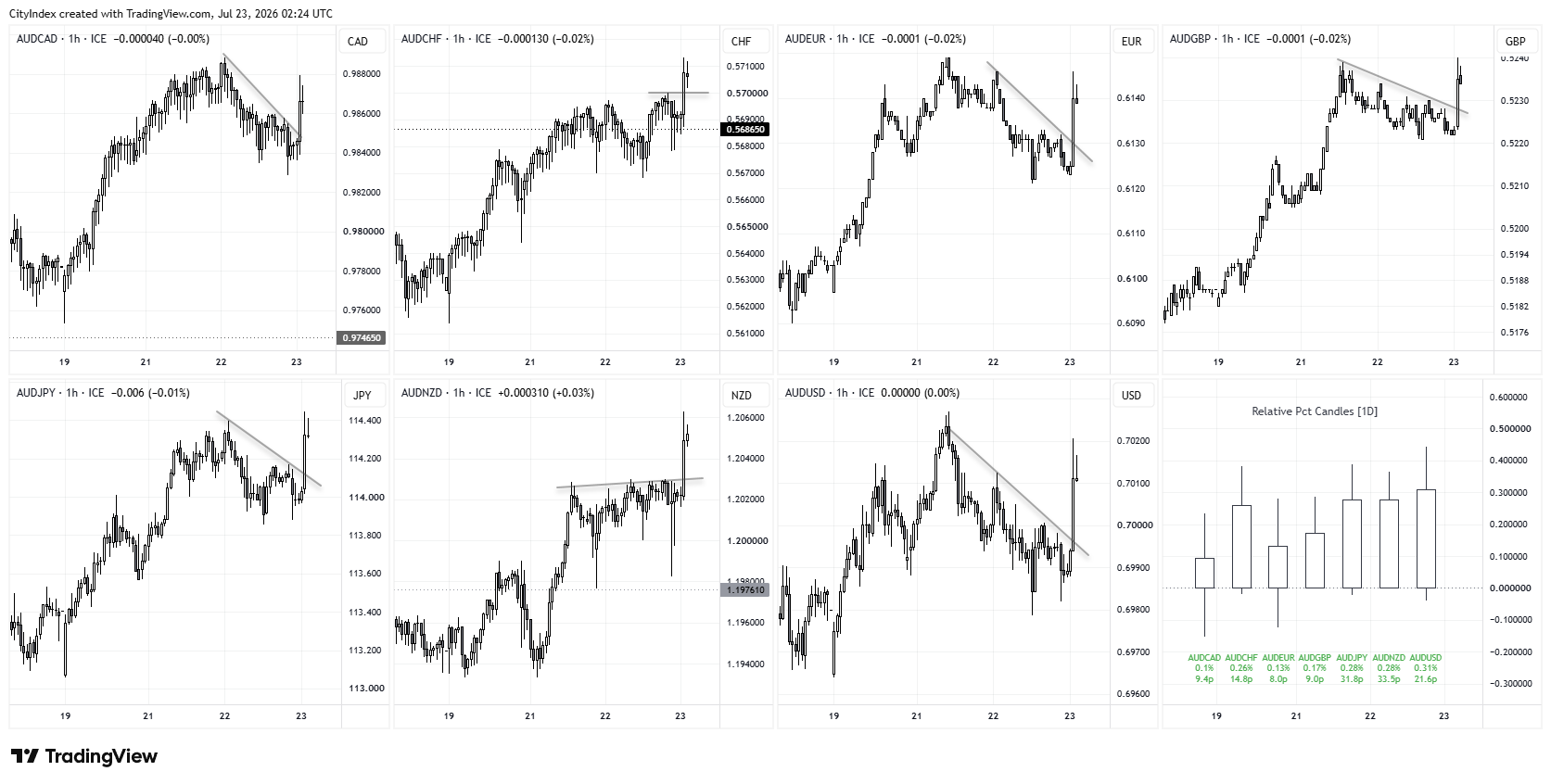
The Australian dollar is the strongest-performing G10 currency following the stronger-than-expected employment report, rising against every major peer and making particularly strong gains against the Swiss franc and British pound. Australian government bond yields also climbed, with the 2-year yield rising to a six-week high of 4.6% and the 5-year yield reaching 4.7%.
Source: ICE, ASX, TradingView
- AUD/CHF is on track for its best week since April 2025, up just under 2% from last week's close.
- The British pound has also weakened by around 1% against the Australian dollar, with GBP/AUD falling to a four-week low.
- Meanwhile, the Australian dollar has held up well against the stronger US dollar, with AUD/USD attempting to notch a fourth consecutive weekly gain.
- AUD/JPY has also accelerated higher and is on track for a fourth straight weekly advance, supported by the absence of intervention from Japan's Ministry of Finance.
AUD/USD Technical Analysis: Australian Dollar vs US Dollar
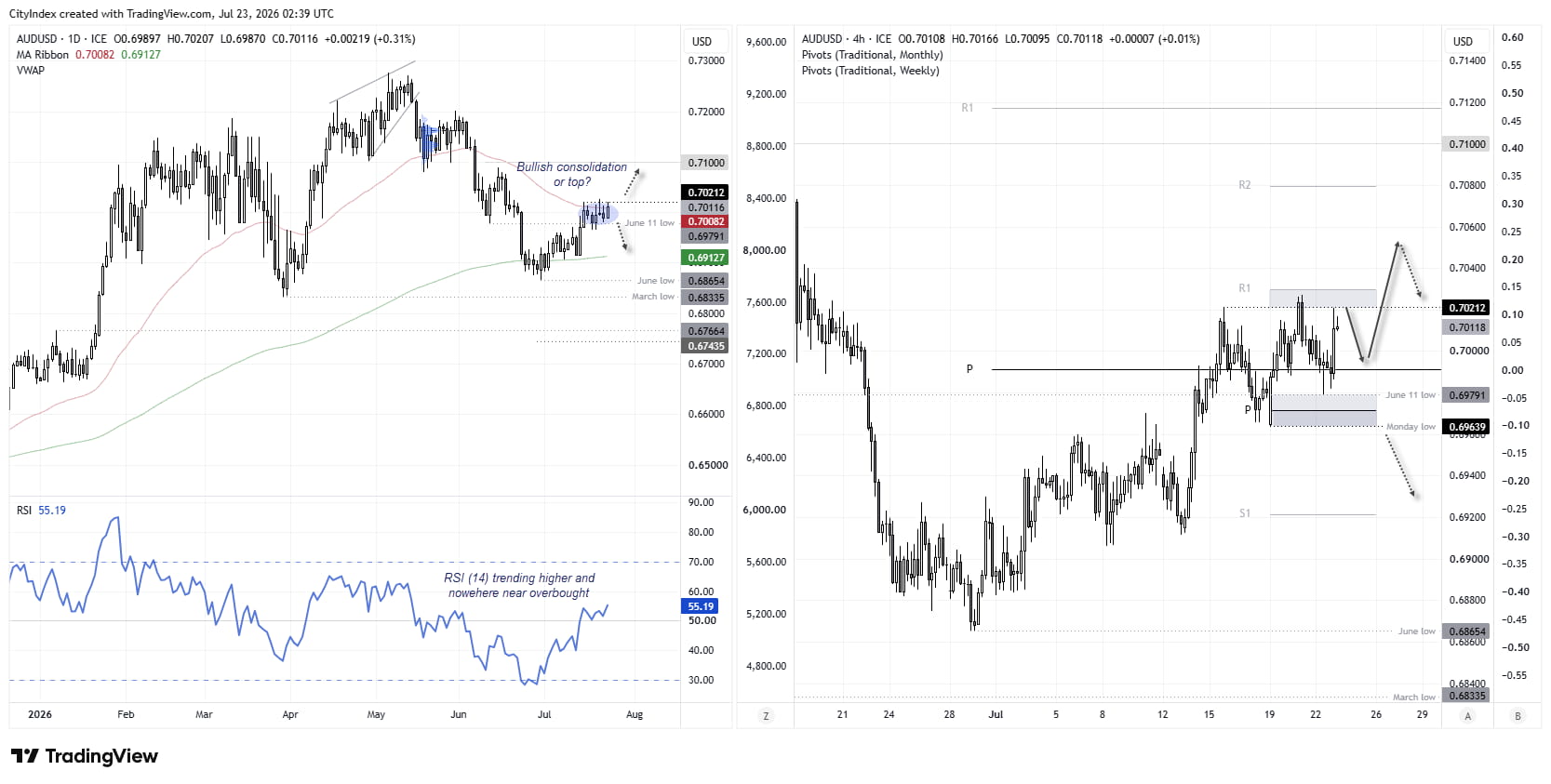
While markets have viewed today’s employment report as slightly more hawkish, AUD/USD is not exactly on a runaway rally. The pair has already risen 2.3% from its June 30 low but has yet to decisively break above the June 15 high.
That said, bullish momentum is clearly building within the current daily consolidation, with a prominent swing low forming on the 4-hour chart. Now that price is back above 70 cents, a bullish breakout may be on the cards.
Source: ICE, ASX, TradingView
- Bulls may be seeking dips towards the monthly pivot point at 0.6991 in anticipation of a break above the recent swing high and the weekly R1 pivot at 0.7029.
- However, bulls may want to tread carefully around these highs and remain on guard for a near-term pullback, especially if traders begin to price in a higher probability of another RBA rate hike following the jobs report.
- Upside could also be limited if the US dollar continues to benefit from safe-haven demand and rising US rate-hike expectations linked to Middle East tensions.
- A break below Monday's low would invalidate the near-term bullish breakout scenario.
View the full economic calendar
-- Written by Matt Simpson
Follow Matt on Twitter @cLeverEdge
How to trade with City Index
You can trade with City Index by following these four easy steps:
- Open an account, or log in if you’re already a customer
• Open an account in the UK
• Open an account in Australia
• Open an account in Singapore
- Search for the market you want to trade in our award-winning platform
- Choose your position and size, and your stop and limit levels
- Place the trade
Related tags:







Web Trader platform
Our sophisticated web-based platform is packed with features.
Open an account today
Experience award-winning platforms with fast and secure execution.
Economic calendar
Related articles

Euro Short-term Outlook: EUR/USD Pullback Nears Pivotal Uptrend Support 8 28 2026
Warsh's comments accelerated the EUR/USD selloff, raising the stakes as buyers look to stabilize the broader recovery.
Gold and S&P 500 analysis: What now after Warsh’s hawkish speech?
The dollar surged across the board after the Fed Chair Kevin Warsh surprised with a hawkish-leaning speech at the Jackson Hole summit. All the bearish dollar bets that had been accumulated since last Friday on the back of data weakness and bond market troubles had to be squared and that triggered a short squeeze rally for the dollar. Gold and silver dropped, as a result, as too did bitcoin, while US indices were giving back earlier gains.


EUR/USD forecast: All eyes on Warsh at Jackson Hole - Forex Friday
For much of this week, the EUR/USD has been edging lower with the US dollar regaining some ground after last week’s sell-off that was triggered, in part, by the bond market worries. Investors have been unwilling to bet further against the US dollar so far this week ahead of Kevin Warsh’s keynote speech at the Jackson Hole summit, due later today.