


Australian Dollar Outlook: AUD/USD Faces Inflation, Fed and Jackson Hole
AUD/USD approaches 72c after eight weeks of gains as Australian inflation, Jackson Hole and Fed policy risks take centre stage.
Written by
Matt Simpson
Market Analyst
The Australian dollar not only rallied for an eighth consecutive week – its best run since December 2020 – but the move also accelerated to mark its strongest week in 18. AUD/USD now sits within striking distance of 72c at an 11-week high.
The US Treasury’s surprise buyback plan provided the latest catalyst, keeping the US dollar under pressure. Attention now shifts to the Jackson Hole symposium later this week, and more specifically Kevin Warsh, as Fed speeches at the event often lay the groundwork for important policy shifts.
View related analysis:
- Australian Dollar Outlook: Jobs Cool, AUD/JPY and AUD/NZD in Focus
- Nasdaq 100 Outlook: Bond Yields Stoke Wall Street Risk
- Australian Dollar Outlook: Sentiment Rebounds, AUD/USD Nears Resistance
- Australian Dollar Outlook: AUD/USD Grinds into Jobs, DXY Holds Support
- How to Read the COT Report to Track Forex Market Sentiment
Australia This Week: Economic Data and Events for AUD/USD Traders
Jackson Hole Puts Warsh’s Fed Reaction Function in Focus
The main event of the week is Fed Chair Kevin Warsh’s speech at Jackson Hole. While the symposium has traditionally been used as a platform for the Fed to signal major policy shifts, the growing consensus is that Warsh will use his speech to define how the Fed operates rather than provide a clear signal on the next rate decision. Ultimately, traders are looking to Jackson Hole for clarification after Warsh’s more ambiguous communication since the July meeting.
That puts the focus on the Fed’s reaction function, particularly how Warsh views persistent inflation, elevated oil prices and the recent rise in Treasury yields. He may not need to sound especially dovish to trigger a relief rally; simply reassuring markets that the Fed is not itching to hike could weigh on yields and the US dollar, providing another tailwind for AUD/USD.
If PCE inflation perks up on Wednesday, it could give Warsh more reason to lean hawkish, lifting the US 2-year yield and US dollar ahead of his speech.
AUD/USD Tends to Rise on Jackson Hole Speech Day
A quick look at how AUD/USD has traded either side of recent Jackson Hole speeches shows it tends to fall heading into the event and rise on the day. AUD/USD also posts positive average and median returns over the following two days – pointing to further US dollar weakness – although those returns diminish.
Naturally, the average daily high-to-low range peaks on Fed speech day, at 1.3%, with a median of 1.4%. Over the past eight years, the range has averaged 1.3%, been as low as 1% and no higher than 1.6%. These are interesting patterns, but eight years is a small sample size – and past performance is not indicative of future returns.
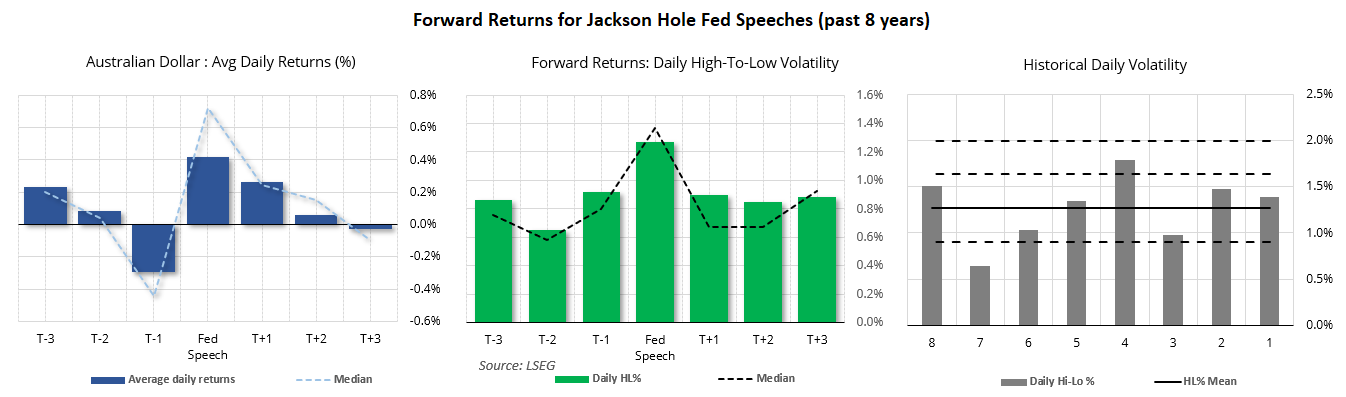
Source: LSEG
Australian Inflation Needs to Reaccelerate to Revive RBA Hike Bets
RBA cash rate futures currently imply just 15bp of tightening by April, effectively pricing around a 60% chance of a single hike by then. However, those odds could shift higher and murmurs of an earlier hike could emerge should trimmed mean inflation tick higher.
Even if inflation does not accelerate, it remains elevated relative to the RBA’s 2–3% target band. So unless we see an unlikely sharp drop in this week’s CPI figures, the RBA seems poised to retain its hawkish bias even though many suspect rates have peaked at 4.35%. And I don’t see Tuesday’s RBA minutes moving the needle much either.
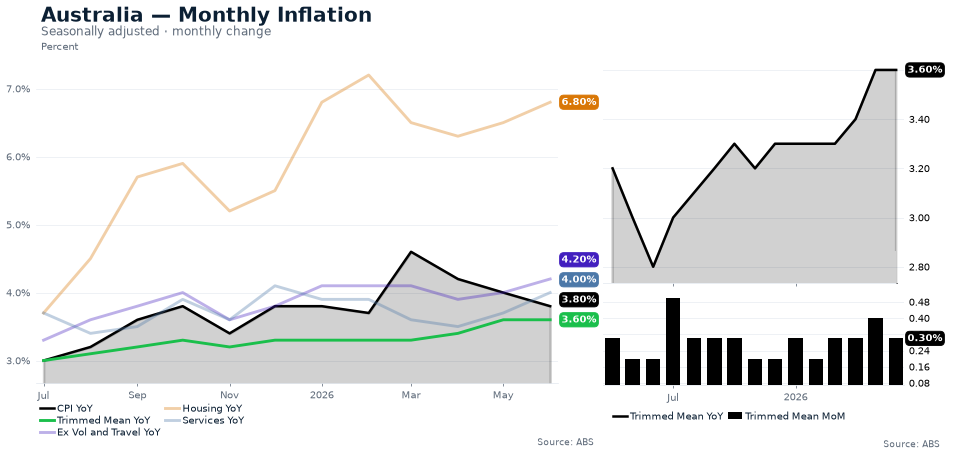
Source: ABS, StoneX Calculations
AUD/USD Technical Analysis: Australian Dollar vs US Dollar
AUD/USD Correlations
You can tell that big macro themes have emerged as correlations are once again strong. When these themes take hold, it quickly becomes a case of the US dollar versus the world – but in this instance, to the detriment of USD and the benefit of the relatively high-yielding Australian dollar.
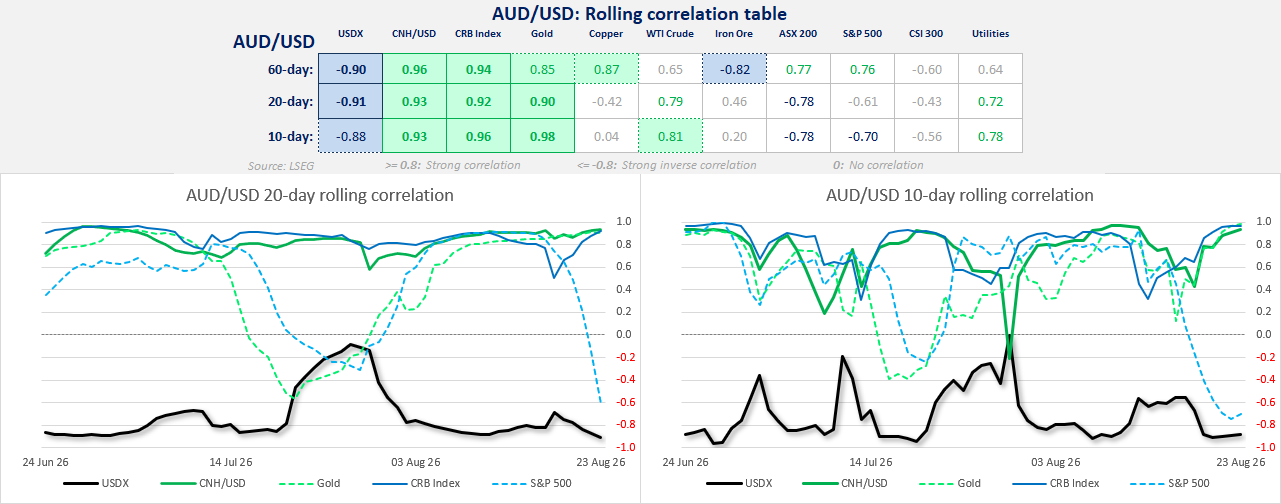
Source: LSEG
- AUD/USD remains strongly inversely correlated with the US Dollar Index across all three windows, near -0.9.
- The yuan remains a major tailwind, with CNH/USD correlations above +0.9 across 10, 20 and 60 days.
- Gold and the broader CRB commodity index are also strongly aligned with AUD/USD, reinforcing the reflation/risk-on theme.
- Equity correlations have weakened sharply over shorter windows, suggesting the Aussie rally is being driven more by USD and commodity dynamics than stocks.
This content was created by an affiliate of FOREX.com and represents the views and opinions of the author/speakers, not the views and opinions of FOREX.com, StoneX Group Inc., or its subsidiaries. The content has not been independently reviewed by FOREX.com.
AUD/USD Futures Positioning | COT Report
It is not often we see the Aussie rally for eight consecutive weeks, and even rarer for it to do so while net-short exposure increases. Yet that is what we’re seeing in the futures market.
That said, much of last week’s AUD/USD gains arrived in the second half of the week – after the Commitment of Traders (COT) data was compiled – so we may find that short covering took hold and net shorts were actually reduced. Still, the broader trend of rising net-short exposure alongside higher prices suggests speculators are either hedging or in pain as they are overpowered by broader demand for the Australian dollar. The fact that open interest is accelerating alongside prices suggests there are bigger forces at work than speculative positioning alone would imply, for now.
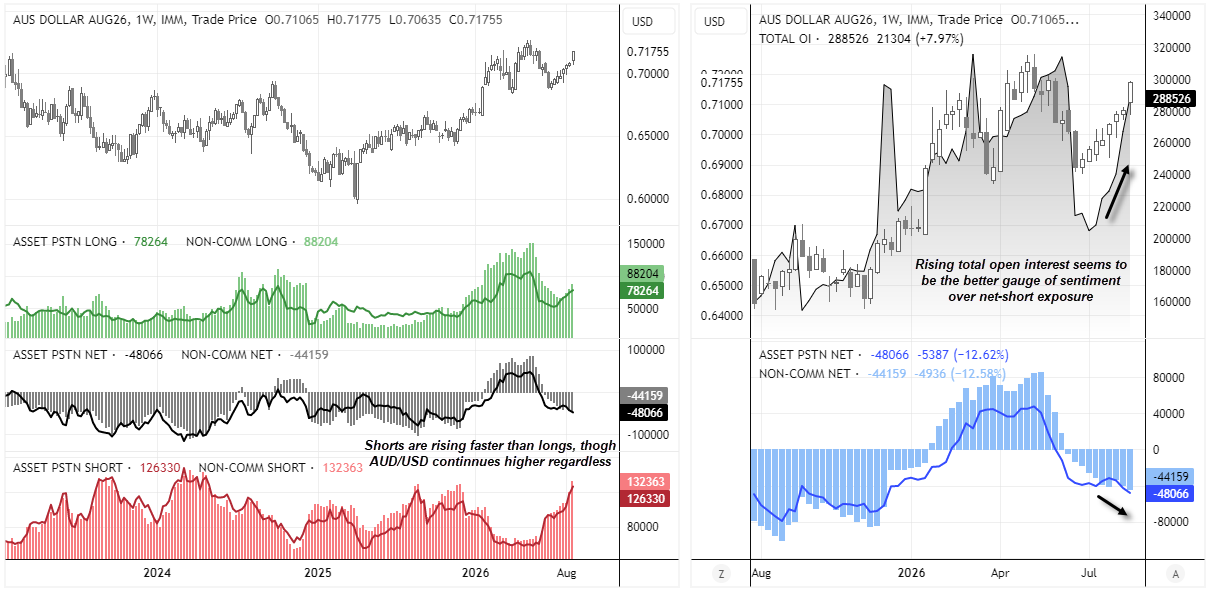
Source: CFTC (COT) CME, LSEG
AUD/USD Options and Volatility Analysis (Risk Reversals, HVN Levels)
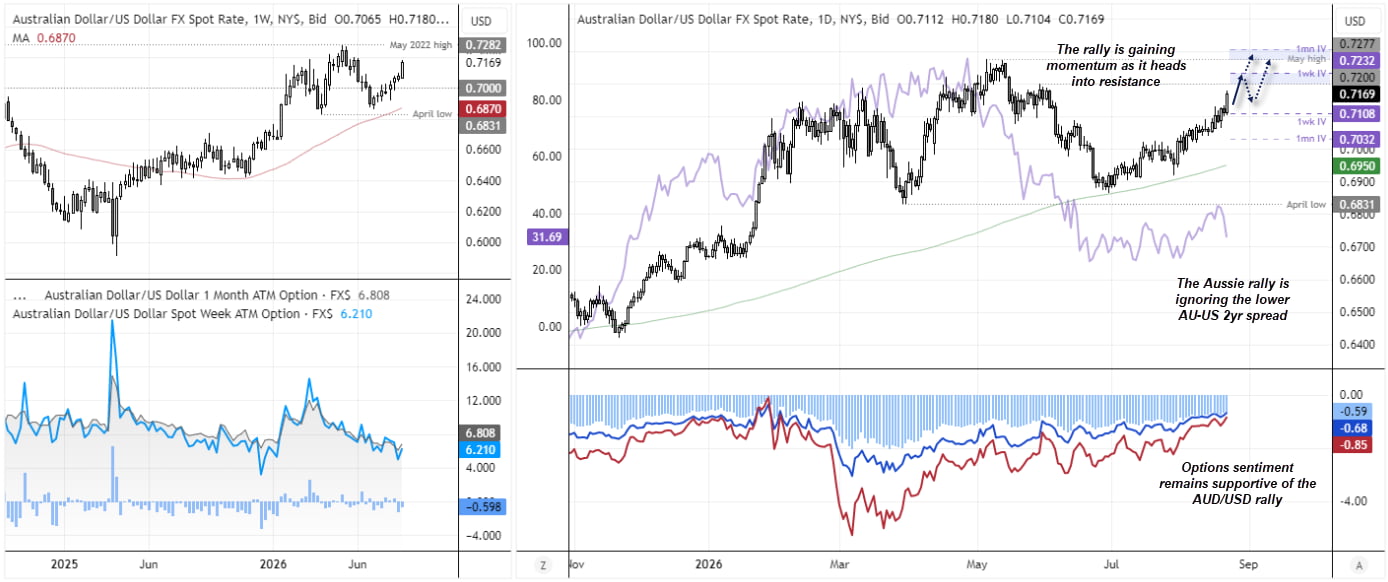
I think we can write off the head and shoulders topped I tentatively mentioned last week, given the increased bullish momentum. Still, AUD/USD is fast approaching 72c and the 2022 high – levels which could at least see the rally pause for breath. The near-term risks for AUD/USD could be tilted to the upside in the current climate of a weaker US dollar and US treasury buyback plan.
Options sentiment appears supportive of the rally so far with risk reversals continuing to show greater demand for calls relative to puts. However, with resistance nearby and the AU-US 2yr yield differential falling, perhaps the upside can finally be limited for AUD/USD. Though I have been saying this for a few weeks now. Ultimately, the direction of AUD/USD sits in the hands of the US dollar.
Source: ICE, TradingView
Related tags:
Latest market news








Web Trader platform
Our sophisticated web-based platform is packed with features.
Open an account today
Experience award-winning platforms with fast and secure execution.
Economic calendar
Related articles

EUR/USD forecast: All eyes on Warsh at Jackson Hole - Forex Friday
For much of this week, the EUR/USD has been edging lower with the US dollar regaining some ground after last week’s sell-off that was triggered, in part, by the bond market worries. Investors have been unwilling to bet further against the US dollar so far this week ahead of Kevin Warsh’s keynote speech at the Jackson Hole summit, due later today.


Bitcoin Forecast: BTC/USD Back to $80K Ahead of Warsh’s Jackson Hole Speech
After surging over $15,000 in the past 10 days alone, there is risk of a near-term pullback if Warsh says anything remotely hawkish at Jackson Hole - what are the levels to watch from here?


Gold Falters at Resistance, Grappling With PCE, Month-End Flows and Jackson Hole
Gold has pulled back from resistance after sticky PCE data, with month-end flows and Jackson Hole now shaping the near-term outlook.