


Australian Dollar Outlook: AUD/USD Grinds into Jobs, DXY Holds Support
AUD/USD grinds higher into Australian jobs data as RBA-Fed expectations remain finely balanced and the US dollar holds support.
Written by
Matt Simpson
Market Analyst
AUD/USD extended its rally to a seventh consecutive week, although momentum remains far from convincing. RBA and Fed rate expectations are finely balanced, leaving Thursday’s Australian employment report as the main domestic event. With yield differentials and options sentiment supporting the Aussie but DXY holding above support, a stronger catalyst may be required to drive AUD/USD sustainably above 71c.
View related analysis:
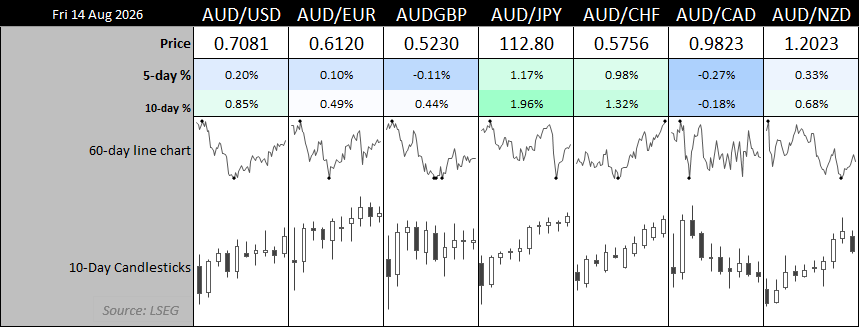
AUD/USD Grinds Higher as Jobs Data Looms and DXY Holds Support
RBA Retains Hawkish Bias, but a Hike Seems Unlikely for Now
The RBA delivered their slightly hawkish hold, though I’m not overly concerned with their obligatory threat to raise rates if necessary. The Middle East did not provide the secondary surge in inflation as feared – even though inflation remains above target. RBA cash rate futures imply just 15bp of hikes by March, though the odds of a December hike sit at around 50%. Ultimately, there seems to be little reason to expect an imminent hike unless incoming data perks up notably.
RBA-Fed Policy Stalemate Gives AUD/USD a Slight Edge
The US dollar faced fresh selling pressure on Friday after a soft retail sales report. Its 0.9% decline in July was its first contraction in nine months, with core retail sales also dipping 0.2%. Producer prices also failed to reignite hawkish Fed bets, while consumer sentiment deteriorated in July according to the University of Michigan. Together with a soft but still elevated CPI print, the odds of a Fed hike this year remained below 50% according to Fed funds futures by Friday’s close.
And that means we now have the RBA and Fed at a stalemate regarding policy expectations, which could keep volatility capped. But it may provide the Australian dollar with a slight advantage over the US dollar, given the RBA’s higher base rate relative to the Fed’s.
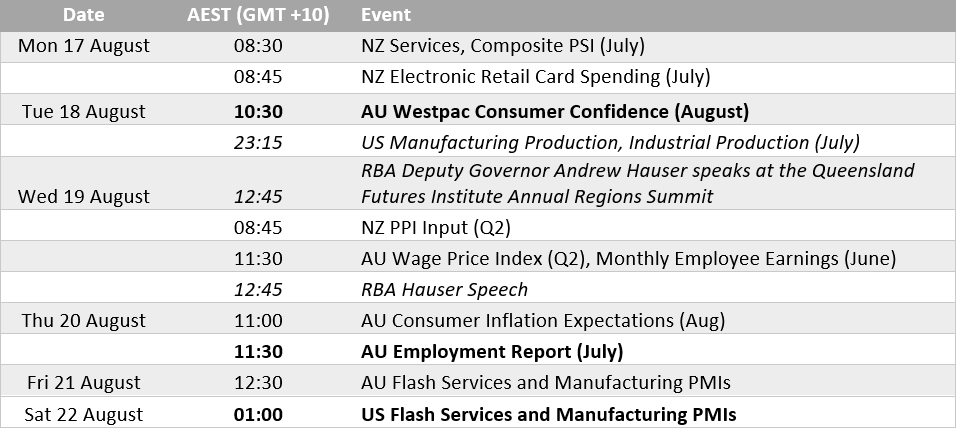
Australia This Week: Economic Data and Events for AUD/USD Traders
Consumer Confidence Rebound Unlikely to Shift RBA Outlook
Westpac’s consumer confidence increased 4.1% in July from relatively low levels, with its 83.9 print still in the bottom 10% of all-time readings. The family finances versus a year ago sub-index increased 5.6% to 71.1, while job-loss concerns eased. Lower fuel prices also provided some relief to households. The updated report lands on Tuesday, though it is hard to envisage either a sufficiently strong rebound to materially lift rate-hike expectations or a collapse severe enough to bring an immediate rate cut into play.
Strong Jobs Report Needed to Shift AUD/USD
Thursday’s labour force report is the main domestic event. While headline job growth was strong in June at 76.3k, it came alongside a 0.3 percentage point rise in the participation rate to 67%, an 11-month high. It’s therefore possible that job growth will struggle to maintain that pace, but still print a reasonable figure while unemployment remains around 4.4%. None of this will likely move the needle for the RBA if that turns out to be the case. Therefore, a strong report is likely required to prompt a reaction from AUD/USD, as a hike is more likely than a cut and could bolster bets for a December hike.
Australia’s wage price index and flash PMIs will of course warrant a look, though neither tends to be a strong market mover for AUD/USD traders. I am also doubtful that the two speeches from RBA members this week will prompt any major changes to policy expectations.
It is a relatively quiet calendar for the US, though PMIs will be the main focus on Friday. And with traders now fully honed in on the potential for a weaker US economy, it might not take much of a PMI miss to weigh on the US dollar, especially if the prices paid and employment sub-indices fall further.
AUD/USD Technical Analysis: Australian Dollar vs US Dollar
AUD/USD Correlations
- AUD/USD remains strongly inversely correlated with the US dollar, at -0.80 over 20 days, although this has weakened to -0.61 over 10 days.
- The yuan remains a strong positive influence, with CNH correlations of 0.90 over 20 days and 0.77 over 10 days.
- Risk appetite remains supportive, with AUD/USD holding a 0.90 correlation with the S&P 500 over 20 days.
- Commodity signals are mixed: gold remains positively correlated, while copper has sharply decoupled and iron ore remains negatively correlated.
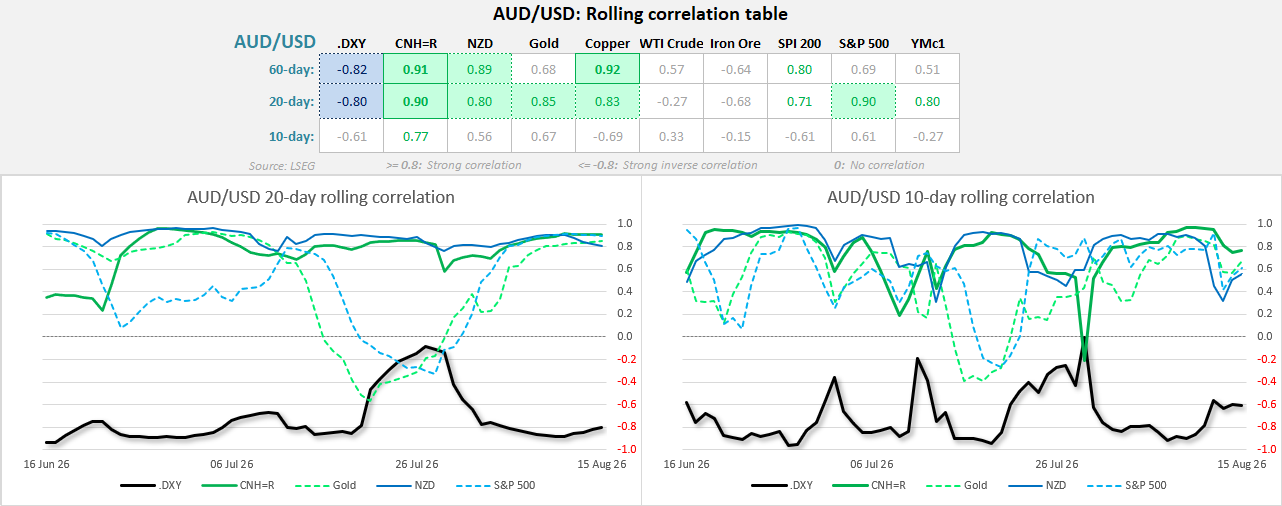
Source: LSEG
AUD/USD Futures Positioning | COT Report
The Aussie continues to defy gravity, at least where bearish futures traders are concerned. AUD/USD closed higher for a seventh consecutive week – its best such sun since December 2020. Yet traders remained net-short, and slightly more so than the prior week. Gross longs and gross shorts are trending higher among large speculators and asset managers, though fresh shorts have the slight edge.
With traders sat on the fence over a single hike by December, a slightly underwhelming employment report could see those odds drop below 50% and stifle the Australian dollar’s rally. And if the correct catalyst comes, we can consider the potential for a ‘right shoulder’ to form on the AUD/USD for a head and shoulders top.
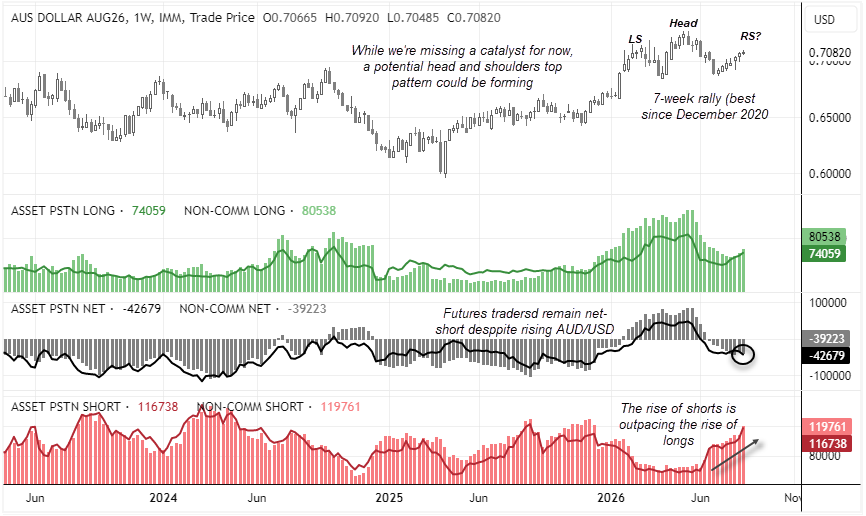
Source: CFTC (COT) CME, LSEG
For traders wanting a deeper understanding of futures positioning, I’ve also published a guide on how to read and interpret weekly COT data in forex markets.
This content was created by an affiliate of FOREX.com and represents the views and opinions of the author/speakers, not the views and opinions of FOREX.com, StoneX Group Inc., or its subsidiaries. The content has not been independently reviewed by FOREX.com.
AUD/USD Options and Volatility Analysis (Risk Reversals, HVN Levels)
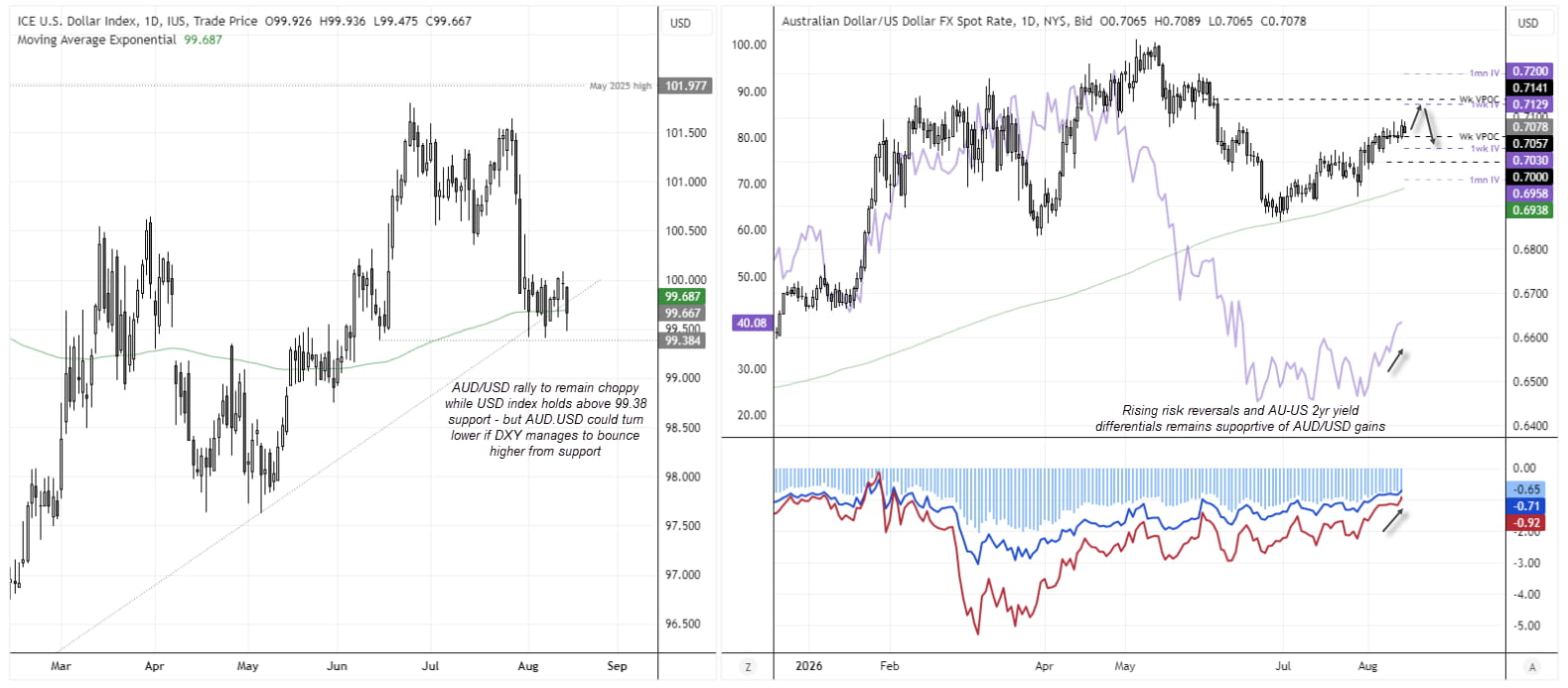
Implied volatility has fallen to its lowest level this year, according to the options market. That has seen the one-week implied volatility range narrow to 100 pips, which means traders currently estimate a 50-pip move either side of current levels by Friday. Also note that the open-to-low range between Monday and Thursday was a mere 10 pips, less than 20% of its 52-pip high-to-low range.
Were it not for weak retail sales on Friday, AUD/USD would have struggled to close the week at a 10-week high or tally up its seventh consecutive bullish week. Ultimately, the Australian dollar’s lacklustre rally is being driven primarily by rising yield differentials and a weaker US dollar. So it likely needs the US dollar index to break beneath its 99.38 low before we can expect the Aussie to rip higher with conviction. But with yield differentials and risk reversals tending higher, the path of least resistance tilts higher for now. 71c is the next major hurdle, a break above which brings a prior weekly VPOC into focus at 0.7141. Should momentum turn lower, next major support for AUD/USD is around 70c.
Source: ICE, TradingView
View the full economic calendar
-- Written by Matt Simpson
Follow Matt on Twitter @cLeverEdge
How to trade with City Index
You can trade with City Index by following these four easy steps:
- Open an account, or log in if you’re already a customer
• Open an account in the UK
• Open an account in Australia
• Open an account in Singapore
- Search for the market you want to trade in our award-winning platform
- Choose your position and size, and your stop and limit levels
- Place the trade
Latest market news









Web Trader platform
Our sophisticated web-based platform is packed with features.
Open an account today
Experience award-winning platforms with fast and secure execution.
Economic calendar
Related articles

Gold Falters at Resistance, Grappling With PCE, Month-End Flows and Jackson Hole
Gold has pulled back from resistance after sticky PCE data, with month-end flows and Jackson Hole now shaping the near-term outlook.

AUD/USD Shorts Bear the Brunt of Hot CPI, Renewed RBA Hike Bets
Hot Australian CPI revives RBA hike bets, lifts bond yields and adds fresh pressure to crowded AUD/USD short positions.

AUD/USD forecast tilted to upside as focus turns to key data
The AUD/USD continues to grind higher - as it has done so ever since risk assets bottomed back in April 2025. The Aussie has benefitted from rising metals prices and a strong Chinese yuan. The US dollar meanwhile has had bouts of strength here and there, but not much against the Aussie. The recent bond market stress has further increased the US dollar debasement calls. The focus now is turning to key data from both Australia and the US, and the Jackson Hole symposium.
