


Bitcoin Forecast: What's Next for BTC After the Fed Decision?
Bitcoin has come under consistent selling pressure over the past few trading sessions. In fact, the cryptocurrency has lost more than 3.00% over the last three trading days, a move that once again highlights a short-term bearish bias across the market.
Written by
Julian Pineda
Market Analyst
Bitcoin has come under consistent selling pressure over the past few trading sessions. In fact, the cryptocurrency has lost more than 3.00% over the last three trading days, a move that once again highlights a short-term bearish bias across the market. Part of this pressure stems from uncertainty ahead of the Federal Reserve decision, as a potential environment of higher interest rates could reduce the appeal of risk-oriented investments. This appears to be weighing on Bitcoin in the near term. As a result, if expectations for higher rates remain intact, selling pressure could continue to gain relevance around BTC in the sessions ahead.
Is Demand Losing Strength Ahead of the Fed Decision?
One of the most anticipated events for financial markets this week is the Federal Reserve's monetary policy decision. This time, investors will be closely watching whether the central bank begins to adopt a more aggressive stance over the coming months. Markets are currently pricing in a probability of more than 90% for a rate increase from the current benchmark rate of 3.75% to 4.00%, suggesting that traders have already positioned for a more hawkish outcome.
However, the most relevant aspect is the impact these expectations have already had on the U.S. dollar. Even ahead of the policy announcement, the greenback has been showing consistent strength in the short term. This reflects the fact that a higher-rate environment in the United States can continue to increase the attractiveness of the bond market, encouraging stronger demand for U.S. dollars. Expectations of a more aggressive Federal Reserve are already becoming visible in the performance of the DXY Index, which measures the dollar against a basket of major currencies. The index continues to develop along a steady upward slope and is once again approaching the 100-point level, an area that has attracted significant buying interest in recent sessions.
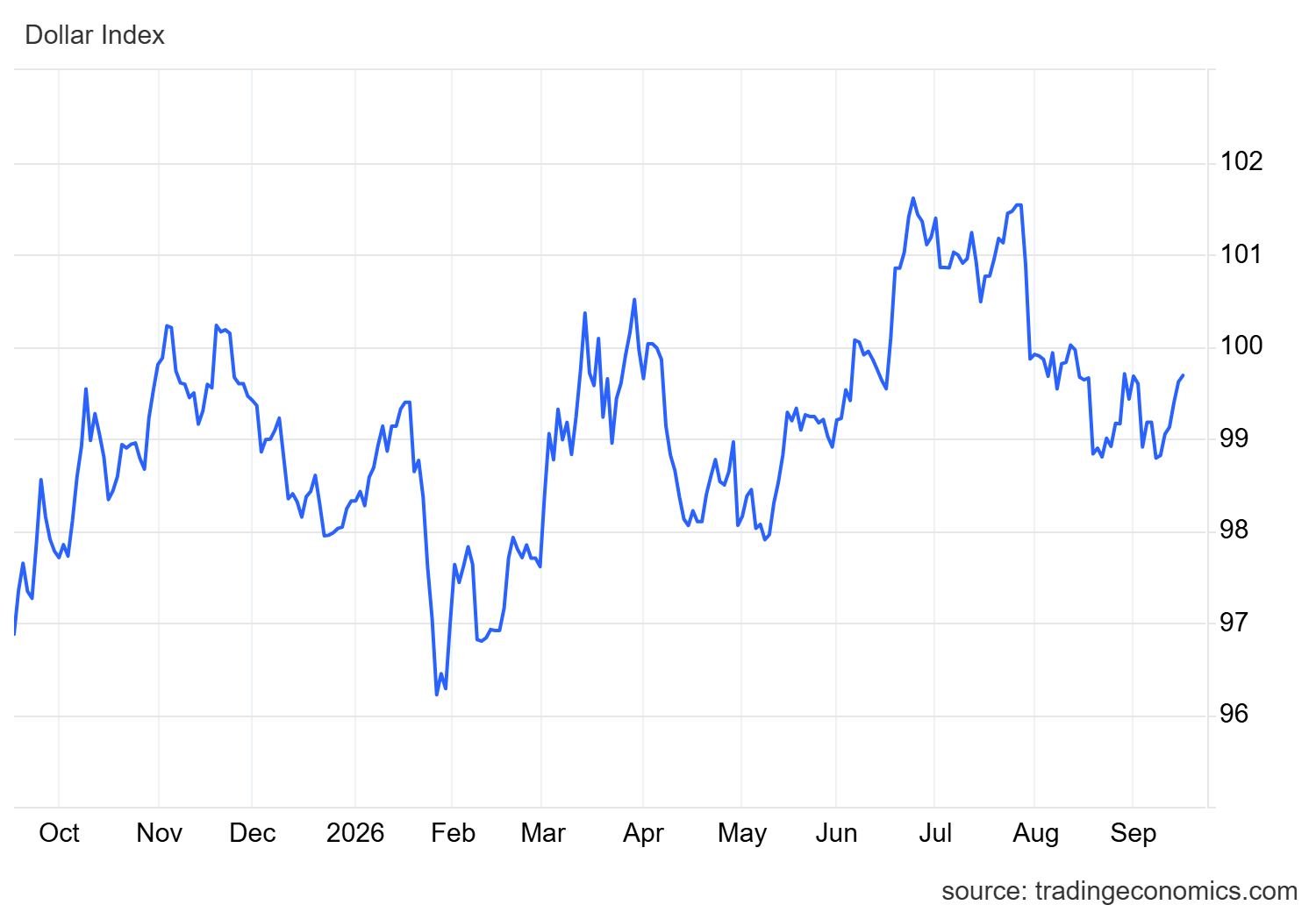
Source: TradingEconomics
With that in mind, it is important to recognize that this backdrop is not particularly favorable for Bitcoin. On one hand, a higher interest-rate environment could reduce the liquidity available for risk assets such as BTC. On the other hand, the U.S. dollar is often viewed as a more defensive alternative compared to speculative assets, meaning that a stronger dollar can divert part of the capital flows that might otherwise be directed toward Bitcoin.
This effect becomes particularly important because demand activity around Bitcoin has started to show signs of slowing while the dollar continues to strengthen and markets maintain expectations of a more aggressive Federal Reserve. This can be observed in open interest, an indicator that measures the total number of outstanding long and short positions across exchanges and has recently climbed to approximately $25.5 billion. While this reflects increased market participation, when combined with the recent decline in price it may also suggest growing bearish positioning and softer demand conditions. Overall, this highlights Bitcoin's continued sensitivity to the macroeconomic factors mentioned above.
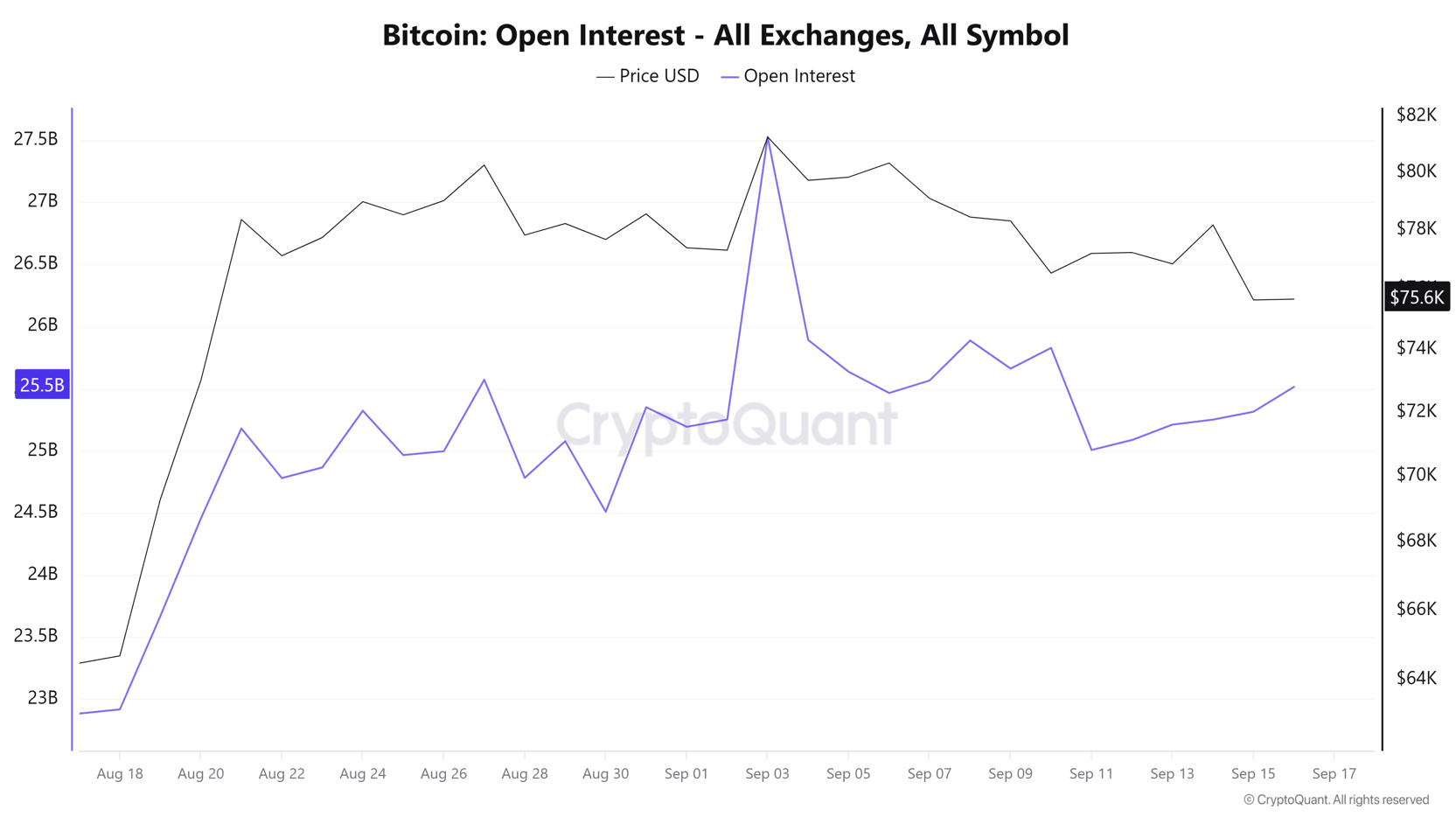
Source: CryptoQuant
Taking all of this into account, demand activity around Bitcoin appears to be facing limitations as the dollar strengthens and expectations of a more hawkish Federal Reserve remain in place. If this outlook persists following today's central bank decision, risk assets could continue losing some of their appeal in the short term, potentially affecting the stability of demand around BTC. Under this scenario, selling pressure could continue to gain traction in the sessions ahead.
Bitcoin Technical Forecast
Source: StoneX, Tradingview
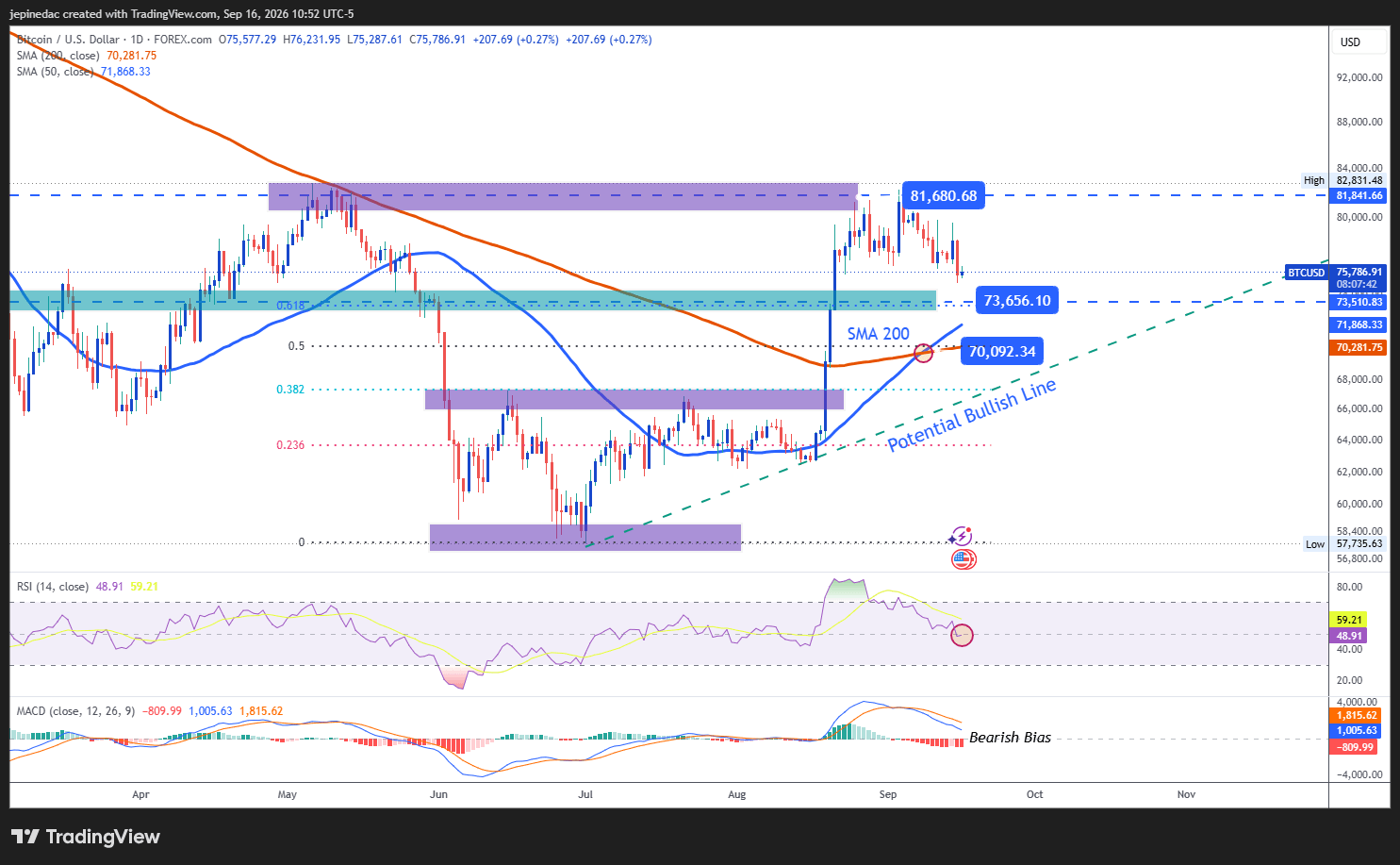
- Potential trendline begins to enter a risk zone: Although Bitcoin had been maintaining a sequence of bullish price swings that helped shape a potential medium-term uptrend over recent weeks, the latest price action has started to reveal more consistent weakness on the chart and is beginning to cast doubt on the durability of that structure. As a result, if buying interest fails to stabilize in the coming sessions, current market conditions could open the door to a more relevant bearish bias during the weeks ahead.
- MACD: The MACD histogram currently remains below the 0 neutral line, a reading that suggests the average strength of short-term moving averages continues to favor a bearish dynamic. As a consequence, downside momentum remains a relevant feature of the current market structure.
- RSI: The RSI presents a slightly different picture. The indicator continues to fluctuate around the 50 level, suggesting a balance between average buying and selling pressure. This reading may indicate that a broader sense of indecision has not completely disappeared from the chart.
Key Levels:
- 81,600 – Major resistance: An area marked by recent highs and the main upside barrier within the current structure. Price action that manages to break above this level could begin to restore the relevance of a stronger bullish bias and support the development of a more structured uptrend over the coming weeks.
- 73,600 – Near-term barrier: This level coincides with an important equilibrium zone observed months ago and also aligns with the most significant 61.8% Fibonacci retracement on the chart. The importance of this area could begin to slow the progress of the current bearish move, potentially acting as a key barrier and opening the door to short-term bullish corrections.
- 70,000 – Critical support: A key support zone that coincides with both the 50-period and 200-period simple moving averages. Price action that begins to move back toward this area could undermine the recovery seen in recent weeks, place the formation of a potential uptrend at risk, and open the door to a more consistent bearish bias over the coming weeks.
Written by Julian Pineda, CFA, CMT – Market Analyst
Follow him on: @julianpineda25
Related tags:
Latest market news










Web Trader platform
Our sophisticated web-based platform is packed with features.
Open an account today
Experience award-winning platforms with fast and secure execution.
Economic calendar
Related articles

Bitcoin Forecast: BTC/USD Back to $80K Ahead of Warsh’s Jackson Hole Speech
After surging over $15,000 in the past 10 days alone, there is risk of a near-term pullback if Warsh says anything remotely hawkish at Jackson Hole - what are the levels to watch from here?


Bitcoin, Gold Price Outlook: US CPI & Overbought Risks in Focus
Bitcoin, Gold Price Outlook Following a steep risk-on rally across US equity indices and precious metals, several major markets are approaching critical technical levels as momentum becomes increasingly stretched.


Bitcoin, Dow Jones Outlook: Dow Tests Major Resistance and Bitcoin Lags Below $67,000
Bitcoin, Dow Jones Outlook: Bitcoin remains below $67,000 while the Dow Jones tests major multi-year resistance. Key technical levels that could determine the next market move.