


DAX, EUR/GBP Forecast: Two trades to watch
DAX rises despite Trump’s tariffs. EUR/GBP struggles to gain ground as BoE–ECB rate differentials weigh.
Written by
Fiona Cincotta
Senior Market Analyst
DAX rises despite Trump’s tariffs
European shares are rising sharply on Thursday, with banks and tech leading the surge, despite concerns over the Trump administration's plans for new tariffs and the outlook for the AI trade.
A late equity rally in the U.S. last night helped the Nasdaq recover from 4% declines to close just 0.6% lower. This helped fuel a rally in Asia, which then transferred into Europe even after President Trump's latest tariff package.
The proposed new tariffs on 14 major trading partners use the excuse of combating structural excess industrial capacity. This is just another, different legal route for the same aim of bringing manufacturing back to the U.S., and probably makes as much sense as citing national emergencies.
However, crucially, they would not be on top of the 10% or 12.5% levies imposed in July on a group of 60 trading partners, and they would apply to certain goods.
The hearing on the proposals will not be until January 25, suggesting they may not actually go into effect until the end of Q1, which gives countries more time to prepare.
Meanwhile, on the data front, German consumer confidence gave the markets little reason to cheer. German households remain downbeat amid persistent inflation and sluggish growth, which complicate the outlook. Consumer confidence fell from -30.2 to -30.8, below the expected -29.9.
This doesn't bode well for the Christmas shopping season. It also signals to the ECB that the euro area's largest economy is not doing so well despite a resilient first half of the year. There is a danger that the second half could see stagnating momentum.
For now, policymakers are expected to be able to hike again in December, but the outlook beyond that is less certain.
DAX forecast – technical analysis
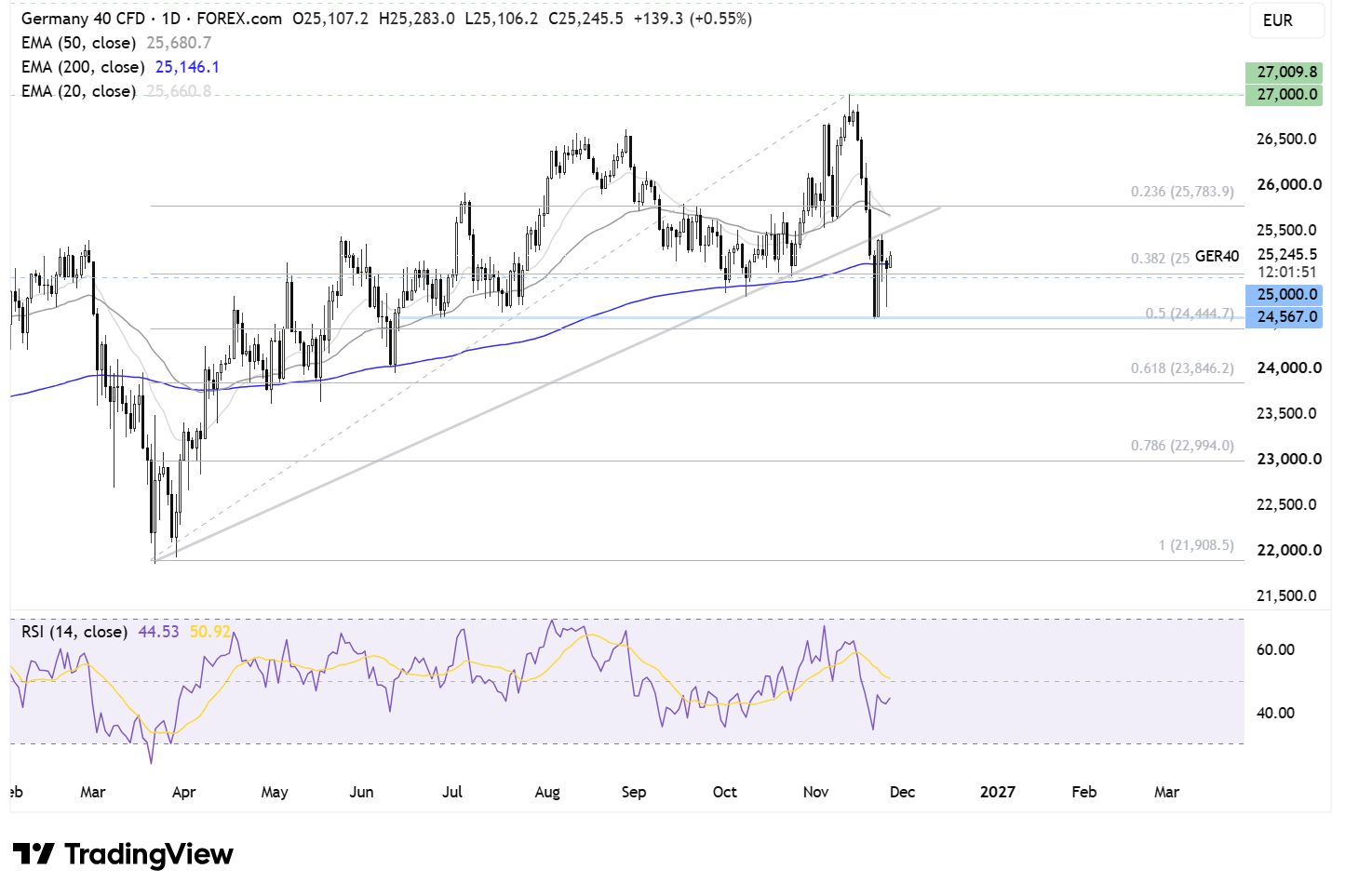
After finding support around the 24,500 level, the DAX has recovered higher and is holding above the 200 EMA as well as the 38.2% Fibonacci retracement of the 21,860 low and the 27,000 high. However, the RSI is below 50, suggesting momentum remains weak.
Should this support hold, buyers will need to rise above the rising trendline resistance around 25,500 in order to expose the 50 EMA at 25,700, as well as the 23.6% Fibonacci retracement. Above here, attention turns back to 27,000 and record highs.
Failure to hold above the 200 EMA and the 38.2% Fibonacci level could see the price retest 24,500 (the November low) and 24,450 (the 50% Fibonacci retracement). A break below here turns attention to 23,850, the 61.8% Fibonacci level, ahead of 23,000, the 78.6% Fibonacci level.
EUR/GBP struggles to gain ground as BoE–ECB rate differentials weigh
EUR/GBP is rising very modestly on Thursday but remains within a broader bearish picture.
EUR/GBP had fallen over 2.4% in October, marking its weakest month in over four years. However, those losses have steadied, with the pair so far gaining 0.4% this month as it hovers around 18-month lows.
The pair had come under steep pressure amid increasing hawkish Bank of England expectations. The BoE hiked rates at its November meeting, and the markets are pricing in an 80% probability of a further hike in December. Additionally, the market sees several more rate hikes in the first half of 2027.
This contrasts with the ECB, which has already raised interest rates twice to 2.5%. Whilst the ECB left rates unchanged in October, it signalled a cautious approach to further tightening. The ECB is expected to hike rates again in December, but the path beyond that is less certain, with the potential for one more hike in 2027.
In addition to the BoE–ECB differential, the euro has also been under pressure owing to the French political and fiscal turmoil, although that appears to have calmed for now.
With the pair hovering around levels last seen in April 2025, the latest macro data has failed to provide significant support for the euro after German consumer confidence came in below expectations, around its lowest level in two years.
EUR/GBP forecast – technical analysis

EUR/GBP has been trending lower across 2026 before finding support at 0.8320, a level last seen in March 2025. From here, the price has recovered slightly, pushing above the 20 EMA. However, the broader technical outlook remains bearish, with the price below the 50 and 200 EMAs.
Buyers would need to continue grinding higher towards the 50 EMA at 0.8420 and rise above horizontal resistance at 0.8450 in order to put the price on a firmer footing. Above here, 0.8500 comes into focus, as well as the 200 EMA at 0.8530.
On the downside, immediate support can be seen at the 20 EMA at 0.8360. It would take a break below 0.8320, the 2026 low, to create a lower low and extend the bearish move towards 0.8240, the 2025 low.
Related tags:
Latest market news









Web Trader platform
Our sophisticated web-based platform is packed with features.
Open an account today
Experience award-winning platforms with fast and secure execution.
Economic calendar
Related articles

DAX, GBP/USD Forecast: Two trades to watch 2708
DAX rises as Nvidia boosts AI trade ahead of Jackson Hole. GBP/USD slips below 1.36 as Fed expectations shift.

DAX and EUR/USD forecast: Lower energy prices, yields offer support
But the question, of course, is how much further oil prices and bond yields can fall. For now, the combination is supportive of risk assets and is helping to sustain a relatively benign decline in the dollar. The focus today will be on US core PCE inflation, due for release shortly, while Nvidia’s second-quarter earnings will provide another test for risk appetite after the US markets close – not just for US indices but for global tech-heavy indices given the influence Nvidia has over the global tech and AI names.


Oil, EUR/USD Forecast: Two trades to watch 2608
Oil falls further on diplomatic hopes for a Middle East resolution. EUR/USD consolidates ahead of U.S. inflation and Jackson Hole.